By LCN Business Desk
The Fondo de Garantía de Depósitos has paid out inside Paraguay. The money the prosecutors are now chasing is in three other countries, and a guarantee fund cannot reach it.
Paraguay's Ministerio Público said on Monday 9 November that it has asked three foreign jurisdictions for help tracing assets connected to the collapse of ueno bank. Agence France-Presse reported the communiqué's own words: the office "se trabaja para ubicar y asegurar bienes en el exterior, con el fin de repatriarlos e indemnizar a las víctimas", that is, it is working to locate and secure assets abroad in order to repatriate them and compensate the victims.
Which jurisdictions were asked, and what moves the money?
Three were asked, one has publicly answered, and the instrument is a letter to a foreign court.
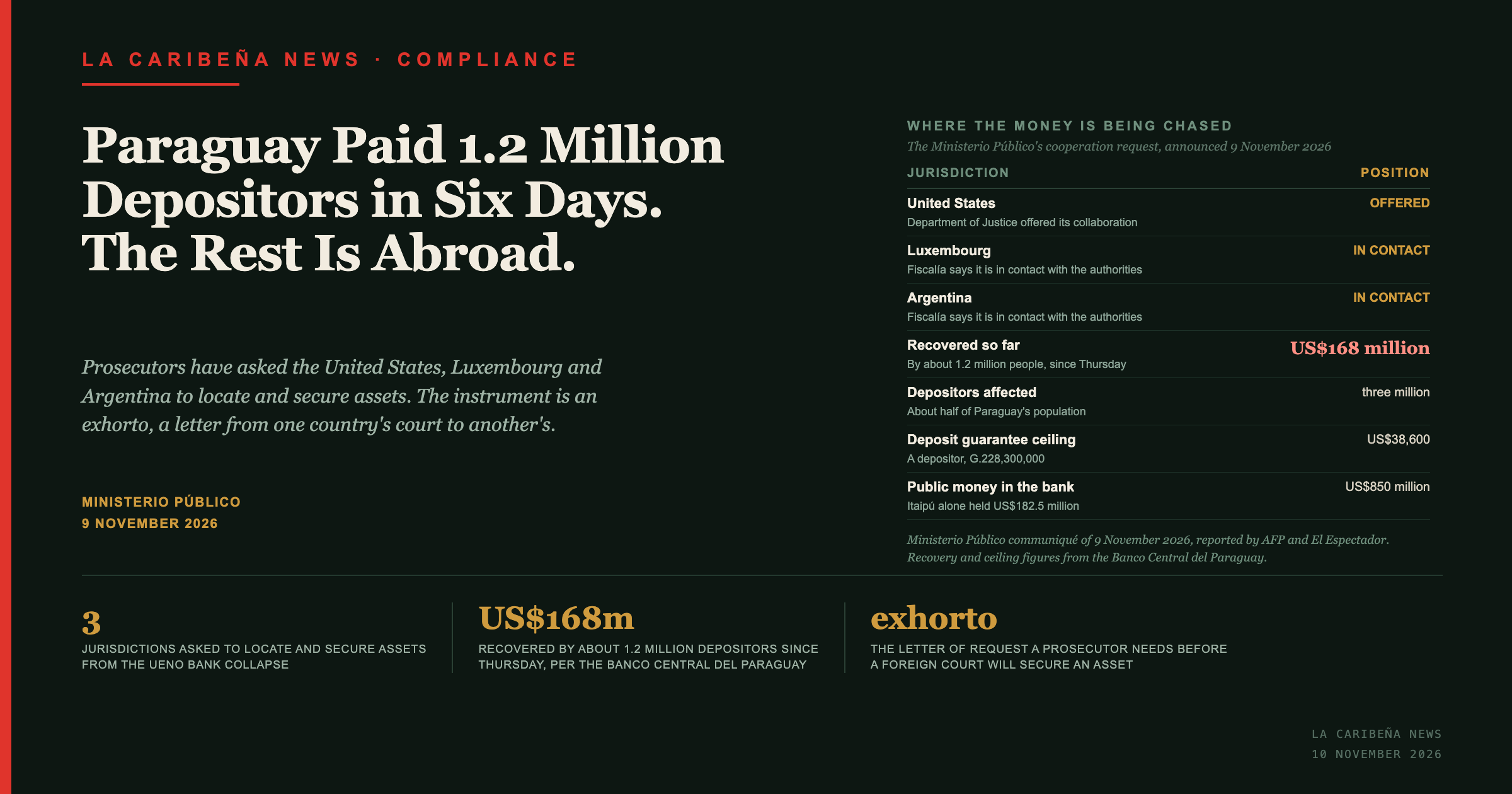
| Jurisdiction | Stated position, as reported |
|---|---|
| United States | The Department of Justice "ofreció su colaboración" |
| Luxembourg | The Fiscalía says it is in contact with the authorities |
| Argentina | The Fiscalía says it is in contact with the authorities |
Source: Ministerio Público communiqué of 9 November 2026 as reported by AFP and by El Espectador.
An offer of collaboration and a contact are not the same thing as an order, and neither is a seizure. The two accounts also name different prosecutors: El Espectador attributes the explanation to Manuel Doldán, the deputy prosecutor for international affairs, while AFP names Silvia González at the press conference and Christian Benítez speaking to ABC. On the record both outlets carry, no filing date is given for the requests themselves.
Mr Doldán told the press conference the object is to "localizar bienes y poder determinar exhortos", to locate assets and establish which letters of request to issue, and then to obtain "aseguramiento con fines de decomiso de los bienes", securing them for confiscation. An exhorto, or carta rogatoria, is a formal request from one country's court to another's. It is the instrument that stands between a prosecutor naming an asset and a state taking it.
That is the step a guarantee scheme never has to take. Paraguay's cover is paid from a domestic fund against a domestic list of depositors.
How much has gone back so far?
US$168 million, to 1.2 million people, in under a week.
That is the Banco Central del Paraguay's own count, reported by AFP, and it covers six days. President Santiago Peña signed the law to pay ueno bank's depositors faster on 4 November, Ley 7745, letting the Fondo de Garantía de Depósitos advance up to 40 minimum wages, and the Cámara de Diputados impeached him 78-0 the following day.
The Fiscalía puts the number of people affected at about three million, roughly half Paraguay's population. Paraguay now has a different head of state, President Pedro Alliana, and the former President is held in prisión preventiva on allegations connected to his financial links with the bank. Neither report states which chamber removed him from office, or on what date.
What sits above the line the fund will pay?
Public money, and a great deal of it.
About US$850 million of Paraguayan public money was in ueno bank when it was dissolved on 2 November. Itaipú had US$182.5 million in the bank and filed a criminal complaint on 7 November, and the deposit guarantee stops at about US$38,600 a depositor. The state pension fund is paid before other depositors when the assets are sold.
Every one of those public holdings is above the ceiling by orders of magnitude. For them the guarantee is not the mechanism. The exhorto is.
What does this mean for a depositor in the Caribbean?
That the ceiling and the recovery are two different systems, and only one of them is quick.
The Banco Central del Paraguay dissolved its fifth-largest bank after its solvency ratio fell below half the required minimum, and cover stops at G.228,300,000 a depositor. A Guyanese or wider Caribbean business reading the Paraguayan sequence is reading its own: a capped domestic fund that pays fast, and above the cap a process that depends on foreign courts.
Guyana's own scheme lists pension funds among the deposits it will not reimburse. The fund that exclusion applies to took in G$2.68 billion more than it paid out in 2023 and still shrank by G$4.76 billion, and it holds G$906.5 million of Berbice Bridge paper. The question a treasurer carries forward from Asunción is not what the cover is. It is which instrument their jurisdiction would use on the day the money is already abroad, and how long a court in Luxembourg takes to answer it.
The entities
- ueno bank is the Paraguayan lender dissolved on 2 November 2026. - Ministerio Público is Paraguay's public prosecution service, which made the cooperation request. - Manuel Doldán is its deputy prosecutor for international affairs, who explained the request. - Silvia González and Christian Benítez are the prosecutors AFP names on the same day. - Fondo de Garantía de Depósitos is the deposit guarantee fund that pays the capped claims. - Banco Central del Paraguay dissolved the bank and publishes the recovery figures. - Santiago Peña is the former president, held in prisión preventiva. - Pedro Alliana is the president of Paraguay. - Itaipú is the binational hydroelectric entity that held US$182.5 million in the bank. - Ley 7745 is the law of 4 November 2026 letting the fund advance up to 40 minimum wages.
What the title card says
- Headline: Paraguay paid 1.2 million depositors in six days, and the money above the ceiling is now being chased in three countries. - Jurisdictions asked: United States, Luxembourg, Argentina. - United States position: the Department of Justice offered its collaboration. - Recovered so far: US$168 million to about 1.2 million people. - Depositors affected: about three million, roughly half the population. - Deposit guarantee ceiling: about US$38,600 a depositor. - Public money in the bank at dissolution: about US$850 million. - Itaipú's holding: US$182.5 million. - The instrument named by the prosecutor: the exhorto, or letter of request.
Frequently Asked Questions
What did Paraguay's prosecutors ask for?
Help from the United States, Luxembourg and Argentina to locate and secure assets abroad connected to the ueno bank collapse, so they can be repatriated and used to compensate victims.
Has any of those countries agreed to act?
The United States Department of Justice offered its collaboration. The Fiscalía says it is in contact with the authorities in Luxembourg and Argentina. On the record both outlets carry, no order or seizure has been reported.
What is an exhorto?
A formal request from a court in one country to a court in another, also called a carta rogatoria. It is the instrument a prosecutor needs before a foreign state will secure an asset for confiscation.
How much has been paid back?
About US$168 million to roughly 1.2 million people since Thursday, according to the Banco Central del Paraguay, out of about three million depositors affected.
Why does the guarantee not cover the public holdings?
Cover stops at about US$38,600 a depositor. About US$850 million of public money was in the bank, and Itaipú alone held US$182.5 million, so those holdings sit far above the ceiling and depend on recovery rather than on the fund.