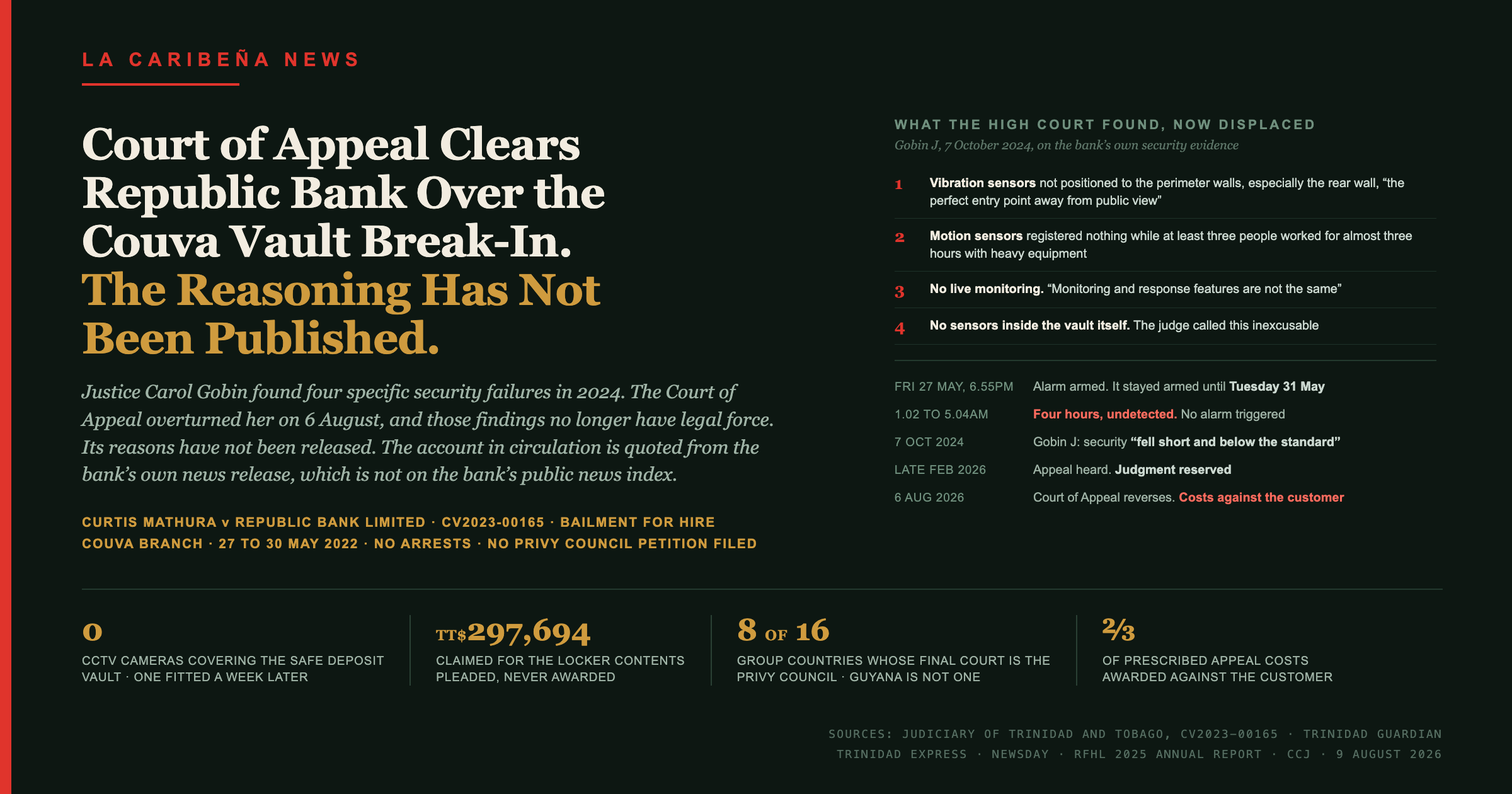
Quick summary: Trinidad and Tobago's Court of Appeal held on 6 August 2026 that Republic Bank exercised reasonable care over the 2022 break-in at its Couva branch, overturning Justice Carol Gobin's October 2024 finding of negligence and awarding costs against the customer. Gobin's four findings of security failure no longer have legal force. The court's reasons have not been published.
BY LA CARIBEÑA NEWS · 9 AUGUST 2026
Trinidad and Tobago's Court of Appeal has cleared Republic Bank of negligence over the break-in at its Couva branch in May 2022, in which intruders drilled through a wall, opened safe deposit lockers and left without an alarm being triggered.
Justices of Appeal Mark Mohammed, Maria Wilson and Ricky Rahim delivered judgment on 6 August, overturning the finding of Justice Carol Gobin, who in October 2024 had held the bank liable to one of the locker holders. The panel had heard the appeal in late February and reserved its decision.
A reversal is not a disagreement between two live judgments. It replaces one. Since 6 August the legal position is that Republic Bank met the standard of care the law required of it, and Gobin's contrary findings have no continuing effect. They are set out below because they remain the only judicial account of the Couva security arrangements that has been published, and because the reasons for displacing them have not been.
What did the Court of Appeal decide?
That the bank had met the standard after all.
Beyond that, what is publicly known about the decision comes from a single source, and it is not the court. The Trinidad Guardian reports the substance of the ruling inside a quotation it introduces with the words "According to a news release from the Bank following the ruling". Within that quotation sit the four propositions now circulating as the court's reasoning: that Republic Bank implemented comprehensive security measures at the Couva branch demonstrating its effort to exercise reasonable care; that its employees exercised the expected ordinary care in operating the bank's security systems; that there was no evidence of negligence on their part; and that the law requires reasonable care and not infallibility. The same quotation carries the costs order, that the bank recover its prescribed costs in the High Court and two-thirds of those costs on the appeal.
The Trinidad Express reproduces the same four propositions in the same order, in the newspaper's own voice, as findings of the court.
Nothing improper attaches to a successful party publishing an account of its own victory, and the costs order is consistent with that account. But a party's summary of a judgment is not the judgment. On the public record this newspaper can find, no journalist has quoted any member of the panel directly, and Republic Bank's news release does not appear on the bank's own news index, which runs to 4 August, two days before the ruling.
The judgment itself has not appeared on the Judiciary's public database as at 9 August. That database does carry Gobin's first-instance ruling in full, does index Court of Appeal decisions, and is current to July 2026, so the absence is most likely cataloguing lag three days after delivery rather than anything else. This was not a decision given from the bench. At the February hearing the panel said the matter was significant and that a written judgment would be delivered as soon as possible, and the Express reports a judgment dated 6 August. The reasons exist. They have not yet been released.
Nigel Baptiste, President and Managing Director of Republic Bank, said the decision "confirms that Republic Bank exercised reasonable care in relation to the operation of our employee procedures and security systems", and that while the events at Couva "were regrettable, the Court has affirmed that the Bank acted responsibly and diligently in the circumstances."
What is a safe deposit box, legally?
Not storage. A bailment.
Gobin set out the relationship in her second paragraph: bailor and bailee, "under a contract of bailment for hire". The customer hands over goods, the bank takes charge of them for a fee, and duties attach to that transfer of possession which do not attach to an ordinary account. Money in a current account is a debt the bank owes. Jewellery in a locker is property the bank holds.
The contract in this case expressly provided for a minimum duty of ordinary care in the operation of the bank's security system, and for due diligence to deny unauthorised persons access to the box.
Once the customer proves the loss, the burden shifts to the bank. The bank must then prove, on the balance of probabilities, that it took reasonable care, or that the loss would have happened even if it had. It is not enough for the bank to say that nobody can point to a failure on its part. Gobin cited Lord Denning in Morris v CW Martin and Sons: a bailee for reward who loses the goods "is liable unless he can show, and the burden is on him to show, that the loss or damage occurred without any neglect or default or misconduct of himself or of any of the servants to whom he delegated his duty." The clearest modern statement of the same rule is the Privy Council's decision in Port Swettenham Authority v T W Wu, which is not a safe deposit case but a goods-handling one.
That burden does not fire automatically. It fires once the customer has proved both the loss and the contents, and in a safe deposit case that is not a formality, because the bank never sees inside the box. Gobin accepted Mathura's evidence on what he had lost. Her acceptance of it rested on hearing him give evidence, which is the category of finding an appellate court is least willing to disturb.
The standard is reasonable care, not a guarantee. Gobin said so herself, citing Bolton v Stone. So the case was never about whether thieves are to blame for a theft. It was about who has to prove what once the theft has happened, and whether what the bank had in place was enough.
One thing this case is not. No exclusion clause defeated this customer, and no liability cap was in play. The contract recorded a minimum duty of ordinary care, which means the bank contracted into a floor rather than out of responsibility. Mathura paid a $200 annual security fee for the box, and his counsel told the Court of Appeal that the agreement suggested insurance rather than requiring it. Readers taking a lesson from the reversal should not take the wrong one: the bank won on the standard and on the evidence, after losing at first instance, not on small print.
What had the High Court found, and what has been displaced?
That the bank could not discharge the burden, on four specific grounds.
The bank's evidence came from its Manager of Corporate Security, a Mr Forte. He described steel lockers inside a fireproof vault of pre-cast concrete and steel sheeting, an intrusion detection system with magnetic contacts, motion sensors, vibration sensors and glass-break sensors, and a communication link to a central monitoring station operated by an external provider. The alarm had been armed at about 6.55pm on Friday 27 May and remained armed until Tuesday 31 May.
Gobin gave no weight to his evidence that the measures were industry standard, or to his reliance on the United States Bank Protection Act, because neither had been pleaded in the defence.
Her four findings were these.
The vibration sensors did not register. Forte was reluctant to say they malfunctioned and suggested it was a matter of positioning. Gobin held that installing vibration sensors was not enough if they were not close to perimeter walls, "and especially on the wall to the rear of the building which afforded the perfect entry point away from public view."
The motion sensors did not register at least three people over almost three hours, carrying heavy equipment. The bank's explanation involved a "pet alley", a gap at floor level intended to stop animals setting off the alarm. Gobin was unimpressed: it "made little sense in the context of security at a bank. It would simply not be necessary unless a 'pet' was trained to walk along it."
There was no live monitoring. What the bank described as monitoring was, in Gobin's characterisation, third-party response to a triggered alarm. "Monitoring and response features are not the same," she wrote, adding that live monitoring "is now a fairly common feature of security measures adopted by ordinary home owners even at significant cost."
There were no vibration or motion sensors inside the vault itself. Gobin called this "inexcusable". Forte's explanation was that "this particular vault does not have electrical conduits" and that sensors were placed around the general area instead.
There were also no CCTV cameras covering the safe deposit locker vault. That was deliberate, for customer privacy. A wide-angle camera focused on the vault door was installed about a week after the break-in.
Her conclusion: "the Defendant's security systems fell short and below the standard that was required."
The sentence in that judgment most exposed on appeal is a different one. At paragraph 11 Gobin wrote that "it is not an answer to say that the system did not fail, rather that the thieves succeeded." Read strictly, that makes the fact of a successful intrusion evidence of inadequate care, and a bailee is before the court only when the loss has already happened. "Reasonable care and not infallibility," the proposition in the bank's release, answers it almost word for word. On what has been published, the disagreement between the two courts was about how good is good enough, not about who has to prove what.
For the bank, Kerwyn Garcia SC argued at the hearing that Gobin had been "manifestly wrong". Republic Bank had declined to compensate Mathura, maintaining that it bore no liability for the criminal acts of third parties.
Who brought the case, and who else lost?
Curtis Mathura, who worked at Republic Bank for close to 31 years before retiring, and who had held a box at the Couva branch since 2013. He filed in January 2023 and put the contents at TT$297,694 in jewellery and cash, roughly US$44,000. The Trinidadian reports carry the figure unmarked, as local copy ordinarily does with the local dollar.
That figure is his own, and no court has tested it. Gobin gave judgment on liability and invited submissions on quantum by 9 October 2024. On the record of the Judiciary's database, no assessment ruling followed, and the appeal was therefore from a liability-only judgment. Reports that Mathura "was awarded compensation" do not reflect the judgment, which contains no monetary figure anywhere in its seven pages.
He was not the only one. Newsday described him as one of "scores of customers" who lost jewellery and family heirlooms. In June 2022, about a dozen of them retained counsel jointly and gave the bank 28 days to negotiate reimbursement or face proceedings. Mathura filed alone seven months later. On the public record this newspaper can find, no other Couva claim has reached judgment, and the reversal now sits across the path of anyone in that group who has not sued.
Nobody has been arrested or charged over the break-in. Two outlets reported that positively at the appeal stage, four years after a four-hour operation carried out opposite a police station.
What happens next?
Mathura's attorneys have indicated that they wish to take the matter to the Privy Council. That is an indication, not a filing, and no lawyer is named or quoted saying it.
The route is open, and it does not depend on anyone's permission. Section 109(1)(a) of the Constitution gives an appeal to the Judicial Committee as of right from final decisions of the Court of Appeal in civil proceedings where the matter in dispute is of the value of fifteen hundred dollars or upwards. Leave of the Court of Appeal, under section 109(2), is the route for civil cases below that threshold which raise a question of great general or public importance. This claim clears the threshold many times over.
On the Judicial Committee's own case list, current to 7 August, no Mathura or Republic Bank matter appears.
What does the ruling settle beyond Trinidad?
Less than the size of the bank suggests.
It binds no court outside Trinidad and Tobago. Until its reasons are published it cannot persuade one either, because persuasive authority is authority by reason and there is nothing yet to read.
Nor is there a regional shortcut, because the Caribbean does not share a final court. Republic Financial Holdings says in its 2025 annual report that the group operates in 16 countries. Of its Caribbean markets, Trinidad and Tobago, Anguilla, the British Virgin Islands, the Cayman Islands, Grenada, St Kitts and Nevis, and St Vincent and the Grenadines still go to the Privy Council. Barbados, Guyana, Dominica and Saint Lucia have replaced it with the Caribbean Court of Justice, which names five states in its appellate jurisdiction alongside Belize. Suriname is a civil law jurisdiction outside both systems, where the common law of bailment does not apply at all. Sint Maarten appeals run through the Joint Court of Justice to the Hoge Raad in The Hague. Ghana has had its own final court since it became a republic in 1960.
The split runs through the group's own structure. Republic Bank (EC) Limited is incorporated and licensed in Saint Lucia, a CCJ state, and operates branches in Dominica, St Kitts and Nevis, Saint Lucia and St Vincent and the Grenadines, two of which go to London and two of which do not.
The Privy Council is the final court for seven of the group's Caribbean markets and for the Isle of Man, eight of the sixteen. Even there, a ruling on a Trinidadian appeal would carry high persuasive authority rather than bind, and in the four CCJ states it would carry less than that. It would not settle the standard of care for a locker holder in Georgetown or Bridgetown.
What travels is not the ruling. It is the contract. On the public record this newspaper can find, no Commonwealth Caribbean appellate court has decided a bank's liability for the contents of a safe deposit box as bailee for reward, which is why the Court of Appeal itself said at the hearing that the case raised issues of broader legal importance about the scope of a bank's duty of care in relation to safe deposit facilities.
The nearest Privy Council authority is a nineteenth-century one, and it points the other way on its facts. In Giblin v McMullen, a banker held a customer's securities for nothing and was held liable only on proof of gross negligence. A box rented for an annual fee is a different arrangement and carries a higher duty. Courts elsewhere have reached the question more recently. In Amitabha Dasgupta v United Bank of India, decided in 2021, the Supreme Court of India held that a bank whose staff broke open a locker contrary to its own procedures was liable, and observed that the dominant view of courts around the world has been to treat the bank as a bailee. Whether that is so in any given case turns on whether the customer has really given up possession, which is the point on which such claims are most often lost.
For any customer of a regional bank holding a box, three things survive the reversal unchanged. The relationship is bailment, not storage. The contract fixes the standard of care, and it is worth reading before signing. And the security arrangements protecting the box stay invisible to the customer until a court makes the bank describe them, which is the only reason any of the Couva detail is public at all.
LCN has previously reported on a Guyanese bank customer's fight through the Full Court, on the long arc of banking in Guyana since 1836, and on how Caribbean courts are handling machine-generated evidence.
The data in this article
- Break-in: Republic Bank Couva branch, Southern Main Road, over the Indian Arrival Day long weekend of 27 to 30 May 2022. Entry by drilling through roughly eight inches of concrete and a one-inch metal sheet. Discovery on Tuesday 31 May.
- Duration recorded in the High Court judgment: a four-hour operation between 1.02am and 5.04am, undetected. The same judgment records motion sensors missing at least three people over almost three hours, and on appeal the claimant's counsel put the intruders inside for roughly 28 hours. The four-hour figure is the court's.
- Location: opposite the Couva police station. The cash vault was not breached.
- Alarm armed at approximately 6.55pm on Friday 27 May 2022 and remained armed until Tuesday 31 May.
- Number of lockers opened: not established. Every account says "several". Police recorded no count.
- First instance: Justice Carol Gobin, delivered 7 October 2024, Claim No. CV2023-00165, seven pages. Judgment for the claimant on liability only.
- Legal relationship: bailor and bailee under a contract of bailment for hire. The burden shifts to the bailee once the customer proves the loss and the contents.
- Authorities cited by the High Court: Morris v CW Martin and Sons (1965), British Road Services v Arthur Crutchley (1968), Coldman v Hill (1919), Bolton v Stone (1951).
- Four failures found: vibration sensors not positioned to perimeter walls; motion sensors that did not register at least three people over almost three hours; no live monitoring, only third-party response to an alarm; no vibration or motion sensors inside the vault, described as inexcusable.
- No CCTV covered the safe deposit vault area at the time. A wide-angle camera on the vault door was installed about a week later.
- Appeal: Justices of Appeal Mark Mohammed, Maria Wilson and Ricky Rahim. Heard and reserved in late February 2026, judgment dated 6 August 2026. Costs to Republic Bank in the High Court and two-thirds of prescribed costs on appeal. No civil appeal number has been published.
- The appeal judgment had not appeared on the Judiciary's public database as at 9 August 2026. The account of its reasoning in circulation is quoted from Republic Bank's news release, which does not appear on the bank's own public news index.
- Claimant: Curtis Mathura, a Republic Bank employee of close to 31 years before retirement, box holder at Couva since 2013, claim filed January 2023. Contents put at TT$297,694, roughly US$44,000. Trinidadian reports carry the figure unmarked. It is the pleaded amount, never an award; the High Court judgment contains no monetary figure.
- Annual box fee: $200. Counsel for the claimant told the appeal court that the agreement suggested insurance rather than requiring it.
- Scores of customers lost property. About a dozen issued a joint pre-action demand in June 2022. No other Couva claim has reached judgment on the public record.
- No arrests or charges reported as at August 2026.
- Privy Council: an appeal lies as of right under section 109(1)(a) of the Constitution where the matter in dispute is of the value of fifteen hundred dollars or upwards. Attorneys have indicated an intention. No petition appeared on the Judicial Committee's case list, current to 7 August 2026.
- Comparable authority: no Commonwealth Caribbean appellate decision on a bank's liability for safe deposit contents as bailee for reward was found. Every one of the 9,438 judgments of the Eastern Caribbean Supreme Court was searched in full text, and none is on the point. Nor is anything in the reported decisions of Jamaica's Court of Appeal, the Bahamas Court of Appeal or the Caribbean Court of Justice. Guyana's court records could not be searched, so the statement does not extend to Guyana.
- Final courts across the group: the Privy Council for Trinidad and Tobago, Anguilla, the British Virgin Islands, the Cayman Islands, Grenada, St Kitts and Nevis, St Vincent and the Grenadines, and the Isle of Man. The Caribbean Court of Justice for Barbados, Guyana, Dominica and Saint Lucia, which with Belize are the five states in its appellate jurisdiction. Suriname's Hof van Justitie for Suriname. The Hoge Raad in The Hague for Sint Maarten. Ghana's own Supreme Court since 1960.
- Group footprint: Republic Financial Holdings Limited reports operations in 16 countries and is listed on the Trinidad and Tobago Stock Exchange. Republic Bank (Ghana) PLC is 66.54 per cent held and separately listed in Accra. Republic Bank (EC) Limited, incorporated in Saint Lucia, covers Dominica, St Kitts and Nevis, Saint Lucia and St Vincent and the Grenadines.
Frequently Asked Questions
What is the legal relationship between a bank and a safe deposit customer?
Bailment. The High Court described it as bailor and bailee under a contract of bailment for hire. The bank takes possession of the goods for a fee, and duties attach to that possession. It is not the same as a deposit account, where the bank owes a debt rather than holding property.
Who has to prove what when the contents of a safe deposit box are stolen?
The customer must establish the loss and the contents. The burden then shifts to the bank, which must prove that it took reasonable care, or that the loss would have happened anyway. It is not enough for the bank to point to an absence of evidence of fault. The Court of Appeal's decision did not disturb that principle. On the account published so far, it held that the bank had discharged the burden.
Is the Court of Appeal's reasoning available?
Not as at 9 August 2026. The judgment had not appeared on the Judiciary's public database, which does carry the first-instance judgment in full. The account of the reasoning circulating in the press is quoted from Republic Bank's news release issued after the ruling. A written judgment was promised at the February hearing and the Express reports one dated 6 August.
Did Curtis Mathura ever receive damages?
No. The High Court decided liability only and invited submissions on quantum. On the public record no assessment ruling followed, and the finding of liability has now been overturned. The figure of TT$297,694 is the amount he claimed, not an amount any court awarded.
Is the case over?
As matters stand, yes. The Court of Appeal's ruling is the final decision in the case. His attorneys have said they wish to petition the Privy Council, where an appeal in a civil matter of this value lies as of right rather than requiring leave, but no petition appeared on the Judicial Committee's case list as at 7 August 2026.