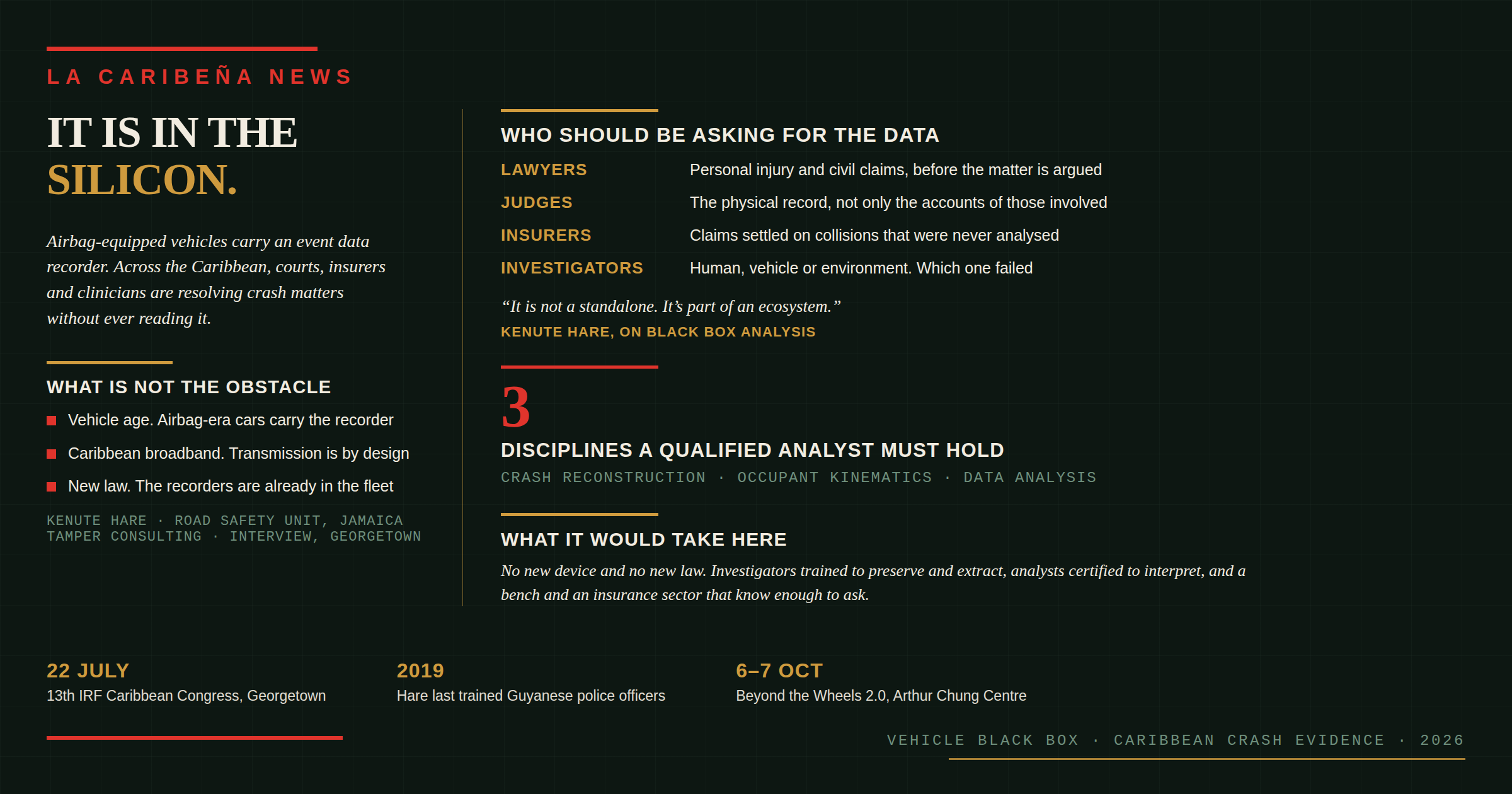
A Jamaican forensic reconstructionist came to the IRF Congress in Georgetown to tell lawyers, insurers and judges something most of them had never been told: the vehicle already knows what happened, and almost nobody in the region is asking it.
BY LCN NEWSROOM
Quick summary: Kenute Hare, Director of the Road Safety Unit in Jamaica's Ministry of Transport and Mining and head of TAMPER Consulting, told La Caribeña News at the IRF Caribbean Congress in Georgetown that airbag-equipped vehicles carry an event data recorder, and that Caribbean courts and insurers are resolving crash matters without reading it.
What is actually in the car?
A recorder, and increasingly a transmitter.
The device commonly called a black box is an event data recorder. In Hare's account, it sits inside the vehicle alongside the airbag system and captures the vehicle's movements through the seconds surrounding a collision. "If you really want to know what happened, it is in the vehicle," he said in an interview in Georgetown. "It is in the silicon."
He goes further than the physical module. Modern vehicles equipped with connected systems, he said, transmit crash data to servers operated either by the manufacturer or by a partner the manufacturer has an arrangement with, which makes cloud analysis a second and separate discipline from pulling a module in a workshop.
Asked directly whether Caribbean internet connectivity undermines that, given how much of the region's data infrastructure lags, Hare rejected the premise. The vehicles are designed to send the data, he said, and the transmission is a function of the vehicle and the manufacturer's server arrangements rather than of local broadband. He expects the position to sharpen rather than soften: from 2027 onward, he argues, vehicles will carry substantially more data, and investigators will need to be better trained to handle what is already there.
Which cars, and how old?
Older than most people assume, on his account.
Hare ties the presence of the recorder to the presence of an airbag, and puts airbags in the vehicle fleet from around 1996 onward. The practical implication for the Caribbean matters, because the region does not buy new. Much of the fleet arrives reconditioned and second-hand, and the assumption that recorded data is a luxury of new cars is, on his account, wrong. Unless a buyer has deliberately sought a vehicle without an airbag and without a seatbelt pretensioner system, the data is likely to be there.
That reframes the regional problem. It is not that Caribbean vehicles are too old to hold evidence. It is that the evidence is sitting in them unread.
Who should be reading it?
Four groups, and only one of them is the police.
Lawyers. Hare's strongest appeal was to the bar. Any lawyer handling a personal injury matter or a civil claim arising from a collision should, he argued, ensure a black box analysis is executed on the vehicles involved before the matter is argued.
Judges. He extended the same point to the bench, on the basis that adjudication improves when the physical record is before the court rather than only the accounts of those involved.
Insurers. His claim here is blunt and commercial. Insurance companies, he said, are paying on claims they should not be paying on, because the underlying collision has never been analysed. For an industry that prices risk for a living, an unexamined data source that speaks directly to liability is an unusual thing to leave alone.
Investigators. A crash occurs, in the framework he works to, because of a breakdown in the human element, the vehicle element or the environmental element. Establishing which requires analysis rather than assumption.
The part that gets skipped
The analyst matters as much as the data.
The most consequential thing Hare said is a warning against the shortcut. A black box analyst, in his account, is not a technician who downloads a file. The competence sits on three legs: training in crash reconstruction, training in occupant kinematics, meaning how bodies move inside a vehicle during impact, and training in the data analysis itself.
"It is not a standalone," he said of black box work. "It's part of an ecosystem." His analogy for an untrained operator was a firearm: someone not trained to use it will misuse it.
That has a direct bearing on how any Caribbean jurisdiction should approach this. A ministry or an insurer that buys download hardware without buying the reconstruction competence behind it has purchased a way to produce numbers, not a way to produce evidence. Hare's own position, that the analysis should be executed by someone certified in all three disciplines, is also a standard a court can test a witness against.
Why this landed in Georgetown
Because Guyana's fleet is growing faster than the systems around it.
The 13th IRF Caribbean Regional Congress convened at the Pegasus Corporate Suites in Georgetown on 22 July, and the theme running through it was that building fast is not the same as building safely. IRF Chairman Randell Iwasaki used his opening address to press the host government to investigate the failure and maintain what it builds, rather than to congratulate it on new asphalt. Public Works Minister Bishop Juan Edghill argued in the same room that the country needs engineers who can read a traffic camera as fluently as a load calculation.
The congress spent much of its floor time on prevention. Delegates heard the case for slipform concrete barriers over metal guardrails on both safety and cost, and IRF Chief Operating Officer Magid Elabyad argued that autonomous vehicles will not run on Caribbean roads until road quality, signage and sensors improve.
Crash data analysis is the same argument applied after the impact rather than before it. Barrier specification and sensor readiness are decisions made before a collision. The recorder speaks only afterwards, and it is the half of the problem the region has left unattended. A country installing smart traffic systems and climate-resilient design, while resolving collisions on eyewitness accounts alone, has modernised one side of it.
What it would take here
Not much hardware. Considerably more institutional will.
Nothing in Hare's account requires Guyana to legislate a new device into vehicles. The recorders are already in the fleet. What is missing is a chain: investigators trained to preserve and extract, analysts certified to interpret, and a judiciary and insurance sector that know enough to ask for the analysis. He has trained in Guyana before, having worked with a cohort of Guyanese police officers in 2019.
The gap, on the evidence of his own IRF session, is awareness. He told La Caribeña News that members of the audience acknowledged it was the first time they had heard the material, and that he told them not to feel badly about it, because there was a time when he did not know either.
Beyond the Wheels 2.0
The argument gets its next Guyanese hearing in October. Beyond the Wheels 2.0, the Transportation and Road Safety Summit, runs on 6 and 7 October 2026 at the Arthur Chung Conference Centre in Georgetown, with 200 delegates across nine transportation and safety tracks. It is built for exactly the constituency this story concerns: fleet operators, regulators, insurers, government and the drivers who move the country. The Private Sector Commission has already met the organisers on fleet management and road safety. Registration and the programme are at beyondthewheelsforum.com.
The Summit's own framing makes the case for why post-crash competence matters now. The Summit's published figures put growth in registered vehicles at 187 per cent over the past decade, citing the Guyana Revenue Authority, and attribute one in four road fatalities to commercial transport operators, citing the National Road Safety Council. La Caribeña News has not independently verified either figure against a dated source document. A fleet that size, weighted toward commercial operators, generates precisely the collisions where liability is contested and where a recorder settles it.
Disclosure: Beyond the Wheels 2.0 is convened by Clarke's Productions Inc., a client of EICCIO Advisors, which is under common ownership with La Caribeña News.
Frequently Asked Questions
What is a vehicle black box?
An event data recorder, a module in the vehicle that captures data about the vehicle's movement and systems around the moment of a collision. Kenute Hare ties its presence to airbag-equipped vehicles, which he dates in the fleet from around 1996.
Does it work on older or reconditioned vehicles common in the Caribbean?
On Hare's account, yes. The determining factor is whether the vehicle is airbag-equipped rather than whether it is new, which covers much of the region's second-hand and reconditioned fleet.
Do Caribbean connectivity problems stop the data reaching the cloud?
Hare says no. Vehicles with connected systems are designed to transmit to manufacturer or partner servers, and that transmission does not depend on local broadband quality.
Who should be commissioning this analysis?
Hare's appeal was directed at lawyers in personal injury and civil matters, judges, insurers and law enforcement. He argued insurers in particular are settling claims that a proper analysis might have contested.
Can anyone download and read the data?
He argues strongly against it. A qualified analyst should hold training in crash reconstruction, in occupant kinematics and in data analysis itself, because the recorder is one element of a reconstruction rather than a standalone answer.
Has this capability been taught in Guyana before?
Yes. Hare says he was involved in training a cohort of Guyanese police officers in 2019.