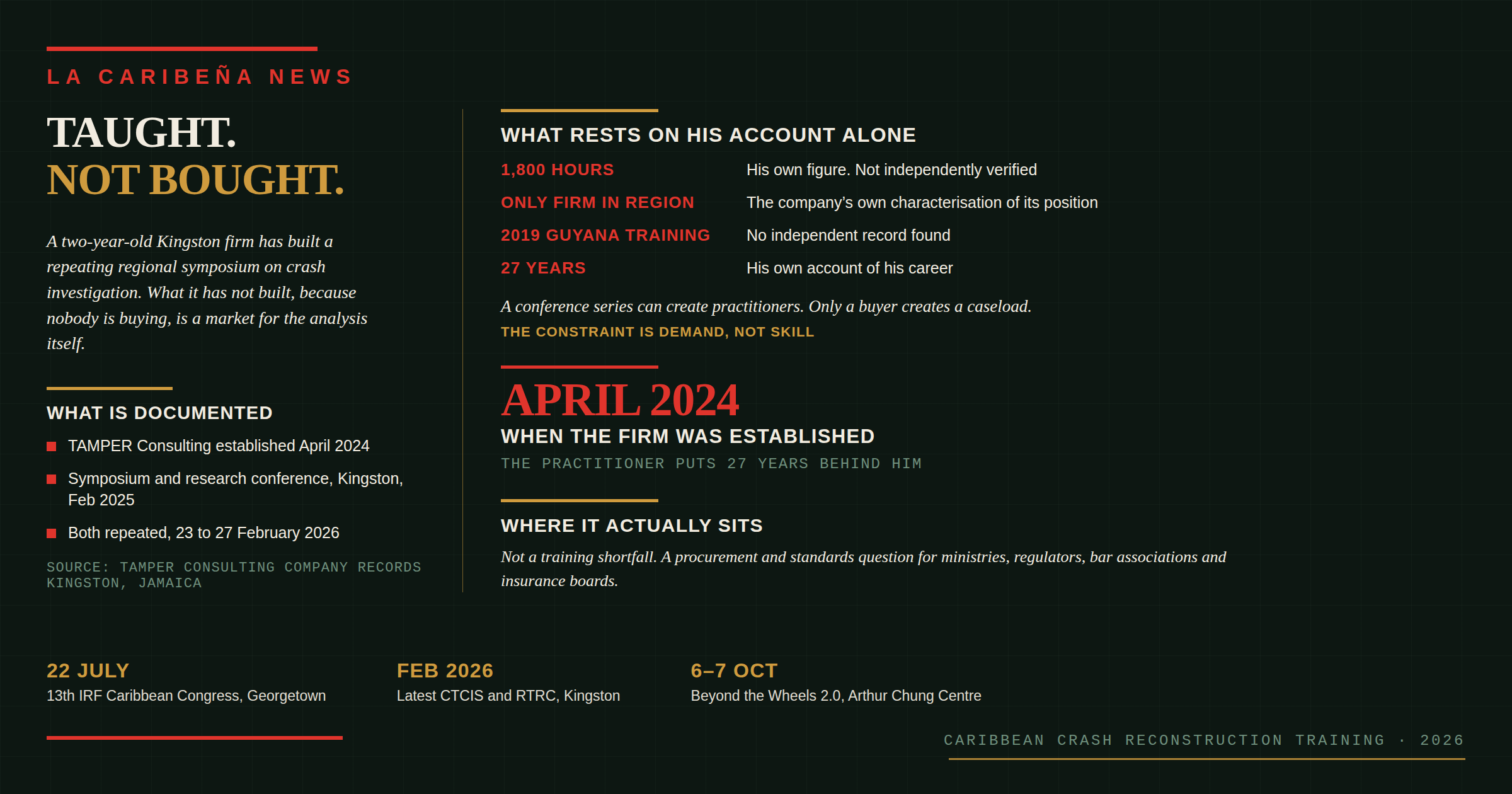
A two-year-old Kingston firm has built a repeating regional conference on crash investigation. What it has not built, because nobody is buying, is a market for the analysis itself.
BY LCN NEWSROOM
Quick summary: Kenute Hare, Director of the Road Safety Unit in Jamaica's Ministry of Transport and Mining, told La Caribeña News at the IRF Caribbean Congress in Georgetown that the region's constraint in crash reconstruction is institutional demand rather than available skill. His firm, TAMPER Consulting, was established in April 2024 and now runs an annual regional symposium.
What is documented
A young firm, an experienced practitioner, and a conference series that recurs.
The three are easily collapsed into one another, and they should not be. Hare puts 27 years in traffic crash investigation and reconstruction behind him. TAMPER Consulting, the vehicle he now works through, is much newer. The firm's own site records that it was established in April 2024, operates from Kingston, and delivers specialised training in traffic safety, driver behaviour and crash investigation alongside parking surveys and traffic impact assessments.
What the firm has built quickly is a regional gathering. TAMPER ran the Caribbean Traffic Crash Investigation Symposium in Kingston in February 2025 under the theme "Cracking the Code with Technology," immediately before its Regional Transport Research Conference on "Perspectives on Conflict in Transport and Mobility." Both returned in 2026, running 23 to 27 February at the Four Seasons and Summit in Kingston under the theme "Using Technology for Safer Systems."
Two editions in two years, drawing industry and academia, is a programme rather than an announcement. It is the strongest documented evidence that regional appetite for the knowledge exists.
What rests on his account alone
The scale claims, and this publication says so plainly.
Hare says TAMPER holds more than 1,800 hours of international training in traffic crash investigation and reconstruction, with over 200 of those hours in event data recorder work specifically. Given the firm's April 2024 founding, that figure is best understood as his own accumulated training carried into the business rather than an institutional record the firm built.
He also describes TAMPER as the only firm in the Caribbean and Latin America at that level of training in the discipline. La Caribeña News has not been able to verify that independently, and it should be read as the company's own characterisation of its position.
The same applies to parts of his working history. Hare says he was involved in training a batch of Guyanese police officers in 2019 and has delivered training in Barbados, and lists Colombia, Brazil, Argentina, Italy, Sweden, France, the United Kingdom and the Netherlands among countries where he has presented or trained. This publication found no independent record of those engagements. They are reported here as his account, not as established fact.
The three-phase model
Investigation, then analysis, then reconstruction.
The programme Hare describes moves practitioners through three stages rather than teaching the endpoint directly: the crash investigation process, then the analysis process, then reconstruction, on the argument that each depends on the one before it.
The same logic governs his view of event data recorder work, which he insists is not a standalone skill. An analyst should hold reconstruction training, occupant kinematics training, meaning the study of how bodies move inside a vehicle during impact, and the data analysis competence, because a recorder output has to be interpreted inside a physical reconstruction to mean anything. This publication has set out that argument in full.
The end point he describes is practical rather than academic: practitioners able to supply usable findings to a judiciary and to treating physicians.
The gap is on the buying side
Skills are being taught. The service is not being purchased.
The pattern Hare describes is a supply of competence meeting an absence of institutional demand. Insurers settle claims without commissioning analysis. Lawyers argue collision matters without the vehicle data. Courts hear accounts of crashes without the physical reconstruction that would test them.
That is not a training problem, and more training will not fix it. It is a procurement and standards problem, and it sits with ministries, regulators, bar associations and insurance boards rather than with practitioners. A conference series can create practitioners. Only a buyer creates a caseload.
For a region that regularly imports technical services at hard-currency rates, an in-region capability that is not being bought is also an economic question. The alternative to using Caribbean reconstructionists is not doing without. It is paying North American or European firms to fly in, or resolving matters on weaker evidence.
Why Georgetown, and why now
Because Guyana is the fastest-changing road environment in the region.
The 13th IRF Caribbean Regional Congress met at the Pegasus Corporate Suites on 22 July. IRF Chairman Randell Iwasaki told the host government to investigate the failure and maintain what it builds. Public Works Minister Bishop Juan Edghill argued that Guyana needs a different kind of engineer, fluent in artificial intelligence, smart traffic systems and climate-resilient design.
The floor also carried the procurement question in its more familiar form. Suppliers made the case for slipform concrete barriers against metal guardrails on safety and cost, a decision ministries know how to evaluate and budget for. IRF Chief Operating Officer Magid Elabyad told delegates that autonomous vehicles remain far off in the Caribbean until road quality and sensors improve.
Investigating a failure requires someone able to investigate it. Barriers get bought because there is a line item for barriers. Analytical capacity has no such line, which is the whole of the problem. A country building at Guyana's pace, adding vehicles at Guyana's pace, will generate the caseload whether or not the capacity exists to meet it. The choice is whether that capacity is regional or imported.
Beyond the Wheels 2.0
The procurement conversation has a venue in October. Beyond the Wheels 2.0, the Transportation and Road Safety Summit, runs on 6 and 7 October 2026 at the Arthur Chung Conference Centre in Georgetown: two days, nine transportation and safety tracks, 200 delegates, hosted by Clarke's Productions Inc. Details and registration are at beyondthewheelsforum.com, and the Private Sector Commission has already met the organisers on fleet management and road safety.
The delegate mix is the reason it is relevant here. The Summit is built to put fleet owners, logistics companies, regulators, government, and insurance and finance in the same room, which is the exact set of institutions that would have to decide to buy crash analysis before any of this changes. Capability questions get settled where the buyers are, not where the practitioners are.
Disclosure: Beyond the Wheels 2.0 is convened by Clarke's Productions Inc., a client of EICCIO Advisors, which is under common ownership with La Caribeña News.
Frequently Asked Questions
Who is Kenute Hare?
Director of the Road Safety Unit in Jamaica's Ministry of Transport and Mining and head of TAMPER Consulting, a forensic traffic crash reconstructionist and event data recorder analyst who says he has 27 years in the discipline. He previously served as Director of Jamaica's Island Traffic Authority.
What is TAMPER Consulting?
A Kingston-based consultancy established in April 2024, delivering training in traffic safety, driver behaviour and traffic crash investigation, alongside parking surveys and traffic impact assessments.
What regional events does the firm run?
The Caribbean Traffic Crash Investigation Symposium and the Regional Transport Research Conference, held together in Kingston in February 2025 and again from 23 to 27 February 2026 under the theme "Using Technology for Safer Systems."
Is the 1,800 hours figure verified?
No. It is Hare's own figure. Given the firm's 2024 founding it is best read as his accumulated personal training rather than an institutional record, and this publication has not independently verified it.
Is TAMPER the only firm at this level in the region?
That is the company's own characterisation. La Caribeña News has not been able to verify it independently.
If the skills exist, why is the region not using them?
On Hare's account the constraint is on the demand side. Insurers, lawyers and courts are largely not commissioning the analysis, which makes it a procurement and standards question for ministries, regulators and professional bodies rather than a training shortfall.