By LCN Business Desk
The world's second largest avocado exporter is finishing a season it expected to grow. Peru's Hass shipments are projected to fall nearly 2 per cent from last year, reversing an initial forecast of 6 per cent growth, FreshFruitPortal reported on 24 September.
Two numbers inside that explain more than the headline does. Shipments to the United States fell about 36 per cent year on year, on greater Mexican and Californian availability and earlier quality concerns. Asia rose nearly 6 per cent, with South Korea up almost 41 per cent and Thailand up 76 per cent from a small base, while China, the largest Asian destination, fell 2 per cent.
What did El Nino do to the crop?
It moved the harvest date rather than the harvest. ProHass reported high variability in dry matter, the measure that decides when fruit is ready to cut, with 22 per cent dry matter treated as an important baseline. Fruit that reaches that threshold unevenly cannot be picked on a fixed schedule, and a grower who cuts early sends fruit that arrives poorly.
That is the first measured effect of this El Nino in a commercial crop that this newspaper has seen reported. The forecast position was set out on Thursday in Brazil Is Planting Into the Strongest El Nino in Years, which put the peak between October and December 2026. Guyana's exposure has its own precedent, in NOAA Puts a 69 Per Cent Chance on a Record El Nino, where the last comparable event cut the rice crop by 37 per cent.
Where does Peru actually sell?
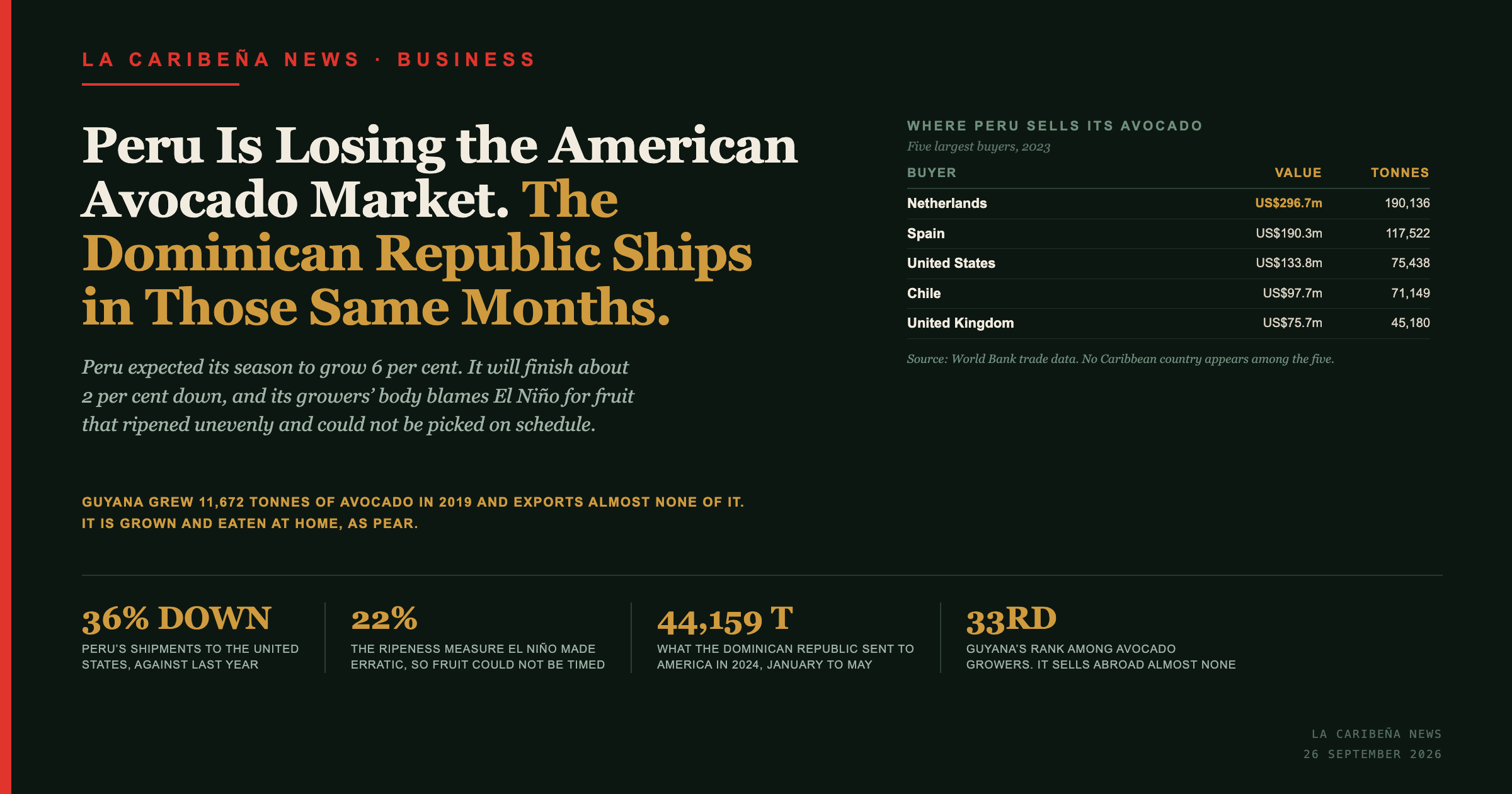
| Destination | Value, 2023 | Volume, 2023 |
|---|---|---|
| Netherlands | US$296.7 million | 190,136 tonnes |
| Spain | US$190.3 million | 117,522 tonnes |
| United States | US$133.8 million | 75,438 tonnes |
| Chile | US$97.7 million | 71,149 tonnes |
| United Kingdom | US$75.7 million | 45,180 tonnes |
Source: World Integrated Trade Solution, Peru's exports of fresh or dried avocados, 2023. These are the five largest destinations and not the full list.
Europe takes about 67 per cent of Peruvian shipments. The sector spent roughly US$3 million on promotion this season, extending into Asia and its own domestic market, which is what an exporter does when its established markets are full.
Arturo Medina, general manager of ProHass, put the structural problem in three words: "Peru competes with Peru." Large volumes arriving at once press the price down. That is the same arithmetic every single-crop exporter faces, and the Caribbean has met it in sugar, rice and bananas.
Which Caribbean country sells into the gap?
The Dominican Republic, and the timing is the point. Its avocado export season runs January to May, which is counter-seasonal to Mexican and Californian supply. That is the same American window where Peru has just lost about a third of its volume.
The Dominican Republic shipped 44,159 tonnes of avocado to the United States in 2024 and 5,828 tonnes to the Netherlands, on trade data compiled by Statista. Its avocado export value rose from US$223.4 million in 2020 to US$309.4 million. Against Peru's roughly US$1.49 billion in 2025, the Dominican Republic sells about a fifth as much.
This is the second time this month the country has appeared here as the regional first mover. It dated its first rare earth export for 2028, in The Dominican Republic Dated Its First Rare-Earth Export.
Does Guyana grow avocado?
Yes, and it sells effectively none of it. Guyana produced 11,672 tonnes in 2019, ranking 33rd in the world, on FAO figures compiled by NationMaster. That is a single compilation of a seven-year-old figure and it is the most recent this newspaper could establish. The fruit is grown and eaten at home, as pear.
The constraint is the one Guyanese farmers describe themselves. Wakenaam growers produce heavily and lose the margin at the Georgetown end, reported in Wakenaam Farmers Produce Big, But Prices Squeeze Profit. Where Guyana has moved a crop into an export product it has been through processing rather than fresh fruit, as with the Lusignan pepper sauce launched in Doha, in Guyana's President Launched a Lusignan Pepper Sauce in Doha.
The wider position is in the national accounts. Guyana's economy grew 33.3 per cent in the first half while the forecast for everything except oil was cut, in Guyana's Economy Grew 33.3 Per Cent. Agriculture is one of the five sectors the Guyana Development Bank has named as priorities, in Guyana Development Bank Names Five Priority Sectors.
What does a Caribbean buyer take from this?
Food prices in the region already move on hemispheric supply rather than local harvests, the position reported in Venezuela's Food Basket Rose 12.5 Per Cent in August. A crop that finishes 2 per cent down after forecasting 6 per cent up is a two-cent swing on nothing that happened in the Caribbean.
The same pattern ran through the American beef quota, where Washington opened 300,000 tonnes to the hemisphere and only Brazil could fill it, in Washington Opened 300,000 Tonnes of Beef to the Hemisphere. Access is not the binding constraint. Volume at export standard is.
Peru's season ends where it ends. What the figures show is a market rearranging itself between Mexico, California and the countries that can ship in the months those two cannot.
What the title card shows
- About 2 per cent down: where Peru's Hass avocado shipments are projected to finish against 2025, after an initial forecast of 6 per cent growth. Source: FreshFruitPortal, 24 September 2026.
- About 36 per cent: the fall in Peruvian shipments to the United States, on greater Mexican and Californian availability and earlier quality concerns.
- 22 per cent dry matter: the ripeness threshold that decides when fruit can be cut. ProHass reported high variability in it, and named El Nino as the cause.
- 44,159 tonnes: what the Dominican Republic shipped to the United States in 2024, in a January to May season counter-seasonal to Mexico and California.
- 11,672 tonnes: Guyana's avocado production in 2019, ranking 33rd in the world, on FAO figures compiled by NationMaster. Grown and eaten at home.
Frequently Asked Questions
Why are Peru's avocado exports down?
Shipments are projected about 2 per cent below last year against a forecast of 6 per cent growth. Exports to the United States fell about 36 per cent on greater Mexican and Californian availability and earlier quality concerns, while Asian volumes rose nearly 6 per cent.
What did El Nino have to do with it?
ProHass reported that El Nino caused high variability in dry matter, the measure that determines harvest timing, with 22 per cent treated as an important baseline. Uneven ripening makes a fixed picking schedule unreliable.
Does the Caribbean export avocado?
The Dominican Republic does, shipping 44,159 tonnes to the United States in 2024 in a January to May season that is counter-seasonal to Mexican and Californian supply. Its avocado export value rose from US$223.4 million in 2020 to US$309.4 million.
How much avocado does Guyana grow?
11,672 tonnes in 2019, ranking 33rd in the world on FAO figures compiled by NationMaster. It is grown for the domestic market rather than for export.