By LCN Business Desk
The records coming out of Brazil this month and the risk this newspaper reported two weeks ago are not in conflict. They belong to different crops.
Piaui, in Brazil's northern cerrado, has taken off the largest grain harvest in its history. Brazil as a whole is on course for its largest soya export year. Neither figure tells a Caribbean food importer anything about 2027, because both were sown before the El Nino that is now consolidating in the equatorial Pacific.
The crop that carries that risk is going into the ground now.
What did Piaui actually harvest?
6.82 million tonnes, a fifth more than last year.
The state harvested 6.82 million tonnes of cereals, pulses and oilseeds in 2026, the largest in its history and 20 per cent above the 5.67 million tonnes of the year before, on figures from the Brazilian Institute of Geography and Statistics. The National Supply Company has separately confirmed a record.
Soya accounted for 4.19 million tonnes and maize for 2.1 million, together more than 92 per cent of the state's output. The crop came off 1.85 million hectares, an area 8.3 per cent larger than the year before, which means the rise is roughly half more land and half better yield.
The longer line is the one worth holding. Piaui harvested 1.33 million tonnes in 2016. The 2026 figure is five times that.
Is Brazil's export record in the same crop?
Yes, and it is the reason the price signal this year says nothing about next.
Brazil's 2025/26 soya harvest came in at a record 179.5 million tonnes. The National Supply Company projects 114.4 million tonnes of soya exports in calendar 2026, against about 109 million in 2025, with maize exports around 43 million tonnes, up about 16 per cent.
Brazilian soya is sown between September and December and harvested from January. The beans being loaded at Paranagua and Santos this month were planted a year ago, under different weather. So were Piaui's.
A record in the barn is not a forecast. It is a receipt for last year's rainfall.
Where does the El Nino risk actually fall?
On the centre-north, which is where Piaui is.
This newspaper reported on 24 September that the World Meteorological Organization puts the probability of El Nino effects persisting to February 2027 at close to 100 per cent, with a 95 per cent probability of a peak between October and December 2026. Brazilian analysts were not forecasting a general fall in production. They were forecasting unevenness: excess rain in the south, irregular rainfall in the centre-west and south-east, and heat with less available water in the centre-north.
Piaui sits in that last band. Its record was harvested before the peak the forecasters are pointing at, and its next crop is being sown into it.
That is not a prediction of failure. The state has added 8.3 per cent to its planted area and five-fold to its output in a decade, and a larger, better-run cerrado absorbs a bad season better than a smaller one. It is a statement about which number answers which question.
What does this mean for Caribbean food importers?
That the cheap grain is this year's, and the exposure is next year's.
The Caribbean does not buy Brazilian soya and maize mainly as food. It buys them as animal feed, which sets the cost of poultry, eggs and pork across the region, and it buys them through a shipping route with its own weather problem. Panama cut the canal's loading limit four times in nine weeks and has since cut daily booking slots to 32, under the same climate system.
CARICOM's agriculture ministers asked the region to buy Caribbean produce at the end of September, and Belize remains the region's benchmark on food security with the regional deadline slipped to 2030. Neither of those positions is helped by a year of abundant imported feed, and neither is tested by one.
The test arrives with the 2027 shipments. Guyana already has a measure of what that can look like: the last comparable El Nino took 37 per cent of a Guyanese rice crop.
What would change the picture?
Planting progress and the January rains, in that order.
The useful indicators between now and the harvest are how much of the centre-north goes in on time this month and next, whether the peak arrives in the window the World Meteorological Organization has given, and what the National Supply Company's first 2026/27 survey says rather than what the 2025/26 outturn said.
Until then, the honest position is that Brazil has had an excellent year and the question for the Caribbean has not yet been asked.
What the title card shows
Every data point on the article's title card, in text.
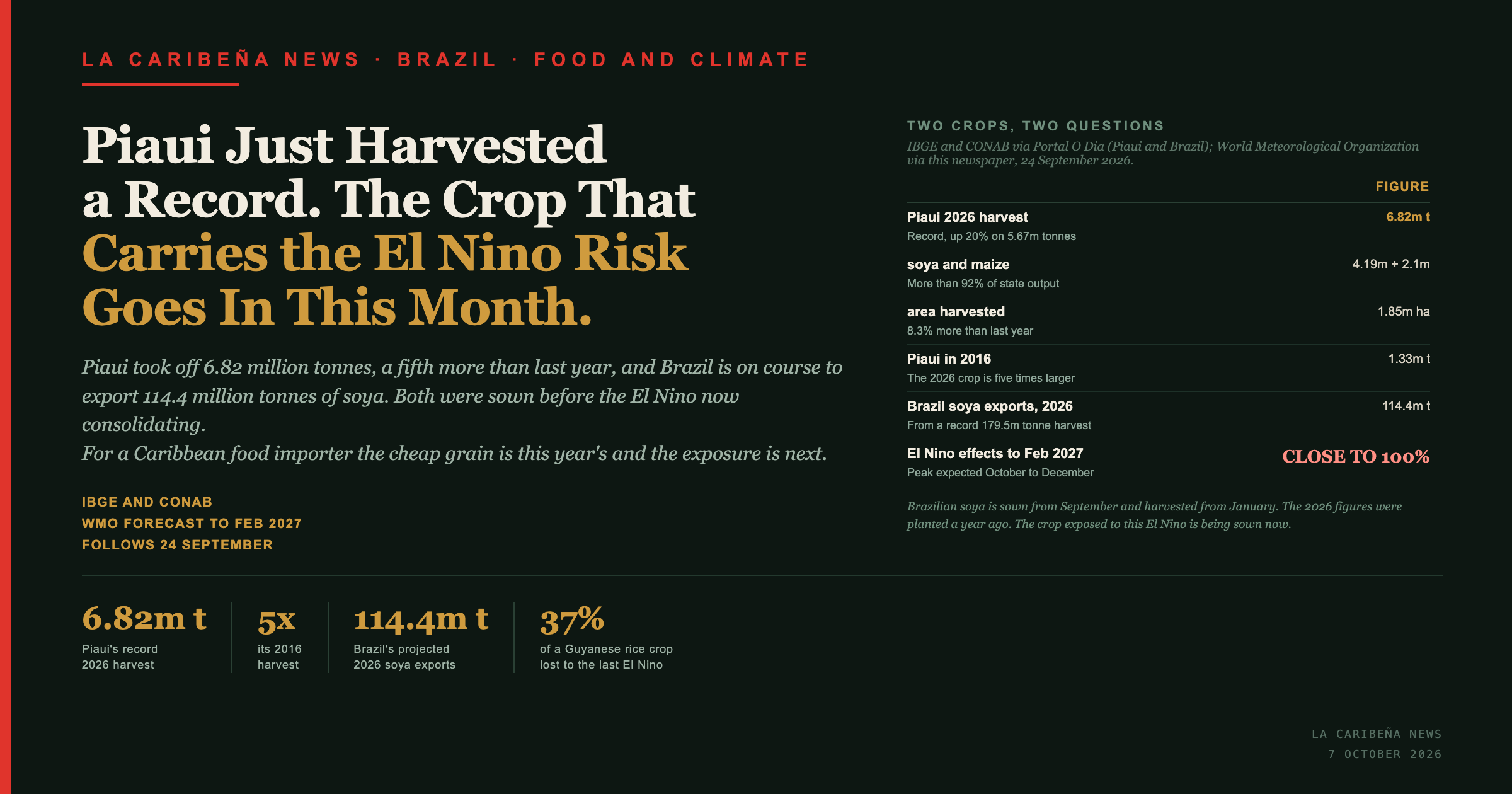
* 6.82 million tonnes. Piaui's 2026 grain harvest, a state record, 20 per cent above the 5.67 million tonnes of 2025. Source: Brazilian Institute of Geography and Statistics, as reported by Portal O Dia. * 4.19 million and 2.1 million tonnes. The soya and maize components, together more than 92 per cent of state output. Source: as above. * 1.85 million hectares. The area harvested, 8.3 per cent more than the year before. Source: as above. * 1.33 million tonnes. Piaui's grain harvest in 2016, against which the 2026 figure is five times larger. Source: as above. * 179.5 million tonnes. Brazil's record 2025/26 soya harvest. * 114.4 million tonnes. Projected Brazilian soya exports in calendar 2026, against about 109 million in 2025, per the National Supply Company. Maize exports are put near 43 million tonnes, up about 16 per cent. * Close to 100 per cent. The World Meteorological Organization's probability that El Nino effects persist to February 2027, with a 95 per cent probability of a peak between October and December 2026, as previously reported by this newspaper. * 37 per cent. The share of a Guyanese rice crop lost to the last comparable El Nino.
Frequently Asked Questions
How much grain did Piaui harvest in 2026?
6.82 million tonnes, the largest in the state's history and 20 per cent above 2025. Soya accounted for 4.19 million tonnes and maize for 2.1 million, together more than 92 per cent of output, taken off 1.85 million hectares.
Does that record mean El Nino has not affected Brazil?
No. Brazilian soya is sown from September and harvested from January, so the 2026 harvest was planted a year ago. The El Nino consolidating now bears on the 2026/27 crop being sown this month.
How much soya will Brazil export this year?
About 114.4 million tonnes in calendar 2026 on the National Supply Company's projection, against roughly 109 million in 2025, from a record 179.5 million tonne harvest. Maize exports are put near 43 million tonnes.
Why does a Brazilian harvest matter to the Caribbean?
Because Brazilian soya and maize set the cost of animal feed, and therefore of poultry, eggs and pork, across a region that imports most of what it eats. The route also runs through the Panama Canal, which has been cutting loading limits and booking slots under the same climate system.
When would a Caribbean importer feel an El Nino effect?
In the 2027 shipments rather than this year's. The last comparable event took 37 per cent of a Guyanese rice crop.