By LCN Business Desk
In 2024/25 Jamaica's central government originally allocated J$80.0 billion to capital expenditure. It spent J$57.5 billion. The Ministry of Finance and the Public Service reported the year's execution rate as 94.6 per cent.
Both of those statements come from the Ministry's own documents, and neither is wrong. They measure against different budgets.
What did the senator actually claim?
That the gap runs to J$96.3 billion and has run for a decade.
Opposition Senator Ramon Small-Ferguson made the charge during the State of the Nation Debate in the Senate on 9 October, in remarks reported by the Jamaica Observer. Over the ten financial years from 2016/17 to 2025/26, he said, approximately J$635.7 billion was originally budgeted for central government capital expenditure and approximately J$539.4 billion was spent. Actual expenditure fell below the original allocation in nine of the ten years.
He split the gap in two: about J$61.8 billion arose through budget reductions made during the year, and about J$34.5 billion went unspent against the reduced allocations.
The arithmetic is internally consistent, which is not always true of a figure delivered in a chamber. J$635.7 billion less J$539.4 billion gives his figure exactly, and so does J$61.8 billion plus J$34.5 billion.
Do the Ministry's own documents support the figures?
On the years that can be checked, yes.
Table 3G of the Fiscal Policy Paper 2026 carries central government capital expenditure year by year, with each column labelled as an actual, a provisional, an estimate or a projection.
| Financial year | Basis as labelled | Capital expenditure, J$mn |
|---|---|---|
| 2021/22 | Actual | 50,510.2 |
| 2022/23 | Actual | 53,184.5 |
| 2023/24 | Actual | 55,863.5 |
| 2024/25 | Provisional | 57,455.9 |
| 2025/26 | Estimate | 55,482.2 |
| 2026/27 | Projection | 79,740.4 |
| 2027/28 | Projection | 81,771.4 |
| 2028/29 | Projection | 90,253.8 |
| 2029/30 | Projection | 93,375.0 |
Source: Ministry of Finance and the Public Service, Fiscal Policy Paper 2026 (As Passed), Table 3G, Central Government Summary Accounts.
The senator put 2023/24 spending at J$55.9 billion. The Ministry records J$55,863.5 million. He put the 2024/25 shortfall at J$22.5 billion measured against what Parliament first approved. The Fiscal Policy Paper 2025 gives that original allocation as J$80,000.0 million, and the outturn is J$57,455.9 million. The difference is J$22,544.1 million.
Why does the Ministry report 94.6 per cent?
Because it is measuring against the budget as revised, not as passed.
The Ministry's Fiscal Policy Paper Interim Report of December 2025 states, of 2024/25: "The execution rate for Capital Expenditure was 94.6 percent." The sentence does not say what the rate is measured against.
The arithmetic says. J$57,455.9 million against the original J$80,000.0 million is 71.8 per cent. For the rate to come out where the Ministry puts it, the denominator has to be about J$60.7 billion, which is the allocation after it was cut during the year.
| 2024/25 capital expenditure | J$mn | Execution rate |
|---|---|---|
| Original allocation | 80,000.0 | not applicable |
| Allocation after revision, implied by the Ministry's own rate | ~60,735.6 | not applicable |
| Actual, provisional | 57,455.9 | 94.6% against the revised figure |
| Actual against the original allocation | 57,455.9 | 71.8% |
Source: original allocation and revision from Fiscal Policy Paper 2025; outturn from Fiscal Policy Paper 2026, Table 3G; stated execution rate from the Fiscal Policy Paper Interim Report, December 2025. The implied revised figure is LCN's arithmetic on the Ministry's own rate and outturn.
One year, two official figures, both correct. The difference is which budget the spending is weighed against.
The senator's split follows that line exactly. His first component is the distance between the original allocation and the revised one. His second is what was then left unspent against the revised figure. The Ministry reports the second and not the first.
What explanation has the Ministry given?
The same sentence, two years running.
The Fiscal Policy Paper 2025 recorded the cut and explained it: Capital Expenditure "of $61.7bn (down by $18.3bn or 22.8 percent)" against the original budget, because "the downward revision of Capital Expenditure reflects the slower-than-planned execution of several public sector investment projects."
The Fiscal Policy Paper 2026 explains the following year's cut in the same words, one of them dropped: "the downward revision of Capital Expenditure reflects the slower-than-planned execution of several public investment projects."
In the Senate, Small-Ferguson argued that "after 10 years, procurement difficulties and capacity constraints cannot remain recurring explanations without a programme to correct them." He asked the Government to lay before Parliament within six months a programme naming the principal sources of delay, the reforms required, the institution responsible for each and its deadline.
What does Jamaica's own fiscal watchdog say?
It reached the same finding eight months earlier, and used stronger language.
The Independent Fiscal Commission is a statutory body that reports on the Government's fiscal performance. Its Economic and Fiscal Assessment Report of February 2026 lists "chronic under-execution of capital expenditure" among the major risks requiring structural correction, and states that "under-execution remains one of the largest structural weaknesses in Jamaica's public financial management."
The Commissioner put the consequence in a single image: by not anchoring wages to economic performance, "Jamaica risks eating its 'seed corn' - prioritizing wages today at the expense of capital investments required for tomorrow's growth and climate resilience."
On the year then running, the Commission found that of the J$62.6 billion originally budgeted for capital expenditure in 2025/26, "only 49.8 percent was executed over the first nine months of the fiscal year." Spending the rest would have required "close to 50 percent of the full year allocation" in the final quarter alone. The Commission said the pace "continues to undermine the credibility of the forecast."
The self-financing public bodies showed the same pattern on a larger scale, with a capital under-execution of J$29.7 billion by December.
A statutory watchdog called it chronic in February. A senator costed it at J$96.3 billion in October.
What happened to this year's capital budget?
J$20 billion left it between the version of the fiscal paper presented to Parliament and the version passed by it.
The Fiscal Policy Paper 2026 exists in two published forms. Table 3G appears in both, with the same column labels and the same figures for every year except one.
| 2026/27 projection, J$mn | As Presented | As Passed | Change |
|---|---|---|---|
| Capital Expenditure | 99,740.4 | 79,740.4 | −20,000.0 |
| Programmes, recurrent | 408,249.2 | 428,249.2 | +20,000.0 |
| Recurrent Expenditure | 1,174,450.8 | 1,194,450.8 | +20,000.0 |
| Total Expenditure | 1,309,675.2 | 1,309,675.2 | 0.0 |
Source: Ministry of Finance and the Public Service, Fiscal Policy Paper 2026, Table 3G, in its As Presented and As Passed versions. Capital projections for 2027/28, 2028/29 and 2029/30 are identical in both at J$81,771.4 million, J$90,253.8 million and J$93,375.0 million.
Total spending does not change. The money moves from capital to recurrent programmes, and the later years are left alone.
Even after that reduction, 2026/27 is planned as a step up: J$79.7 billion of capital spending against the J$55.5 billion estimated for 2025/26. The context is reconstruction. Hurricane Melissa reversed Jamaica's debt path, and the Commission projects debt to rise to 68.2 per cent of GDP by the end of 2025/26 against 62.4 per cent a year earlier.
Jamaica's borrowing and what it funds were examined in Jamaica Borrowed US$1 Billion to Buy Back Old Bonds. Most of It Is Going to the Budget.. Its growth position in the Fund's latest forecasts is in The IMF Put Latin America and the Caribbean at 2.3 Per Cent, and the levy question in Jamaica Wants a Caribbean Visitor Levy for Resilience.
Which figure could not be checked?
The most recent one.
Small-Ferguson put the 2025/26 shortfall at J$14.8 billion against the original allocation. That year ended on 31 March 2026, and no Fiscal Policy Paper held by this newspaper carries its outturn: the Fiscal Policy Paper 2026 still shows 2025/26 as an estimate, at J$55,482.2 million against the J$62,595.6 million originally budgeted, a gap of J$7.1 billion. The interim report that would carry the final figure covers 2026/27 and is not due until about December.
His number is consistent with what the Commission found. Capital spending reached J$31.2 billion in the first nine months. A full-year outturn of about J$47.8 billion, which is what a J$14.8 billion shortfall implies, would mean roughly J$16.6 billion in the final quarter, against the roughly J$31.4 billion that full utilisation needed.
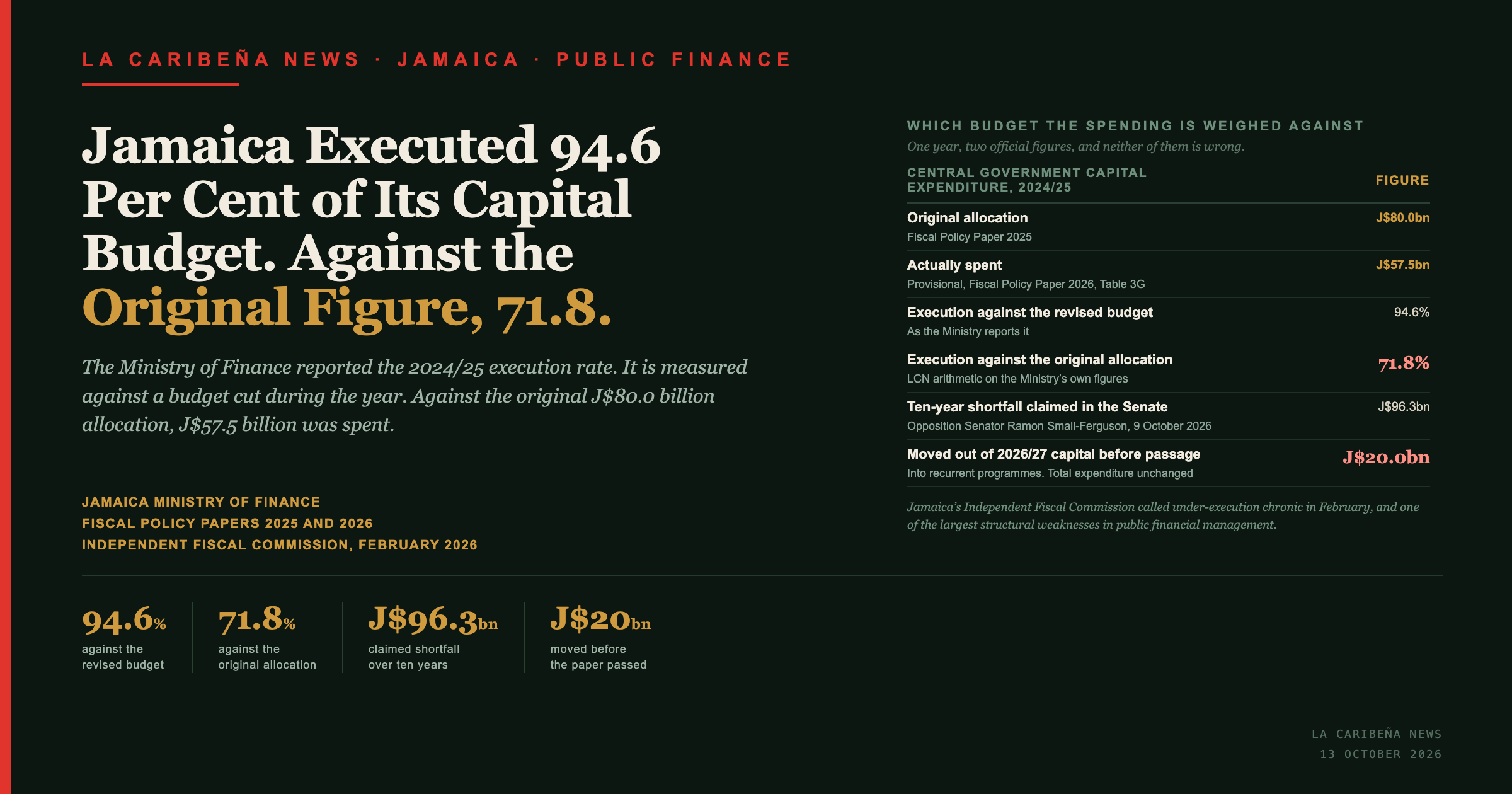
What the title card shows
Every data point on the article's title card, in text. Source for all: Ministry of Finance and the Public Service, except where stated.
- 94.6 per cent. The execution rate for capital expenditure in 2024/25, as stated in the Fiscal Policy Paper Interim Report of December 2025. The sentence does not name the baseline it is measured against.
- 71.8 per cent. The same year's spending measured against the original allocation. J$57,455.9 million of J$80,000.0 million. LCN's arithmetic on the Ministry's own figures.
- J$80.0 billion. The original 2024/25 capital allocation, from the Fiscal Policy Paper 2025.
- J$57.5 billion. What was actually spent, from Table 3G of the Fiscal Policy Paper 2026.
- J$96.3 billion. The ten-year shortfall against original allocations claimed by Opposition Senator Ramon Small-Ferguson in the Senate on 9 October 2026, as reported by the Jamaica Observer. His 2023/24 and 2024/25 figures match the Ministry's documents; his 2025/26 figure could not be checked, because no Fiscal Policy Paper held carries that outturn.
- J$20.0 billion. Moved out of the 2026/27 capital projection and into recurrent programmes between the As Presented and As Passed versions of the Fiscal Policy Paper 2026. Total expenditure is unchanged at J$1,309,675.2 million.
- 49.8 per cent. The share of the 2025/26 capital budget executed in the first nine months, per the Independent Fiscal Commission of Jamaica, February 2026.
- J$29.7 billion. Capital under-execution by the self-financing public bodies to December 2025, per the same report.
Frequently Asked Questions
How much of Jamaica's capital budget went unspent?
Opposition Senator Ramon Small-Ferguson told the Senate on 9 October 2026 that approximately J$96.3 billion of a J$635.7 billion ten-year capital allocation went unspent between 2016/17 and 2025/26, with actual spending below the original allocation in nine of the ten years. His figures for 2023/24 and 2024/25 match the Ministry of Finance's own published documents.
Why does the Ministry of Finance report a 94.6 per cent execution rate?
Because that rate is measured against the budget after it was revised during the year, not against the allocation Parliament originally approved. For 2024/25 the original allocation was J$80.0 billion and the outturn was J$57.5 billion, which is 71.8 per cent. A 94.6 per cent rate implies a baseline of about J$60.7 billion.
What explanation has the Government given?
The Fiscal Policy Papers for 2025 and 2026 each attribute the downward revision of capital expenditure to the slower-than-planned execution of public investment projects, in near-identical sentences a year apart.
Has anyone outside the Opposition made the same finding?
Yes. The Independent Fiscal Commission of Jamaica, a statutory body, listed "chronic under-execution of capital expenditure" among the major fiscal risks in its February 2026 assessment and called under-execution "one of the largest structural weaknesses in Jamaica's public financial management."
What changed in this year's capital budget?
Between the As Presented and As Passed versions of the Fiscal Policy Paper 2026, the 2026/27 capital projection fell from J$99,740.4 million to J$79,740.4 million, while recurrent programmes rose by the same J$20,000.0 million. Total expenditure was unchanged, and the projections for 2027/28 onwards were not altered.