By LCN Business Desk
The Government of Jamaica went to international markets this month with two offers at once. It would sell US$1 billion of new bonds, and it would buy back three older ones from anyone willing to sell.
Investors took all of the first offer. Most holders turned down the second.
What did Jamaica sell?
US$1 billion of notes paying 6.25 per cent, maturing in 2037.
The final term sheet the Government filed with the United States Securities and Exchange Commission shows the notes priced on 10 September at 100 per cent of face value, for a yield of 6.25 per cent. They settle on 17 September and are to be listed on the Euro MTF market in Luxembourg. Citigroup Global Markets was global coordinator, with Scotia Capital (USA) as joint lead manager.
The principal is repaid in three instalments of roughly a third each, on 17 September 2035, 2036 and 2037, according to the prospectus supplement. Interest is paid every March and September, starting in March 2027.
Investors had initially been guided to a rate of about 6.50 per cent, and the issue was heavily oversubscribed, the Jamaica Observer reported, citing market sources.
The filings carry Jamaica's ratings as Ba3 from Moody's, BB from S&P and BB- from Fitch, all with stable outlooks.
How many holders sold their old bonds back?
About a sixth of what was on offer.
The Government invited holders of its 6.75 per cent notes due 2028, 8.50 per cent notes due 2036 and 8.00 per cent notes due 2039 to sell them back for cash at a premium. The three issues had a combined US$2.33 billion outstanding, the Gleaner reported when the invitation opened on 2 September.
When it closed on 9 September, holders had tendered about US$476.62 million in face value, or about US$392.23 million once the part of the 2028 notes already repaid is taken out, the Observer reported. The Government's offer prices were 102.625 for the 2028 notes, 117 for the 2036 notes and 118 for the 2039 notes.
Most of what came in was the shortest-dated bond. In a column in the Gleaner, Kerice Gray of VM Wealth Management put the 2028 notes at US$343 million of the amount tendered, and set out why holders of the longer bonds stayed put. The 2039 notes traded well above 140 after the pandemic, so selling at 118 would force many institutions to book losses on bonds bought at higher prices. Long-dated Jamaican bonds are also used as collateral for repurchase lines by local and regional institutions.
The buyback is expected to cut the Government's annual interest bill by about US$3.5 million, the Observer reported.
Where does the money go?
Mostly to the budget.
When the deal was launched, the Observer reported on 4 September, citing a roadshow document, that about US$600 million of the US$1 billion was earmarked for the buyback and the balance for general budgetary purposes, the Rio Times noted. The Observer's report on 11 September repeated that split, putting the budget portion at about US$400 million.
The final filings, dated after the tender closed, set out a different split. Net proceeds are about US$997.6 million. The Government "intends to use a portion of the net proceeds" to pay for notes accepted in the tender, "and to use approximately U.S.$590,000,000 of the proceeds for general budgetary purposes," the prospectus supplement says.
The preliminary prospectus filed on 2 September left both figures blank.
Why does it matter for the region?
Because Jamaica is borrowing on these terms less than a year after a hurricane that its own prospectus values at US$8.8 billion in damage.
The Government's prospectus describes Hurricane Melissa, which struck on 28 October 2025, as destroying electricity infrastructure, communications networks and gas stations across the western parishes, and closing airports and cruise piers for a period. The Gleaner reported that the Government has put the damage at the equivalent of more than half of the island's annual output.
Jamaica's public debt has fallen from about 116 per cent of gross domestic product in 2015 to about 68 per cent, the Observer reported. The Bank of Jamaica, which has a new governor, sits on the monetary side of that record.
The Observer also compared the pricing with Trinidad and Tobago, which carries higher ratings and issued a 10-year US$1 billion bond at 6.50 per cent earlier this year, followed by US$800 million of 12-year bonds at 6.20 per cent.
Britain's export credit agency, UK Export Finance, publishes a market risk appetite of £4 billion to £5 billion for Jamaica, above its band for Guyana, as this newspaper reported on the agency's Caribbean table.
The repayment shape is the other feature. Spreading principal across three years, from 2035 to 2037, avoids a single large payment falling due on one date.
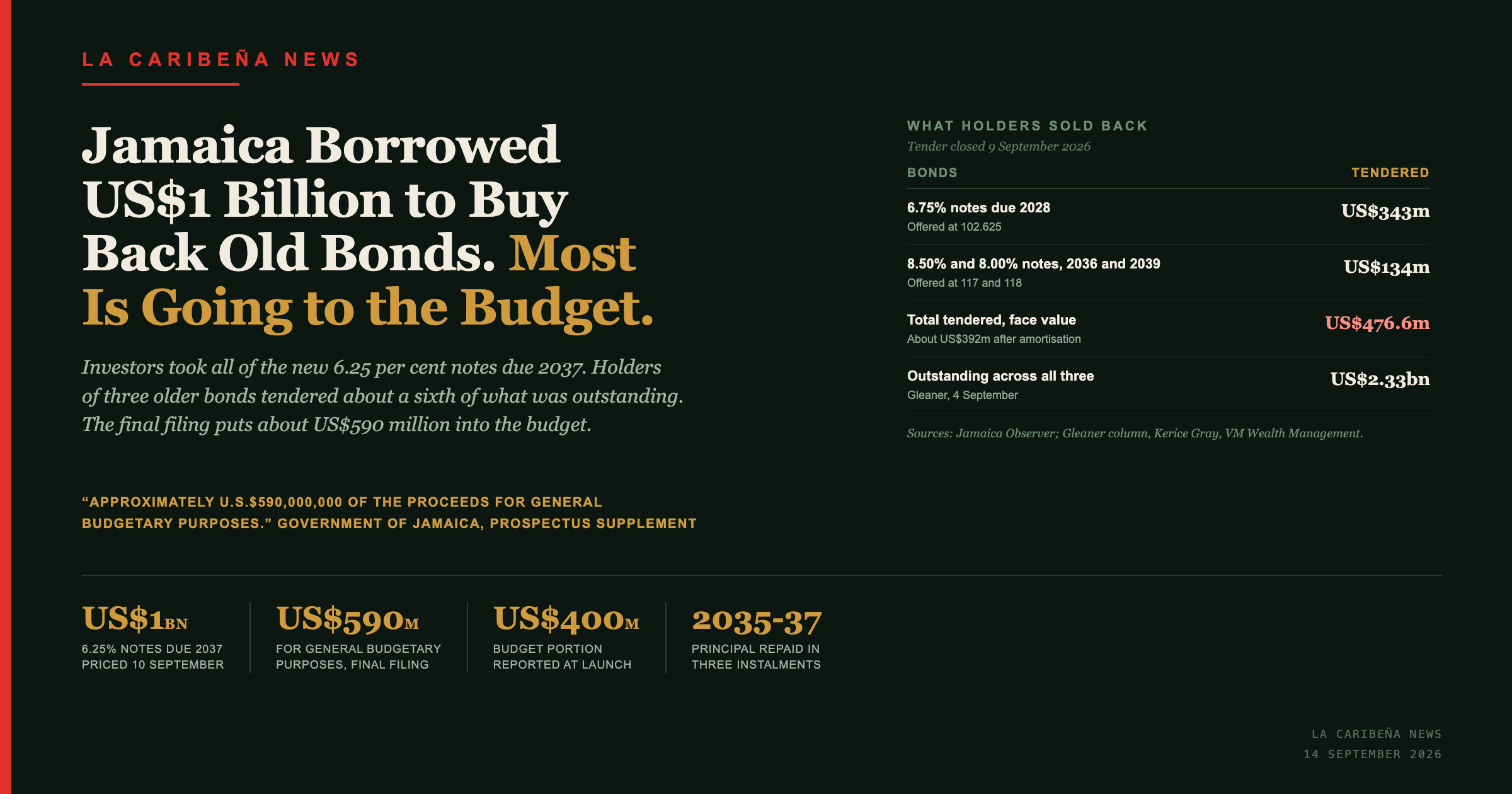
What the title card shows
- US$1,000,000,000 of 6.250% Notes due 17 September 2037; priced 10 September 2026 at 100.000, yield 6.250%; settlement 17 September. Source: Government of Jamaica final term sheet, SEC.
- Principal repaid 33.33% / 33.33% / 33.34% on 17 September 2035, 2036 and 2037. Source: prospectus supplement, SEC.
- About US$590 million of proceeds for general budgetary purposes; net proceeds about US$997.6 million. Source: final term sheet and prospectus supplement. Reporting at launch: about US$400 million (Jamaica Observer).
- Tender offer on 2028, 2036 and 2039 notes, about US$2.33 billion outstanding; about US$476.62 million tendered (US$392.23 million adjusted for amortisation). Sources: Gleaner, 4 September; Jamaica Observer, 11 September.
- Tender prices 102.625 / 117 / 118; of the amount tendered, US$343 million from the 2028 notes and about US$134 million from the 2036 and 2039 notes combined (the balance of the US$476.62 million total). Source: Gleaner column, Kerice Gray, VM Wealth Management; Jamaica Observer.
- Ratings Ba3 / BB / BB-, stable. Source: final term sheet.
Frequently Asked Questions
What bond did Jamaica issue in September 2026?
US$1 billion of 6.25 per cent notes due 17 September 2037, priced on 10 September at par. Principal is repaid in three roughly equal instalments in 2035, 2036 and 2037, and the notes are to be listed in Luxembourg.
How much did bondholders sell back to Jamaica?
About US$476.62 million in face value was tendered from the 2028, 2036 and 2039 notes, or about US$392.23 million after adjusting for amortisation of the 2028 notes, according to the Jamaica Observer. The three issues had about US$2.33 billion outstanding.
How will Jamaica use the money?
The Government's final prospectus supplement says a portion will pay for notes accepted in the tender and about US$590 million will go to general budgetary purposes. Reporting at launch had put the budget portion at about US$400 million.
Why did most holders keep their old bonds?
A Gleaner column by Kerice Gray of VM Wealth Management said selling the 2039 notes at 118 would force losses on bonds bought at higher prices, and that long-dated Jamaican bonds serve as collateral for institutions' funding lines.