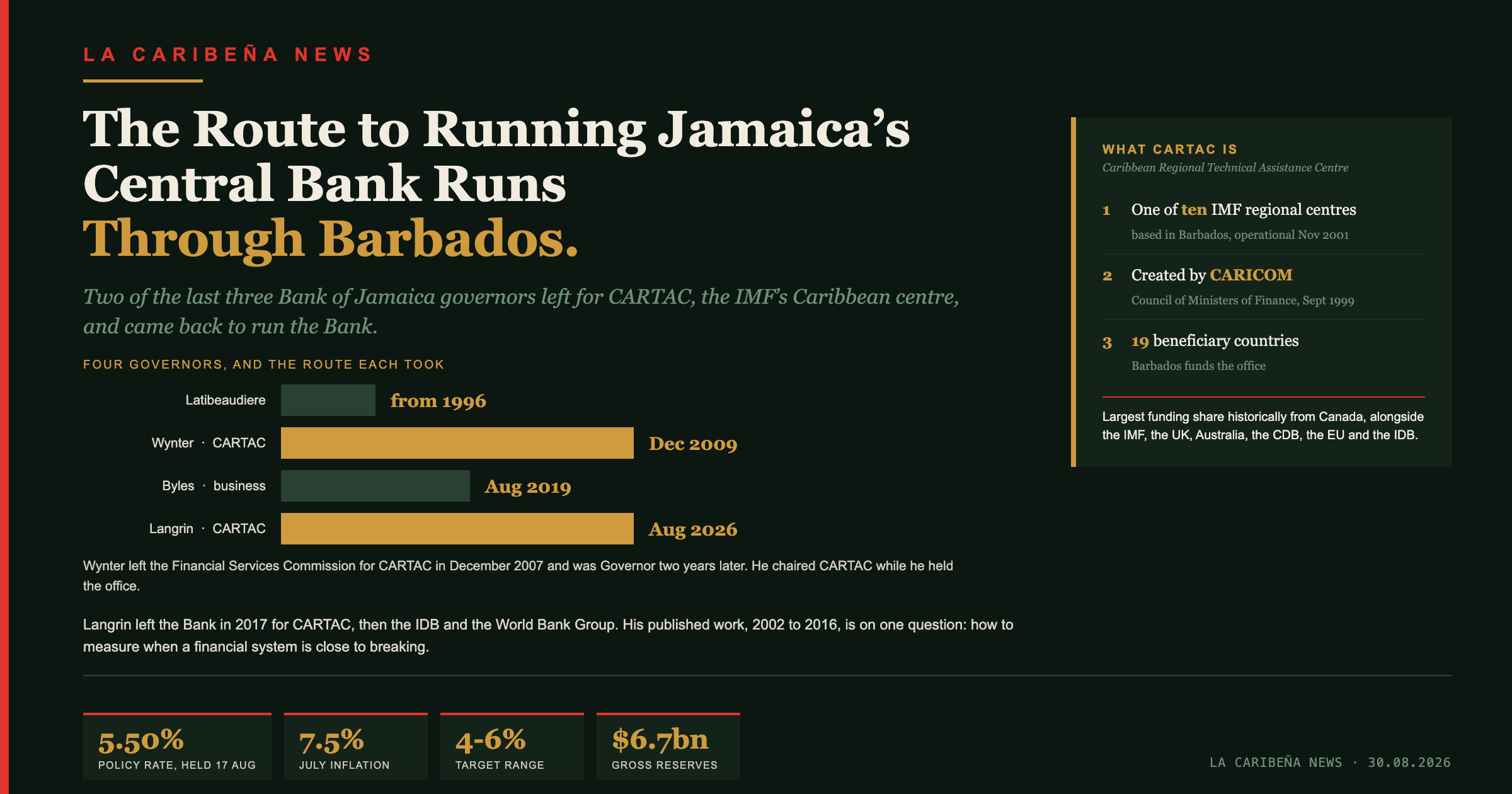
Quick summary: Dr R. Brian Langrin became Governor of the Bank of Jamaica on 19 August 2026. He left the Bank in 2017 for CARTAC, the IMF's Caribbean centre in Barbados, returning after roles at the Inter-American Development Bank and the World Bank. Brian Wynter took the same route.
By La Caribeña News · 30 August 2026
Put two curricula vitae side by side and a route appears.
Dr R. Brian Langrin became Governor of the Bank of Jamaica on 19 August, appointed by the Governor General on the recommendation of Cabinet under the Bank of Jamaica Act. He spent more than fifteen years at the Bank before he left it.
Where he went in 2017 was Barbados.
What is CARTAC?
An IMF centre that the Caribbean asked for.
The Caribbean Regional Technical Assistance Centre is one of ten regional centres the International Monetary Fund operates around the world, alongside others in the Pacific, Africa, the Middle East, India and Central America. It is based in Barbados and became operational in November 2001.
It was not imposed. CARICOM's Council of Ministers of Finance and Planning took the decision to establish it in September 1999.
Its work is the machinery of economic management: budget and tax policy and administration, financial sector supervision and regulation including of offshore centres, and the compilation of financial, economic and social statistics. It delivers through resident advisers, short-term specialists, workshops and regional training.
Barbados finances the office. Nineteen other beneficiary countries contribute to running costs. The larger money has come from outside the region: the Canadian development agency has provided the largest share, with the IMF, the United Kingdom, Australia, the Caribbean Development Bank, the European Union and the Inter-American Development Bank alongside it, and Ireland, the United Nations Development Programme, the United States and the World Bank over its life.
Its priorities are set by a steering committee of recipient countries, donors and the Fund.
Who took the route before?
The Governor who ran the Bank for the decade before last.
Brian Wynter was appointed the first Executive Director of Jamaica's Financial Services Commission in August 2001. He held that post until December 2007, when he left to join CARTAC in Barbados as Capital Markets and Financial Sector Adviser.
Two years later he was Governor of the Bank of Jamaica, replacing Derick Latibeaudiere in December 2009. He served ten years, until August 2019.
While Governor, he chaired CARTAC.
Where does Langrin's route differ?
He did not come back directly, and he collected three more institutions on the way.
Langrin joined CARTAC in 2017 as resident adviser in financial stability and remained until 2020. From there he became Executive Director at the Inter-American Development Bank Group, chairing the Board's Audit and Assurance Oversight Committee, and Board Adviser to the World Bank Group's Executive Director for Canada, Ireland and the Caribbean. Most recently he advised CARICOM on modernising the region's digital financial market infrastructure.
Inside the Bank he had been Chief Economist in the Research and Economic Programming Division, then Head of the Financial Stability Department, where he was technical lead for the Government of Jamaica on two sovereign debt restructurings.
He holds a doctorate in economics from Pennsylvania State University, and a master's and bachelor's from the University of the West Indies.
Richard Byles, who led the Bank between them from August 2019, is the exception in the sequence. He came from business.
What has he actually published?
Twenty-four years on one question.
Langrin's own research runs from an early warning system for the prevention of banking sector crisis in Jamaica, written in 2002 in the Bank's Research and Economic Programming Division, to a single aggregate measure of financial system stability for Jamaica, published in July 2016.
The department he went on to lead built in the same direction, developing an absorption ratio for macroprudential monitoring and a composite indicator of systemic stress.
The through-line is measurement of when a financial system is close to breaking. It is a narrower and more technical specialism than the office he now holds.
What did he do in his first week?
Held the rate, and named three priorities that are not monetary policy.
Delivering the Quarterly Monetary Policy Report on 20 August, his second day in office, Langrin presented the Monetary Policy Committee's decision of 17 August to hold the policy rate at 5.50 per cent.
Headline inflation stood at 7.5 per cent in July, up from 6.7 per cent in June, above the Bank's target range of 4 to 6 per cent. He attributed the rise to the second phase of a 16 per cent taxi fare increase, international commodity prices feeding electricity rates and selected services, and agricultural prices under worsening drought and heat. The Committee expects inflation to stay above target through the September quarter before moderating.
"The message today is straightforward: the Bank is holding the policy rate steady because the current inflation pressures appear largely temporary, but we remain alert and ready to act if those pressures become more persistent," he said.
He forecast real growth of 1 to 3 per cent for the 2026/27 financial year, noted the exchange rate had appreciated 2 per cent year on year to 13 August against a 2.2 per cent depreciation a year earlier, and put gross international reserves at US$6.7 billion, or 144.3 per cent of the reserve adequacy measure.
He also acknowledged Byles' stewardship, and said his own tenure would give increased focus to digitalisation, financial inclusion and resilience, including broadening access to formal financial services for small businesses and people facing barriers to participation.
What does the record suggest?
Continuity on the framework, and movement on the plumbing.
An insider held the rate at his first meeting, reaffirmed the target range, characterised an overshoot as temporary and external, and praised his predecessor's framework. Nothing in that signals a change of monetary regime.
The three priorities he named for himself are where his career points. The Bank already operates a central bank digital currency in JAM-DEX. His last assignment before the governorship was regional digital financial market infrastructure. His subject for twenty-four years has been financial stability.
The Caribbean Development Bank is separately backing a study on a regional stock exchange for CARICOM, which is the same question of regional financial plumbing approached from another direction.
What is not established?
Whether the route is a Jamaican habit or a regional one.
Two Bank of Jamaica governors have arrived by way of CARTAC. That is a pattern in one country, twice, and this newspaper does not extend it further. Timothy Antoine, Governor of the Eastern Caribbean Central Bank, came from twenty-two years in the Government of Grenada, fourteen of them as Permanent Secretary in the Ministry of Finance.
The two sovereign debt restructurings Langrin led technically are not named in the Bank's release. Jamaica conducted two well-known exchanges in the years concerned, but the Bank does not identify them and neither does this newspaper.
Where Richard Byles goes next is not on the public record this newspaper can find.
The IMF welcomed the appointment on 19 August. This newspaper has set out before how the Fund's language about a Caribbean member is read more strongly in the region than the Fund writes it.
Text equivalent of the title card
Every data point shown on the title image, with its source.
- Dr R. Brian Langrin, Governor of the Bank of Jamaica from 19 August 2026, appointed by the Governor General on Cabinet's recommendation under the Bank of Jamaica Act. Source: Bank of Jamaica, 17 August 2026.
- CARTAC, 2017 to 2020, resident adviser in financial stability, after more than fifteen years at the Bank of Jamaica.
- Brian Wynter: Financial Services Commission 2001 to December 2007, CARTAC from December 2007, Governor from December 2009 to August 2019. He chaired CARTAC while Governor.
- Richard Byles: Governor 19 August 2019 to 18 August 2026. Seven years.
- CARTAC is one of ten IMF regional centres, established by decision of CARICOM's Council of Ministers of Finance and Planning in September 1999, operational November 2001, based in Barbados, with 19 beneficiary countries contributing to running costs. Source: CARICOM; CARTAC.
- Policy rate held at 5.50 per cent on 17 August. Inflation 7.5 per cent in July, against a target range of 4 to 6 per cent.
- Growth forecast 1 to 3 per cent for 2026/27. Gross international reserves US$6.7 billion, 144.3 per cent of the reserve adequacy measure.
The sequence
| Governor | Before the Bank | Governor from |
|---|---|---|
| Derick Latibeaudiere | 1 April 1996 | |
| Brian Wynter | Financial Services Commission, then CARTAC from December 2007 | December 2009 |
| Richard Byles | Business | 19 August 2019 |
| R. Brian Langrin | Bank of Jamaica, then CARTAC 2017 to 2020, then IDB and World Bank | 19 August 2026 |
Frequently Asked Questions
Who is the new Governor of the Bank of Jamaica?
Dr R. Brian Langrin, appointed effective 19 August 2026. He was previously Chief Economist and then Head of the Financial Stability Department at the Bank, and served at CARTAC, the Inter-American Development Bank and the World Bank Group.
What is CARTAC?
The Caribbean Regional Technical Assistance Centre, one of ten regional centres operated by the International Monetary Fund. It is based in Barbados, was established by a decision of CARICOM's Council of Ministers of Finance and Planning in September 1999, and became operational in November 2001.
Did the previous Governor also come through CARTAC?
Richard Byles did not. Brian Wynter, Governor from December 2009 to August 2019, joined CARTAC in December 2007 as Capital Markets and Financial Sector Adviser and chaired the centre while he was Governor.
What did Langrin do at his first monetary policy press conference?
He presented the Committee's decision to hold the policy rate at 5.50 per cent, described the rise in inflation to 7.5 per cent as largely temporary, and said the Bank was ready to act if the pressures proved persistent.
What has he said his priorities are?
Digitalisation, financial inclusion and resilience, including broadening access to formal financial services for small businesses and people facing barriers to participation.