By LCN Business Desk
The Caribbean gave India something concrete this week. CARICOM ministers pledged the Community's support for India's candidature for a United Nations Security Council term in 2028-29 at the India-CARICOM Foreign Ministers' Meeting on the margins of the 81st United Nations General Assembly, on the Ministry of External Affairs readout reported by The Tribune.
External Affairs Minister S Jaishankar co-chaired the meeting with Suriname's Minister of Foreign Affairs, International Business and International Cooperation, Melvin WJ Bouva. Jaishankar said India and CARICOM must deepen economic, digital and mobility ties, Business Standard reported, and asked members to consider joining the International Solar Alliance and the Global Biofuels Alliance.
Who was in the room?
| Represented by | Countries |
|---|---|
| Foreign ministers | Antigua and Barbuda, The Bahamas, Barbados, Dominica, Guyana, Haiti, Jamaica, St Kitts and Nevis, St Lucia, St Vincent and the Grenadines, Suriname, Trinidad and Tobago |
| A finance minister | Grenada |
| A ministry chief executive | Belize |
| The Secretariat | CARICOM Secretary-General Dr Carla Natalie Barnett |
| Co-chairs | S Jaishankar for India, Melvin WJ Bouva of Suriname for CARICOM |
Source: the Ministry of External Affairs readout, as carried by The Tribune and ANI. Guyana's foreign minister is Hugh Todd.
Who told the Caribbean what its ministers agreed?
Indian outlets carried it. The CARICOM Secretariat's own India page has not been added to since October 2025, and its last substantive entry is the Second CARICOM-India Summit in Georgetown in November 2024. The Secretariat does not appear to be keeping the Community updated on a relationship its ministers meet on every year.
Fourteen governments committed to backing another state's Security Council candidature, and the account of it came from Delhi.
What do the two alliances actually cost to join?
Nothing, and that is the point of them. The International Solar Alliance and the Global Biofuels Alliance are treaty-based bodies India founded and hosts. The Alliance counts 113 member countries, which have signed and ratified its framework agreement, and 16 signatory countries, which have signed and not ratified. On its published membership lists Guyana sits in the second group, having signed and not completed ratification.
That makes Jaishankar's request narrower than it sounds. Most of the room has already signed. What was asked for is the step after signature, and what ratification is worth is the question each government answers before it deposits the instrument.
What does Indian solar cost against American solar?
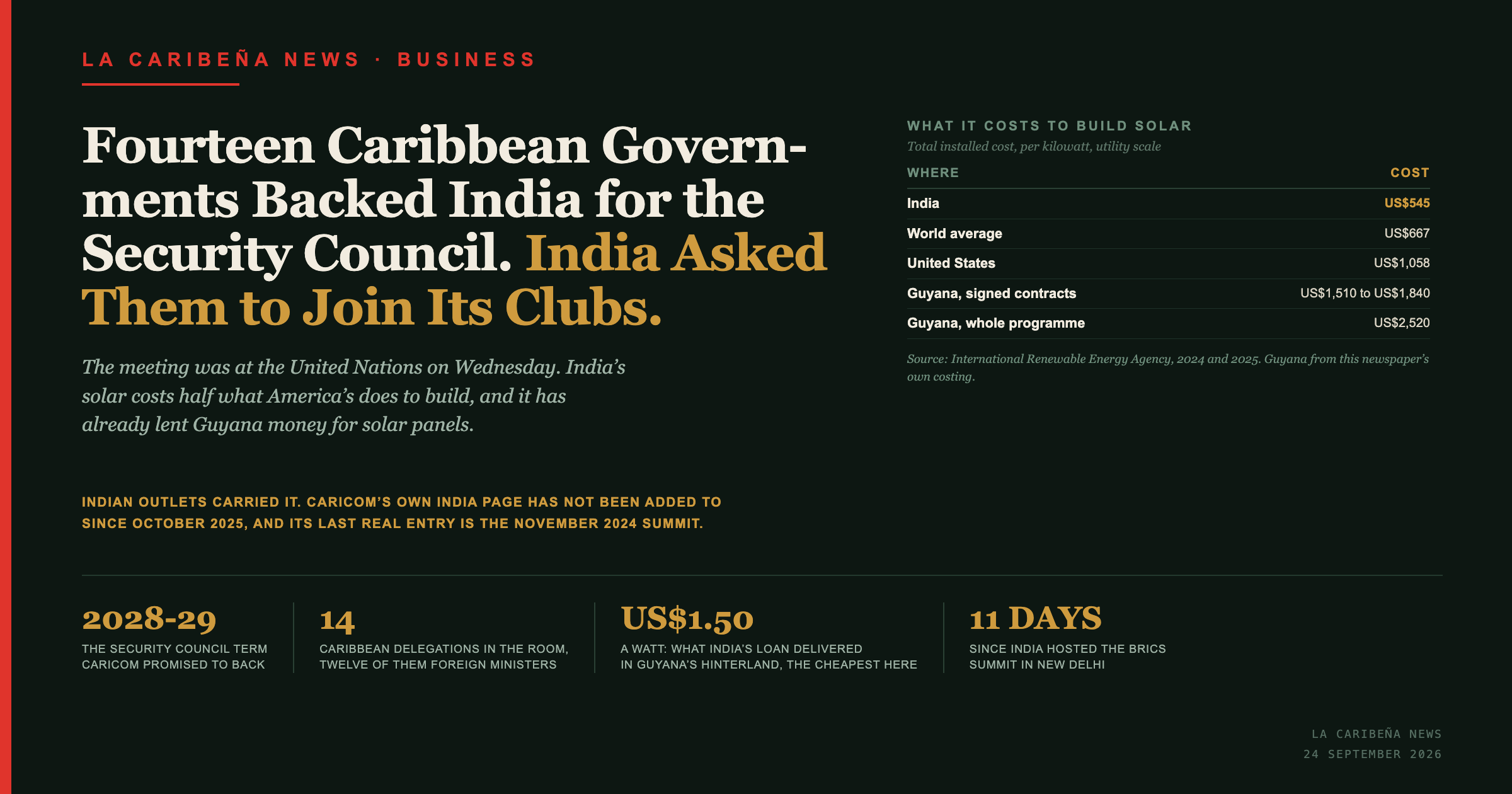
Less than half, on the International Renewable Energy Agency's figures. The Agency's cost report puts the total installed cost of utility-scale solar in India at US$545 a kilowatt in 2025, against a global weighted average of US$667 and a United States average of US$1,058 a kilowatt on 2024 commissionings. India's levelised cost of solar electricity was US$35 a megawatt-hour in 2025. The United States figure was US$70.
| Where | Total installed cost, utility-scale solar | What it is |
|---|---|---|
| India | US$545 a kilowatt | 2025, IRENA |
| World average | US$667 a kilowatt | 2025, IRENA |
| United States | US$1,058 a kilowatt | 2024 commissionings, IRENA |
| Guyana, signed contracts | US$1,510 to US$1,840 a kilowatt | GUYSOL construction contracts |
| Guyana, full programme | US$2,520 a kilowatt | GUYSOL programme budget |
Guyanese figures from this newspaper's own costing in Guyana Publishes What Each Solar Farm Costs. They are not like for like: Guyana's contracts include battery storage and the projects are small and remote, which raises the per-watt figure anywhere in the world.
On modules alone the gap is narrower and runs the same way. Trade publication GreentechLead puts Indian module prices at US$0.14 to US$0.25 a watt in 2026 against roughly US$0.30 a watt in the United States, with Chinese production about 20 per cent below American.
Has Indian solar money already reached Guyana?
Yes, and it bought the cheapest watts in the country. The Export-Import Bank of India financed Guyana's hinterland Solar Home Energy scheme with a US$7.2 million line of credit, delivering 30,000 systems at US$240 each. That works out at US$1.50 a watt including a battery, the lowest per-watt figure in Guyana's entire solar portfolio, below both GUYSOL construction contracts and the programme budget.
Two export credit agencies were at work on Guyana this week. The American one met President Irfaan Ali in New York on 21 September, reported in Guyana's President Met the American Lender on Monday. The Indian one has been lending here for years, on smaller sums and at better prices per watt.
What that money did not do is change the shape of the grid. The cost of putting a rooftop system on every household is set against the gas programme in A Rooftop System for Every Guyanese Household, and households have been buying their own through the blackouts, reported in Before Gas-to-Energy Arrives.
How does the ask fit India's BRICS year?
India assumed its fourth BRICS chairship on 1 January 2026 under the theme Building for Resilience, Innovation, Cooperation and Sustainability, and hosted the 18th BRICS summit at Bharat Mandapam in New Delhi on 12 and 13 September. The bloc adopted the New Delhi Declaration, a 140-paragraph document covering reform of the United Nations and the international financial institutions, trade and finance, energy, technology and health, Forbes India reported. China takes the chair in 2027.
Eleven days later India's foreign minister sat with fourteen Caribbean delegations and came away with an endorsement for a Security Council seat. Reform of the Security Council is in the declaration the bloc had just adopted, and a Security Council candidature is won by counting votes in the General Assembly, where CARICOM is fourteen of them.
The two alliances work the same way. Neither is a BRICS body. Both are institutions India founded and convenes, which is the instrument a state uses when it wants standing without waiting for an existing forum to give it. India's economy is forecast by the International Monetary Fund to grow 6.3 per cent in calendar 2026, and on that base it has been building bodies rather than joining them. This newspaper has covered the same approach applied to industry in India Is Rebuilding Its Small-Business Economy in Public, and to each Caribbean country differently in India's Caribbean Doctrine.
What did the Caribbean get?
A list of things delivered. Small and medium enterprise projects and Quick Impact Projects, completed in several countries and continuing in others. Haemodialysis units. BHISHM Cube compact medical units. Limb fitment camps. Training slots with customised programmes. Cooperation on United Nations reform, climate change, counter-terrorism and transnational crime.
On minerals the comparison has already been drawn here, in Guyana Charges One Royalty for Every Grade of Bauxite, where India's graded royalty regime was the measure Guyana's own terms were set against.
The endorsement is dated for 2028-29. The ratifications are not dated at all.
What the title card shows
- 2028-29: the United Nations Security Council term CARICOM ministers pledged to support India's candidature for. Source: the Ministry of External Affairs readout.
- Fourteen delegations: twelve foreign ministers, Grenada's finance minister and Belize's ministry chief executive, plus CARICOM Secretary-General Dr Carla Natalie Barnett.
- US$545 against US$1,058 a kilowatt: what utility-scale solar costs to install in India against the United States, on International Renewable Energy Agency figures. Guyana pays US$1,510 to US$2,520.
- US$1.50 a watt: what the Export-Import Bank of India's US$7.2 million line of credit delivered in Guyana's hinterland, 30,000 systems at US$240 each, the cheapest per watt in the country's solar portfolio.
- Eleven days earlier: India hosted the 18th BRICS summit in New Delhi on 12 and 13 September 2026, in its own chairship year.
Frequently Asked Questions
What did CARICOM agree at the meeting?
CARICOM ministers pledged the Community's support for India's candidature for a United Nations Security Council term in 2028-29. The two sides also agreed to work together on United Nations reform, climate change, counter-terrorism and transnational crime.
Who attended?
Foreign ministers from Antigua and Barbuda, The Bahamas, Barbados, Dominica, Guyana, Haiti, Jamaica, St Kitts and Nevis, St Lucia, St Vincent and the Grenadines, Suriname and Trinidad and Tobago, along with Grenada's finance minister, the chief executive of Belize's foreign ministry, and CARICOM Secretary-General Dr Carla Natalie Barnett. S Jaishankar and Suriname's Melvin WJ Bouva co-chaired.
Is Guyana already in the International Solar Alliance?
It has signed the framework agreement but on the Alliance's published lists it sits among the signatory countries rather than the 113 member countries, which are those that have both signed and ratified.
Why does India build alliances rather than join them?
The International Solar Alliance and the Global Biofuels Alliance are bodies India founded and hosts, and neither is a BRICS institution. India holds the BRICS chair in 2026 and hosted the bloc's summit in New Delhi on 12 and 13 September, where the New Delhi Declaration called for reform of the United Nations and the international financial institutions.
What has Indian financing already built in Guyana?
The Export-Import Bank of India provided a US$7.2 million line of credit for the hinterland Solar Home Energy scheme, which delivered 30,000 systems at US$240 each, or US$1.50 a watt including a battery.