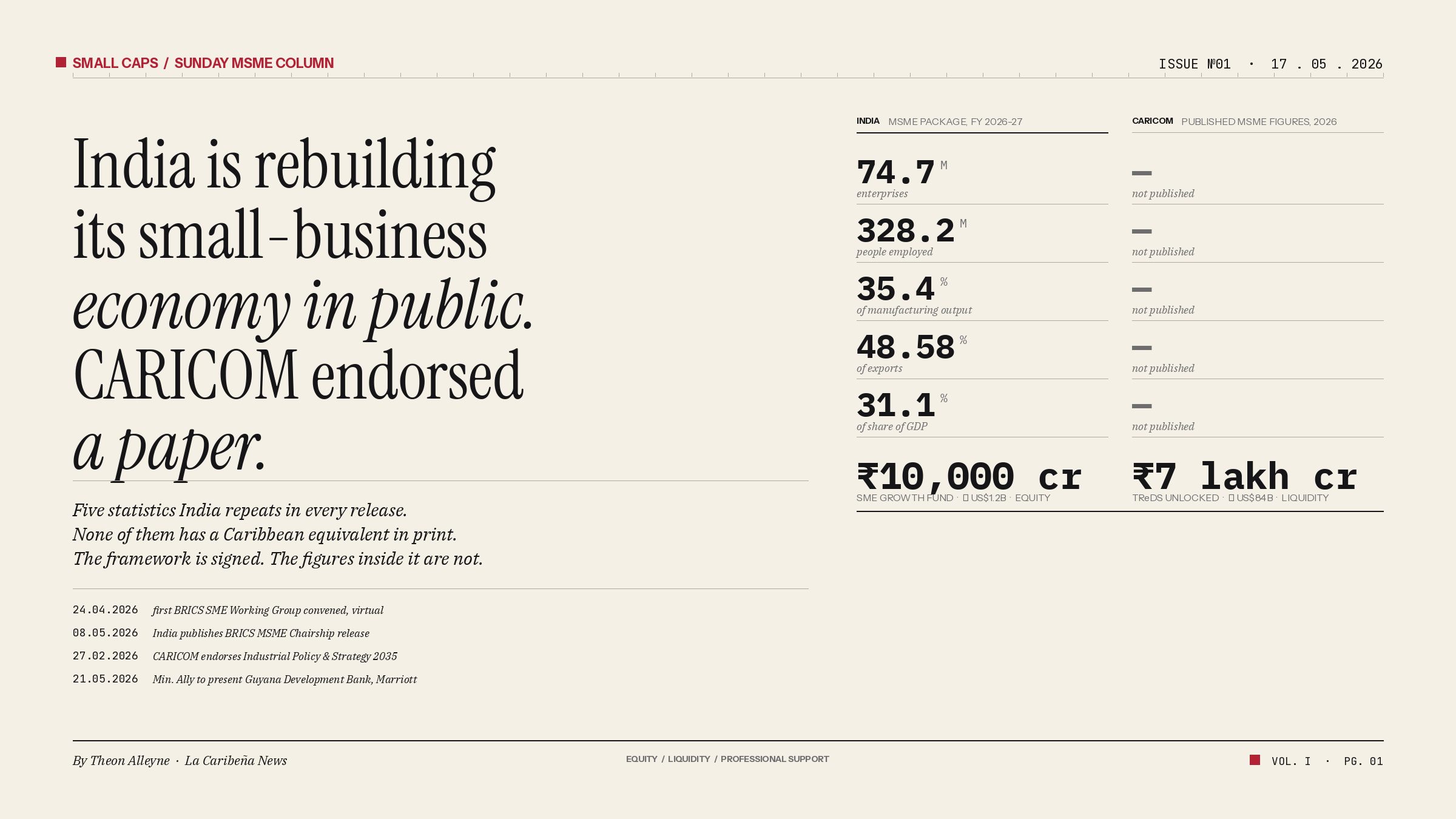
Five statistics India repeats in every release. None of them has a Caribbean equivalent in print. Two CARICOM chairs have presided over 2026 so far; the next handover is six weeks away. The regional framework is signed. The figures inside it are not.
By Theon Alleyne / La Caribeña News / Sunday, May 17, 2026
On April 24, 2026, the Indian Ministry of Micro, Small and Medium Enterprises convened the first BRICS SME Working Group meeting under India’s 2026 BRICS Chairship. The session, held virtually, opened with two themes the ministry had been advancing for six months: bridging the MSME credit gap through financial inclusion and credit readiness, and building fintech-driven ecosystems for SME credit and global trade payments. By May 8, the ministry’s press wing had published a release with named themes, identified participating countries, and a calendar of two more Working Group sessions and the inaugural BRICS MSME Forum still to come.
That release, picked up across Indian and Asian business media in the days that followed, was paragraph after paragraph of numbers. A new SME Growth Fund worth 10,000 crore rupees, roughly US$1.2 billion at current exchange rates, for equity injections into mid-sized firms. More than 7 lakh crore rupees, approximately US$84 billion, unlocked through TReDS, India’s invoice-discounting platform, now mandatory for Central Public Sector Enterprises. Bilateral MSME cooperation pacts already signed with Japan, South Africa, and New Zealand. A 10 lakh rupee per-consignment cap on courier exports removed in the 2026-27 Union Budget. Five aggregate statistics the ministry can quote from memory and does, in almost every release: 74.7 million enterprises, 328.2 million people employed, roughly 35.4 percent of manufacturing output, roughly 48.58 percent of exports, roughly 31.1 percent of GDP.
Three months earlier, the Caribbean Community produced its own MSME headline. On February 27, 2026, in Basseterre, the 50th Conference of Heads of Government endorsed the CARICOM Industrial Policy and Strategy 2035. The policy targets twelve industrial ecosystems and five cross-cutting enablers; Micro, Small and Medium-sized Enterprises is named as one of the twelve. Three months on, Caribbean MSME owners can read the framework. They cannot tell you what it cost, what it funded, or which agency runs it. That contrast is what this column will return to every Sunday. India shows its math. CARICOM tells you the math is coming.
Equity. India built a fund. The Caribbean has SEAF, and a lot of waiting.
India’s 2026-27 Union Budget created the SME Growth Fund at 10,000 crore rupees. The instrument is equity, not debt. Indian small firms that want to scale can take a check in exchange for a stake; they are not first forced into bank borrowing they cannot service. The fund is positioned to produce what India’s ministry calls “future champions,” firms large enough to compete internationally but currently capital-starved.
The closest Caribbean equivalent is the SEAF Caribbean SME Growth Fund, a private-sector vehicle headquartered in Jamaica with representation in Trinidad, Guyana, and Barbados. SEAF’s public mandate is to make 10 to 15 equity investments in CARICOM small and mid-sized enterprises across manufacturing, agribusiness, tourism, ICT, and financial inclusion. That is a useful instrument. It is also private capital, with private return targets, and limited in absolute size relative to the demand. The Inter-American Development Bank has supported Guyanese export-oriented SMEs through a US$28 million Trade Finance Facilitation Programme allocation, an instrument that finances trade rather than ownership. Guyanese officials spoke in late 2025 about a forthcoming state-backed development bank that would offer zero-interest credit with reduced collateral requirements. As of mid-May 2026, the bank is not yet operational.
That bank may move from concept to detail on May 21, 2026. The Guyana Manufacturing and Services Association has scheduled a business luncheon at the Georgetown Marriott Hotel with the Hon. Zulfikar Ally, Minister of Public Service, Government Efficiency and Implementation, as featured speaker. The session title, “Unlocking the Guyana Development Bank: what businesses need to know about financing, eligibility, documentation and timelines,” is itself a publication test. If Minister Ally arrives with named loan ceilings, eligibility thresholds, documentation lists, and a disbursement timeline, Small Caps will report them on May 24. If the answers are still framed as forthcoming, the column will say so. Either way, the luncheon is the first sitting-Minister presentation of the Development Bank to a major industry association in 2026.
Between India and CARICOM, the gap is not desire. The gap is publication.
India tells small-business owners exactly what the equity pool is, what it will fund, and who runs it. Caribbean MSME owners are referred to an “ongoing review” or an “upcoming announcement.” That is not how confidence is built in any business community.
Liquidity. India fixed the 90-day wait. The Caribbean has not started.
Every Caribbean small-business owner who has supplied a hotel, a supermarket chain, or a government agency knows the wait. The invoice goes in. Sixty days pass. Ninety. Sometimes one hundred and twenty. The supplier covers wages out of personal savings, or borrows at unsecured-loan rates to bridge the gap. Cash flow, not order book, is what kills small firms in this region.
India built a fix. TReDS, the Trade Receivables Discounting System, is a regulated electronic platform where small suppliers sell unpaid invoices to financiers at a small discount and receive cash in days. By the ministry’s account, more than 7 lakh crore rupees has been unlocked through TReDS for Indian MSMEs. Central Public Sector Enterprises are now mandated to onboard. The Credit Guarantee Trust for Micro and Small Enterprises provides backing. The Government e-Marketplace integrates with TReDS so that small suppliers selling to government can finance receivables on the same platform.
There is no Caribbean TReDS. There is no CARICOM-wide invoice-discounting platform. There is no public commitment by the CARICOM Secretariat, the Caribbean Development Bank, or any individual member state to build one. The most cited regional figure is the CARICOM Secretariat’s estimate that MSMEs deliver roughly 50 percent of regional GDP and roughly 45 percent of jobs. The Secretariat does not publish a comparable estimate of how many invoice days small Caribbean firms wait for payment, or how much working capital is locked in unpaid receivables. The data is not collected because no one is solving for it.
Professional support. India trains compliance helpers. The Caribbean still expects MSMEs to hire their own.
India will fund Professional Institutions to design short modular courses for compliance helpers the government is calling “Corporate Mitras.” Their job is to provide affordable regulatory help to MSMEs that cannot pay for a full-time accountant or lawyer. The state pays to train them. The MSME pays a small fee. The compliance burden falls.
A Guyanese small-business owner this Sunday is responsible for filings with the Guyana Revenue Authority, the National Insurance Scheme, beneficial ownership registries, occupational safety, and a list of sector-specific permits that varies by activity. The Small Business Bureau, under the Ministry of Tourism, Industry and Commerce, reported on January 3, 2026 that it trained 3,234 entrepreneurs and disbursed G$280 million in loans during 2025. On March 30, 2026, 54 women received grants of G$300,000 each through the SBB Women Innovation and Investment Network. Earlier this month, SBB Chief Executive Officer Mohamed Shazim Ibrahim launched the 2026 Green Technology Fund, offering up to G$1.2 million per grant for green innovation; the deadline for submissions is May 31, 2026.
That is meaningful coverage. It is also a training-and-financing model. It is not a model that puts an affordable accountant or lawyer within reach of a market vendor in Bartica. India’s Corporate Mitras programme is. As of May 16, 2026, CARICOM has not adopted an equivalent framework; nor has GO-Invest, the Small Business Bureau, or the Ministry of Tourism, Industry and Commerce announced a similar scheme.
Two chairs, one calendar.
India holds the BRICS Chairship for all of 2026. Within four months it has convened one SME Working Group meeting, scheduled two more, and committed to host the inaugural BRICS MSME Forum. Dr. Terrance Drew, Prime Minister of St. Kitts and Nevis, has chaired CARICOM since January 1 and hands over on July 1. Six weeks remain. His tenure produced the CARICOM Industrial Policy and Strategy 2035, endorsed by Heads in February, with MSMEs named as one of twelve industrial ecosystems. The framework names the sector. It does not yet attach a number to it.
The question Small Caps will return to: what figures can the next CARICOM Chair quote on July 2 that did not exist on January 1? Five would be a start. Five is what India publishes weekly. The Industrial Policy and Strategy is the framework. The work now is filling it with figures, deadlines, and named officials. Small-business owners across the region are waiting to read them.