By LCN Business Desk
In June, Guyana objected to a 35 per cent regional tariff on paint and the decision was sent back for assessment. The assessment now has dates, four products instead of one, and a membership list.
Who is doing the assessing, and when?
Four teams, between 12 and 27 October, coordinated by the CARICOM Secretariat.
The Caribbean Community (CARICOM) Secretariat announced the meetings on 9 October. The teams were established by the Council for Trade and Economic Development (COTED) at its Sixty-second Regular Meeting in Georgetown on 11 and 12 June 2026, and their reports will be, in the Secretariat's words, "critical inputs that regional trade ministers will consider in deciding on future tariff treatment for the products".
| Assessment team | Member States named |
|---|---|
| Petroleum bitumen | Barbados, Grenada, Guyana, Jamaica, Suriname, Trinidad and Tobago |
| Other hydraulic cement | Antigua and Barbuda, Barbados, Guyana, Jamaica, Trinidad and Tobago |
| Glass bottles | Barbados, Grenada, Guyana, Jamaica, Suriname, Trinidad and Tobago |
| Paints and varnishes | Antigua and Barbuda, Barbados, Dominica, Grenada, Guyana, Jamaica, Trinidad and Tobago, and the Organisation of Eastern Caribbean States Commission |
Source: CARICOM Secretariat, 9 October 2026.
Four Member States appear on all four teams: Barbados, Guyana, Jamaica and Trinidad and Tobago. Eight Member States are named in total. The remaining seven of the Community's fifteen are named on no team, four of them members of the Organisation of Eastern Caribbean States, whose Commission is named on the paints team. The CARICOM Private Sector Organization has also been invited to participate.
What are the teams actually measuring?
More than whether the region can supply the goods.
The Secretariat says the groups will examine the competitiveness of intra-regional trade against extra-regional imports, "including the effect of the Common External Tariff, non-tariff barriers and logistics costs", and will review how the Community's Rules of Origin criteria apply to the products.
A product can carry the right duty and still lose on freight, or qualify on paper and fail the origin test in practice.
Ambassador Wayne McCook, Assistant Secretary-General for CARICOM Single Market and Trade, set the instruction the Council gave. "The Council has directed the assessment teams to be rigorous in examining the regional supply and demand for products and give careful consideration to the sensitivities of all stakeholders and consumers who rely on a stable and predictable supply of the products being assessed."
How did paint get here?
Through an objection from Guyana that stopped a tariff eight days before it took effect.
The 60th meeting of COTED, in June 2025, raised the Common External Tariff on paints and varnishes under eight tariff headings to 35 per cent, with effect from 1 July 2026. At its June 2026 meeting the Council agreed the alteration would not be implemented on that date, and that all aspects of the decision would be reconsidered after an assessment of regional demand, supply and production. That reversal, and the CARICOM Private Sector Organization study behind the original decision, which found regional suppliers could meet 75 per cent of demand, were reported in How One Objection From Guyana Reopened a CARICOM Tariff Decision.
What has changed since is scope. One assessment of paint has become four assessments covering paint, cement, glass and bitumen, and the state that raised the objection is on every one of them.
Why does the Common External Tariff keep producing these reviews?
Because the treaty allows the rate to be altered and suspended, and both routes run through the same Council.
The Common External Tariff is the duty applied at the edge of the single market to goods arriving from outside it, and its purpose under the Revised Treaty of Chaguaramas is to encourage production and trade inside. A Member State can seek suspension of the rate where regional supply falls short, under Article 83(4) of the Treaty as amended, with the Secretary-General authorised to grant it and required to report to COTED. A separate mechanism under Article 84 issues safeguard certificates permitting extra-regional inputs in goods that still qualify as of Community origin.
The reach of that duty across the region's household goods was examined in Sanitary Pads Enter the Caribbean at 20 Per Cent Duty, and the routes open to a business seeking protection were set out in CARICOM Gives a Business Three Ways to Raise a Trade Barrier.
On the Secretariat's published archive of those suspensions and safeguard certificates, the most recent item is dated 12 September 2022, and the most recent reporting period runs to 31 March 2022. The archive is two pages and there is no third.
Who is reporting this, and who has a seat?
BVI News carried it to a territory with no place at the table.
BVI News reported the assessments on 15 October under the heading that CARICOM is eyeing regional suppliers amid global disruptions, framing the work against pressure from United States tariff policy and conflicts in the Middle East that have disrupted shipping routes. It named four participating countries, Jamaica, Barbados, Guyana and Trinidad and Tobago, and reported that the findings could influence future import duties.
The British Virgin Islands is an Associate Member of CARICOM rather than a Member State, and it is named on none of the four teams. Its builders, bottlers and road contractors buy the same four products, and the duty they pay on them is decided by a Council it does not sit on.
That asymmetry is not peculiar to the BVI. Seven Member States are also unnamed.
What does this mean for Guyana?
A seat on every team, and a construction bill that moves with the outcome.
Guyana is the only state on all four lists that is also running the region's largest construction programme, and cement, bitumen, paint and glass are inputs to it. A higher Common External Tariff raises the landed cost of extra-regional supply and favours regional producers. A suspension does the reverse. Georgetown has already shown it will object when it judges the technical work inadequate, and it now has a technical representative inside each assessment rather than a position to argue at the ministerial table.
The matter returns to COTED for decision.
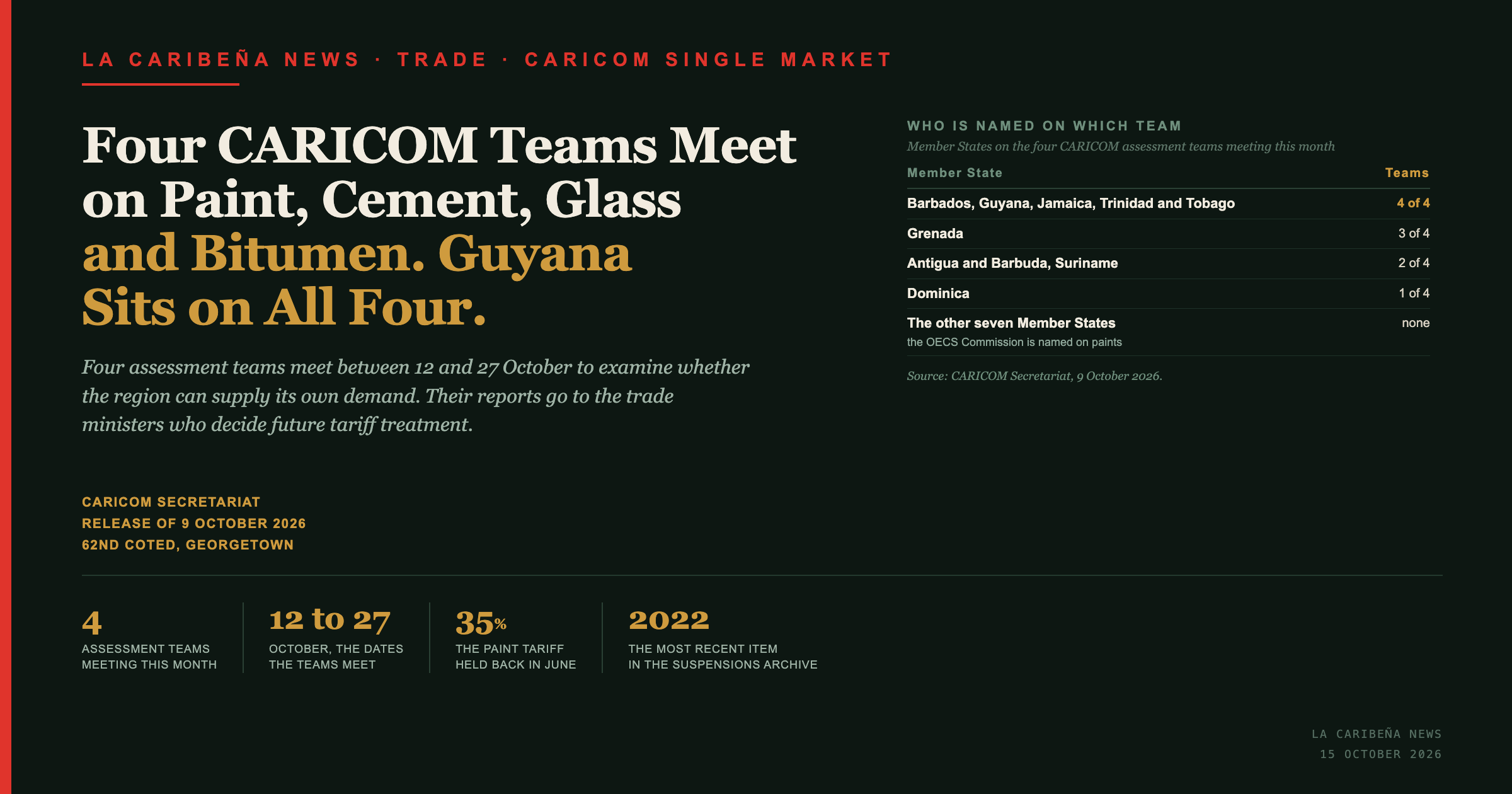
What the title card shows
Every data point on the article's title card, in text.
- 4 assessment teams. Established by COTED at its Sixty-second Regular Meeting and meeting this month.
- 12 to 27 October 2026. The window in which the four teams meet.
- 4 of 4. The teams on which Guyana, Barbados, Jamaica and Trinidad and Tobago are each named.
- 35 per cent. The Common External Tariff on paints and varnishes set by the 60th COTED in June 2025 for 1 July 2026, which was not implemented.
- 12 September 2022. The date of the most recent item in the Secretariat's published archive of CET suspensions and safeguard certificates.
Frequently Asked Questions
What are the four teams assessing?
Whether the region can meet its own demand for paints and varnishes, other hydraulic cement, glass bottles and petroleum bitumen, and how competitive intra-regional trade in them is against extra-regional imports, including the effect of the Common External Tariff, non-tariff barriers, logistics costs and the Community's Rules of Origin criteria.
Who sits on them?
Technical representatives from eight Member States, with membership differing by product. Barbados, Guyana, Jamaica and Trinidad and Tobago are named on all four. Antigua and Barbuda, Dominica, Grenada and Suriname appear on some. The Organisation of Eastern Caribbean States Commission is named on the paints team, and the CARICOM Private Sector Organization has been invited to participate.
What happens to their reports?
They go to the Council for Trade and Economic Development, the CARICOM organ comprising the ministers responsible for trade in the fifteen Member States, which decides future tariff treatment for the products.
Why is paint on the list?
A 35 per cent Common External Tariff on paints and varnishes under eight tariff headings, set in June 2025 to take effect on 1 July 2026, was held back by COTED in June 2026 after an objection from Guyana, pending an assessment of regional demand, supply and production.
Does the British Virgin Islands take part?
No. The British Virgin Islands is an Associate Member of CARICOM rather than a Member State, and it is not named on any of the four teams.