By LCN Business Desk
On Friday 9 October the Haitian Ministry of Agriculture launched a new component of its food security programme at the offices of the National Coordination of Food Security in Port-au-Prince. The European Union is funding it with €4,000,000, alongside a ministry financing agreement of €254,280. It runs for three years.
It is called the Port-au-Prince metropolitan area component. It mainly targets Léogâne, Grand-Goâve and Petit-Goâve, which are not in Port-au-Prince.
That is not a mistake. It is a choice about where a city's hunger is best addressed, and it is worth setting out.
What exactly was launched?
A production programme, not a feeding programme.
PMSAN 2 is the second phase of Haiti's Multi-sectoral Food and Nutritional Security Programme, run by the agriculture ministry, known as MARNDR. The component launched on 9 October covers the West department and, in the ministry's words, "mainly targets the Palmes region (Léogâne, Grand-Goâve and Petit-Goâve)".
What the money buys is listed: rehabilitation of irrigation systems, cultivation of agricultural land, acquisition of equipment, installation of greenhouses, development of poultry production, construction of a food quality control laboratory, temporary jobs for agricultural workers, and strengthened capacity for the Communal Agricultural Offices and farmer organisations.
Coordination and supervision for the metropolitan area sits with the ministry in partnership with Expertise France, the French public international cooperation agency.
Three officials were named at the launch: Hélène Roos, Ambassador of the Delegation of the European Union in Haiti; Charles Jean-Jacques, National Authorizing Officer of the European Development Fund; and David Bruchon, Director of Expertise France in Haiti.
Why put a Port-au-Prince programme in the Palmes?
Because the capital does not grow its own food, and the land that supplies it is reachable while the capital in parts is not.
The Palmes sits west of Port-au-Prince along the coast. Léogâne, Grand-Goâve and Petit-Goâve are agricultural communes whose produce moves into the capital's markets. Investing in irrigation, greenhouses and poultry there is an intervention in the capital's food supply made at the point where food is produced rather than where it is eaten.
The logic was stated plainly at the launch, though about a different place. Jean-Jacques used his speech to ask for support for farmers in Kenscoff, the highland commune above the capital, "severely affected by the violence", so they could resume production. He put the reasoning in one sentence:
"Kenscoff is an agricultural land which feeds the capital every day. When we help the farmers of Kenscoff to resume their activities, it is the capital and the whole country that we are helping."
That is an argument for treating Port-au-Prince's food problem as a rural production problem. It is also, from the man who signs for European Development Fund money in Haiti, a request made at the launch of a programme that does not cover Kenscoff.
Where are the worst outcomes expected?
Inside the city, and in departments this component does not reach.
FEWS NET, the famine early warning system funded by the United States, published its Haiti outlook update in April 2026, projecting April to September. Most of the country is expected to remain in Crisis, the third of the five IPC phases.
Emergency, phase four, is expected in specific places. FEWS NET names certain communes of the Port-au-Prince metropolitan area, "particularly Cité Soleil and Croix-des-Bouquets", with internally displaced people especially affected, and households living in displacement sites within the metropolitan area likewise. Outside the capital it expects pockets of Emergency in Artibonite, Centre and some communes of the Nord-Ouest.
None of those named places is Léogâne, Grand-Goâve or Petit-Goâve.
So the geography divides in a way worth stating without drawing a conclusion the documents do not support. The Emergency outcomes are projected for dense urban communes and for displacement sites. The money launched on 9 October goes to irrigation, greenhouses and poultry in farming communes to their west. Those are different interventions on different timescales, and a programme running for three years is not an emergency response.
What is driving the hunger?
Violence and the movement of people, more than the harvest.
FEWS NET names the causes: armed violence, disruption to markets and transport, displacement, constrained access to agricultural inputs, and rainfall variability. Of the displaced people it counted, 81 per cent were hosted by families and 19 per cent were in displacement sites, with around 52 per cent concentrated in Dessalines commune, which it notes puts pressure on basic services, local markets and rural food systems.
That matters for how a production programme should be read. Greenhouses and irrigation raise what the Palmes can grow. They do not reopen a road, and they do not reduce the number of households sheltering other households.
What is not yet clear?
How far the money reaches.
The ministry states that "with PMSAN 2, the aim is to support 15,000 families, or more than 60,000 direct beneficiaries". That figure is attached to PMSAN 2 as a whole. The €4,000,000 announced on 9 October is one component of it, covering one department. Nothing published reconciles the two, so the cost per household of this component cannot be calculated from what is on the record, and this newspaper has not attempted it.
The same applies to the relationship between this component and the wider programme's budget. What is established is the amount, the duration, the department, the named communes, the implementing partnership and the list of works.
Haiti is a member of CARICOM, whose governments have spent several years pursuing a regional target to cut the Caribbean's food import bill, and whose development fund placed food security among the eligible uses of the US$250 million bond launched this month. LCN has reported how exposed that ambition is to a single season's weather in a supplier country. In Haiti the exposure is not weather.
What the title card shows
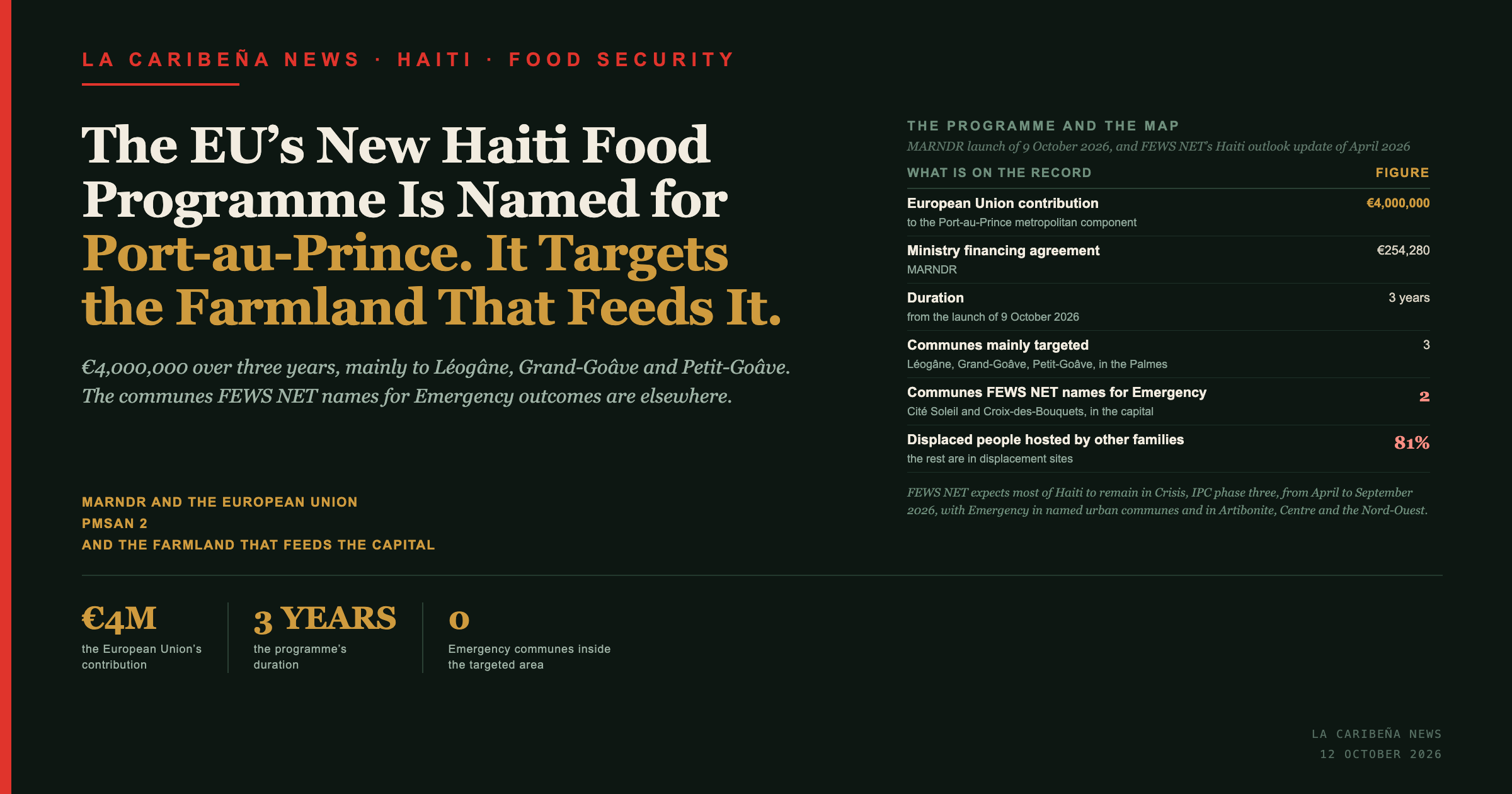
The card sets the headline against a panel drawn from the Haitian agriculture ministry's launch of 9 October 2026 and from FEWS NET's Haiti outlook update of April 2026, each row marked to its source. It gives the European Union contribution of €4,000,000; the ministry's own financing agreement of €254,280; the programme duration of three years; the targeted communes, Léogâne, Grand-Goâve and Petit-Goâve in the Palmes region; the communes FEWS NET names for Emergency outcomes, Cité Soleil and Croix-des-Bouquets; and the share of displaced people hosted by other families, 81 per cent.
Three figures run along the foot of the card: €4M, the European Union's contribution; 3 YEARS, the duration; and 0, the number of communes named for Emergency outcomes that fall inside the area this component targets. The flag block reads MARNDR AND THE EUROPEAN UNION, PMSAN 2, AND THE FARMLAND THAT FEEDS THE CAPITAL.
Frequently Asked Questions
What is PMSAN 2?
The second phase of Haiti's Multi-sectoral Food and Nutritional Security Programme, run by the Ministry of Agriculture (MARNDR). The component launched on 9 October 2026 covers the West department and is funded by the European Union with €4,000,000 plus a ministry financing agreement of €254,280, over three years.
Where does the money go?
Mainly to the Palmes region, comprising Léogâne, Grand-Goâve and Petit-Goâve. It funds irrigation rehabilitation, land cultivation, equipment, greenhouses, poultry production, a food quality control laboratory, temporary agricultural jobs, and capacity building for Communal Agricultural Offices and farmer organisations.
Why is a Port-au-Prince programme spending outside Port-au-Prince?
Because it is a production intervention. The Palmes supplies the capital's markets. The European Development Fund's National Authorizing Officer made the same argument at the launch about Kenscoff, saying that helping its farmers resume work helps "the capital and the whole country".
Where does FEWS NET expect the worst outcomes?
In Emergency, IPC phase four: certain communes of the Port-au-Prince metropolitan area, particularly Cité Soleil and Croix-des-Bouquets, including households in displacement sites, and pockets in Artibonite, Centre and some communes of the Nord-Ouest.
How many households will this component reach?
It is not possible to say from the public record. The 15,000 families and 60,000 direct beneficiaries cited by the ministry are attached to PMSAN 2 as a whole, not to the €4,000,000 component launched on 9 October.