By LCN Business Desk
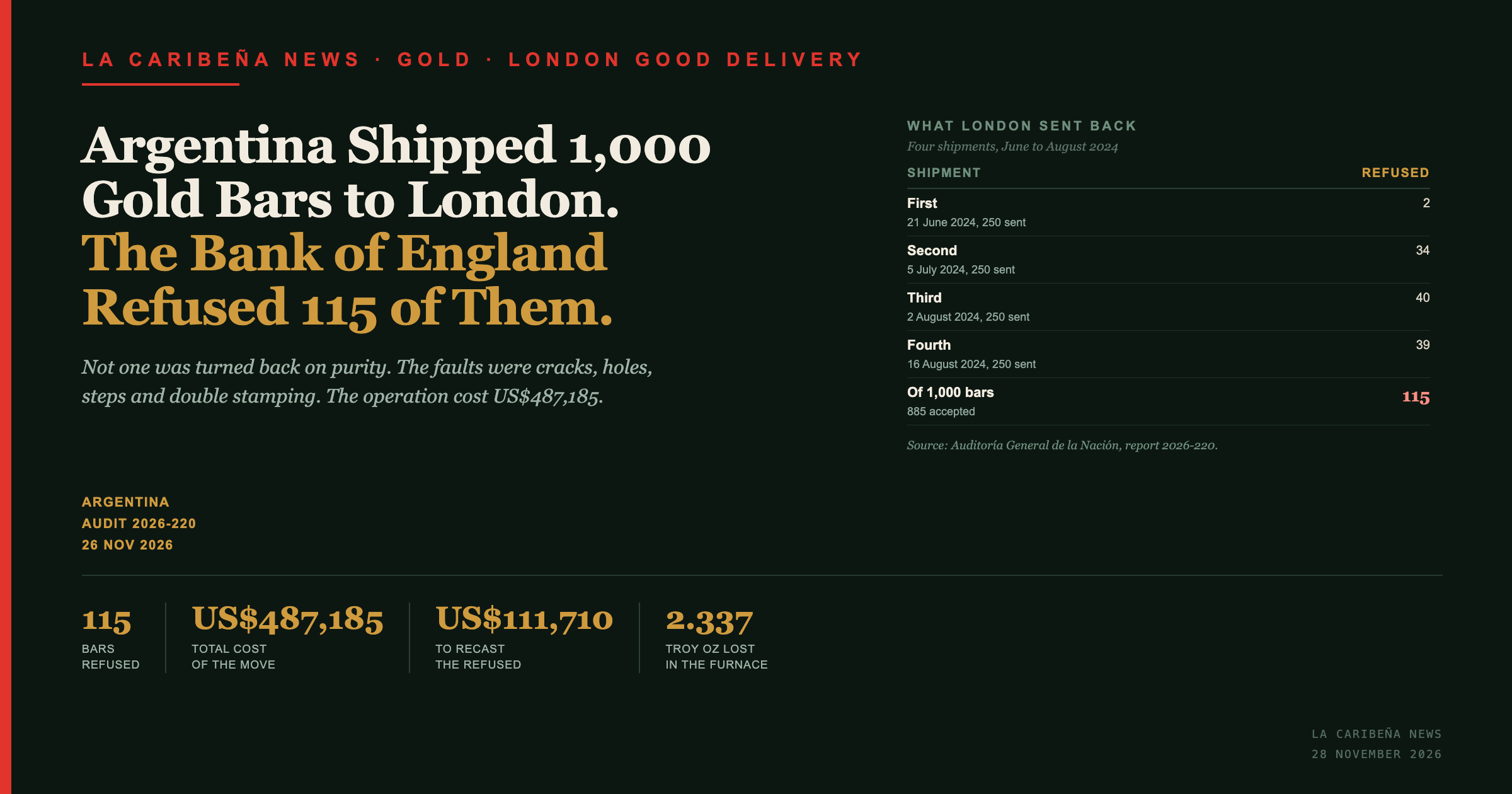
The Central Bank of the Argentine Republic (BCRA) sent 1,000 gold bars to London in 2024. The Bank of England handed 115 of them back.
Not one was refused on purity.
What did the Bank of England reject?
Bars with damaged faces, consignment by consignment.
| Shipment | Delivered to London | Sent | Accepted | Refused |
|---|---|---|---|---|
| First | 21 June 2024 | 250 | 248 | 2 |
| Second | 5 July 2024 | 250 | 216 | 34 |
| Third | 2 August 2024 | 250 | 210 | 40 |
| Fourth | 16 August 2024 | 250 | 211 | 39 |
| Total | 1,000 | 885 | 115 |
Source: Auditoría General de la Nación, report 2026-220, approved 26 November 2026.
Why were the bars refused?
For what was wrong with the metal's surface, not what was in it.
On the first consignment the Bank rejected two bars "for having a defective reverse side". On the second it named "cracks, depressions, holes, steps and double stamping". On the third the faults were "cracks and holes".
The fourth consignment is the only one the audit breaks down by stamp. Of its 250 bars the Bank accepted 211, being 117 of the US Assay Office New York stamp and 94 of the Johnson Matthey Plc stamp, and refused 39, "all of the US Assay Office NY stamp".
Good gold can fail this inspection. What is tested is the object.
What does Good Delivery require?
A list of physical conditions, with purity only one of them.
The London Bullion Market Association sets the standard. The audit records its requirements: weight between 350 and 450 troy ounces, specified dimensions and shapes, no surface defects, obligatory markings covering the refinery stamp, numbering, year of manufacture, purity and weight, and manufacture by a refinery on the LBMA's approved list.
On purity the threshold is stated exactly. The minimum for a bar to qualify as Good Delivery is "995.0 parts per thousand (99.5 per cent pure gold)".
Fine weight is the figure a vault credits, and the audit gives the formula. It is the net quantity of pure gold a bar holds, got by multiplying the gross weight by the purity.
What did it cost?
US$487,185.29, and three quarters of that was transport.
| Item | US$ |
|---|---|
| Transport, packing and insurance, four shipments | 370,628.00 |
| Recasting the refused bars | 111,710.29 |
| Weight lost in the furnace, 2.337 troy ounces | 4,847.00 |
| Total | 487,185.29 |
Each shipment was carried at US$92,657, on four purchase orders to Loomis Argentina between 6 June and 2 August 2024. The Bank's contracts department recorded that only two international providers offer the service in the country, Loomis and Brinks.
The US$111,710 recasting bill divides further: US$34,693.99 in charges from the Bank for International Settlements, US$31,935.46 in financing, US$23,222.08 for melting and re-manufacture, US$21,828.76 to move the metal from the Bank of England to the refinery, and US$30.00 for a Swift message.
Financing and institutional charges together came to more than half of it.
What happened to the refused metal?
It left the vault as bars and came back as a number.
The refused bars were held at the Bank of England until all four consignments had arrived, so they could be melted in one run at a lower cost. MKS Pamp, a Geneva company on the LBMA's list of accepted refiners, withdrew the 115 on 27 August 2024, leaving the equivalent in ounces, 46,260.984 troy ounces, in custody. The BIS credited that figure to the central bank's account. Recasting was confirmed complete on 6 September 2024.
The furnace kept 2.337 ounces.
Why does this matter to a gold producer?
Because acceptance happens at the vault door, on the condition of the object, and the remedy has a price.
Guyana does not receive its royalty on the Aurora Gold Mine in money. Clause 9.4 of the Aurora Mineral Agreement says it "shall be paid in kind by the Company to the GoG unless otherwise agreed", and the agreement values it at the London price, defined as the spot price "as fixed on such day by the London Bullion Houses (second fixing)".
So the state is handed metal, and London is already the reference. This newspaper reported on 9 November that turning those ounces into money, with whatever refining, transport and timing that involves, falls outside the clause entirely.
The Guyana Gold Board says it is on track to pass its 2025 purchases of about 200,000 ounces, and Aris Mining's prefeasibility study on Toroparu sets out 5.6 million ounces over 29 years. Suriname, which banned cyanide for small-scale gold mining in 2023, is the other producer on Guyana's border.
What else did the audit find?
That the holding stopped being bars.
After the transfers the balance in the central bank's account at the BIS stood at 626,432.33 fine troy ounces, which the audit puts at 1,557 ingots. The bank "ceased to hold individualised physical bars under its custody and became the holder of a right over a quantity of gold, expressed in troy ounces, credited to an unallocated gold account".
Two questions the auditors could not close are whether the gold was used as collateral, and whether the reserves involved were placed at risk of losing immunity. The Auditoría General de la Nación (AGN) approved the report by majority, with three of the auditors general dissenting, and parts of it are reserved, including the transport routes and the annexes. On the same day, Congress rewrote the charter of Argentina's central bank, repealing the article that let the bank advance the Treasury.
Where does Venezuela come into it?
At the other end of the same question.
The Bank of England has held roughly 31 tonnes of Venezuelan reserves since 2019. Venezuela put its own liabilities at US$237.5 billion this month. The Partido Socialista Unido de Venezuela said on Friday that a senior British official will visit Caracas about releasing the gold, after a fourth round of United States-brokered talks closed on 23 November.
No British confirmation appears in those reports, no official is named and no date is given. The announcement is the governing party's own.
Argentina's holding in London is now a credit entry. Venezuela's is still bars, and still in the vault.
Title card, text equivalent
All figures on the title card, with their sources.
- 115: bars the Bank of England refused, of 1,000 sent in four shipments. Source: Auditoría General de la Nación, report 2026-220.
- 885: bars accepted. Source: the same.
- US$487,185.29: the total cost of the operation. Source: the same.
- US$111,710.29: the cost of recasting the refused bars. Source: the same.
- 2.337 troy ounces: weight lost in the furnace, put at US$4,847. Source: the same.
- 31 tonnes: Venezuelan gold held at the Bank of England since 2019. Source: EFE, 27 November 2026.
Entities named in this report
- The London Bullion Market Association (LBMA) sets the Good Delivery standard and the approved refiner list.
- The Bank of England inspected and held the bars, acting as custodian for the BIS.
- The Bank for International Settlements (BIS) holds the central bank's gold account and charged for the recasting.
- The Auditoría General de la Nación (AGN) audited the operation in report 2026-220.
- The Central Bank of the Argentine Republic (BCRA) owned and shipped the gold.
- MKS Pamp is the Geneva refiner that recast the bars, on the LBMA's accepted list.
- Loomis Argentina carried the four shipments.
- The Guyana Gold Board buys and exports declared gold in Guyana, a producing country whose state royalty on one mine is paid in metal.
Frequently asked questions
Why did the Bank of England refuse 115 bars?
For surface condition. The audit records cracks, depressions, holes, steps, double stamping and defective reverse sides. None of the refusals is recorded as a failure of purity.
What does London Good Delivery require?
Weight between 350 and 450 troy ounces, specified dimensions and shapes, no surface defects, obligatory markings including refinery stamp, numbering, year, purity and weight, manufacture by an LBMA-approved refinery, and a minimum purity of 995.0 parts per thousand.
What did the operation cost?
US$487,185.29 in all: US$370,628 to move the gold, US$111,710.29 to recast the refused bars, and US$4,847 for the 2.337 troy ounces lost in melting.
What happened to the refused bars?
MKS Pamp withdrew them from the Bank of England on 27 August 2024 and 46,260.984 troy ounces were credited to the central bank's account at the BIS. Recasting was confirmed complete on 6 September 2024.
Does Guyana hold physical gold?
Clause 9.4 of the Aurora Mineral Agreement provides for the royalty to be paid in kind rather than in money, and the Guyana Gold Board buys declared gold. Neither the Board nor the government publishes a rejection rate for that metal at an overseas vault.