By LCN Business Desk
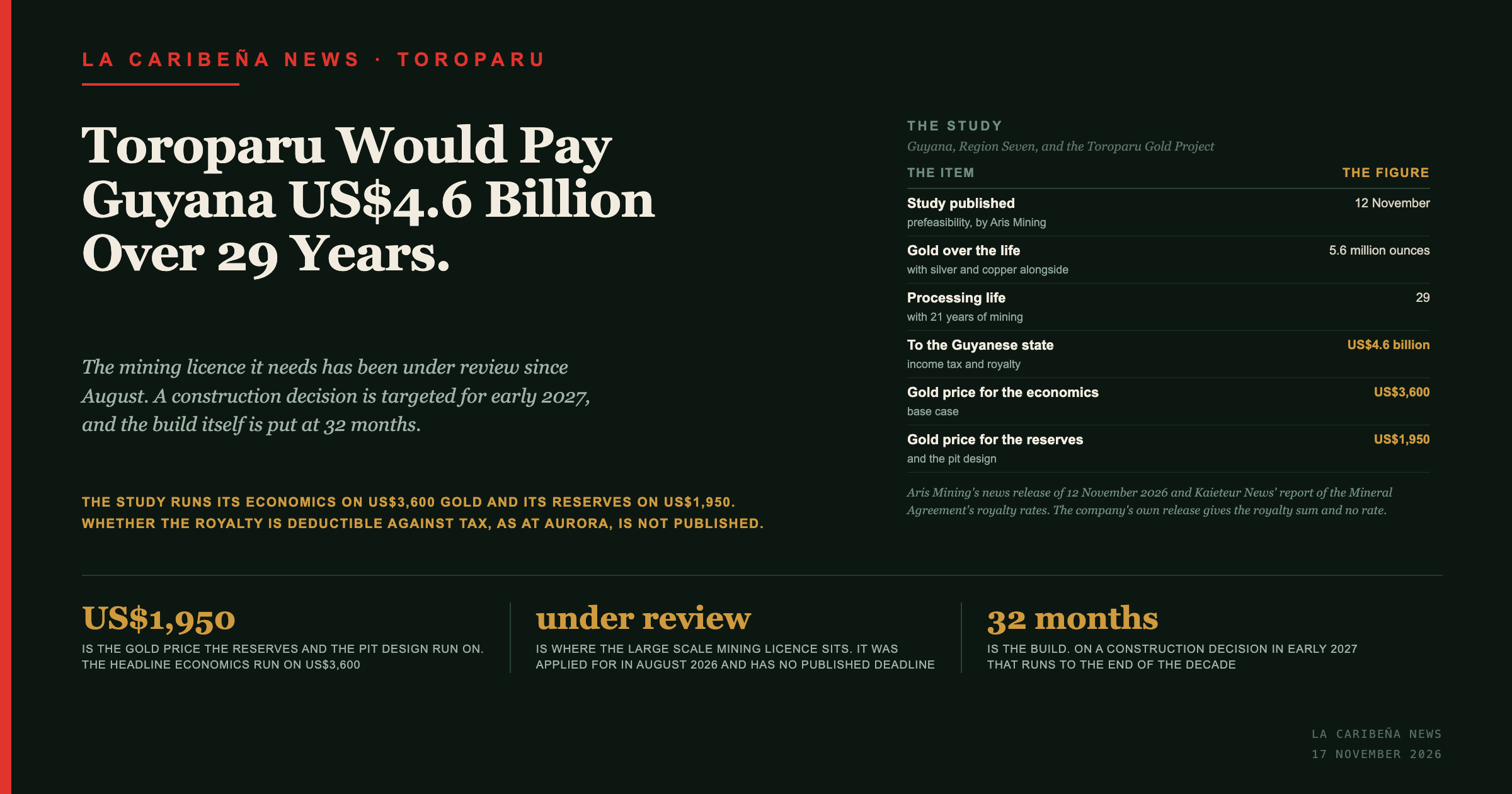
The Toroparu Gold Project in Region Seven now has a number on what it would pay the state. Aris Mining Corporation published a prefeasibility study on Toroparu on 12 November. It puts income tax of US$3,033 million and royalties of US$1,609 million to Guyana, about US$4.6 billion in all, across a processing life of 29 years.
It also needs a licence it does not have. Aris applied for a large scale mining licence in August 2026, and the Government of Guyana is still reviewing it.
What did the study actually find?
A mine with its first reserve estimate, and a 2.2 year payback.
The study sets out 5.6 million ounces of gold over the life of the operation. Mining runs 21 years and processing 29. Average output is 258,000 ounces a year through the first 17 years of main pit work, and 195,000 ounces across the full processing life. The strip ratio is 3.3 to 1.
Proven and probable reserves are stated at 200.2 million tonnes grading 0.92 grams of gold a tonne, for 5,922,000 contained ounces. Measured and indicated resources are 360.9 million tonnes at 0.80 grams, for 9,254,000 ounces. Inferred resources add 115.4 million tonnes at 0.68 grams.
On the base case the after tax net present value is US$2,828 million at a 5 per cent discount rate, with an internal rate of return of 31.5 per cent and payback 2.2 years after operations start. Cash cost is US$1,119 an ounce and all in sustaining cost US$1,494.
Which gold price is the study built on?
Two of them, for two different purposes, and the gap between them is large.
The economics run at US$3,600 an ounce. The reserve estimate and the pit design run at US$1,950. So the headline return is calculated on one price and the shape of the hole in the ground is designed on another, a little over half of it.
That is standard practice and the release states both. It matters to a reader because the two numbers answer different questions. The US$1,950 figure is what the rock has to be worth for it to be worth digging. The US$3,600 figure is what the return depends on.
The study also publishes what happens if the price moves. At US$3,000 an ounce the after tax value falls to US$1.8 billion and the return to 24.3 per cent. At US$4,200 it rises to US$3.8 billion and 37.8 per cent.
What does Guyana get, and on what terms?
Tax and royalty, on a royalty threshold that stopped mattering years ago.
Aris is party to a Mineral Agreement with the Government of Guyana. Kaieteur News, reporting the study, sets that agreement's gold royalty at 5 per cent on sales at prices up to US$1,000 an ounce and 8 per cent above it, with 1.5 per cent on copper and other valuable minerals. The company's own release gives the royalty sum and no rate.
The sum is consistent with the upper band. Royalties of US$1,609 million against payable gold revenue of US$19,859 million is a little over 8 per cent. At any price the study contemplates, the 5 per cent tier never applies.
Whether the two sums simply add together is a different question. Another Guyanese gold Mineral Agreement, at the same 8 per cent, does not work that way: clause 9.4 of the Aurora agreement has the royalty paid in gold rather than money, and lets the company deduct its value as an expense. A royalty that is deductible reduces the tax beside it. Nothing published about Toroparu says whether its agreement carries the same clause.
How does the royalty compare with what oil pays?
Four times the rate, on the state's own published terms.
Stabroek oil carries a 2 per cent royalty under the 2016 production sharing agreement, and the state settles the contractors' corporation tax. The scale is different too: Guyana's oil fund has taken in US$10.5 billion since 2020, against the US$4.6 billion Toroparu would pay across 29 years. This newspaper set the two regimes side by side in August, when Omai Gold Mines published its own assessment. A gold miner pays 8 per cent and pays its own tax.
That piece left one thing open. No Mineral Agreement for a redeveloped Omai had been published, so 8 per cent was what the regime provided rather than what any project had agreed. Toroparu is the case where an agreement exists and both tiers are stated.
The rate is not uniform across what Guyana digs up. The country charges a single royalty on every grade of bauxite it exports, while India charges many times more for the refractory grades.
What has to happen before anything is built?
A licence, about a billion dollars and 32 months.
The licence application went in during August 2026 and sits with the Government. A construction decision is targeted for early 2027, subject to that licence and other approvals. The build itself is put at 32 months.
The body that handles it has published its own account of how it awards them. The Guyana Geology and Mines Commission found no material deviations in mineral licence awards and transfers for 2023 and 2024, on six documented processes covering medium and large-scale properties. Large scale is the scale Aris has applied at.
The funding requirement is US$1,005 million. That is US$1,017 million of construction capital, US$102 million of contingency and US$24 million of working capital, less US$138 million available from Wheaton. Sustaining capital over the life of the operation is a further US$459 million. The Northern Miner reported the construction cost as about 36 per cent above the 2025 preliminary economic assessment.
Neil Woodyer, chair and chief executive of Aris Mining, said "Toroparu is positioned to become our next major growth project".
Who else holds rights on the ground?
One named individual, on terms agreed six years ago.
Aris owns the project outright through its Guyanese subsidiary, ETK Inc. In 2020 it exercised an option to acquire Alfro Alphonso's rights in the lands and permits for US$20 million. Alphonso kept rights to alluvial mining outside defined buffer areas, and the use of certain roads and an airstrip.
What should a supplier or a Region Seven business plan against?
Two dates, and neither of them is the study.
The first is the licence decision, which has no published deadline. The second is the construction decision targeted for early 2027. Little is procured before the first and not much before the second. A 32 month build starting in 2027 puts first gold near the end of the decade.
Mining is not oil for local content purposes. The Local Content Act's forty reserved categories are written for the petroleum sector, and the words small and women-owned appear nowhere in them. For a contractor in Cuyuni-Mazaruni the question is whether capacity, registration and working capital exist by early 2027. Aris says it is expanding its Guyana team.
The entities
- Aris Mining Corporation: the Canadian company that owns the Toroparu Gold Project and published the prefeasibility study on 12 November 2026. - ETK Inc.: the Guyanese subsidiary through which Aris Mining holds the project. - Toroparu Gold Project: a gold, silver and copper project in Region Seven, Cuyuni-Mazaruni. - Mineral Agreement: the agreement between Aris Mining and the Government of Guyana, which Kaieteur News reports sets a two tier gold royalty and 1.5 per cent on copper. - Neil Woodyer: chair and chief executive of Aris Mining. - Wheaton: the counterparty under the Toroparu precious metals purchase agreement, providing US$138 million against the funding requirement. - Alfro Alphonso: the holder whose rights in the lands and permits Aris acquired for US$20 million in 2020, retaining alluvial and access rights. - Omai Gold Mines: the company whose Guyana assessment this newspaper compared with the oil regime in August 2026.
What the title card says
- Prefeasibility study published: 12 November 2026. - Gold over the life of the operation: 5.6 million ounces. Mining 21 years, processing 29. - To the Guyanese state: US$3,033 million income tax and US$1,609 million royalty. - After tax net present value: US$2,828 million at 5 per cent. Return 31.5 per cent. Payback 2.2 years. - Gold price for the economics: US$3,600 an ounce. For the reserves and pit design: US$1,950. - All in sustaining cost: US$1,494 an ounce. - Funding required: US$1,005 million. Build: 32 months. - Large scale mining licence: applied for August 2026, under review.
Frequently asked questions
How much gold would Toroparu produce?
5.6 million ounces over the life of the operation, averaging 258,000 ounces a year through the first 17 years and 195,000 across the full 29 year processing life.
How much would Guyana receive?
About US$4.6 billion on the study's base case, being US$3,033 million of income tax and US$1,609 million of royalty.
What royalty rate applies?
Kaieteur News reports the Mineral Agreement at 5 per cent on gold sold up to US$1,000 an ounce and 8 per cent above, with 1.5 per cent on copper. The company's release gives the royalty sum and no rate. The sum works out a little above 8 per cent of payable gold revenue.
What gold price does the study assume?
US$3,600 an ounce for the economics and US$1,950 for the reserve estimate and pit design.
Is the mine approved?
No. Aris Mining applied for a large scale mining licence in August 2026 and the Government of Guyana is reviewing it. A construction decision is targeted for early 2027.
When would it start producing?
The build is put at 32 months. On a construction decision in early 2027 that runs to the end of the decade.
What is not established?
When the licence decision is due, which has no published date. Whether the US$1,005 million of funding has been raised or committed. And the royalty rates, which the company's own release does not state.