By LCN Business Desk
Argentina's Congress rewrote the charter of its central bank on 26 November 2026. The article that allowed the bank to lend the Treasury money is gone.
That article set the ceiling as a share of the money in circulation. Three tranches sat inside it.
What did Congress actually repeal?
Congress repealed article 20 of the central bank's charter, which carried three separate lending powers.
| What Article 20 allowed | Ceiling |
|---|---|
| Temporary advances to the national government | 12 per cent of the monetary base |
| Further advances against government cash receipts | 10 per cent of the last twelve months' receipts |
| Exceptional advances, for up to eighteen months | a further 10 per cent of those receipts |
Source: Carta Orgánica of the Banco Central de la República Argentina, article 20, in the text in force before the reform.
The article defines the monetary base itself. It is notes in circulation, plus the sight deposits banks hold at the central bank. So the ceiling moved with the money supply rather than sitting at a fixed sum.
Advances had to be repaid within twelve months, and the power could not be used again while any advance stood unpaid.
The article being repealed is not an old one. It was substituted by Law 26.739, published on 28 March 2012.
What is the bank's mission now?
The bank's mission is now preserving the value of the currency. It may not finance the public sector.
The reform "establece como misión primaria y fundamental de la entidad preservar el valor de la moneda e impide el financiamiento monetario al sector público", the Office of the President said in a statement on 26 November.
The same statement says the reform removes temporary advances to the Treasury and direct purchases of public debt.
What else changes at the board?
Two things change at the board. The Minister of Economy stops attending, and removing the bank's leadership gets harder.
The reform "excluye al Ministro de Economía de las reuniones de su Directorio", the Office of the President said. It also "limita la remoción de sus autoridades".
The minister was never a member of that board. Under the charter in force before the reform, the minister or a representative could take part in board sessions "con voz, pero sin voto", with a voice but no vote. The board itself is a president, a vice-president and eight directors, and article 8 bars national government employees from being directors.
So what goes is the government's voice in the room, not a vote it held.
The Chamber of Deputies' committee report says removal by the Executive needs the Senate's approval, by absolute majority.
What happens to the reserves?
The free-availability regime goes, and only realised profits may be transferred.
The reform repeals the régimen de reservas de libre disponibilidad, the free-availability reserves regime. Only "utilidades efectivamente realizadas y líquidas" may go to the Treasury, on the Office of the President's account. It also sets up a mechanism to reduce the obligations standing between the Treasury and the bank.
Profits that exist only as a revaluation cannot be moved. The gate is narrower than the one it replaces.
Its swap line with China reads US$19 billion, and under US$700 million was still owed.
How did the vote go?
The Chamber of Deputies carried it with 141 votes in favour and 99 abstentions, on the reported count. The Senate had approved it in September.
The figures are as reported, not as published by the Chamber.
The Office of the President set the vote against a longer history. It named the 2010 Fondo del Bicentenario, a bicentenary fund, and US$10 billion of reserves it says were never returned. It also named the 2012 charter that widened the financing powers. President Javier Milei said the reform ends 91 years.
What does this mean for a business trading with Argentina?
That the limit on printing money to cover the deficit now sits in a statute rather than in policy.
The practical difference is where the Treasury goes for money. It borrows, at a price set by whoever lends, rather than drawing on an account at the central bank measured against the monetary base.
Other figures have been moving too. Argentina's third-quarter output figure arrives on 16 December, and its import bill has already fallen 2.9 per cent. Household loan delinquency stopped rising in June, and part of that improvement was written off the books.
The 2012 text being repealed was itself a rewrite of what came before it, and a later Congress can rewrite this one.
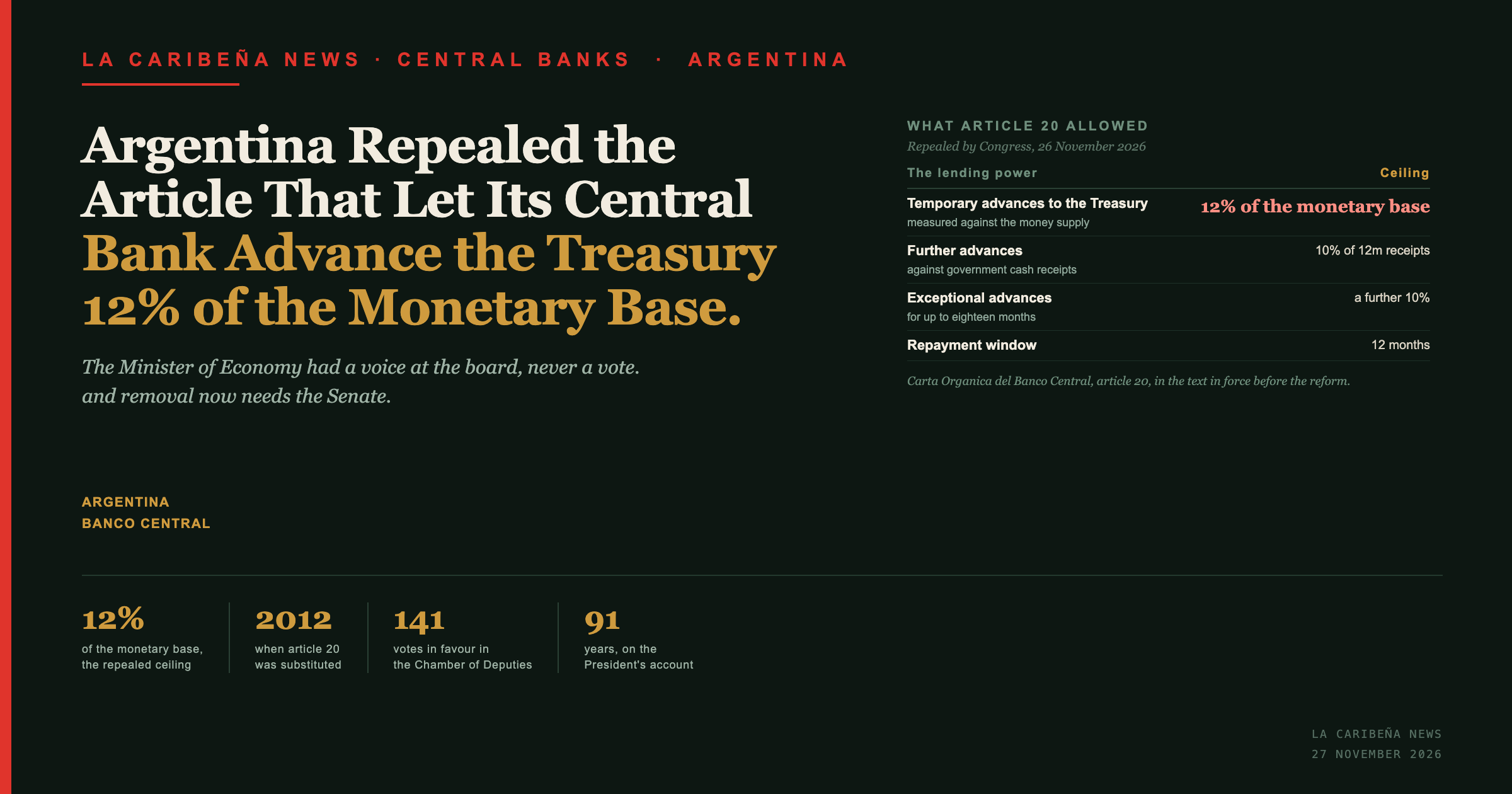
Title card, text equivalent
All figures on the title card, with their sources.
- 12 per cent of the monetary base: the ceiling on temporary advances to the national government under the repealed article 20. Source: Carta Orgánica of the Banco Central de la República Argentina, article 20.
- 10 per cent: the further advances permitted against the last twelve months' government cash receipts, under the same article. Source: the same.
- A further 10 per cent, for up to eighteen months: the exceptional tranche under the same article. Source: the same.
- 26 November 2026: the date Congress gave final approval. Source: Office of the President, Comunicado Oficial 173.
- 141 and 99: votes in favour and abstentions in the Chamber of Deputies, as reported. Source: press reports, not the official division record.
- 28 March 2012: the publication date of Law 26.739, which substituted the article now repealed. Source: Carta Orgánica, note to article 20.
- US$10 billion: the reserves the Office of the President says were used in 2010 and never returned. Source: Comunicado Oficial 173.
Entities named in this report
- The Banco Central de la República Argentina (BCRA) is Argentina's central bank, whose charter has been rewritten.
- Carta Orgánica is that charter, and article 20 is the repealed provision that permitted advances to the Treasury.
- Law 26.739 substituted article 20 and was published on 28 March 2012.
- The Office of the President issued Comunicado Oficial 173 on the sanctioned reform.
- President Javier Milei said the reform ends 91 years.
- The Chamber of Deputies carried the reform on 26 November 2026; the Senate had approved it in September.
Frequently asked questions
What did Argentina's Congress approve on 26 November 2026?
A rewrite of the central bank's charter. It repeals article 20, which permitted advances to the Treasury, and makes preserving the value of the currency the bank's primary mission.
How much could the central bank lend the Treasury before?
Up to 12 per cent of the monetary base in temporary advances. It could add up to 10 per cent of the government's cash receipts over the previous twelve months. On an exceptional basis it could add a further 10 per cent of those receipts, for up to eighteen months.
Does the Minister of Economy still sit on the board?
No. The Office of the President says the reform excludes the Minister of Economy from meetings of the board.
How is the central bank's leadership removed now?
On the Chamber of Deputies' committee report, removal by the Executive requires the Senate's approval by absolute majority.
What changes for the bank's reserves?
The free-availability reserves regime is repealed. Only profits actually realised and liquid may go to the Treasury. A gain that exists on paper cannot be moved.