By LCN Business Desk
Prohibiting the use of a substance and prohibiting its arrival are different instruments. Suriname issued them three and a half years apart, and the population caught by the first was the one buying the product stopped by the second.
President Jennifer Simons instructed the Minister of Economic Affairs, Entrepreneurship and Technological Innovation, Andrew Baasaron, to stop the import of Jin Chan *"met onmiddellijke ingang"*, with immediate effect. The measure applies *"tot nader order"*, until further notice.
What is Jin Chan?
A Chinese-branded gold processing agent, sold as an alternative to the thing the small-scale sector was told to stop using.
The product is also known as a Gold Dressing Agent. It extracts gold from ore, and its manufacturer offers it as an alternative to sodium cyanide. A chemical and environmental expert quoted by Dagblad Suriname in August said it cannot simply be treated as safe, because it contains cyanide components and because other chemicals are used alongside it in extraction.
Dutch public broadcaster NOS described the product in 2023 as iron cyanide, not toxic in itself, becoming active and toxic only after a chemical process involving sunlight. The two accounts sit side by side on the record without being reconciled.
What exactly was banned in 2023?
Cyanide use by small-scale miners. Not by everyone.
On 17 May 2023 the Regeringsraad decided, in its own words, *"cyanide gebruik voor kleinschalige goudmijnbouw stop te zetten"*, to stop cyanide use for small-scale gold mining. The same government statement records that permits had been issued to two companies only: *"Tot nog toe zijn er uitsluitend vergunningen aan Newmont Suriname en Rosebel Gold Mines NV verstrekt."*
The then Minister of Natural Resources, David Abiamofo, said that because the regulations were not yet in order, Newmont Suriname was using cyanide approved by the national environment institute.
So the prohibition fell on the informal and small-scale sector, and the two multinationals operated on permits. The environmental organisation ProBios had reported in 2018 that cyanide use was concentrated in that same informal sector.
What were the readings behind that decision?
Two of three samples, at about 1,600 times the drinking water norm.
The national environment institute and the commission on ordering the gold sector sampled near Toebuka Mauw on the Brokopondo reservoir on 28 April 2023, with analysis by Filab Suriname. Cyanide was found in two of the three samples, at 334.02 and 421.42 milligrams per litre. The government put those readings at about 1,600 times international drinking water norms.
Residents of Brokopondo called the announced prohibition a smokescreen and set the government an ultimatum.
What happened at Godo Olo?
A boat took on water, and the owner washed it out into the river.
A liba krutu was held at Dritabiki on Sunday 1 November with the Aucaan community, where the incident was the central subject, and a presidential delegation led by the general adviser Edgar Dikan attended. On the account given there, a boat carrying Jin Chan took on water, and the owner then cleaned the boat and discharged the water into the river.
Authorities found some dead fish and no mass die-off. The Nationale Milieu Autoriteit said relatively little cyanide had entered the water and that the water is currently safe to drink.
| Date | What happened |
|---|---|
| 2018 | ProBios reports cyanide use concentrated in the informal gold sector |
| 28 April 2023 | Sampling near Toebuka Mauw finds cyanide in two of three samples |
| 17 May 2023 | The Regeringsraad stops cyanide use for small-scale gold mining. Permits are held by two multinationals |
| August 2026 | The Nationale Milieu Autoriteit reports cyanide and heavy metals in water and fish from the Saramacca river area |
| 31 August 2026 | 150 bags of Jin Chan are stopped on two trucks at the Burnside checkpoint in Coronie. No documents are produced and the cargo is placed under police guard |
| 1 November 2026 | A boat carrying Jin Chan takes on water at Godo Olo and is washed out into the river |
| 2 November 2026 | The President orders the import stopped, with immediate effect, until further notice |
*Sequence from the Government of Suriname's own statement of May 2023, and from reporting by NOS, Dagblad Suriname and Starnieuws.*
The region has seen the larger version of this. In August 1995 the tailings dam at the Omai gold mine in neighbouring Guyana failed, releasing more than 400 million gallons of cyanide-bearing tailings into the Omai River and from there into the Essequibo, a source of drinking water and fish. The Guyana Geology and Mines Commission has described it as the worst industrial disaster to hit that country.
Had the supply chain been visible before this?
In quantity, ten weeks earlier, on a public road.
The August interception at Coronie involved 150 bags moving on two trucks, and the drivers and an escort could not produce the required documents. By count of bags that is ten times what went into the Brokopondo reservoir in 2023, though no source gives a weight for either load.
The consignment was first reported as cyanide and corrected by the police to Jin Chan. That distinction is the one the matter turns on, because a product sold as an alternative to sodium cyanide is not obviously caught by a measure written about cyanide.
In 2023 the government said a police and military team was responsible for detection, that criminal prosecution was possible, and that seized cyanide would be destroyed by a team of experts.
What does this week's order not do?
Three things, and each decides whether it changes anything.
It does not say how the halt will be enforced. It does not say what happens to stock already in the country. And it does not, on the reporting, reach the use of the substance in mining, which is governed by the 2023 measure rather than by this one.
Dikan said the government is doing everything it can to stop the use of such toxic substances in the area. No instrument giving effect to that has been published.
What should a trader or an operator take from this?
That the instrument reaches the border and not the pit.
An import halt stops the next shipment. It does not reach a bag already in a warehouse, on a truck, or at a landing on a river. Anyone holding stock is holding something whose position under the 2023 measure was never settled in public, and whose import position changed on Monday.
What is not established?
The composition, the legal basis, and what became of the bags.
No published composition or safety data sheet for Jin Chan has been located, and the two public characterisations of its toxicity are not reconciled. The instrument behind the President's order has not been published, so whether it is a ministerial decision, a licensing measure or a standing instruction is not on the record. Whether the 2023 measure remains in force, and whether it was ever read as covering this product, is not stated. Nor is the outcome of the August interception, or what became of the 150 bags. The date of the boat capsizing that preceded the April 2023 sampling is not established here.
The entities
- Jin Chan is a Chinese-branded gold processing agent, also known as a Gold Dressing Agent, offered by its manufacturer as an alternative to sodium cyanide.
- Jennifer Simons is the President of Suriname, who ordered the import stopped on 2 November 2026.
- Andrew Baasaron is the Minister of Economic Affairs, Entrepreneurship and Technological Innovation, instructed to carry the order out.
- Regeringsraad is the Surinamese council of government that decided on 17 May 2023 to stop cyanide use for small-scale gold mining.
- Newmont Suriname is one of the two companies recorded as holding a permit at that date.
- Rosebel Gold Mines NV is the other.
- David Abiamofo is the then Minister of Natural Resources, who said Newmont Suriname was using cyanide approved by the national environment institute.
- Nationale Milieu Autoriteit is Suriname's national environment authority, which assessed the water at Godo Olo and reported the Saramacca river findings.
- Brokopondo reservoir is the lake where cyanide was found in two of three samples in April 2023.
- Godo Olo is the place in the Sipaliwini district where a boat carrying Jin Chan took on water on 1 November 2026.
- Edgar Dikan is the general adviser who led the presidential delegation to the liba krutu at Dritabiki.
- ProBios is the environmental organisation that reported informal-sector cyanide use in 2018.
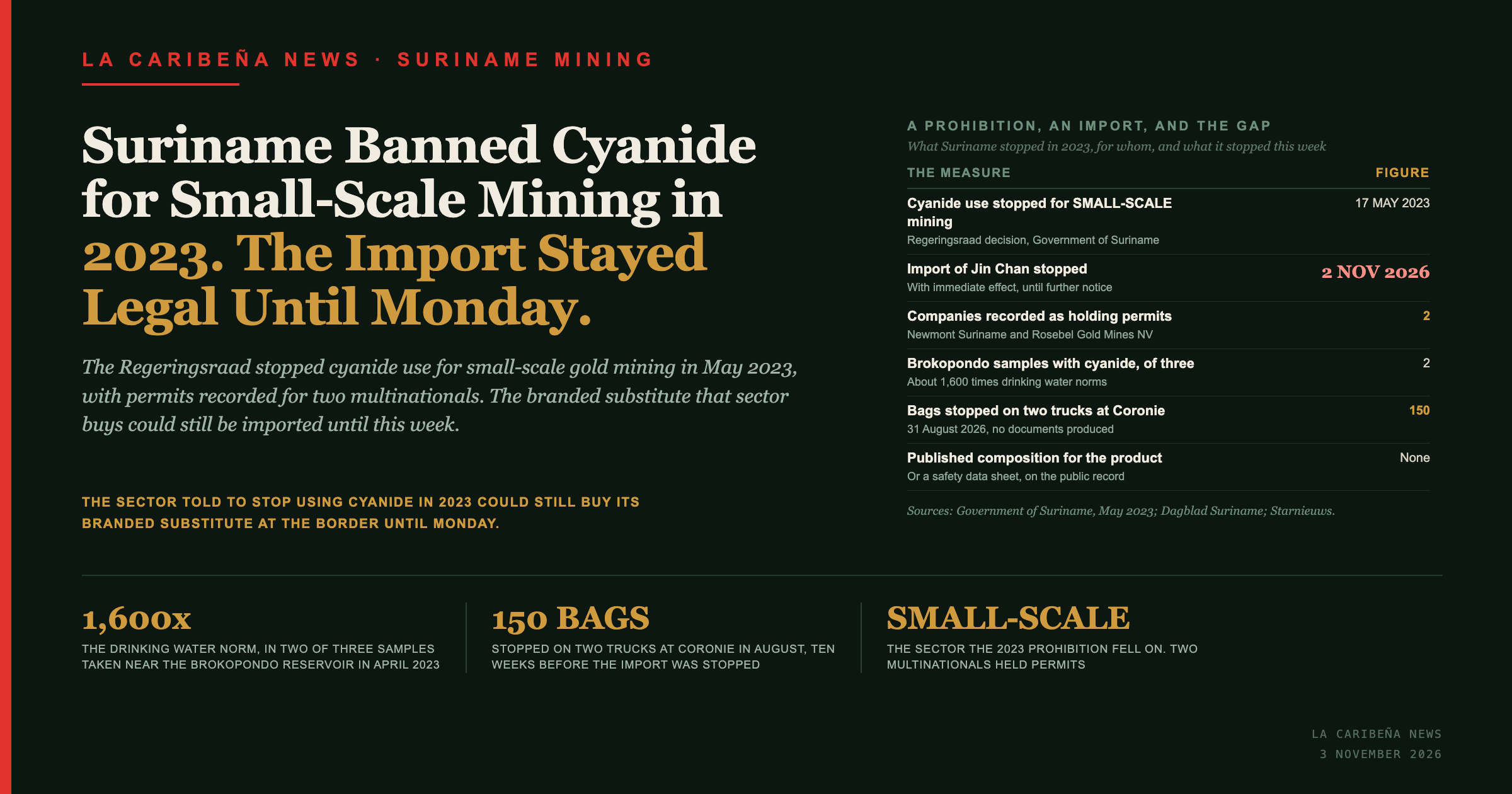
What the title card says
- Headline: Suriname banned cyanide for small-scale gold mining in 2023, and the import stayed legal until Monday.
- Date cyanide use was stopped for small-scale gold mining: 17 May 2023.
- Date the import of Jin Chan was stopped: 2 November 2026.
- Companies recorded as holding permits at the 2023 date: two.
- Samples near the Brokopondo reservoir in April 2023 containing cyanide, of three taken: two.
- Those readings against international drinking water norms: about 1,600 times.
- Bags of Jin Chan stopped on two trucks at Coronie on 31 August 2026: 150.
- Published composition or safety data sheet for the product: none located.
Frequently Asked Questions
What has Suriname banned?
The import of Jin Chan, with immediate effect and until further notice, ordered by President Jennifer Simons on 2 November 2026. Separately, the Regeringsraad stopped cyanide use for small-scale gold mining on 17 May 2023.
Did the 2023 measure apply to everyone?
No. It addressed small-scale gold mining. The government's statement of the time records that permits had been issued to Newmont Suriname and Rosebel Gold Mines NV only, and the then Minister of Natural Resources said Newmont Suriname was using cyanide approved by the national environment institute.
What is Jin Chan used for?
Extracting gold from ore. It is a Chinese-branded Gold Dressing Agent offered by its manufacturer as an alternative to sodium cyanide. A chemical and environmental expert quoted in August 2026 said it contains cyanide components and cannot simply be treated as safe.
Does this week's order stop the substance being used?
Not on the reporting. The order addresses import. Use in mining is governed by the May 2023 measure, and whether that measure was ever read as covering this product is not stated.
What happens to stock already in the country?
That is not established. Reporting states explicitly that it is unclear how the halt will be enforced and what happens to stocks already present.