By LCN Business Desk
A company seeking a mineral property on titled land in Guyana negotiates with the village, not with the regulator. The regulator is forbidden to be at that table, and it decides whether the licence issues.
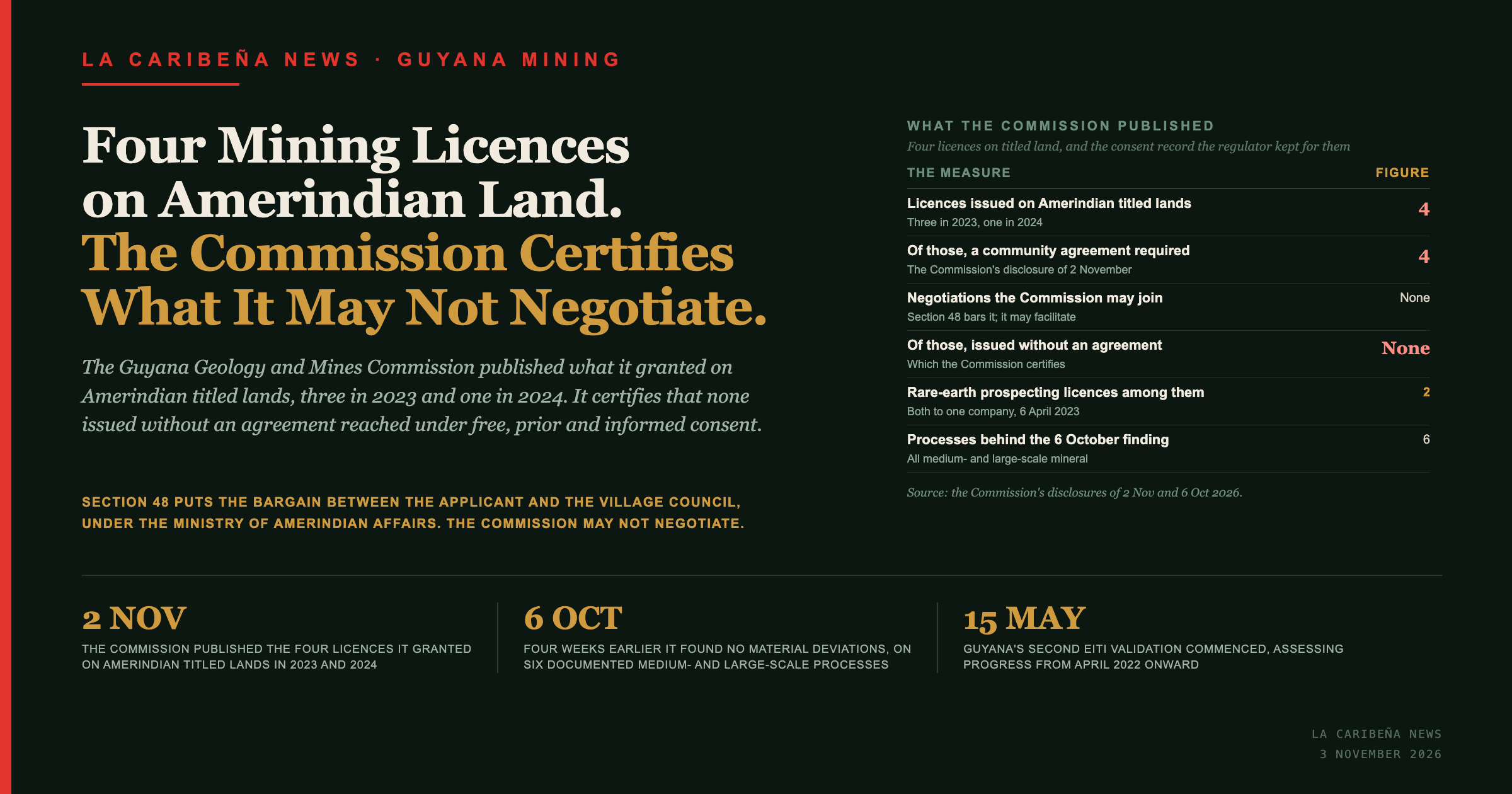
The Guyana Geology and Mines Commission set both halves out on 2 November 2026 in Community Consultation and FPIC, listing what it granted on Amerindian titled lands across the 2023 and 2024 reporting periods. There are four, three issued in 2023 and one in 2024, and the Commission *"certifies"* that none of them issued without the submission of an agreement reached under free, prior and informed consent.
Its own words on where it stands: *"GGMC may facilitate the consultations, but may not take part in negotiations between the mining applicant and the village."*
Which licences were granted?
Two quarry and aggregate permits, and two prospecting licences over rare earths.
| Company | Type | Mineral | Granted | Titled land | Agreement |
|---|---|---|---|---|---|
| Demerara Quarry Inc. | QL | Quarriable materials | 26 Apr 2024 | Batavia | Yes |
| EKAA HRIM Earth Resources Management Inc. | ML | Aggregates, dimension stones | 20 Apr 2023 | Batavia | Yes |
| Laurentian Mountain Resources (Guyana) Inc. | PL | REE, rare earth elements, radioactive minerals | 6 Apr 2023 | Kangaruma | Yes |
| Laurentian Mountain Resources (Guyana) Inc. | PL | REE, rare earth elements, radioactive minerals | 6 Apr 2023 | Tassarene | Yes |
*The Commission's disclosure of 2 November 2026. All four are recorded as Granted, and the agreement column reads Yes in every row.*
One company holds both rare-earth prospecting licences, on two separate titled lands, applied for on the same day in May 2021 and granted on the same day in April 2023.
Who negotiates the agreement, and who convenes it?
The applicant and the Village Council, under a different arm of government.
The Commission states that section 48 of the Amerindian Act 2006 places the responsibility for consultation and negotiation on the mining applicant and the relevant Village Council. Those consultations take place, in its words, *"under the auspices of the Ministry of Amerindian Affairs"*, and it is within that process that *"the scope for FPIC to occur arises"*.
The Commission says it is not a party to those negotiations and neither conducts nor supervises them. It may facilitate the consultation. It may not negotiate. What it offers instead is information, seeking to make the statutory mining process and the applicable legal requirements generally available to applicants, Village Councils and other stakeholders.
What has to be in place before a licence issues?
The agreement, concluded and submitted, and then a further public window.
Where an agreement is required, the Commission says it must be concluded and submitted before the mineral tenure is issued, and that a tenure will not issue without it. The certification it published on 2 November speaks to that requirement.
A second gate follows. The intention to grant is published in the Official Gazette, opening a further 21 days in which members of the public and other interested persons may review the proposed grant and communicate concerns or objections, and in which further consultation may occur before the process concludes.
What had the Commission already said about these two years?
That it found nothing materially wrong in how licences were awarded and transferred.
On 6 October 2026 it published a statement on material deviations from the legal and regulatory framework for the award and transfer of extractive licences, reporting no material deviations for mineral licences at small, medium and large scales over the same 2023 and 2024 periods, and none for petroleum.
That finding rests on six documented application and transfer processes, all of them medium- and large-scale mineral properties. The petroleum conclusion is given in one sentence, with no sample size attached.
Do the two disclosures count the same population?
No. Their denominators are different and neither reconciles to the other.
The October statement shows six processes, medium and large scale. The November table shows four grants on titled lands, and numbers them 15, 16, 19 and 21. The numbering skips, so the four are drawn from a longer numbered list reaching at least 21 entries. The Commission does not state what that list totals, and neither page names the Act or regulation the processes were measured against.
Which standard are these answering?
Two limbs of one Extractive Industries Transparency Initiative requirement.
Requirement 2.2 of the 2023 EITI Standard, dated 12 June 2023, asks an implementing country to disclose the award or transfer process, the technical and financial criteria including free, prior and informed consent, the licence recipients, and *"Any material deviations from the applicable legal and regulatory framework governing license transfers and awards"* together with *"an explanation of the methodology adopted for the assessment"*.
The October statement answers the deviations limb. Consent is the limb the November table answers. The requirement applies *"including for companies whose payments fall below the agreed materiality threshold"*, and its objective reaches whether the statutory procedures are followed in practice. Neither page mentions the initiative by name.
Why does the timing matter?
Guyana's second validation against that standard is already running.
The initiative's board set it to commence on 15 May 2026, after deferrals from 1 October 2025 and then 1 January 2026, with the international secretariat assessing progress from April 2022 onward. Guyana's 2022 validation scored fairly low overall and the board warned then that failure to show progress could lead to temporary suspension. The country was suspended in February 2023 over a late report and reinstated in June 2024. In June 2026 it took a seat on the initiative's international board for 2026 to 2029.
No outcome of the current validation has been published.
How does this sit beside Guyana's other disclosures on titled land?
Consent on Amerindian land already carries a price in the carbon market, and the minerals beneath it are still being surveyed.
Village Sustainability Plans under the carbon-credit programme are produced under free, prior and informed consent, and Amerindian titled lands and extensions are 12.7 per cent of Guyana's forested area, with the villages' revenue share deliberately set above that at 15 per cent. On the minerals, Guyana has a national airborne survey under way to find out which critical minerals it has, and the country was still mapping while the Dominican Republic dated its first rare-earth export. The two prospecting licences above were granted to look for those minerals on titled land, three years before that survey reported.
The initiative's governance in Guyana has had its own difficulties: in October the Minister of Natural Resources defended a civil-society convener's appointment on the ground that his mining holdings were dormant.
What do these pages not establish?
The methodology, the instruments, and the size of the population the figures are drawn from.
Requirement 2.2 asks for an explanation of the method used to assess deviations. The October statement names the categories of record consulted without saying how the six processes were selected, or whether they are a sample or the whole of medium- and large-scale activity in those years. The November table gives no total for the list its four rows sit inside. Neither page names a signatory, and neither records what any of the four agreements contains, those being private between the parties.
For a firm preparing an application over titled land, the operational content is exact: the bargain is yours to strike with the Village Council under the Ministry of Amerindian Affairs, the regulator may help convene but may not negotiate, no tenure issues until the agreement is submitted, and the Gazette then opens 21 days for objections.
The entities
- Guyana Geology and Mines Commission is the Guyanese regulator that awards and transfers mineral and petroleum licences and published both disclosures described here.
- Amerindian Act 2006 is the Guyanese statute whose section 48 places responsibility for consultation and negotiation on the mining applicant and the relevant Village Council.
- Village Council is the elected body of an Amerindian village and the counterparty to a mining applicant seeking consent on titled land.
- Ministry of Amerindian Affairs is the Guyanese ministry under whose auspices the section 48 consultations take place.
- Free, prior and informed consent is the consultation principle named in Requirement 2.2 among the criteria to be disclosed for a licence award.
- Extractive Industries Transparency Initiative is the global extractive-sector disclosure standard whose Requirement 2.2 covers licence awards and transfers.
- Laurentian Mountain Resources (Guyana) Inc. is the holder of the two prospecting licences over rare earth elements and radioactive minerals in the disclosure.
- Official Gazette is the Guyanese government publication in which an intention to grant is published, opening a 21-day period for objections.
What the title card says
- Headline: Guyana issued four mining licences on Amerindian land in two years, and the Commission certifies the consent it may not negotiate.
- Licences issued on Amerindian titled lands, as the Commission states the split: three in 2023 and one in 2024.
- Of those four, the number issued without a submitted consent agreement: none, which the Commission certifies.
- The Commission's own position on negotiating: it may facilitate consultations but may not take part in negotiations.
- The body under whose auspices the consultations take place: the Ministry of Amerindian Affairs.
- The statute placing consultation and negotiation on the applicant and the Village Council: section 48 of the Amerindian Act 2006.
- Objection window after the intention to grant is gazetted: 21 days.
- Prospecting licences among the four covering rare earth elements and radioactive minerals: two, both to one company.
- Date the Commission published the consent record: 2 November 2026.
- Date it published its material-deviations statement: 6 October 2026.
- Documented application and transfer processes behind that earlier statement: six, all medium- and large-scale mineral.
- Row numbers of the four consent entries: 15, 16, 19 and 21, drawn from a list reaching at least 21.
Frequently Asked Questions
How many mining licences did Guyana issue on Amerindian titled lands in 2023 and 2024?
Four. The Guyana Geology and Mines Commission states the split as three licences issued in 2023 and one in 2024, in its disclosure of 2 November 2026. They went to Demerara Quarry Inc. and EKAA HRIM Earth Resources Management Inc. on Batavia, and to Laurentian Mountain Resources (Guyana) Inc. on Kangaruma and on Tassarene.
Was consent obtained for them?
The Commission certifies that none of the four issued without the submission of an agreement reached under free, prior and informed consent, and records a community agreement as required and received in every row of its table.
Why is the Commission not part of the negotiations?
Because section 48 of the Amerindian Act 2006 places consultation and negotiation on the applicant and the Village Council. In the Commission's words it may facilitate the consultations but may not take part in the negotiations, and it is not a party to them and neither conducts nor supervises them. The consultations take place under the auspices of the Ministry of Amerindian Affairs.
What happens after an agreement is submitted?
The mineral tenure can issue, and the intention to grant is published in the Official Gazette, opening a further 21 days in which the public and other interested persons may raise concerns or objections before the licensing process concludes.
What did the Commission's earlier statement find?
In a statement dated 6 October 2026 it reported no material deviations from the legal and regulatory framework governing the award and transfer of mineral licences at small, medium and large scales in the same two reporting periods, and none for petroleum. That finding rests on six documented application and transfer processes, all of them medium- and large-scale mineral properties.