By LCN Business Desk
The United States is tightening a trade action against Brazil. One of the two ways it proposes to do that is a charge on sugar, and not only Brazil's sugar but every country's.
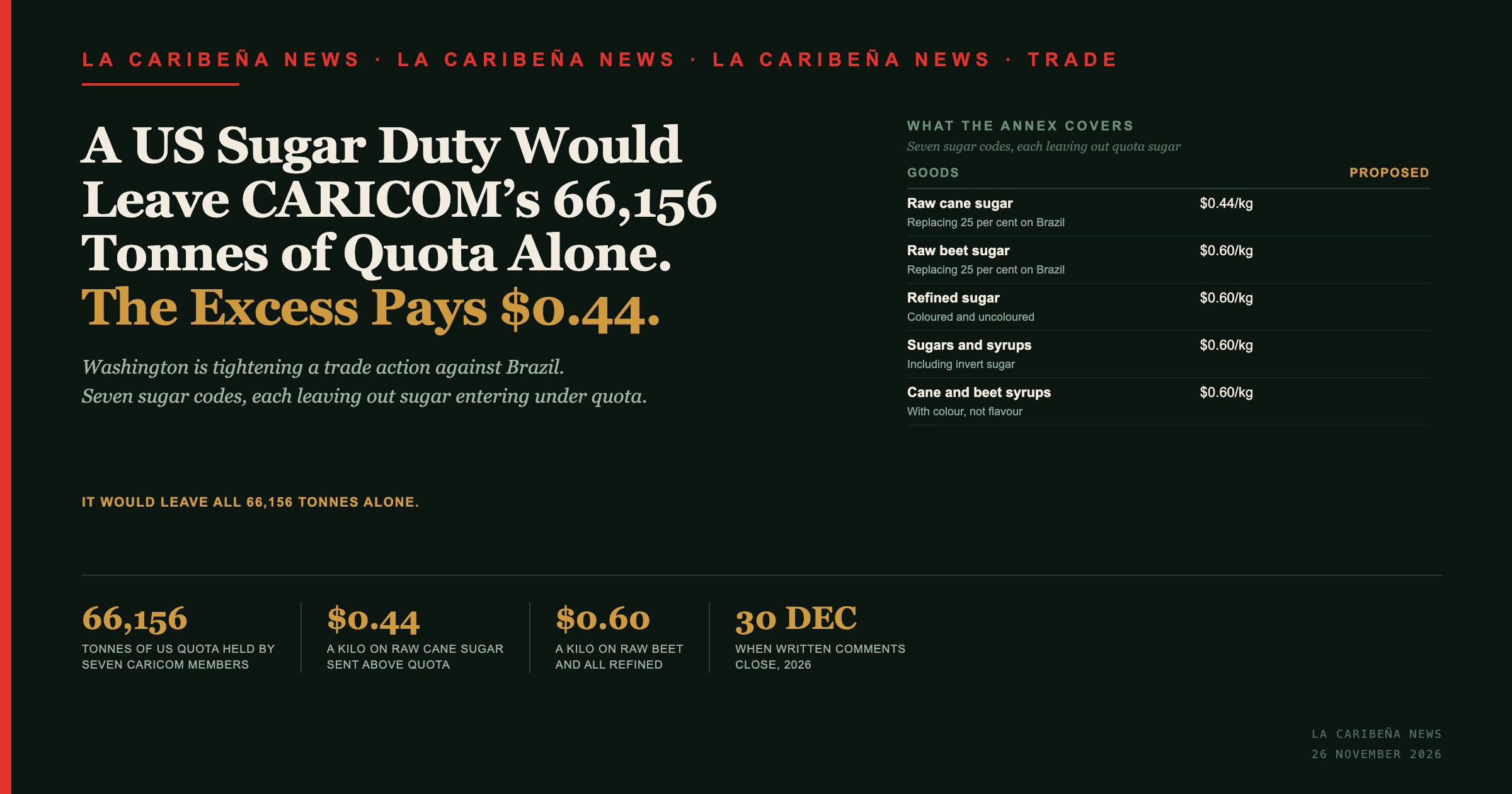
Seven CARICOM members hold 66,156 tonnes of United States sugar quota between them. The charge would leave all of it alone, and reach whatever a country sends on top.
Does this reach Caribbean sugar?
Only above the quota. The Trade Representative's notice names seven codes from the Harmonized Tariff Schedule of the United States, the catalogue American customs charges duty from.
Every one of those seven covers only goods "not subject to GN 15 or add. U.S. note 5 to Ch.17 of the HTSUS." Sugar pays the new charge only if it lands on one of them.
Additional U.S. Note 5 to Chapter 17 of the HTSUS is the legal basis for the United States sugar quotas. Sugar inside a country's share enters at a low rate. Sugar beyond it pays the high rate.
The proposed charge attaches to sugar paying the high rate. Quota sugar sits outside every line in the annex.
So an exporter shipping inside its share would pay nothing new. One shipping above it would pay what Brazil pays.
How much quota does the region hold?
A small share, split seven ways. The United States set aside 1,117,195 tonnes of raw cane quota for the last fiscal year, of which the Dominican Republic took 189,343 tonnes and seven CARICOM members shared 66,156.
Those shares are not ceilings on trade. A country may ship beyond its share and pay the high rate on the excess, which is exactly the sugar this proposal would reach.
Ten countries sit on the floor of that quota at 7,258 tonnes each, two of them CARICOM members, and when spare tonnage was handed out in September they got none of it. A small share is passed sooner.
What exactly would be charged?
A weight, in place of a percentage. A 25 per cent duty now falls on certain Brazilian sugar. It would give way to a flat charge, on sugar from anywhere.
| Tariff line | Current general rate | Section 301 rate on Brazil now | Proposed |
|---|---|---|---|
| 1701.13.50 raw cane sugar | $0.3387/kg | 25% | $0.44/kg, all countries |
| 1701.14.50 other raw cane sugar | $0.3387/kg | 25% | $0.44/kg, all countries |
| 1701.12.50 raw beet sugar | $0.3574/kg | 25% | $0.60/kg, all countries |
| 1701.91.30 refined, coloured | $0.3574/kg | 25% | $0.60/kg, all countries |
| 1701.99.50 refined, uncoloured | $0.3574/kg | 25% | $0.60/kg, all countries |
| 1702.90.20 sugars and syrups | $0.3574/kg | 25% | $0.60/kg, all countries |
| 2106.90.46 cane and beet syrups | $0.3574/kg | 25% | $0.60/kg, all countries |
A percentage rises and falls with the price. A charge by weight does not, so it bites hardest when sugar is cheap.
What is Brazil accused of?
Six practices, under Section 301 of the Trade Act of 1974. The notice that opened the investigation in July 2025 sets out what each one means, and the Trade Representative now says the July 2026 action against them "may no longer be appropriate as Brazil has made insufficient progress."
| Practice | What the notice alleges |
|---|---|
| Digital trade and electronic payment services | Social media firms made liable for users' posts without a court order, secret orders to censor posts and remove political critics, limits on moving personal data out of Brazil, and Brazil advantaging its own government-developed payment system |
| Unfair, preferential tariffs | Preferential rates for India and Mexico that the United States does not get. Brazil's average applied rate was 12.2 per cent in 2024, against America's 3.3 |
| Anti-corruption enforcement | Opaque leniency deals by prosecutors, conflicts of interest in judicial rulings, and a Supreme Court justice throwing out convictions in a bribery case |
| Intellectual property protection | Counterfeits and illicit streaming devices, and patents taking almost seven years, or 9.5 years for pharmaceutical patents granted between 2020 and 2024 |
| Ethanol market access | A tariff of 18 per cent since January 2024. United States ethanol exports to Brazil fell from $761 million in 2018 to $53 million in 2024 |
| Illegal deforestation | Weak enforcement letting illegally cleared land cut farming costs. The United States agricultural trade deficit with Brazil rose from about $3 billion in 2020 to about $7 billion in 2024 |
None of the six is about sugar. The notice says the proposed duties seek "to create additional leverage to encourage Brazil to eliminate" the practices.
Describing deforestation, the notice says that when China restricts United States agricultural exports, "Brazilian producers readily backfill those products." Back-filling is also the reason it gives for charging every country rather than Brazil alone.
Why charge every country for one country's conduct?
Because the notice says a charge on Brazil alone could be walked around.
"As sugar is a globally-traded, fungible commodity, and Brazil is the global leader in production and export of sugar, applying such tariffs on a nondiscriminatory basis may be appropriate to prevent arbitrage or back-filling that would reduce the effectiveness of the action."
The charge follows the commodity because the commodity is what moves.
What is still open, and until when?
The question of charging every country at all. The Trade Representative put five questions to the public, and the last asks whether applying the change "on a nondiscriminatory basis would be appropriate."
The others ask whether any listed product should come out, whether the rates are right, whether other products should go in, and whether the duties would cause "serious dislocations in the supply of the products and economy-wide disruptions."
| Date | Step |
|---|---|
| 27 November 2026 | Comment period opens |
| 7 December 2026 | Requests to appear at the hearing, with a summary of testimony |
| 30 December 2026 | Written comments |
| 14 January 2027 | Public hearing, which may run on to 15 January |
| Seven days after it ends | Post-hearing submissions |
The Section 301 Committee holds the hearing. Comments go through the Trade Representative's portal under docket USTR-2026-0628.
How exposed is the region?
Less than the measure's reach suggests, and nobody has published how much less.
The 66,156 tonnes CARICOM holds are untouched. The exposure is confined to tonnage sent above that, at $0.44 a kilogram for raw cane. How much each member ships above its share is not in the notice, and no figure accompanies it.
Washington opened 300,000 tonnes of beef to the hemisphere in August on terms only Brazil could fill, and a Senate letter later set the forced-labour ban on a Dominican sugar producer against the Section 301 tariffs Guyana pays at the higher band.
Comments on this one close on 30 December.
Title card, text equivalent
All figures on the title card, with their sources.
- 66,156 tonnes: United States raw cane sugar quota held by seven CARICOM members between them, out of 1,117,195 tonnes allocated for the last fiscal year. Source: La Caribeña News, 6 November 2026.
- $0.44 a kilogram: the proposed charge on raw cane sugar, applied to all countries. Source: the Trade Representative's proposed modification of the Section 301 action on Brazil.
- $0.60 a kilogram: the proposed charge on raw beet and all refined sugar, on the same basis. Source: the same.
- 25 per cent: the Section 301 rate on certain Brazilian sugar that the charge would replace. Source: the same.
- Seven: sugar lines in the annex, each one leaving out goods subject to additional U.S. note 5 to Chapter 17. Source: the same.
- 7,258 tonnes: the quota share held by each of the ten countries on the floor, two of them CARICOM members. Source: La Caribeña News, 6 November 2026.
- 30 December 2026: the deadline for written comments. Source: the Trade Representative's notice.
Entities named in this report
- The Office of the United States Trade Representative (USTR) proposes the change and takes the comments.
- Section 301 of the Trade Act of 1974 is the authority for the action, and section 307 is the authority for changing it.
- The Harmonized Tariff Schedule of the United States (HTSUS) is the customs catalogue that gives each importable good a code and a duty rate.
- Additional U.S. Note 5 to Chapter 17 of the HTSUS is the legal basis for the United States sugar quotas.
- The Section 301 Committee holds the public hearing.
- Brazil is the country whose acts, policies and practices the action addresses.
- CARICOM members hold 66,156 tonnes of the United States raw cane sugar quota between them.
Frequently asked questions
Would Caribbean sugar be taxed?
Only sugar entering above a country's quota share. Each of the seven lines in the annex leaves out goods subject to additional U.S. note 5 to Chapter 17, which is the legal basis for the quotas. Sugar arriving inside a share is not covered by the proposal.
How much quota does the Caribbean hold?
Seven CARICOM members held 66,156 tonnes of raw cane sugar quota between them for the last fiscal year, out of 1,117,195 tonnes the United States allocated in all. The Dominican Republic held 189,343 tonnes on its own.
What is being charged, and on what?
A flat $0.44 a kilogram on raw cane sugar and $0.60 a kilogram on raw beet and all refined sugar, replacing a 25 per cent duty that now falls on certain Brazilian sugar. Unlike a percentage, a charge by weight does not fall when the sugar price falls.
Why apply a duty aimed at Brazil to everyone?
To stop it being walked around. The notice says sugar is a globally traded, fungible commodity and Brazil is the global leader in producing and exporting it, so a charge on all countries may prevent arbitrage or back-filling that would weaken the action.
When does this close?
Written comments are due on 30 December 2026 and the hearing is set for 14 January 2027, with the possibility of running on to 15 January. Requests to appear are due on 7 December 2026, and post-hearing submissions seven days after the hearing ends.