By LCN Business Desk
Deputy Secretary of State Christopher Landau met Caribbean government representatives in Washington on Thursday and announced a package. More than half of it is undersea cable.
What was announced?
Four lines, and the three smaller ones carry no country list.
Diario Libre reported that the initiative announced on Thursday 15 October contemplates investments of approximately US$340.5 million, covering digital infrastructure, port security, telecommunications, strengthening of security forces and training of health personnel.
| Line | Amount |
|---|---|
| Undersea cables, to widen high-speed internet connections | US$175m |
| Health programmes | US$61.5m |
| Modernisation of the region's security forces and military institutions | about US$67m |
| New programmes to protect critical digital infrastructure and reinforce port security | US$37m |
| Total stated | about US$340.5m |
Source: Diario Libre, 15 October 2026. Those four components add to exactly 340.5, and the cable line is the largest of them.
"I am pleased to announce 37 million dollars in new programmes to protect critical digital infrastructure and reinforce port security," Landau said. He told the meeting it had been "a source of pain" to see that the United States had not given the Western Hemisphere, and the Caribbean specifically, "the attention it deserves", and said Washington is "restoring the Western Hemisphere to its position of pre-eminence and priority in United States foreign policy".
The Dominican Republic was represented by Foreign Minister Víctor Bisonó, Defence Minister Carlos Antonio Fernández Onofre and its ambassador in Washington, María Isabel Castillo. The meeting came seven months after the Escudo de las Américas summit convened by President Donald Trump in Miami.
What is already on the record about the cable money?
A programme name, a purpose, and five countries.
On 28 July 2026 the Associated Press reported a notification sent to Congress the previous Friday, setting out US$175.8 million to replace outdated and ageing undersea telecommunications cables in the Caribbean and Central America. AP obtained a copy of the notification.
The programme has a name. According to that reporting it is the "Countering CCP Control of Caribbean and Central America Undersea Cables project", and it will "fund the installation of strategically-selected undersea cable infrastructure" and support foreign governments in partnering with private sector cable installers. The money will "support replacement of outdated undersea telecommunications cables in the Caribbean and Central America region with secure, US and trusted alternatives".
The notification names where it is expected to go.
| Anticipated beneficiary | Region |
|---|---|
| El Salvador | Central America |
| Guatemala | Central America |
| Honduras | Central America |
| Nicaragua | Central America |
| Haiti | Caribbean |
Source: congressional notification as reported by the Associated Press, 28 July 2026. The reporting adds that the United States has tenuous ties with Nicaragua and would not be working with the government there.
Whether the US$175 million presented in Washington on Thursday is this money, additional money, or an overlapping tranche is not stated on the public record. The figures correspond closely and the July notification is the only itemised description of a cable programme of that size in the region that has been published.
Why does the distinction matter?
Because a cable lands somewhere, and the landing points are named.
Undersea cable is not a regional good in the way a health programme is. It is a physical asset that comes ashore at a specific station in a specific country, and the economics of capacity, latency and resilience follow the route. A cable replacing an ageing link into Guatemala does not change what a business in Georgetown or Bridgetown pays for transit.
Of the five anticipated beneficiaries, 1 is in the Caribbean and 4 are in Central America. Eleven of the fifteen CARICOM member states are not named in the July notification. Neither is the Dominican Republic, whose ministers were in the room on Thursday.
Has a Caribbean government been here before?
In September, with a different American institution and the same outcome.
On Monday 21 September 2026 President Irfaan Ali met the chairman of the United States Export-Import Bank in New York and listed six Guyanese projects: gas to energy at Wales, a second phase of it, a deepwater port in Berbice, Amaila Falls hydropower, the Lethem airport and an affordable housing project.
On Tuesday 22 September the same bank signed a framework with Argentina making up to US$7 billion available through 2027 for railways, pipelines, ports and power networks tied to energy security and critical minerals.
| Guyana, 21 September | Argentina, 22 September | |
|---|---|---|
| Form | A meeting and a project list | A signed framework |
| Ceiling | None stated | Up to US$7 billion |
| End date | None stated | Through 2027 |
Both are reported in Guyana's President Met the American Lender on Monday. The corridor branding launched alongside the Argentine framework was examined in America Built Its First Trade Corridor in This Hemisphere.
Where does this sit in United States technology policy?
In a line of it running from minerals to telecommunications to artificial intelligence.
Landau was in Georgetown in August to discuss critical minerals, reported in The Deputy Secretary of State Is in Georgetown to Talk Critical Minerals.
On telecommunications, the United States has already moved against the directors of a Latin American utility that chose Chinese equipment, reported in A Patagonian Power Co-op Chose Huawei. Washington Went After Its Directors' Visas.
On artificial intelligence, when American industry leaders published a plan in September to slow the technology down, that plan named Washington, its allies and Beijing, and did not name the Caribbean. It is examined in The Plan to Slow AI Names Washington, Its Allies and Beijing. Chinese models reached the region regardless: Alibaba's Qwen passed three billion downloads in six months against 418 million for Google and 227 million for Meta, reported in A Ugandan Developer Chose Alibaba Over Meta and Google.
Washington's own name for the cable programme places this package in that line of policy rather than in development assistance.
What should a Caribbean government read in the package?
The three smaller lines, which are not geographically named.
US$61.5 million for health programmes, about US$67 million for security force and military modernisation, and US$37 million for critical digital infrastructure and port security carry no published country list. Port security was the line Landau named aloud in his own announcement.
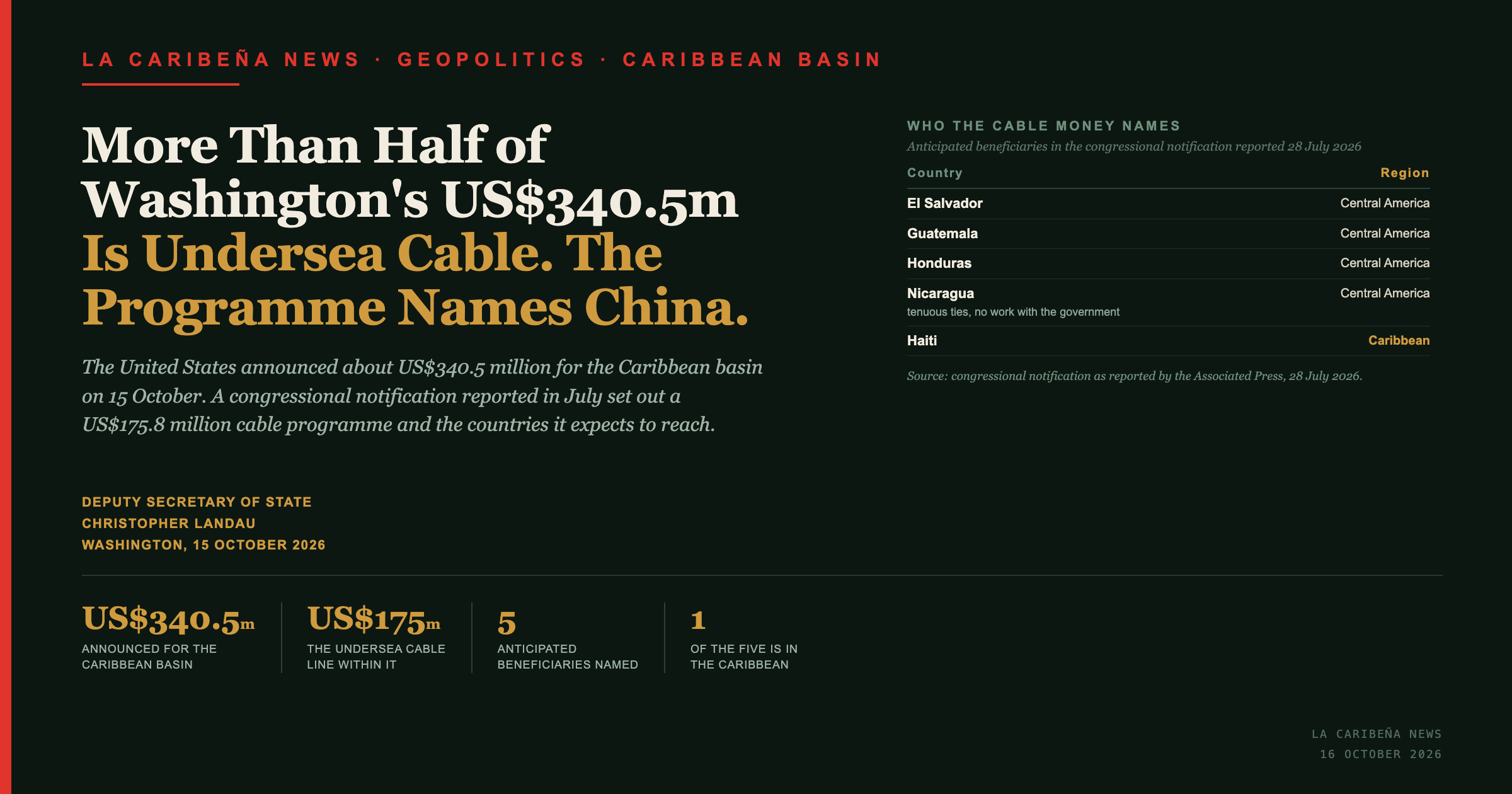
What the title card shows
Every data point on the article's title card, in text.
- US$340.5 million. The approximate total the initiative announced on 15 October 2026 contemplates for the Caribbean basin.
- US$175 million. The undersea cable line within it, the largest of four.
- US$175.8 million. The figure in the congressional notification reported by the Associated Press on 28 July 2026 for the "Countering CCP Control of Caribbean and Central America Undersea Cables project".
- 5 anticipated beneficiaries. El Salvador, Guatemala, Honduras, Nicaragua and Haiti, of which only Haiti is in the Caribbean.
- US$37 million. The new programmes Landau named for critical digital infrastructure and port security.
Frequently Asked Questions
What did the United States announce on 15 October 2026?
Investments of approximately US$340.5 million in the Caribbean basin, announced by Deputy Secretary of State Christopher Landau at a meeting with Caribbean government representatives in Washington, covering undersea cables, health programmes, security force modernisation, critical digital infrastructure and port security.
What is the largest component?
US$175 million for undersea cables, to widen high-speed internet connections.
What is the "Countering CCP Control of Caribbean and Central America Undersea Cables project"?
The name given, in a notification sent to Congress and reported by the Associated Press on 28 July 2026, to a US$175.8 million programme to replace outdated and ageing undersea telecommunications cables in the Caribbean and Central America with secure, United States and trusted alternatives, and to fund installation of strategically-selected cable infrastructure.
Which countries are named in that notification?
El Salvador, Guatemala, Honduras, Nicaragua and Haiti are the anticipated beneficiaries. Four are in Central America. The reporting notes the United States has tenuous ties with Nicaragua and would not be working with the government there.
Are the two cable figures the same money?
That is not stated on the public record. The figures correspond closely, and the July notification is the only itemised description published of a cable programme of that size in the region.