By LCN Business Desk
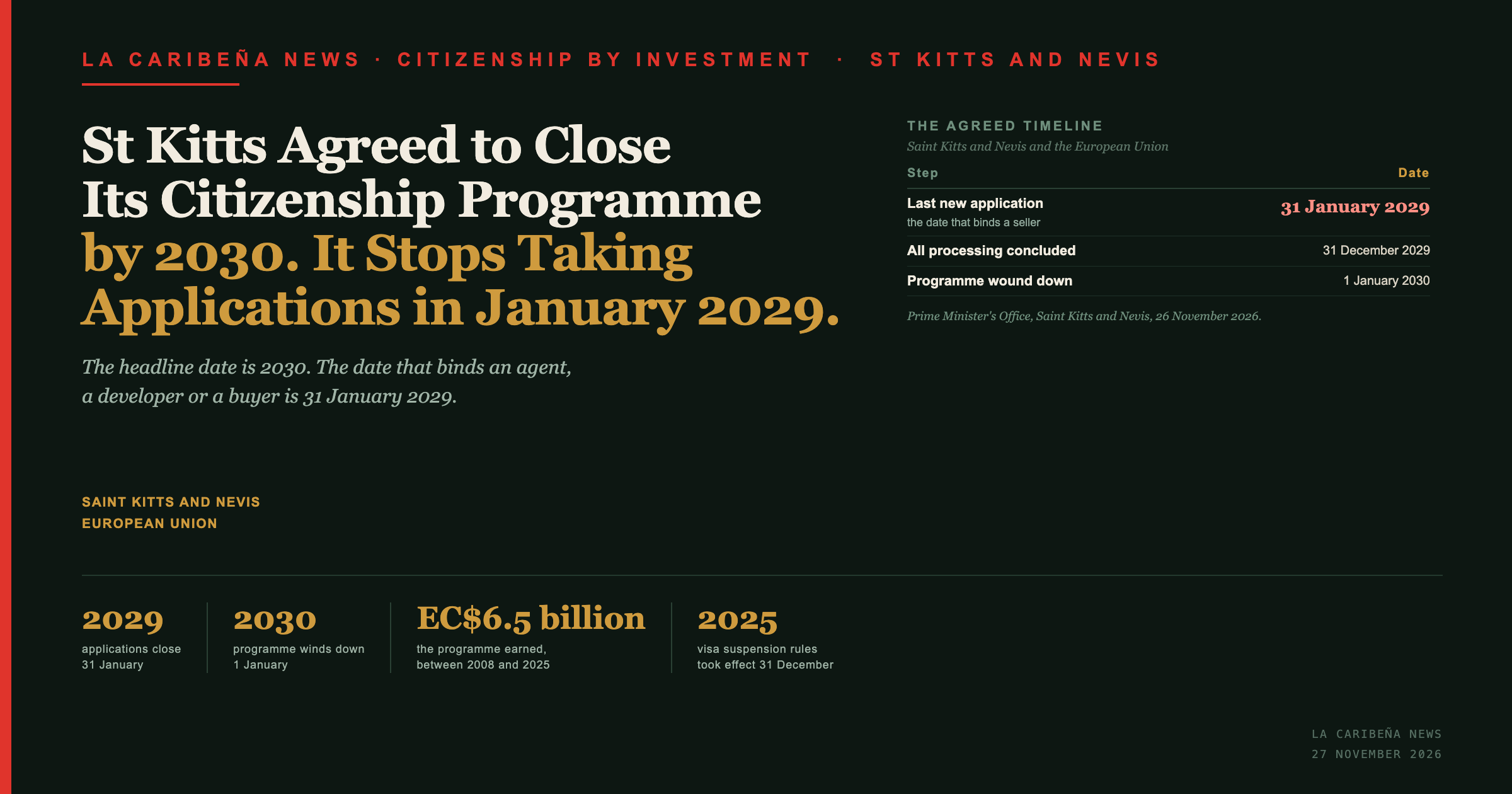
Saint Kitts and Nevis said on 26 November 2026 that it has agreed a closing date with the European Union. The programme winds down by 1 January 2030.
Two earlier dates do the work. The Citizenship by Investment Unit takes new applications until 31 January 2029. Everything in the pipeline must be processed by 31 December 2029.
What date did Saint Kitts and Nevis actually agree?
Saint Kitts and Nevis agreed three dates, running from January 2029 to January 2030.
| Date | What happens |
|---|---|
| 31 January 2029 | Last day the unit receives a new application |
| 31 December 2029 | All processing concluded |
| 1 January 2030 | The programme is wound down |
The Prime Minister's Office said the deal followed long negotiations, in a statement on 26 November 2026. It gives the federation more than three years. From the announcement to the closing date is thirty-eight months.
This newspaper reported on 14 November that the federation would wind the programme down on a timeline still being negotiated. The timeline is now fixed.
Which of those dates binds a business?
The first date binds a business. An agent has until 31 January 2029 to lodge an application, which is twenty-six months away.
The 2030 date closes the programme. The 2029 date closes the market, eleven months earlier.
A developer whose project is paid for by these applications has thirty-seven months for the money to clear. The applications themselves must all be lodged inside the first twenty-six.
Nor will the price fall as the deadline nears. The Prime Minister's Office said there will be "no reduction in pricing, investment thresholds or due diligence standards". The Eastern Caribbean Citizenship by Investment Regulatory Authority is to monitor compliance.
A closing programme with a last order date usually invites discounting. The federation has said in advance that there will be none. An agent cannot promise to go under the published price.
Dominica has called discounted citizenship illegal since 2018, and a hotelier says it never stopped.
Why is the federation closing it at all?
To keep its banks linked to banks abroad. Prime Minister Terrance Drew put that ahead of visa-free travel.
"Our banks depend on banks in the United States, Canada, and Europe to move money in and out of this country. If those banks cut us off, a visitor could not pay with a credit card. A family abroad could not send money home. A business could not pay for goods it imports," Drew said in his national address, as the Prime Minister's Office reported on 16 November 2026.
Those links are called correspondent banking. They are what joins a local bank to the wider system. The office said losing them would reach tourism, banking and offshore education, which all need to send and receive money across borders.
The European Union's revised visa suspension rules took effect on 31 December 2025. Under them, selling citizenship to people with no genuine link to a country is grounds for the Union to consider suspending visa-free travel. The European Commission invited the federation in June 2026 to wind the programme down.
In February 2026 the United States Financial Crimes Enforcement Network (FinCEN) withdrew its 2014 advisory on the programme.
Where does this leave the other Eastern Caribbean programmes?
It leaves the other three Eastern Caribbean programmes with no announced closing date, on the public record this newspaper can find. Antigua and Barbuda agreed the same application deadline on the same day.
This newspaper reported on 17 November that Antigua and Barbuda had told the European Commission on 30 October it would wind down, and asked for until the end of 2030. The Commission had asked for 1 June 2028.
Antigua's unit set out its timetable in a memo to agents on 26 November. It takes new applications until 31 January 2029, the same date as Saint Kitts and Nevis, and closes on 31 December 2029, IMI Daily reported. Brussels agreed a date a year earlier than the one Antigua asked for.
The two governments told different audiences. Saint Kitts and Nevis published its agreement through the Prime Minister's Office. Antigua's went to agents over the signature of its unit's deputy chief executive. Antigua's Cabinet published a report of its meeting of 25 November, and its press releases run to 17 November. Neither mentions the programme or the Commission.
Nuri Katz, president of Apex Capital Partners, expects "a huge spike in volume" in both countries as the deadline nears. He expects Dominica, Grenada and Saint Lucia to be asked to close on the same terms.
Drew put the outcome down to reform rather than to argument. "The European Union does not give time to a country it does not trust. It gives time to a partner that has proven it can be trusted," he said.
What is the European Union putting on the other side?
Money for diversifying, on terms not yet published.
The Commission stands ready to keep working with the federation through the change, the Prime Minister's Office said. It named geothermal energy and digital links under the Union's Global Gateway plan. Serious talks have begun.
No figure, instrument or date goes with that offer in either statement of 26 November. None is attached to the geothermal or digital projects named.
The programme earned about EC$6.5 billion between 2008 and 2025. What replaces it is the subject of talks that have started and have not finished.
Title card, text equivalent
All figures on the title card, with their sources.
- 1 January 2030: the date the programme is wound down, agreed with the European Union. Source: the Prime Minister's Office, 26 November 2026.
- 31 January 2029: the last day the unit receives a new application. Source: the same.
- 31 December 2029: the date by which all processing is concluded. Source: the same.
- Twenty-six months: from 27 November 2026 to the last application date. Source: La Caribeña News, from the dates above.
- Thirty-eight months: from the announcement on 26 November 2026 to 1 January 2030, which the government calls more than three years. Source: the same.
- EC$6.5 billion: what the programme earned between 2008 and 2025. Source: Prime Minister Terrance Drew, national address of 13 November 2026.
- 31 December 2025: when the European Union's revised visa suspension rules took effect. Source: the Prime Minister's Office, 16 November 2026.
Entities named in this report
- The Citizenship by Investment Unit receives and processes applications in Saint Kitts and Nevis.
- Prime Minister Terrance Drew announced the decision in a national address on 13 November 2026.
- The European Commission asked the federation in June to wind the programme down, and agreed the timeline.
- The Eastern Caribbean Citizenship by Investment Regulatory Authority is to monitor compliance during the change.
- The United States Financial Crimes Enforcement Network (FinCEN) withdrew its 2014 advisory on the programme in February 2026.
- Global Gateway is the European Union plan under which geothermal and digital projects were named.
- Antigua and Barbuda agreed the same application deadline, 31 January 2029, and closes on 31 December 2029.
- Nuri Katz is president of Apex Capital Partners and expects demand to rise into the deadline.
Frequently asked questions
When does Saint Kitts and Nevis stop selling citizenship?
The unit takes new applications until 31 January 2029. Those lodged before 1 February 2029 may be processed until 31 December 2029. The programme is wound down by 1 January 2030.
Does this affect people who already hold citizenship?
No. The government said the decision has no immediate effect on citizenship already held, or on travel.
Will the investment thresholds be cut before the programme closes?
No. The Prime Minister's Office said there will be no reduction in pricing, investment thresholds or due diligence standards. A regional regulator is to monitor compliance.
Why did the federation agree to close the programme?
To protect correspondent banking, which lets local banks move money in and out of the country. Drew said that without it a visitor could not pay by card, a family abroad could not send money home, and a business could not pay for imports. Visa-free travel to Europe was the other reason.
What is Saint Kitts and Nevis getting in return?
The Commission said it stands ready to support diversifying the economy. Geothermal energy and digital links were named under its Global Gateway plan. No figure, instrument or date goes with it in either statement of 26 November.