By LCN Business Desk
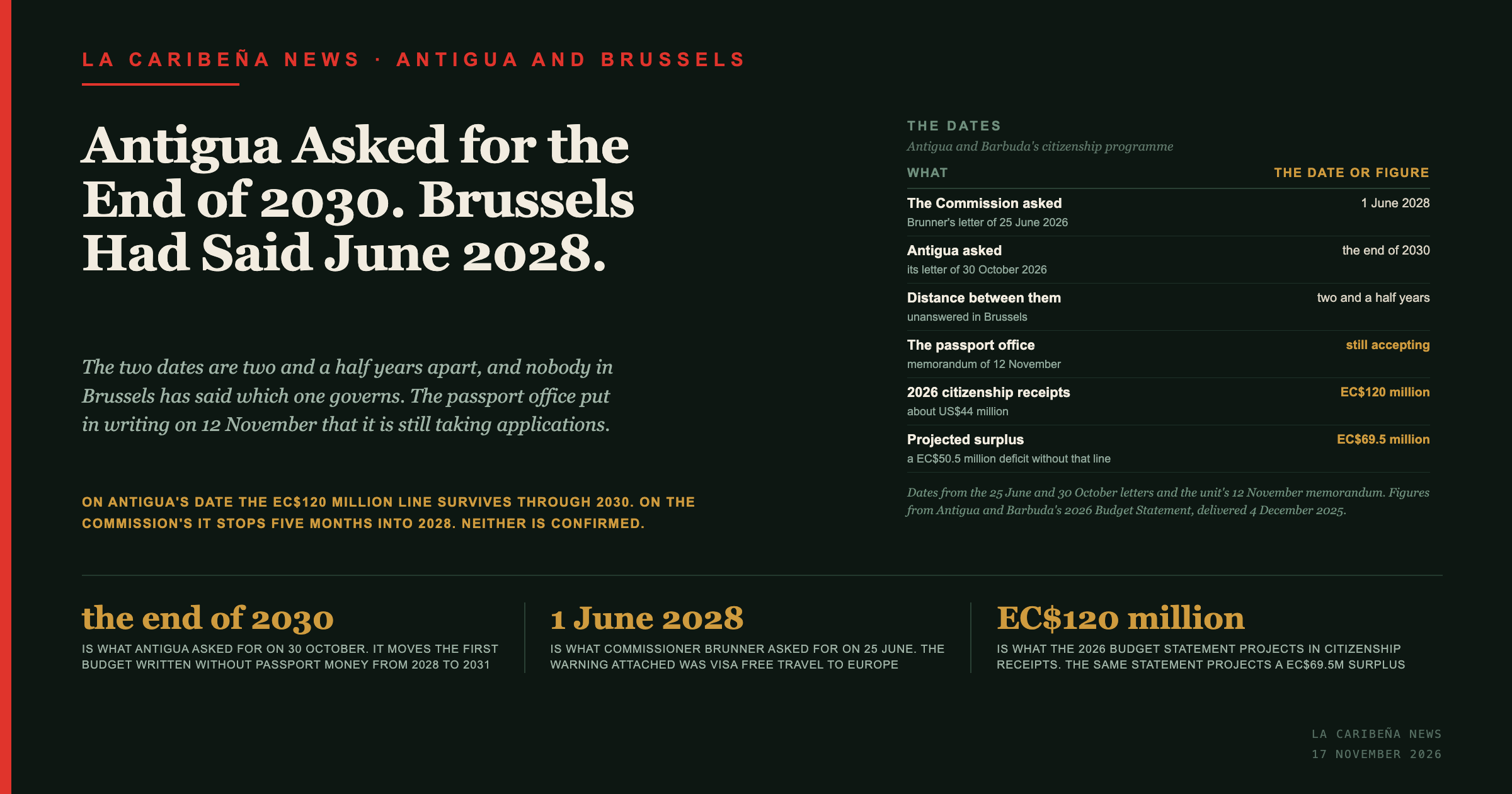
Two dates are on the table for the end of Antigua and Barbuda's citizenship programme, and they are two and a half years apart. The European Commission named 1 June 2028. The Government named the end of 2030. Nobody in Brussels has said which one governs.
In the meantime the office is open. The Citizenship by Investment Unit put that in writing on 12 November. Its memorandum says the unit "remains operational and continues to accept applications for citizenship".
St Kitts and Nevis moved first, and that changes the arithmetic for everyone still asking.
What did Antigua actually tell the European Commission?
That it will wind the programme down, and wants until the end of 2030 to finish doing it.
The Government wrote on 30 October. The letter says it intends to wind down the programme, requests a transition period extending to the end of 2030, and asks for financial and technical assistance to make the transition. Antigua News, reporting the exchange, says the Commission has not publicly confirmed that it accepts 2030.
The Commission's own request came on 25 June. Commissioner Magnus Brunner signed it. It asked for the programme to be wound down by 1 June 2028, and the warning attached was visa free travel to Europe.
Prime Minister Gaston Browne did not answer it alone. He sought a regional response and secured OECS support in July, then proposed a longer transition of his own.
This newspaper reported on 12 November that five Caribbean states faced a deadline that day to confirm they would close programmes worth about five per cent of GDP, and that the programmes run until 2028 either way. The confirmation has now been sent. The date inside it is not the date that was asked for.
Is the programme still selling citizenship?
Yes. The unit put that in writing on 12 November.
Charmaine Donovan, the unit's chief executive, issued the memorandum. It says the unit is open for business until otherwise advised, and that it accepts applications pending further instructions.
The price has not moved either. The Eastern Caribbean programmes run under a floor of US$200,000, set regionally rather than by Brussels.
So an application filed this week enters a programme with no agreed closing date. The citizenship itself is not in question. What a buyer cannot price is how long the travel attached to it lasts.
What does St Kitts moving first do to Antigua's position?
It removes the argument that nobody can go first. St Kitts said so on 13 November.
Prime Minister Terrance Drew spoke on 13 November. St Kitts and Nevis will phase out the programme it started in 1984. He said the Government had told the European Union formally, and that the closing timetable is being negotiated.
Applications there continue until a final deadline is agreed. Citizenship already granted is unaffected.
We reported the following day that the revenue St Kitts is protecting had already fallen, from 25.8 per cent of GDP in 2022 to 6.0 per cent in 2025 on IMF figures. Antigua News puts the same programme at almost 70 per cent of government revenue in 2022 and below 20 per cent in 2026. The two are measured against different denominators and both point the same way.
Antigua has now asked for thirty months more than the state that has already agreed to go.
What is the programme worth to the Treasury?
EC$120 million this year, about US$44 million, against a projected surplus of EC$69.5 million.
Antigua and Barbuda's own 2026 Budget Statement projects citizenship receipts of EC$120 million, about US$44 million at the pegged rate. This newspaper set that against the EC$69.5 million surplus the same statement projects on 30 October. Without that line, on the same statement's own figures, the surplus is instead a deficit of EC$50.5 million.
The programme raised EC$157 million in 2025, about US$58 million. Reuters reports the same two years in United States dollars, at about US$58 million and US$44.4 million, which is the same money counted twice.
The budget that money sits in already carries commitments it has not met. The same statement commits to consolidating what the state owes the Social Security Board into an EC$437.8 million bond over 25 years, which pays the fund no principal until year eleven.
<!-- archive: antigua-depositor-protection-trust-142-million-allocated-balance-unpaid-2026 | read it: the ABI Bank depositor balance is a real unmet commitment in the same Budget Statement, but the piece is an unpublished draft with no URL, so it cannot be linked without a broken anchor -->
The pressure is not only European. The United States made a visa bond permanent on 3 August, demanding up to US$20,000 from visitor visa applicants in fifty countries, and Antigua is one of four Caribbean states on the list. Two capitals are pricing the same passport differently.
Why is the European Union able to ask at all?
Because the rule changed on 31 December 2025, and the trigger is the connection, not the money.
Changes to the European Union's visa suspension mechanism took effect on 31 December 2025. Under them, a country can lose visa free Schengen access if it grants nationality without a sufficiently genuine connection.
Europe applies it at home as well. No European Union state now sells citizenship, after the Court of Justice ended Malta's scheme in April 2025. The market has not disappeared, it has moved: Argentina unveiled a golden passport in Paris in October at a non refundable 311,000 euro contribution, while the Eastern Caribbean operates under a US$200,000 floor and a request to close.
Does the 2030 request change the fiscal arithmetic?
It moves the cliff by two and a half budget years.
Our 30 October analysis ran on the date Brussels had named. The figures in it come from the Budget Statement delivered on 4 December 2025, which also projects a primary surplus of EC$207.9 million and non-tax revenue of EC$240.7 million.
On a confirmation ending the programme on 1 June 2028, the EC$120 million line stays intact this year, largely intact in 2027, and stops five months into 2028. The fiscal problem was the 2028 and 2029 budgets.
The end of 2030 is a different problem. It leaves the line whole through 2027, 2028, 2029 and 2030, and moves the first budget written without it to 2031. That is what Antigua asked for on 30 October, and it is what the Commission has not answered.
What happens next, and when?
The next dated event is a Visa Suspension Mechanism report planned for December 2026, and nothing is scheduled before it.
The Commission will reflect Antigua and Barbuda's response in its Visa Suspension Mechanism report. That report is planned for December 2026, and it is the next dated event on the public record.
There is no published deadline for the Commission to answer the 2030 request itself. Nor has Antigua put a figure on the financial and technical assistance it asked for on 30 October.
St Kitts has said what it will do with the people. It plans to redeploy its unit's experience toward conventional foreign investment. On the public record this newspaper can find, neither country has announced a comprehensive successor programme.
What should a buyer or an agent do with this?
Until the Commission answers, 1 June 2028 and the end of 2030 are a range rather than a deadline.
For an applicant, the citizenship granted is not at risk. Both governments have said so. The Schengen access attached to it is what is being negotiated, and it has no agreed end date.
For an agent, the programme remains open. It is selling a product whose main benefit expires on a date neither party has settled.
For a developer whose project is funded by programme receipts, the number that matters is not the deadline at all. It is the US$44.4 million budgeted for 2026, against US$58 million received in 2025, and whatever the Commission says in December. Next door, Dominica has called discounted citizenship illegal since 2018, and a hotelier says it never stopped.
The entities
- Citizenship by Investment Unit: the Antiguan body administering the programme, whose 12 November memorandum says it remains operational. - Charmaine Donovan: chief executive of the Citizenship by Investment Unit. - Magnus Brunner: the European Commissioner whose letter of 25 June 2026 asked Antigua and Barbuda to wind the programme down by 1 June 2028. - Gaston Browne: Prime Minister of Antigua and Barbuda, who sought a regional response and proposed a longer transition. - Terrance Drew: Prime Minister of St Kitts and Nevis, who announced on 13 November 2026 that his country will phase out the programme it began in 1984. - Visa suspension mechanism: the European Union instrument, changed with effect from 31 December 2025, under which nationality granted without a sufficiently genuine connection can ground suspension of visa free Schengen access. - Visa Suspension Mechanism report: the Commission report planned for December 2026, in which Antigua and Barbuda's response will be reflected.
What the title card says
- Date the Commission asked for: 1 June 2028. - Date Antigua asked for: the end of 2030. - Letter from Antigua to the Commission: 30 October 2026. - Commission's letter to Antigua: 25 June 2026. - Unit memorandum confirming it is still selling: 12 November 2026. - Received from the programme in 2025: about US$58 million. Budgeted for 2026: US$44.4 million. - Next dated event: the Visa Suspension Mechanism report, December 2026.
Frequently asked questions
Has Antigua and Barbuda closed its citizenship programme?
No. The Citizenship by Investment Unit said on 12 November 2026 that it remains operational and continues to accept applications.
When will it close?
That is not settled. The European Commission asked for 1 June 2028. Antigua wrote on 30 October 2026 requesting a transition period to the end of 2030, and the Commission has not publicly accepted it.
Does this affect citizenship already granted?
Both governments have said existing citizenship is unaffected. What is being negotiated is visa free access to the Schengen area.
Why can the European Union ask for this?
Changes to its visa suspension mechanism took effect on 31 December 2025, under which granting nationality without a sufficiently genuine connection to the country can be grounds for suspending visa free access.
What is the programme worth to Antigua?
About US$58 million was received in 2025 on Reuters figures, with US$44.4 million budgeted for 2026.
What is not established?
Whether the Commission will accept the end of 2030, and when it will answer. What financial and technical assistance Antigua has asked for, which the reporting does not quantify. And what the December report will say.