By LCN Business Desk
A government that contracts out its electricity grid learns what leaving costs when it tries to leave. Puerto Rico has now learned something narrower and more useful. The exit it gets is the exit it signed.
What exactly did the court void?
The extension letter, and only that. The case is Autoridad para las Alianzas Público-Privadas v. LUMA Energy, LLC, reported as 2026 TSPR 118 on docket CT-2025-0006, consolidated with CT-2025-0007. The court holds that the Carta-Extensión is void, so the extension "no surtió efecto" for running the grid.
Then it goes the other way. The parties were duly bound by the main contract and the supplementary agreement. The court calls those two documents "la última fuente válida de las obligaciones contractuales de las partes", the last valid source of what each side owes.
One document fell. Two survived.
Who decided it, and who did not agree?
Five justices to four. Associate Justice Luis F. Estrella Martínez wrote for the court. Associate Justice Roberto Feliberti Cintrón wrote a concurrence that Pabón Charneco, Estrella Martínez, Rivera Pérez and Candelario López all joined.
The docket had been before the court already. It issued an earlier resolution in the same consolidated case on 5 August 2026, reported as 2026 TSPR 85, which itself carried concurring and dissenting opinions.
5 parties asked to be heard as amicus curiae, and they are not lawyers' societies alone.
| Amicus curiae | What it is |
|---|---|
| Colegio de Abogados y Abogadas de Puerto Rico | The bar association |
| Financial Oversight and Management Board for Puerto Rico | The federally created board over the island's finances |
| Unión de Trabajadores de la Industria Eléctrica y Riego | The electrical and irrigation workers' union |
| Asociación de Industriales de Puerto Rico | The manufacturers' association |
| Asociación de Farmacias de la Comunidad de Puerto Rico | The community pharmacies association |
A pharmacy association in a grid case is not a constitutional point. It is a business with refrigerated stock.
The appearance list is lopsided. LUMA entered 9 lawyers. The 2 public authorities entered 5 between them. The Governor and the Government of Puerto Rico were represented by the Office of the Solicitor General, which named 4.
Four dissented. Associate Justice Rafael Martínez Torres wrote a dissent joined by Chief Justice Maite Oronoz Rodríguez and Associate Justice Erick Kolthoff Caraballo. Associate Justice Ángel Colón Pérez wrote a separate dissent, with the Chief Justice joining parts one, two and three of it. Kolthoff Caraballo added dissenting expressions of his own.
Why was the extension letter invalid?
Because of two approval steps nobody took. The court decided the case under two statutes and ordinary contract law. Ley Núm. 29-2009 governs public-private partnerships. Ley Núm. 120-2018 governs the reshaping of the Puerto Rico Electric Power Authority.
The letter substantially altered the agreements in force. So it amounted to a transaction of the Authority, and had to clear the same safeguards as the documents it was changing. Two were missed. One is a yes vote from the 2 public-interest members on the board of the Autoridad para las Alianzas Público-Privadas, the island's partnerships authority. The other is an energy compliance certificate from the Negociado de Energía, the energy regulator.
The court also found the letter's terms broke the time limit the law sets on partnerships, and left performance to LUMA's own choice.
Neither missed step is exotic. One is a board vote. The other is a certificate from a regulator. A contract worth billions, carrying 1.5 million customers, turned on paperwork a committee could have completed in an afternoon.
Where did the one-year transition come from?
From the contract, not from the bench.
Having held the extension void, the court turns to the surviving documents. Their provisions on an orderly transition in the operation of transmission and distribution "son vinculantes y deberán ser obedecidas íntegramente": they are binding and must be obeyed in full. The transition must be swift and conclude "dentro del término contractual de un año", within the contractual one-year term, running from the date the Opinion and Judgment takes effect.
So the twelve months are not a remedy the court designed. They are a clause the parties wrote, and the court has held both of them to it.
What happens next, and on what clock?
Immediately, and under one judge. The ruling took effect when the parties were served, on 25 November 2026. The majority opinion runs to 86 pages and will be reported at 218 DPR. The court sent the case to Judge Anthony Cuevas Ramos of the Court of First Instance in San Juan, citing his record in complex cases, and told its own secretariat to send him the file.
It then shortened its own deadlines. Under Rule 50 of its regulations, cited as 4 LPRA Ap. XXI-B, the parties have 10 days from that notice to ask it to think again. The court allowed 1 such request, not the usual sequence, and said it cut the term so the transition could begin at once.
The Court of First Instance will also handle any other legal or contractual claim between the parties, which is where LUMA's money arguments now go.
| Document or step | Status after 25 November 2026 |
|---|---|
| Carta-Extensión | Void. The extension never took effect for grid operation |
| Main contract | Stands. Last valid source of obligations |
| Supplementary agreement | Stands. Its transition provisions are binding in full |
| Transition period | One contractual year from the date the judgment takes effect |
| Supervising forum | Court of First Instance, San Juan, Judge Anthony Cuevas Ramos |
| Reconsideration | Ten days from notification, one request only, under Rule 50 |
| Successor operator | Not named in the ruling |
What does this do to the US$1.3 billion LUMA put on its own exit?
It moves it to a lower court, and the figure in the record has grown. On 6 October this newspaper reported that LUMA had priced its own dismissal at US$1.3 billion. The figure came from a brief it filed with the court the day before. Of that sum it called US$726 million unavoidable.
The dissent records the total as US$1,327.3 million. About US$726 million of that is in contract items that cannot be avoided, it says, even if an incoming operator needed no funding at all. The unavoidable portion matches our October figure to the decimal. The total does not: we reported US$1,314.3 million from the 5 October brief, and the two differ by exactly US$13.0 million.
Both numbers are LUMA's own, filed in its own defence, in litigation it is a party to. Neither has been tested in the proceedings. The majority did not rule on them, and the dissent cites them as the scale of what the remedy implies rather than as a finding.
LUMA also argued the court could not call the letter wholly void and at the same time limit the effects to the future. That argument failed.
What did the majority say about the leak allegations?
That they are serious, and they said so in the judgment itself. Kolthoff Caraballo, dissenting, opened his own expressions on the state's position: "En una acción legal del Estado para anular un contrato y sacar a un contratista". Feliberti Cintrón recorded an expression alongside the concurrence, which Pabón Charneco, Estrella Martínez, Rivera Pérez and Candelario López joined. It calls it "sumamente preocupante", extremely worrying, that anyone should question whether the court keeps its own talks private.
The expression names "imputaciones de la divulgación no autorizada de una determinación judicial antes de su publicación oficial": claims that a ruling was leaked before the court published it. The matter cannot be brushed aside, it says, because it damages trust in the court.
LUMA, in its statement on the ruling, called for an investigation into public allegations of attempts to influence the island's highest court.
What should a Caribbean utility take from this?
That the exit clause is the exit. Several Caribbean states are being urged to hand grid operation to a private firm. Puerto Rico is the region's largest live test of it. Guyana pays 9.5 cents for rented power, Suriname is short 80 megawatts, and a docked cruise ship draws up to 12 megawatts against Grenada's entire 70.
Two things in this ruling travel. The transition the court enforced was contractual, so the terms a utility accepts at signature are the terms it will be held to at separation, by its own counterparty and by a judge. Saint Vincent and the Grenadines granted Global Ports Holding 30 years at its cruise port on the same logic, and that clock runs from signature too. And the extension failed on a board vote and a regulator's certificate, which is to say on governance steps that cost nothing and were skipped anyway.
Venezuela's reformed electricity law, sanctioned and awaiting promulgation, admits private capital to generation on terms where a self-generator that refuses to supply in a state of exception loses its licence. Puerto Rico's case ran the other way: the state wanted the operator out and had to prove its own paperwork was defective to achieve it.
The grid has also been fought over on gas supply. There a federal judge temporarily ordered New Fortress to open its Puerto Rico terminal to other buyers. The operator changes. What the system depends on does not.
The ruling names no successor operator. For up to a year, under a judge in San Juan, 1.5 million customers are served by a company the government went to court to remove.
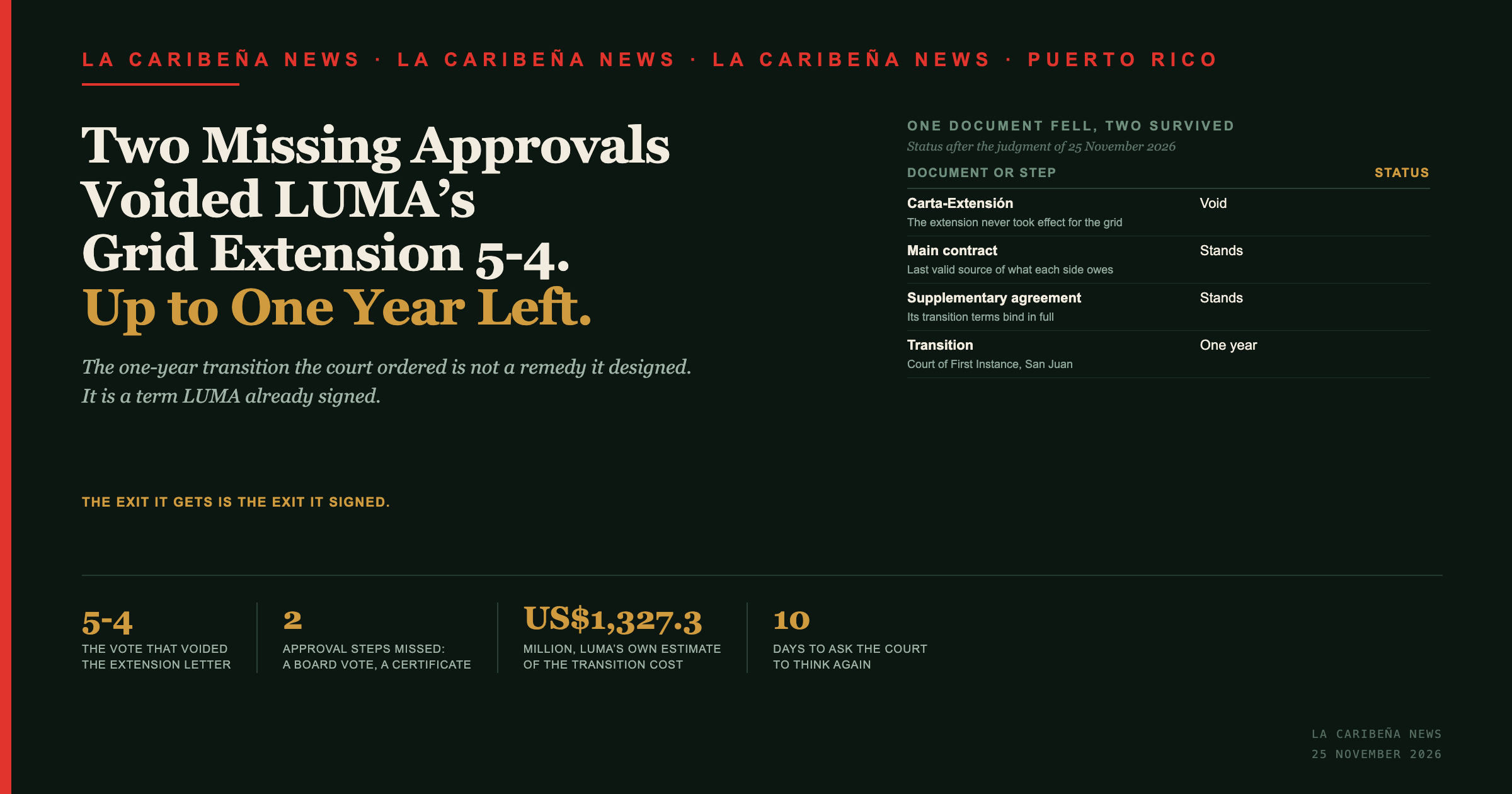
Title card, text equivalent
All figures on the title card, with their sources.
- 5-4: the vote by which the Supreme Court of Puerto Rico held the Carta-Extensión void. Source: 2026 TSPR 118, 25 November 2026.
- 2026 TSPR 118, case CT-2025-0006 consolidated with CT-2025-0007: the citation and docket. Source: the Supreme Court of Puerto Rico's own 2026 decisions index.
- One year: the contractual term within which the transition must conclude, running from the date the Opinion and Judgment takes effect. Source: the opinion, which calls it the "término contractual de un año".
- Ten days: the shortened window for a single request for reconsideration, under Rule 50 of the court's regulations. Source: the opinion.
- Two approval steps missed: the affirmative vote of the two public-interest representatives on the board of the Autoridad para las Alianzas Público-Privadas, and an energy compliance certificate from the Negociado de Energía. Source: the opinion.
- US$1,327.3 million and about US$726 million: LUMA Energy's own estimate of the cost of the transition, and the portion it says is unavoidable, as recorded in the dissent. Source: the dissenting opinion in 2026 TSPR 118.
- US$1,314.3 million: the total this newspaper reported on 6 October 2026 from LUMA's brief of 5 October, which differs from the dissent's total by US$13.0 million. Source: La Caribeña News, 6 October 2026.
- 1.5 million: customers served on the transmission and distribution system. Source: La Caribeña News, 6 October 2026, from LUMA's brief.
- Five amicus curiae parties. Source: the opinion's appearance list.
Entities named in this report
- Supreme Court of Puerto Rico (Tribunal Supremo de Puerto Rico) is the island's highest court, which decided this case.
- LUMA Energy, LLC is the private operator of Puerto Rico's electricity transmission and distribution system.
- Autoridad para las Alianzas Público-Privadas (AAPP) is Puerto Rico's public-private partnerships authority, and a petitioner here.
- Puerto Rico Electric Power Authority (Autoridad de Energía Eléctrica, AEE) is the public power utility that owns the system, and a petitioner here.
- Negociado de Energía is Puerto Rico's energy regulator, which issues the energy compliance certificate the extension lacked.
- Court of First Instance (Tribunal de Primera Instancia) is the trial court that will supervise the transition, through Judge Anthony Cuevas Ramos in San Juan.
- Ley Núm. 29-2009 is Puerto Rico's public-private partnerships statute.
- Ley Núm. 120-2018 governs the transformation of the Puerto Rico Electric Power Authority.
- Financial Oversight and Management Board for Puerto Rico is the federally created board overseeing the island's finances, and an amicus here.
- Unión de Trabajadores de la Industria Eléctrica y Riego (UTIER) is the electrical and irrigation workers' union, and an amicus here.
- Asociación de Industriales de Puerto Rico is the island's manufacturers' association, and an amicus here.
Frequently asked questions
Did Puerto Rico cancel LUMA Energy's contract?
No. The court voided the extension letter only. The main contract and the supplementary agreement both stand, and the court called them the last valid source of what each side owes.
Why was the extension letter void?
It changed the deals in force so much that it counted as a transaction of the power authority, so it had to clear the same safeguards as the documents it changed. Two were missing. One was a yes vote from the two public-interest members of the partnerships authority's board. The other was an energy compliance certificate from the energy regulator.
How long does LUMA keep operating the grid?
Up to one year. The court ordered a swift handover, to end within the one-year term the contract itself sets. The clock runs from the date the judgment took effect, 25 November 2026, when the parties were notified. The ruling names no successor operator.
Who supervises the transition?
The Court of First Instance in San Juan, through Judge Anthony Cuevas Ramos. The Supreme Court sent him the case and the file. That court will also hear any other legal or contract claim between the parties.
Does the ruling decide the US$1.3 billion LUMA says the exit will cost?
No. The majority made no finding on it. The dissent records LUMA's estimate as US$1,327.3 million, of which about US$726 million is unavoidable. It stays a party's own figure, filed in its own defence. The Court of First Instance is where those claims are heard now.