By LCN Business Desk
The gas aboard the tanker was due to run out at one o'clock on Saturday morning. At 12:17 on Friday afternoon, the company told Puerto Rico's power authority that the next vessel was "por determinarse", to be determined.
By then a federal judge had already ordered the company to let somebody else bring gas in.
What did the court order?
That NFEnergía LLC open the San Juan terminal to rival suppliers, despite holding an exclusivity contract over it.
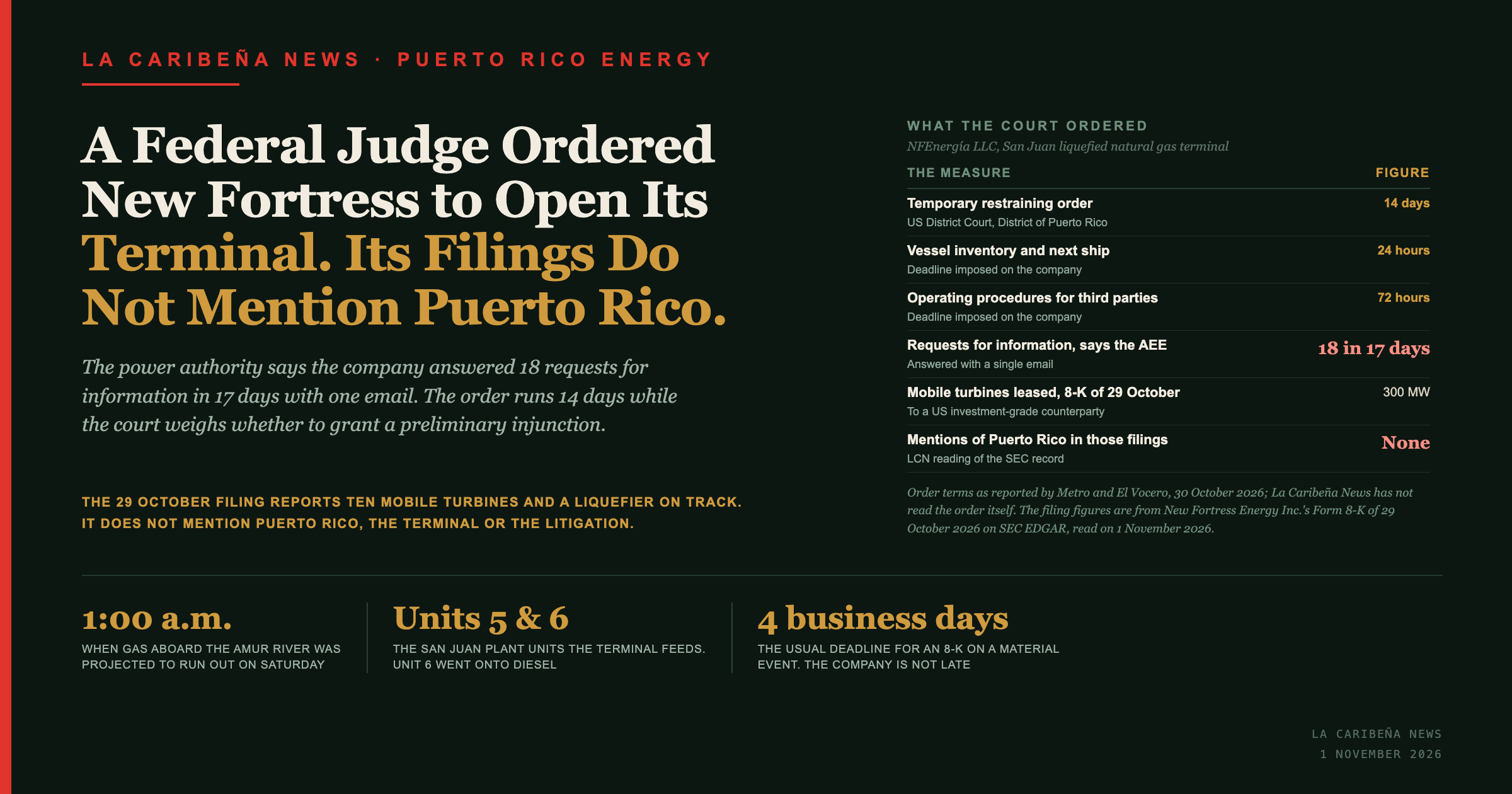
Senior District Judge Pedro A. Delgado Hernández, of the United States District Court for the District of Puerto Rico, granted a temporary restraining order sought by the Autoridad de Energía Eléctrica through the island's public-private partnership authority. Metro and El Vocero both reported it on 30 October; El Vocero places the order itself a day earlier. The power authority says the judge ruled in under four hours.
| The order requires NFEnergía to | Within |
|---|---|
| Report the gas inventory aboard the *Amur River*, when it runs out, and the identity, volume and arrival date of any next vessel | 24 hours |
| Confirm whether the terminal, regasification equipment and pipelines are available for third-party deliveries | 24 hours |
| Name an authorised representative reachable at all times | 24 hours |
| Hand over its procedures for receiving and metering gas, coordinating vessels and transferring title to fuel, with the criteria for judging whether a ship fits the terminal | 72 hours |
| Refrain from any act that impedes or delays third-party gas | throughout |
| Stop conditioning receipt of third-party gas on payment of invoices that are in dispute | throughout |
*Terms as reported by Metro and El Vocero. LCN has not read the order itself and relies on those reports for its contents.*
The order runs an initial 14 days while the court considers whether to grant a preliminary injunction. It is a restraining order, not a final ruling, and the underlying claims are untested.
The judge's reasoning was about the grid rather than the contract. Compromising the reliability of Puerto Rico's electricity network, he found, "constituye claramente un daño irreparable", clearly constitutes irreparable harm. The terminal is the only place in northern Puerto Rico where liquefied natural gas can be landed, and the only route by which fuel reaches units 5 and 6 of the San Juan plant.
What was happening on the ground?
One unit back on gas, one on diesel, and a tanker emptying on a schedule nobody had replaced.
San Juan unit 5 returned to gas on 28 October. Unit 6 went onto diesel. The mobile TM2500 generators had been taking gas in ISO containers since 15 October and, from 22 October, through the terminal header as well.
New Fortress Energy's position, as reported, is that the difficulty is port access rather than the contract or the availability of gas. The company had not responded to El Vocero by its press time.
What have investors been told?
About turbines, and about a liquefier returning to service. Not about Puerto Rico.
New Fortress Energy Inc. filed a Form 8-K on 29 October, under the item used for Regulation FD disclosure. It reports that the company has agreed to lease ten mobile turbines capable of generating up to 300 megawatts to a United States investment-grade counterparty on an initial five-year lease, with delivery staged from the fourth quarter of 2026 into the first quarter of 2027, and says the arrangement is expected to be accretive and to strengthen liquidity. It confirms the FLNG 1 liquefier remains on track to return to service in the fourth quarter.
It does not mention Puerto Rico, the power authority, the San Juan terminal, the litigation or any court order.
That filing is the company's most recent of any kind. The one before it, on 5 October, reported the Fast LNG turbine failure, and LCN has already reported that its supplier had already told the SEC something else while the *Amur River* sat offshore. The island was absent from that one as well.
Two filings, five weeks apart, spanning a payment standoff, a lawsuit, a tanker running dry and a court order.
None of that makes the company late. A Form 8-K reporting a material event is generally due within four business days, which for an order issued on the Thursday or Friday leaves until about 4 or 5 November. The 29 October filing predates the order and could not have covered it. Regulation FD disclosure is furnished voluntarily rather than filed under compulsion, and no company is obliged to narrate a lawsuit in it. What the record shows is a pattern of emphasis, not a breach of a deadline.
Why does a Caribbean reader care about a San Juan terminal?
Because the structure is the one several Caribbean grids have bought into, and this is what it looks like when it is tested.
A single private operator holds the only import point, supplies the fuel through it, and bills the state utility. When supply and payment fall into dispute, the utility cannot simply buy elsewhere, because elsewhere has nowhere to land. The contract anticipated that, through the tolling provision the power authority went to court to enforce, and enforcing it still took a judge.
LCN has reported what the same arithmetic costs in Guyana, where a unit of rented power really costs about 19 cents once the fuel the state buys itself is counted, and PREPA's own experience was part of that comparison. The lesson arriving now is narrower and more practical. A tolling clause is worth what it is worth on the day the supplier stops, and on that day it is a court document rather than a commercial one.
For a government negotiating generation capacity, the question the San Juan order puts is not whether an exclusivity contract is acceptable. It is what the contract says happens in the 24 hours after a cargo fails to arrive, who must answer, how fast, and in writing.
What is not established
Several things, and they matter to how far any of this reaches.
- LCN has not read the order. Its terms here come from Metro and El Vocero, and the case number has not been published in the reporting examined.
- The date is in conflict between the two outlets, and neither reading has been preferred over the other.
- The amounts in dispute are not published. A figure of about US$100 million for diesel burned when gas was not delivered was given by the gas contract administrator at a House hearing on 19 October. The figure is an estimate stated at a hearing rather than a court finding, and it rests on a single account.
- **How much gas actually remained aboard the *Amur River*** has not been published.
- No replacement supply agreement is signed. The government has said it aims to have agreements in place in the week beginning 2 November. An aim is not an agreement.
The entities
- New Fortress Energy Inc. is the United States-listed energy company, SEC filer CIK 0001749723, trading as NFE.
- NFEnergía LLC is the New Fortress Energy subsidiary that holds the San Juan terminal contract and is the respondent to the order.
- Autoridad de Energía Eléctrica (AEE) is Puerto Rico's public electric power authority, the applicant for the order.
- Pedro A. Delgado Hernández is the Senior District Judge of the United States District Court for the District of Puerto Rico who granted it.
- Amur River is the liquefied natural gas carrier whose cargo was running out at the San Juan terminal.
- Form 8-K is the filing by which a United States-listed company reports material events to the Securities and Exchange Commission.
What the title card says
- Headline: a federal judge ordered New Fortress to open its Puerto Rico terminal, and its two most recent filings to investors do not mention Puerto Rico.
- Temporary restraining order granted by Senior District Judge Pedro A. Delgado Hernández, United States District Court for the District of Puerto Rico, reported 30 October 2026. Source: Metro, El Vocero.
- Duration: an initial 14 days, while the court considers a preliminary injunction. Source: Metro.
- Reporting deadlines imposed on the company: 24 hours for vessel inventory and terminal availability, 72 hours for operating procedures. Source: Metro, El Vocero.
- The power authority says the company answered 18 requests for information across 17 days with a single email, sent Friday at 12:17. Source: El Vocero.
- Gas aboard the Amur River projected to run out at 1:00 a.m. Saturday. Source: El Vocero.
- New Fortress Energy Form 8-K filed 29 October 2026: ten mobile turbines, up to 300 megawatts, five-year initial lease. Source: SEC EDGAR.
- That filing and the one before it do not mention Puerto Rico. LCN reading of the SEC record, 1 November 2026.
Frequently Asked Questions
What did the court order New Fortress Energy to do?
A United States District Court judge in Puerto Rico granted a temporary restraining order requiring NFEnergía to let alternative liquefied natural gas suppliers use its San Juan terminal, to report within 24 hours on the gas remaining aboard the *Amur River* and on any next vessel, to hand over its operating procedures within 72 hours, and to stop conditioning third-party deliveries on payment of disputed invoices.
Is this a final ruling against the company?
No. It is a temporary restraining order running an initial 14 days while the court considers whether to grant a preliminary injunction. The underlying claims have not been tested and the company's reported position is that the difficulty is port access rather than the contract or the availability of gas.
Has New Fortress Energy told the SEC about the order?
Not in any filing on the record as at 1 November 2026. Its most recent filing, a Form 8-K of 29 October, concerns a lease of ten mobile turbines and the FLNG 1 liquefier, and predates the order. A Form 8-K reporting a material event is generally due within four business days, so the company is not late.
Why does the San Juan terminal matter so much?
It is the only facility in northern Puerto Rico where liquefied natural gas can be landed, and the only route by which fuel reaches units 5 and 6 of the San Juan plant. With one operator holding the import point and supplying the fuel through it, the utility cannot buy from anyone else without access to that terminal.