By LCN Business Desk
Mexico takes 22.3 per cent of all the foreign investment going into Latin America and the Caribbean, second only to Brazil. On Tuesday it published what its record is made of.
What did Mexico report?
The Secretaría de Economía announced a historic maximum in foreign direct investment for the first nine months of 2026, in Comunicado 114 on 24 November 2026. The figure is US$43.1 billion, and the rise of 5.3 per cent is measured against the US$40.9 billion first published for the same months of 2025.
The ministry's quarterly report to Congress for the third quarter is not out yet. So the release is the fullest account of these figures that exists, and it carries the three-way split Mexico always reports. The split, rather than the total, is what tells a rival economy anything.
What is inside the record?
Mexico reports foreign investment in three parts: new investment, profits ploughed back in, and lending between related firms.
| Component | US$ billion | Share | Change on 2025 |
|---|---|---|---|
| Reinvested earnings | 35.0 | 81.2% | +26.0% |
| Intercompany accounts | 4.3 | 10.0% | −34.6% |
| New investment | 3.8 | 8.8% | −42.1% |
| Total | 43.1 | 100.0% | +5.3% |
Reinvested earnings are profits a foreign firm already made in Mexico and chose not to take out. Intercompany accounts are loans between related firms. New investment is money arriving from outside.
The ministry gives no year-on-year figure for new investment as a whole. It reports a rise of 58.8 per cent in the factory part of that line, from US$708 million to US$1.1 billion, led by transport gear and by computing. The 42.1 per cent fall across the whole line is arithmetic on the ministry's own two published totals, not a figure it chose to print.
The United States supplied US$19.3 billion, or 44.9 per cent. Spain sent US$6.2 billion, Germany US$2.9 billion, the United Kingdom US$2.6 billion and Canada US$2.4 billion. Japan and the Netherlands were in the top five a year ago and are out of it now. Factories took US$19.2 billion, finance US$10.6 billion, and transport, post and storage US$3.1 billion.
Mexico City takes 45.5 per cent of the total by state. That is where firms register, not where they build.
Has new investment been falling for years?
No. It collapsed once, in 2023, and has not recovered its earlier level.
| January to September | Total | New investment | Share |
|---|---|---|---|
| 2021 | US$24.8bn | US$9.5bn | 38.4% |
| 2022 | US$32.1bn | US$14.5bn | 45.2% |
| 2023 | US$32.9bn | US$2.8bn | 8.5% |
| 2024 | US$35.7bn | US$2.1bn | 6.0% |
| 2025 | US$40.9bn | US$6.6bn | 16.0% |
| 2026 | US$43.1bn | US$3.8bn | 8.8% |
The 2023 drop was US$11.7 billion in a single year. The 2025 figure of US$6.6 billion was a part recovery, and Marcelo Ebrard, then economy secretary, put it down in November 2025 to data centres, energy, roads and finance. These were new money and not profits ploughed back in, he said, in those terms. He would not name the firms. Asked directly, he would not tie them to nearshoring either. The 2026 fall is measured against that year.
Does the new investment line count new factories?
Not only. The Economic Commission for Latin America and the Caribbean says in its 2026 report that new-build projects and foreign takeovers of local firms both land in the same equity line. A buyer of an existing Mexican firm shows up where a firm building a plant shows up.
That cuts both ways. A fall in new investment is not by itself a fall in factories, and a rise in it would not be proof of factories either.
The ministry has shown before what a single deal can do to the line. In its report for the third quarter of 2022 it called the Televisa and Univisión merger and the Aeroméxico restructuring extraordinary movements worth US$6.9 billion. Without them, it said, foreign investment that period rose 1.8 per cent, against the 29.5 per cent it had reported. Comunicado 114 carries no equivalent note.
The ministry also warns that its figures are not final, because firms tell the national register late, and that the biggest revisions land on the most recent quarters. Both numbers behind the 8.8 per cent will move.
Why does the measurement basis change the answer?
Because Mexico counts on a different basis from the rest of the region. The Commission's own note gives Mexico's 2025 inflow as US$43.2 billion on the assets and liabilities basis used across Latin America and the Caribbean, which is 5.0 per cent below 2024. Mexico's own measure gave US$40.9 billion and a rise of 10.8 per cent.
A record on one basis and a fall on the other. Same year, same country. The Commission places the gap in loans between related firms, the part the ministry reports down 34.6 per cent this year, and notes that every other country in the region counts on the newer basis.
What did Mexico announce against what it received?
The value of projects announced across Latin America and the Caribbean fell 34.3 per cent in 2025, to US$114.1 billion across 1,326 projects, on the Commission's reading of Financial Times fDi Markets data. Set aside one US$37.7 billion data centre in Ceará, Brazil, and the regional total was US$76.4 billion. The Commission calls that fall of 56 per cent the equal of 1.4 per cent of regional output. Mexico's announced value fell 43 per cent.
So announcements fell 43 per cent in the year Mexico's actual inflow set a record. The two numbers measure different things. A government quoting announcements is quoting the one that fell.
Where does the Caribbean sit in the same table?
Caribbean inflows were US$16.4 billion in 2025, down 1.0 per cent, which is 8.5 per cent of the regional total.
| 2025 inflow | Amount | Change |
|---|---|---|
| Guyana | US$9.0bn | −14.0% |
| Dominican Republic | US$5.0bn | +11.3% |
| Suriname | US$2.0bn | +206% |
| Jamaica | US$283m | −7.2% |
| Antigua and Barbuda | US$282m | n/a |
| Saint Lucia | US$245m | n/a |
| Grenada | US$171m | n/a |
| Bahamas | US$120m | −50.1% |
| Trinidad and Tobago | −US$794m | n/a |
Trinidad and Tobago's figure is negative, meaning more foreign capital left the country in 2025 than entered it.
Guyana alone is 55 per cent of the Caribbean figure. Its US$9.0 billion is its second highest since 1996, even after a fall of 14 per cent. Across 2021 to 2025, foreign money made up 40.2 per cent of all the fixed capital Guyana put in place, the highest share in the region. The Commission has no 2025 data for Barbados or Haiti, and puts Belize at close to nil. The six OECS members drew US$850 million between them.
Two bodies put Caribbean growth excluding Guyana at 1.2 per cent and 2.5 per cent in October. The investment table has the same shape. One economy carries the whole.
New capital does still arrive, and some of it with state backing behind it. The sixth UK Business Mission to Guyana is running in Georgetown this week with more than 30 British firms, and UK Export Finance will fund a Guyanese buyer at up to 100 per cent of project value.
What does Mexico say the result means?
The ministry puts it down to sound macroeconomics and to Plan México, its industry programme. Its report a year earlier used the word nearshoring, saying the figures made Mexico a central hub within it. Comunicado 114 does not use the word at all.
The Commission is blunter about what a high reinvestment share can mean. Its footnote says profits left in place may reflect rules that block taking them out, rather than a free choice to expand. Its text calls a rising reinvestment share predictable, given a bigger stock of investment and no great change in profit. On that reading the 81.2 per cent needs no change of mood to explain it.
Mexico's own economy grew 0.9 per cent in the third quarter and 1.9 per cent across nine months, on the first estimate from the national statistics institute, dated 30 October 2026.
Where does the USMCA review stand?
Not renewed, and still in force. The United States Trade Representative said on 1 July 2026 that the United States did not agree to renew the agreement in its current form. It stays in force, the statement said, until the issues are settled or the deal ends. Talks with Mexico reached a third round in the week of 20 July 2026.
President Claudia Sheinbaum is separately weighing larger purchases of United States goods to narrow a bilateral surplus. AT&T agreed in October to sell its Mexican wireless unit to Grupo Televisa and Fintech Holdings for US$2 billion.
What does this mean for a business in the Caribbean?
It means the money that builds things is scarcer than the headline totals suggest, and the shortage is regional rather than Mexican. The equity component across Latin America and the Caribbean is still below its level in the 2010s, on the Commission's own view. Profits left in place make up 51 per cent of regional inflows, and 81.2 per cent of Mexico's.
For an investment agency in Kingston, Bridgetown or Georgetown, the position is exact. The yardstick country drew US$3.8 billion of new money in nine months, less than half what it drew in the same months of 2025, and its announced pipeline fell 43 per cent the year before. A Caribbean economy is not up against Mexico's US$43.1 billion. It is after a share of a much smaller pool, against a country whose own share of it is falling.
What wins a board, on this evidence, is profit already earned in the market, because that is what 81 per cent of Mexico's record consists of. Three International Monetary Fund economists reported in November that foreign investment in Latin America and the Caribbean produces weaker export growth than in peer regions, putting 20 per cent on the gap. And when the OECD measured the region's steel trade it counted Brazil, Mexico, Argentina, Colombia, Chile and Peru, and no Caribbean economy at all. The comparisons that shape a board's assumptions about this region are built without it.
What the title card shows
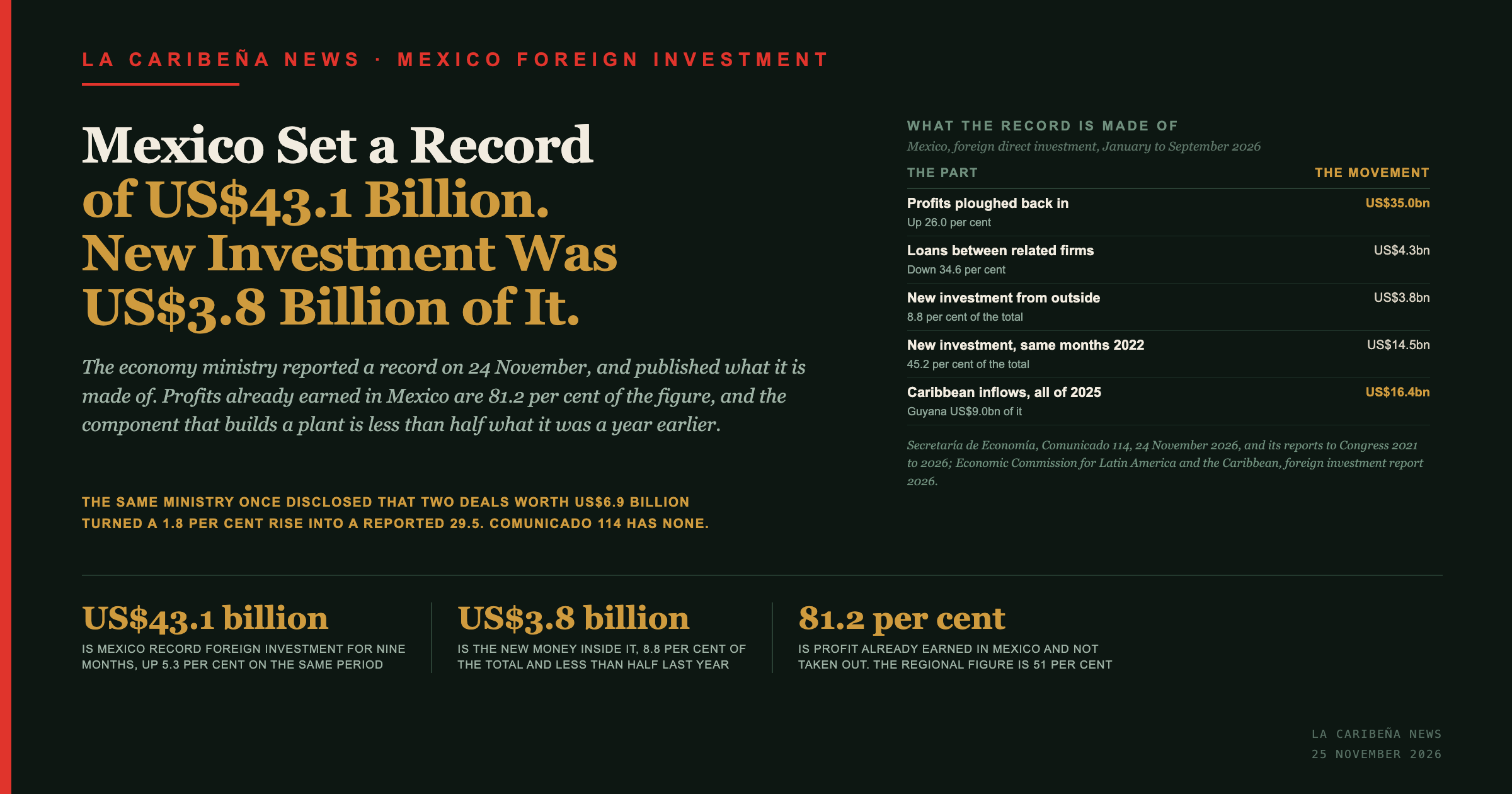
- Total foreign direct investment, January to September 2026: US$43.1 billion, per Secretaría de Economía Comunicado 114, 24 November 2026, up 5.3 per cent. - New investment: US$3.8 billion, 8.8 per cent of the total. - Reinvested earnings: US$35.0 billion, 81.2 per cent, up 26.0 per cent. - Intercompany accounts: US$4.3 billion, 10.0 per cent, down 34.6 per cent. - New investment in the same period of 2022: US$14.5 billion, 45.2 per cent of the total then. - Mexico's 2025 inflow on the regional measurement basis: US$43.2 billion, down 5.0 per cent, per the Economic Commission for Latin America and the Caribbean, 2026. - Announced project value in Mexico, 2025: down 43 per cent, on the Commission's reading of Financial Times fDi Markets data. - Caribbean inflows 2025: US$16.4 billion, down 1.0 per cent, Guyana US$9.0 billion of it.
Sources: Secretaría de Economía, Comunicado 114, 24 November 2026, and its statutory reports to Congress for 2021 to 2026; Economic Commission for Latin America and the Caribbean, La Inversión Extranjera Directa en América Latina y el Caribe 2026; Instituto Nacional de Estadística y Geografía, Boletín 673/26, 30 October 2026; Office of the United States Trade Representative, 1 July 2026; Expansión, 24 November 2026.
The entities
- Secretaría de Economía is Mexico's economy ministry, which publishes the country's foreign direct investment figures and reported US$43.1 billion on 24 November 2026. - Economic Commission for Latin America and the Caribbean (ECLAC) is the United Nations regional commission whose annual foreign investment report gives the comparable figures for 33 countries. - Instituto Nacional de Estadística y Geografía (INEGI) is Mexico's statistics institute, which put third-quarter growth at 0.9 per cent on 30 October 2026. - Organisation for Economic Co-operation and Development (OECD) is the body whose study of regional steel trade counted six Latin American economies and no Caribbean one. - United States-Mexico-Canada Agreement (USMCA) is the trade agreement whose joint review the United States declined to conclude as a renewal on 1 July 2026. - Office of the United States Trade Representative (USTR) is the United States trade agency that issued that statement. - Plan México is the Mexican government's industrial policy programme, named in Comunicado 114 as a reason for the result. - Claudia Sheinbaum is the President of Mexico. - Marcelo Ebrard was Mexico's economy secretary when the 2025 new investment figure was published.
Frequently asked questions
Is the record total wrong?
No. US$43.1 billion is Mexico's own published figure and it is the highest for a January to September period. The question the composition raises is what kind of capital it is, and the ministry answers that itself: 81.2 per cent is profits already earned in Mexico.
Why does 8.8 per cent appear where other reports say 9 per cent?
Because US$3.8 billion of US$43.1 billion is 8.82 per cent. The ministry publishes both figures and the ratio follows from them.
Does a fall in new investment mean fewer factories?
Not by itself. The Commission states that the component counts both greenfield projects and cross-border acquisitions of existing Mexican companies, so a change in it does not separate one from the other.
Why do two different figures exist for Mexico's 2025 inflow?
Because Mexico publishes on a directional basis and the rest of the region on an assets and liabilities basis. Mexico's own measure gave US$40.9 billion and a rise of 10.8 per cent for calendar 2025. The Commission's gave US$43.2 billion and a fall of 5.0 per cent.
What is the Caribbean's share?
US$16.4 billion in 2025, or 8.5 per cent of inflows to Latin America and the Caribbean, down 1.0 per cent on 2024. Guyana accounts for US$9.0 billion of it.