By LCN Business Desk
A lender sizing the Caribbean without its oil economy reaches for a figure that strips Guyana out. There are two of them in circulation this month, and one is about double the other.
The Economic Commission for Latin America and the Caribbean put regional growth at 2.0 per cent for 2026, reported by UN News on 22 October, revising down the 2.2 per cent it published in its Economic Survey of Latin America and the Caribbean 2026 on 20 August. Inside that, it gives the Caribbean 7.4 per cent this year, a figure it says is driven by Guyana, and 1.2 per cent once Guyana is taken out.
Earlier in October the World Bank published the same kind of figure and reached a different place. Its Latin America and the Caribbean Economic Update, which put Guyana at 23.7 per cent against 2.2 per cent for the region, expects Caribbean growth excluding Guyana at 2.5 per cent in 2026 and 3.7 per cent in 2027.
Where exactly do they diverge?
They diverge on the Caribbean without Guyana, and almost nowhere else.
| CEPAL | World Bank | |
|---|---|---|
| Latin America and the Caribbean, 2026 | 2.0% | 2.2% |
| Latin America and the Caribbean, 2025 | 2.4% | 2.4% |
| Caribbean excluding Guyana, 2026 | 1.2% | 2.5% |
| Caribbean excluding Guyana, 2027 | 1.9% | 3.7% |
*CEPAL figures as reported by UN News on 22 October 2026; World Bank figures from its October Latin America and the Caribbean Economic Update.*
On the headline for the whole region the two are a fifth of a point apart and agree exactly on last year. On the subregional figure they are roughly a factor of two apart in both forecast years.
Could they simply be counting different countries?
In part. CEPAL's list is published and runs to 13 countries. The World Bank's is not.
The projections table attached to the Commission's Economic Survey of Latin America and the Caribbean 2026 names its Caribbean as Antigua and Barbuda, The Bahamas, Barbados, Belize, Dominica, Grenada, Guyana, Jamaica, Saint Kitts and Nevis, Saint Lucia, Saint Vincent and the Grenadines, Suriname and Trinidad and Tobago. A note beneath it places Cuba, the Dominican Republic and Haiti in Central America instead.
So the Dominican Republic sits outside everything CEPAL calls Caribbean, and the same table gives that economy 4.0 per cent for 2026, faster than any Caribbean member it lists except Guyana. An aggregate drawn to include it reads higher than one drawn to exclude it, which is the direction of the gap between the two institutions. The size of that effect cannot be worked out, because the World Bank has not published the countries behind its own figure. The vintages differ as well, with CEPAL's October projections dated 22 October and the World Bank update earlier in the month.
Why does the ex-Guyana figure matter more than the headline?
Because the headline is one country.
Roughly six percentage points sit between the subregion as published and the subregion as most of its economies experience it.
Guyana's scale is why. Its own accounts have the oil and gas industry expanding 41.3 per cent in the first half of 2026, and the World Bank's 23.7 per cent for the country sits against 2.2 per cent for the region around it.
What happened when CEPAL revised its own forecast?
The region came down and the Caribbean went up.
| CEPAL projection for 2026 | August | October |
|---|---|---|
| Latin America and the Caribbean | 2.2% | 2.0% |
| The Caribbean | 5.6% | 7.4% |
| The Caribbean excluding Guyana | 1.1% | 1.2% |
*August figures from the Economic Survey of Latin America and the Caribbean 2026, based on information as of 30 July 2026. October figures as reported by UN News on 22 October 2026.*
A subregion was marked up by 1.8 percentage points in the same two months the region around it was marked down, while the measure that strips out one country moved by a tenth. Whatever the Commission changed its mind about in the Caribbean, it was Guyana.
The World Bank's regional figure is the one CEPAL carried before that revision, so the agreement between the two at the headline rests on a number one of them has since left.
Does the same thing happen elsewhere in the region?
Once more, in CEPAL's own figures, and in the opposite direction.
Central America is given 1.7 per cent for 2026 and 2.8 per cent for 2027. CEPAL states that Cuba and Haiti weigh those down, and that without them the subregion averages 4.1 per cent and 4.2 per cent.
CEPAL publishes an ex-outlier figure for two of its aggregates and for no others: the Caribbean without Guyana, and Central America without Cuba and Haiti. One is pulled up by a single economy and one pulled down by two. The Commission is marking its own distorted averages, and South America, at 2.1 per cent for 2026 and 2.4 per cent for 2027, carries no such correction.
What should a firm or a ministry use?
The ex-outlier figure, and the name of the institution that produced it.
Any forecast cited as "Caribbean growth" means little without knowing whether Guyana sits inside it, and whose aggregate it is. A plan built on 7.4 per cent describes an oil economy. A plan built on either of the lower figures describes the rest, and which of the two a lender uses is a decision about whose aggregate to trust rather than a reading of the same data.
What is not established here?
The World Bank has not published the economies behind its Caribbean figure, so the share of the gap that is definitional has a direction and no size.
The UN News account of CEPAL's October projections does not name the publication they accompany and does not name a presenter.
The entities
- Economic Commission for Latin America and the Caribbean is the United Nations regional commission, known as CEPAL, whose October projections put regional growth at 2.0 per cent for 2026.
- World Bank is the development institution whose Latin America and the Caribbean Economic Update of October 2026 put Caribbean growth excluding Guyana at 2.5 per cent.
- Latin America and the Caribbean Economic Update is the World Bank's twice-yearly regional report carrying those projections.
- UN News is the United Nations news service that reported CEPAL's projections on 22 October 2026.
- Guyana is the economy whose growth lifts the published Caribbean average, and whose removal produces the divergent figures.
- Economic Survey of Latin America and the Caribbean 2026 is the Commission's August publication whose projections table names the 13 countries in its Caribbean aggregate.
- Dominican Republic is the economy CEPAL counts in Central America rather than the Caribbean, and projects at 4.0 per cent for 2026.
- Central America is the subregion CEPAL gives 1.7 per cent, rising to 4.1 per cent when Cuba and Haiti are excluded.
What the title card says
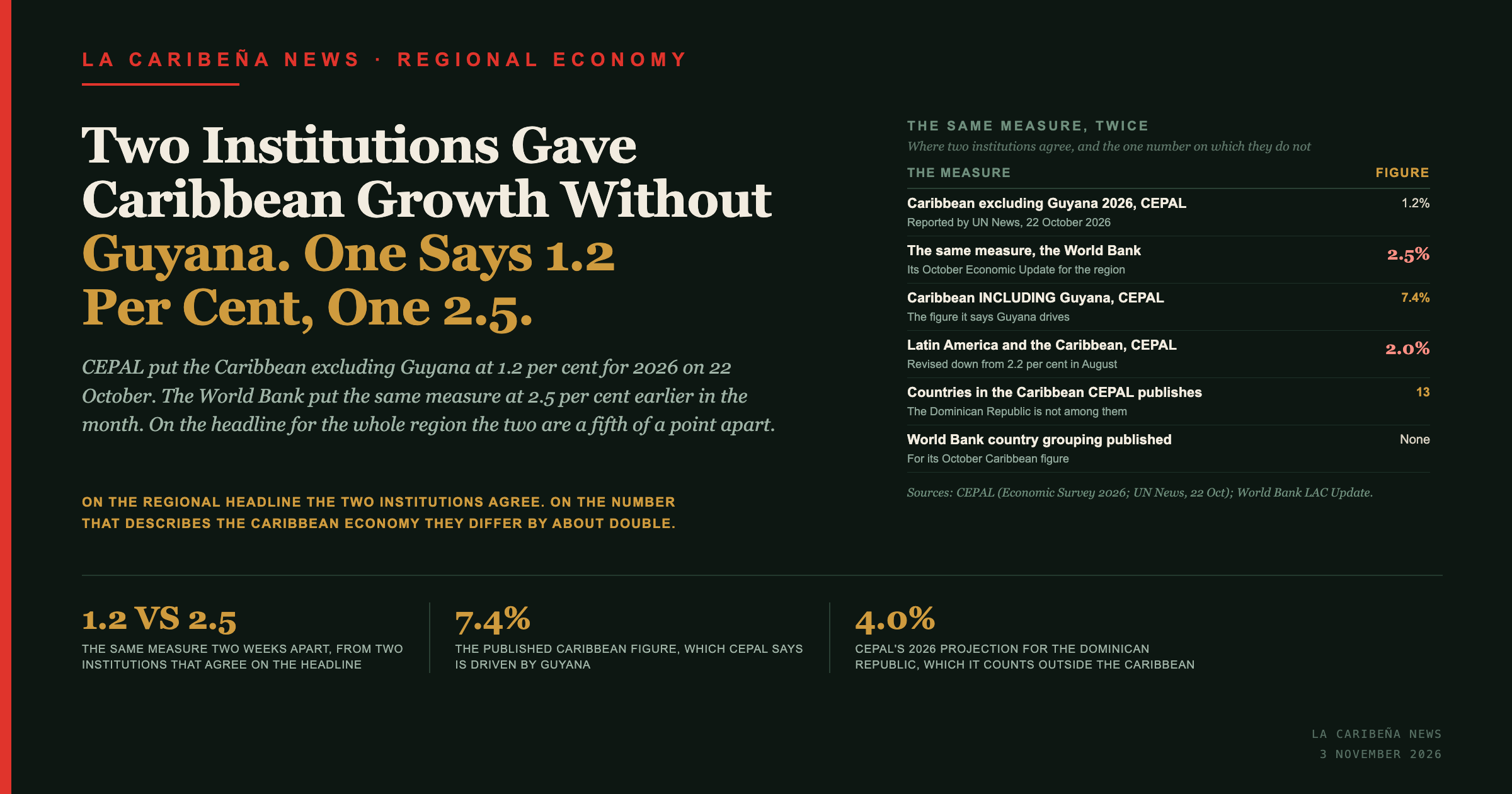
- Headline: two institutions gave Caribbean growth without Guyana, and one says 1.2 per cent and one 2.5.
- CEPAL, Caribbean excluding Guyana, 2026: 1.2 per cent, reported by UN News on 22 October 2026.
- World Bank, the same measure and year: 2.5 per cent, from its October Economic Update.
- CEPAL, Caribbean including Guyana, 2026: 7.4 per cent, the figure it says Guyana drives.
- CEPAL, Latin America and the Caribbean, 2026: 2.0 per cent, revised down from 2.2 per cent in August.
- Countries in the Caribbean grouping CEPAL publishes: 13.
- Whether the Dominican Republic is among them: no.
- CEPAL's 2026 projection for the Dominican Republic: 4.0 per cent.
- World Bank country grouping published for its October Caribbean figure: none.
Frequently Asked Questions
What is Caribbean growth excluding Guyana in 2026?
It depends which institution is cited. CEPAL puts it at 1.2 per cent for 2026 and 1.9 per cent for 2027. The World Bank's October Latin America and the Caribbean Economic Update puts the same measure at 2.5 per cent and 3.7 per cent.
Do the two agree on anything?
Largely on the headline. CEPAL gives Latin America and the Caribbean 2.0 per cent for 2026 and the World Bank 2.2 per cent, and both put 2025 at 2.4 per cent. The divergence is concentrated in the Caribbean subregional figure.
Why is the published Caribbean figure so high?
Because it includes Guyana. CEPAL gives the Caribbean 7.4 per cent for 2026 and states the figure is driven by Guyana, whose own accounts have the oil and gas industry expanding 41.3 per cent in the first half of 2026.
Could the gap just be different country lists?
In part. CEPAL publishes its grouping, 13 countries, and counts Cuba, the Dominican Republic and Haiti in Central America rather than the Caribbean. The Dominican Republic is projected at 4.0 per cent for 2026, so an aggregate including it reads higher than one excluding it. The World Bank has not published the economies behind its figure, so the size of that effect cannot be established.
Does the same pattern appear in Central America?
Yes, inverted. CEPAL gives Central America 1.7 per cent for 2026 and 2.8 per cent for 2027, and states that without Cuba and Haiti those averages would be 4.1 per cent and 4.2 per cent.
Correction, 3 November 2026. This article originally stated that neither institution had published the country grouping behind its Caribbean figure, and that the prior CEPAL projection of 2.2 per cent was not confirmed against the Commission. Both statements were wrong. The projections table attached to the Commission's Economic Survey of Latin America and the Caribbean 2026 of 20 August 2026 publishes the 13-country grouping and the 2.2 per cent figure. The article now carries that grouping, the exclusion of Cuba, the Dominican Republic and Haiti from it, and the August to October revision. The World Bank's grouping remains unpublished. The same table also showed that the Commission publishes more subregional aggregates than the three this article originally attributed to it, and that passage has been rewritten to say what the table shows. The CEPAL and World Bank projections in this article are unchanged.