By LCN Business Desk
Nicolás Gómez-Parra, Eric Huang and Robin Koepke of the International Monetary Fund published a summary of their finding on 9 November 2026, and attached a sentence to the headline number that most reports of it left out.
What does the 20 per cent actually say?
That if the region's investment-to-trade link matched its peers, exports would be higher. Not that they will be.
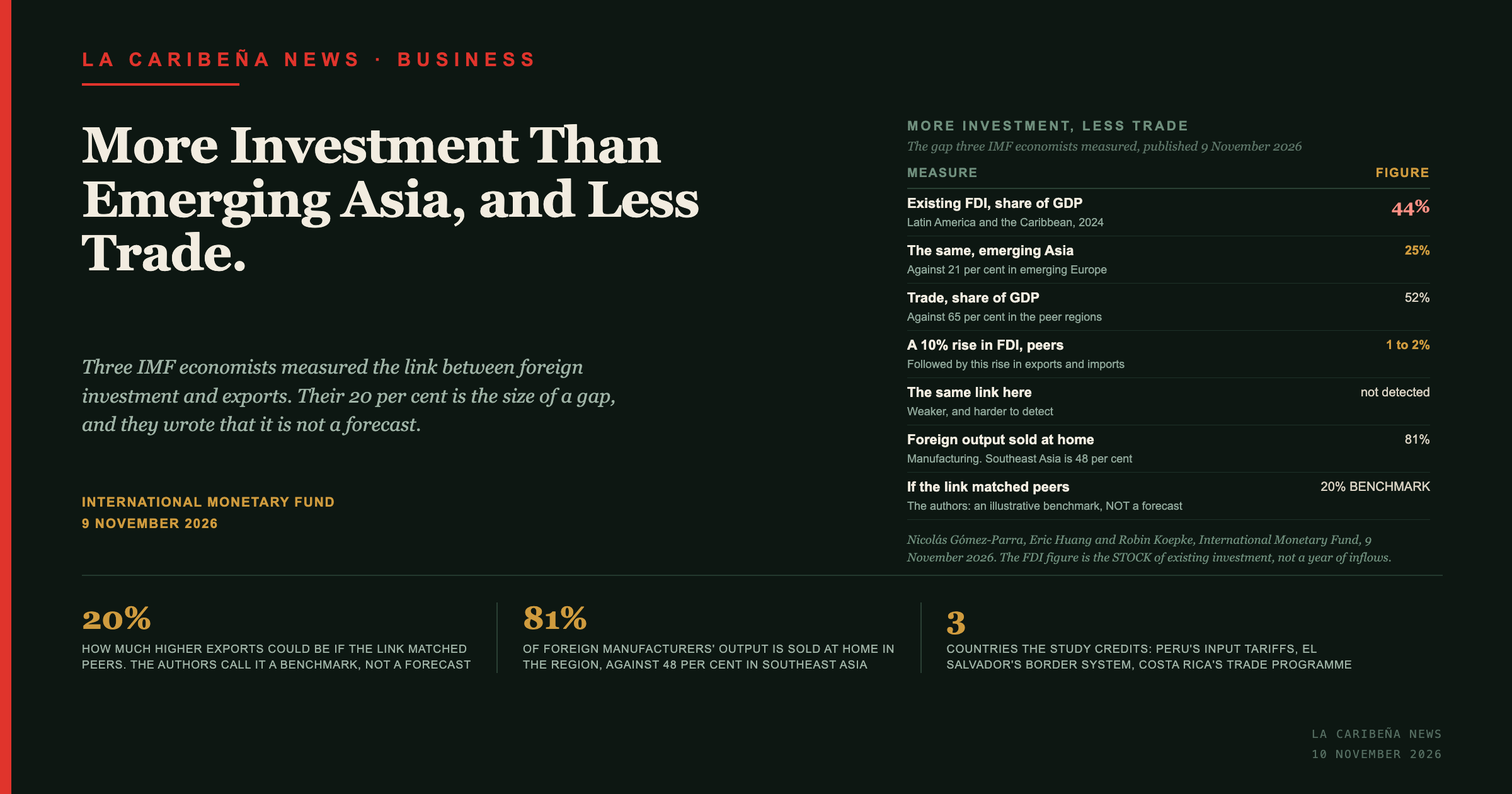
The authors write that exports could be up to 20 per cent higher if the effect of foreign investment on trade were the same as in peer economies, with no increase in investment and no change in the sectors receiving it. Then they bound it: "This is an illustrative benchmark, rather than a forecast of the gains from specific reforms."
A benchmark measures a gap against a comparator. A forecast says what will happen. The number is the same size in both and it is not the same claim.
How is that different from the other 20 per cent?
Because the other one is a forecast, and it landed the day before.
The Economic Commission for Latin America and the Caribbean launched its International Trade Outlook on 15 October 2026, projecting a 20 per cent rise in the value of goods exports, the largest since 2021. That is a projection of what the Commission expects to happen in a stated period.
The Fund's figure comes from Chapter 2 of its Regional Economic Outlook for the Western Hemisphere, "The Missing Link: From Foreign Direct Investment to Trade and Productivity Gains", published on 16 October 2026. The blog of 9 November is a summary of it.
So the two documents are a day apart. One is what a body expects to happen; the other is the size of a gap if a structural relationship changed. A reader who meets both as "exports up 20 per cent" has been handed one number and two meanings.
What is the gap the Fund measured?
More investment than its peers, and less trade.
| Measure, 2024 | Latin America and the Caribbean | Emerging Asia | Emerging Europe |
|---|---|---|---|
| Existing FDI, share of GDP | 44% (about US$3 trillion) | 25% | 21% |
| Trade, share of GDP | about 52% | 65% (peer average) | 65% (peer average) |
Source: Gómez-Parra, Huang and Koepke, IMF, 9 November 2026. The FDI figure is the stock of existing investment, not a year's inflows.
The region therefore carries nearly twice the investment stock of emerging Asia relative to the size of its economy, and trades less. That combination is the finding, and it is why the authors look at the linkage rather than at the amount.
Where does the link break?
In manufacturing, and on the domestic side of the factory gate.
In comparable emerging regions a 10 per cent rise in foreign direct investment is followed by a 1 to 2 per cent rise in exports and imports, within the same sector and with the investor's home country. In Latin America and the Caribbean that link is weaker and harder to detect, and it stays weaker when exports to other countries and cross-sector spillovers are counted in.
Manufacturing shows the largest gap. Foreign manufacturers in the region sell about 81 per cent of their output domestically, against 48 per cent in Southeast Asia. The authors give the domestic market's capacity to absorb technology and know-how as the leading explanation, and suggest the pattern may itself reflect productivity and competitiveness constraints that make the home market a more attractive destination than an export base.
Five things are named as the ecosystem that capacity rests on: reliable supplier networks, efficient logistics, skilled workers, access to finance and effective institutions. The authors single out logistics for a second mention, because a productive firm still cannot export when transport costs are high, customs clearance is slow or infrastructure is unreliable. The standfirst the Fund put on its own summary names three levers, and logistics is one of them.
Capability is one half. The other half is what a firm runs into once it has the capability, and there the Fund sets unpredictable regulations, restrictions on cross-border capital flows and costly imported inputs, which discourage investment and make exporting harder, against clearer rules, greater financial openness, macroeconomic stability, easier access to imported machinery and inputs, and fuller use of existing trade agreements, which help a firm join an international production network.
That last item assumes a firm can read the agreement. CARICOM is finishing an expansion of its 1994 trade agreement with Colombia, and the tariff schedules governing which Guyanese products face cheaper imports have not been published.
What does the study say actually worked?
Three countries, three different instruments, and not one of them is an investment incentive.
In Peru, lower tariffs on imported machinery and intermediate inputs led to higher productivity and greater participation in global value chains. In El Salvador, streamlined electronic border procedures substantially increased trade flows for those using the new system. Costa Rica is offered as the case where deeper trade integration and investment promotion together attracted export-oriented, technology-intensive investment.
A tariff cut, a customs system and a trade-integration programme. Agence France-Presse reported the study the same day.
What does this mean for a Caribbean exporter?
That the levers the study credits sit on the import and customs side, not in what is offered to a foreign investor.
The regional pattern is a factory that sells at home. Two of the three instruments are reachable by a small economy without a large budget: the Peru measure moved the tariff on the machinery and inputs a producer must import before it can export anything, and the El Salvador measure was an electronic border-procedure system, which a customs administration owns.
Access to finance sits in the Fund's list of five and financial openness in its list of barriers, and in Guyana both are a live matter rather than a theoretical one: a furniture exporter asked a Georgetown banking forum why small businesses had such difficulty opening US dollar accounts, and the Fund has itself advised the country to build deeper financial markets. Ecuador priced a new licensed activity at USD 500,000 of paid-in capital on 6 November, and Revolut named regulatory capabilities among the four things it will spend up to US$1 billion on in five Latin American markets. Entrants are pricing the cost of permission while the Fund is measuring the cost of inputs.
Nothing in the study names a Caribbean country. It reports on Latin America and the Caribbean as one region and the examples it gives are South American, which is the ground on which Suriname's President Jennifer Simons told an investor conference in Paramaribo in October that success means productive industries, stronger local enterprises, skilled people.
The entities
- International Monetary Fund published the summary on 9 November 2026 and the underlying chapter, in its Regional Economic Outlook for the Western Hemisphere, on 16 October 2026. - Nicolás Gómez-Parra is a Senior Research Analyst in its Western Hemisphere Department. - Eric Huang is an economist in the same division. - Robin Koepke is an economist in the Fund's Strategy, Policy and Review Department. - Economic Commission for Latin America and the Caribbean published its International Trade Outlook on 15 October 2026. - Agence France-Presse reported the study on 9 November 2026.
What the title card says
- Headline: Latin America holds more foreign investment than emerging Asia and trades less, and the IMF's 20 per cent is a benchmark rather than a forecast. - Study published: 9 November 2026, by three IMF economists. - The 20 per cent: how much higher exports could be if the region's investment-to-trade link matched peers. - The authors' own bound: an illustrative benchmark, not a forecast. - Existing FDI as a share of GDP: 44 per cent, against 25 per cent in emerging Asia and 21 per cent in emerging Europe. - Trade as a share of GDP: about 52 per cent, against 65 per cent in peer regions. - A 10 per cent rise in FDI in peer regions: a 1 to 2 per cent rise in exports and imports. - Foreign manufacturers' output sold at home: 81 per cent, against 48 per cent in Southeast Asia. - CEPAL's 20 per cent, 15 October 2026: a projection of goods export value.
Frequently Asked Questions
Is the IMF forecasting a 20 per cent rise in exports?
No. The authors state that the figure is an illustrative benchmark rather than a forecast of the gains from specific reforms. It measures how much higher exports could be if the effect of foreign investment on trade were the same as in peer economies.
How does that differ from CEPAL's 20 per cent?
The Economic Commission for Latin America and the Caribbean published a projection of a 20 per cent rise in the value of goods exports on 15 October 2026, the day before the Fund's chapter appeared. A projection states what a body expects; the Fund's figure states the size of a gap.
Does Latin America receive less foreign investment than its peers?
No. Existing foreign direct investment was about 44 per cent of regional GDP in 2024, against 25 per cent in emerging Asia and 21 per cent in emerging Europe. Trade was about 52 per cent of GDP against 65 per cent in those peers.
Where is the weakest link?
Manufacturing. Foreign manufacturers in the region sell about 81 per cent of their output domestically, against 48 per cent in Southeast Asia.
What examples does the study give of something that worked?
Three. Peru, where lower tariffs on imported machinery and intermediate inputs led to higher productivity and greater participation in global value chains. El Salvador, where streamlined electronic border procedures substantially increased trade flows for users of the new system. And Costa Rica, as a case of trade integration and investment promotion attracting export-oriented, technology-intensive investment.