By LCN Business Desk
A company that is not a bank can now be authorised to sign up Ecuadorian shops to take card payments, and the resolution that allows it says what that costs.
Ecuador's financial policy board, the Junta de Política y Regulación Financiera y Monetaria, expedited Resolución Nro. JPRFM-2026-048-T in Quito on 6 November 2026, signed by its president, Gustavo Estuardo Camacho Dávila. It runs to 41 pages, repeals two existing chapters of card rules and replaces them with one, and adds a line to the list of services the Banco Central del Ecuador licenses as part of the auxiliary payment system. That line reads "8.- Adquirencia no financiera", non-financial acquiring.
The resolution is in force from the day it was issued. Its final disposition states that it enters into force "a partir de su expedición, sin perjuicio de su publicación en el Registro Oficial", from its issuance, without prejudice to publication in the Official Register.
What did Ecuador actually authorise on 6 November?
Acquiring by companies that are not financial institutions, under central bank authorisation.
The new Título V defines an acquirer in Article 4 as the service by which an authorised entity signs up commercial establishments to accept payment cards and processes payments between the shop and the card issuers. It then splits that role in two. A financial acquirer is a bank, a neobank, a credit union or a mutual association. A non-financial acquirer is "persona jurídica no financiera constituida o domiciliada en el país autorizada por el Banco Central del Ecuador como partícipe del Sistema Auxiliar de Pagos", a non-financial legal person established or domiciled in Ecuador and authorised by the central bank as a participant in the auxiliary payment system.
Article 7 sets out which financial institutions may acquire, and the permission is not uniform across them. Public and private banks, neobanks, segment-one credit unions, housing mutual associations and central funds may acquire for debit, credit and prepaid cards. Credit unions in segments two and three are limited to debit and prepaid.
What does it cost to become a non-bank acquirer in Ecuador?
USD 500,000, paid in full before the application is filed, plus a card-brand licence obtained first.
| Requirement | Non-financial acquirer (Art. 8) | Payment aggregator (Art. 58) |
|---|---|---|
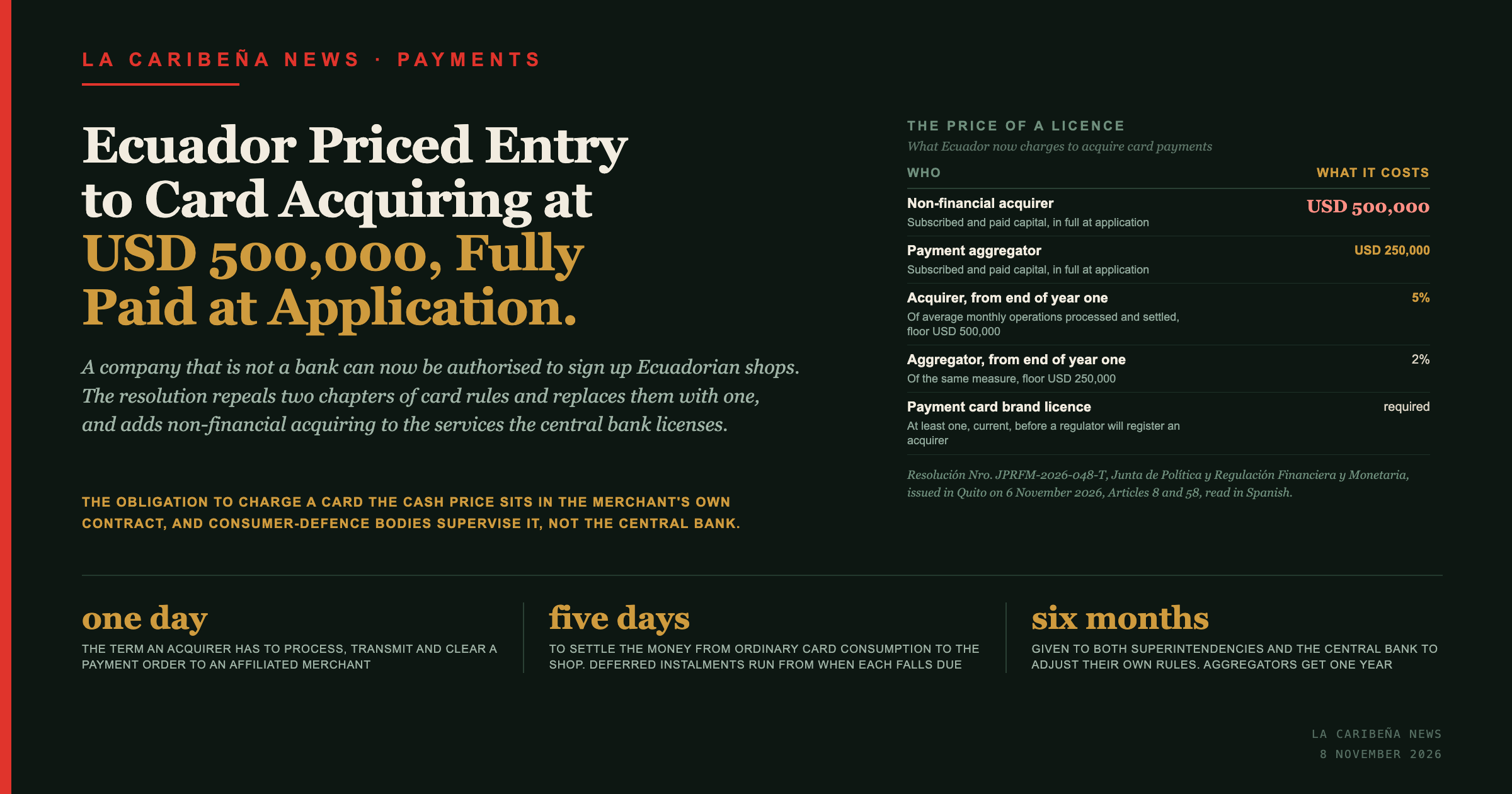
| Subscribed and paid capital at application | USD 500,000 | USD 250,000 |
| Ongoing capital, from end of year one | 5% of average monthly operations processed and settled in the last fiscal year | 2% of the same measure |
| Capital floor if that calculation is lower | USD 500,000 | USD 250,000 |
| Merchant settlement funds | Segregated accounts at authorised financial institutions | Segregated accounts at authorised financial institutions |
| Card-brand licence | At least one, current, before authorisation | Not stated in Article 58 |
| PCI DSS certification | Required | Not stated in Article 58 |
Figures as set out in Resolución JPRFM-2026-048-T, Articles 8 and 58. The aggregator column reflects what Article 58 itself specifies; both roles remain subject to the general requirements of existing regulation.
The first capital test is a gate, payable once at the door. The second is a ratio that rises with the business, so an acquirer that grows into processing USD 10 million a month must hold USD 500,000 against it and an acquirer processing USD 200 million a month must hold ten million. A firm can therefore pass the entry test and fail its first annual test, which is the point of writing both.
Three of the remaining conditions in Article 8 are governance rather than money. The applicant's corporate purpose and its tax-registered economic activity must both relate to payments or transfers. It must have a board and functional independence in risk, audit and compliance, with directors meeting fitness and propriety criteria set by the central bank. And it must file an operating manual describing its policies and controls for merchants, processing, settlement, chargebacks and dispute resolution.
Article 6 adds a precondition that sits ahead of all of them, and it binds financial acquirers too. A regulator can authorise a company to acquire; only Visa, Mastercard or their peers can let it.
How quickly must an acquirer pay a merchant?
One day to clear the payment order, five to settle the money.
Article 5 makes the acquirer answerable to every other participant for seven listed activities. Two of them are deadlines. Payment and transfer orders must be processed, transmitted and cleared to affiliated merchants "en un término no mayor a un (1) día". Funds from ordinary card consumption must be settled to affiliated shops "en máximo cinco (5) días término". Where a purchase was deferred into instalments, the resolution gives five days from the date each instalment becomes payable by the cardholder.
Ecuadorian law defines that word. Article 73 of the Código Orgánico General de Procesos provides that "los términos correrán en días hábiles", terms shall run in business days, which the then president of the Colegio de Abogados del Guayas, Jimmy Salazar Gaspar, explained in El Telégrafo as excluding weekends and public holidays. The resolution attaches "término" to the one-day clearing duty and to the five-day settlement of current consumption, and writes the deferred-instalment deadline as "cinco (5) días" without it. A merchant waiting on an instalment and a merchant waiting on an ordinary sale are therefore counting in different units.
Article 5 also requires acquirers to keep separate and identifiable accounts for the economic activities they carry on, to manage refunds, claims, disputes and chargebacks under the applicable rules and the relevant card brand's own, and to report periodically to the control bodies and the central bank on affiliated merchants and processed operations.
Is this a ban on card surcharges?
No. It is a contract term, and a different body enforces it.
Article 9 governs acquiring contracts, and requires them to state delivery times for funds, commissions and charges, refund and chargeback rules, merchants' information rights and security-standard obligations, with a standardised plain-language summary handed to the merchant. Then it reaches past the acquirer to the shop. Contracts binding the commercial establishment "deberán incluir la obligación de mantener para los pagos con tarjeta el mismo precio aplicable a las operaciones al contado", must include the obligation to maintain, for card payments, the same price applicable to cash transactions. Any offer, promotion, reduction or discount running for cash applies to card.
The sentence that follows decides who polices it: "El cumplimiento y supervisión de lo estipulado en el presente literal corresponde a los órganos competentes y de defensa al consumidor", compliance and supervision belong to the competent bodies and those for consumer defence.
So a shop in Guayaquil that adds a percentage for paying by card is in breach of a term the regulation requires its acquiring contract to contain, and the complaint runs to a consumer-defence body rather than to the central bank. A merchant reading this needs to know which document binds them, and it is the one they signed.
The same article prohibits acquirers from writing exclusivity clauses into merchant contracts, so a shop cannot be tied to accepting only the cards its acquirer and issuer offer. Article 17 carries that through to the hardware: acquirers must ensure that terminals, applications, devices and electronic channels given to merchants accept and process cards of different brands and issuers, and aggregators, gateways and processors must not create "restricciones técnicas injustificadas", unjustified technical restrictions, to that acceptance. Their involvement does not relieve the acquirer of the duty.
What did the resolution take away?
Two chapters of card rules, one for banks and one for the popular and solidarity sector.
Articles 1 and 2 repeal the chapter governing credit, debit and payment card operations by financial institutions under the Superintendencia de Bancos, and the section governing card issuance and operation for the Sector Financiero Popular y Solidario. Article 3 inserts the single replacement title.
Ecuador's constitution, in Article 309, composes the national financial system of public, private, and popular and solidarity sectors, each with its own differentiated rules and control bodies. Card acquiring has now been lifted out of that division and written once for everyone, including participants who sit in none of the three sectors.
Who is now working to a deadline?
The regulators and the aggregators already licensed.
The first transitional disposition gives the Superintendencia de Bancos, the Superintendencia de Economía Popular y Solidaria and the Banco Central del Ecuador six months to adjust their own regulation to implement the new rules. The second gives auxiliary payment system participants already authorised in payment aggregation one year from publication to constitute paid-in capital of at least USD 250,000.
That second deadline is retroactive in effect. A company lawfully aggregating payments in Ecuador today, at whatever capital it was authorised on, now has twelve months to find a figure it was never previously asked for.
Two of the general dispositions bear on pricing and on customers. Existing tariffs for services tied to the issuance, administration, use and acceptance of payment cards continue in force until the Junta resolves otherwise, so this instrument sets entry conditions without resetting what anyone charges. And mechanisms aimed at forcing the migration of cards, individually or en masse, are prohibited, except for technological upgrades improving a card's security or functionality with prior authorisation.
What does a business outside Ecuador do with this?
It is a published price list for a licence most of the region has never written.
Across much of the Caribbean, a merchant who wants to take cards goes to a commercial bank. Where no framework exists for a non-bank to acquire, the number of possible counterparties equals the number of banks willing to board that merchant, and a shop refused by all of them has no appeal. Ecuador has now priced that alternative in public, which gives anyone arguing for one somewhere to start.
The constraint that figure describes is not small. This newspaper reported in May that 99.9 per cent of transactions in Guyana are cash, at a cost running to 2.45 per cent of GDP, against Bank of Italy work putting the GDP gain from a 10 per cent rise in card payments at 0.33 per cent. The gap between those two numbers is what an acceptance network is worth, and acceptance is built by acquirers.
A Caribbean merchant negotiating terms with an acquirer has had no published benchmark to argue against. One now exists on the record in a dollarised economy, at one working day to clear and five to settle. The Caribbean Development Bank's own measure of the problem, MSME loan rejection rates of 35 to 85 per cent across CARICOM, describes a small business that cannot borrow against receivables it waits weeks to receive.
What the resolution does not do is make Ecuador a route in for a foreign payments company. The establishment and tax-registration conditions in Article 8 leave the opening to firms willing to incorporate or domicile there, and the central bank verifies them before it authorises anyone.
What is not established here?
Whether the Código Orgánico General de Procesos governs this resolution's deadlines. That code defines a término as running in business days, and it is a procedural code written for judicial acts. Whether its definition carries into a settlement deadline set by a financial-sector resolution is not settled by either instrument.
What binds payment aggregators outside Article 58. That article sets capital and financial-solidity conditions, and it opens by requiring compliance with the general requirements of existing regulation as well. Those general requirements are not reproduced in it, so the conditions listed here are the ones Article 58 adds, not the whole of what an aggregator must meet.
The entities
- Junta de Política y Regulación Financiera y Monetaria is Ecuador's financial, monetary, securities and insurance policy and regulation board, created by Article 13 of the Código Orgánico Monetario y Financiero as reformed in October 2025, and the highest governing body of the central bank. It issued the resolution. - Banco Central del Ecuador is Ecuador's central bank. Under the new title it authorises non-financial acquirers, registers them, and supervises the operational, technological, security and interoperability aspects of card payments. - Resolución Nro. JPRFM-2026-048-T is the instrument, "Norma que regula la operación de tarjetas de pago en el Ecuador", in force from 6 November 2026. - Superintendencia de Bancos is Ecuador's banking supervisor, and the authority whose card-operations chapter the resolution repeals. It has six months to adjust its own regulation. - Superintendencia de Economía Popular y Solidaria supervises Ecuador's popular and solidarity financial sector, whose separate card rules the resolution also repeals. - Sistema Auxiliar de Pagos is Ecuador's auxiliary payment system, the list of licensed payment services to which non-financial acquiring has been added as item eight. - Caribbean Development Bank is the regional development bank whose 2025 study measured MSME loan rejection rates across CARICOM.
What the title card says
- Headline: Ecuador opened card acquiring to non-banks at USD 500,000, and the price-parity rule went into the merchant's own contract. - Instrument: Resolución Nro. JPRFM-2026-048-T, Junta de Política y Regulación Financiera y Monetaria, issued in Quito on 6 November 2026, in force from issuance. - Paid-in capital for a non-financial acquirer: USD 500,000, in full at application. - Paid-in capital for a payment aggregator: USD 250,000. - Ongoing capital, from end of year one: 5 per cent of average monthly operations processed and settled for acquirers, 2 per cent for aggregators. - Clearing deadline to the merchant: one day. - Settlement deadline for current card consumption: five days. - Time given to the two superintendencies and the central bank to adjust their own rules: six months. - Time given to already-authorised payment aggregators to reach USD 250,000: one year. - Chapters of card rules repealed and replaced by one: two. - Source: the resolution text, read in Spanish.
Frequently Asked Questions
Does this ban shops in Ecuador from charging more for card payments?
It requires their acquiring contracts to contain the obligation to charge card payments the same price as cash, and to extend any cash offer, promotion, reduction or discount to card. Article 9 assigns compliance and supervision to the competent bodies and those for consumer defence, not to the central bank.
How much capital does a non-bank need to acquire card payments in Ecuador?
USD 500,000 subscribed and paid in full at the time of application. From the end of the first year of operation and annually after that, the entity must hold at least 5 per cent of the average monthly value of operations it processed and settled in the last fiscal year, with USD 500,000 as the floor.
When does the resolution take effect?
From 6 November 2026, the date it was issued. Its final disposition states that it enters into force on expedition without prejudice to publication in the Registro Oficial. The Superintendencia de Bancos, the Superintendencia de Economía Popular y Solidaria and the Banco Central del Ecuador have six months to adjust their own regulation to implement it.
Can a foreign payments company use this to acquire in Ecuador?
Only by establishing there. A non-financial acquirer must be constituted as a corporation or limited liability company in Ecuador, or duly domiciled in the country, with a tax-registered economic activity related to payments or transfers.
What happens to payment aggregators already operating in Ecuador?
The second transitional disposition gives auxiliary payment system participants already authorised in payment aggregation one year from publication to constitute subscribed and paid capital of at least USD 250,000.