By LCN Business Desk
Mexico is studying whether to buy more from the United States and less from everyone else. President Claudia Sheinbaum said her government is evaluating increased purchases of US goods to narrow the bilateral trade surplus, which reached US$102.6 billion in the first half of 2026, ahead of the fourth negotiating round of the joint review of the United States-Mexico-Canada Agreement, held in Washington this month, Mexico Business News reported.
The offer answers what Washington has put on the table. The concern the United States brings to the negotiation is the deficit in the bilateral trade balance, and Mexico's response is to buy more American and substitute imports from Asia and Europe with production from Mexico, the United States and Canada, Mexican outlets reported from the president's daily press conference.
Sheinbaum said she had spoken to President Donald Trump by telephone about two things: the tariffs in force on steel, aluminium, their derivatives and vehicles, and the review of the treaty itself, Infobae reported. She said formal conversations would begin at the end of September. The agreement was signed with a review at six years, at which the parties decide whether to extend it by ten or sixteen more.
What has Mexico already done to imports from outside its trade agreements?
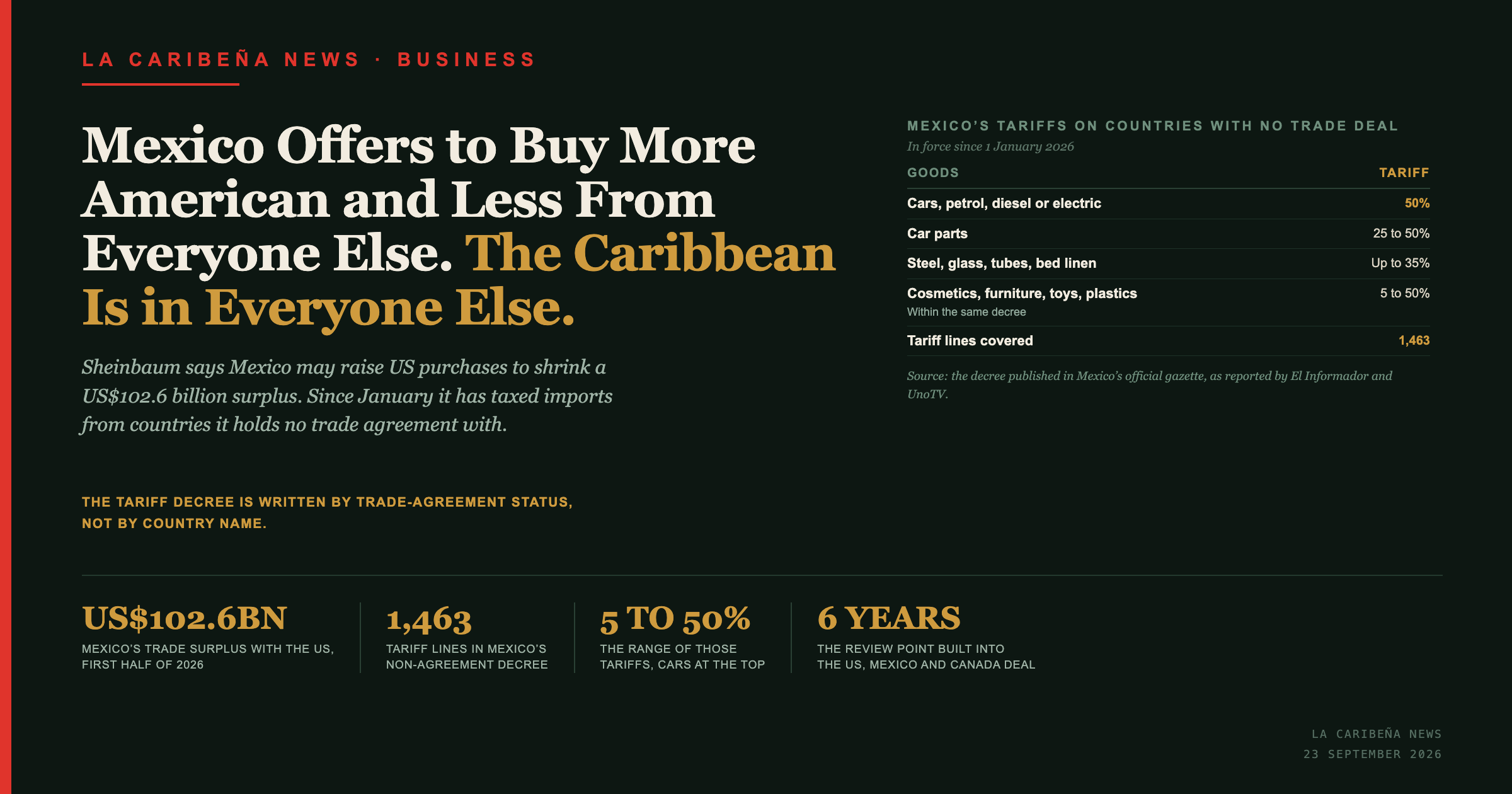
Taxed them. From 1 January 2026, tariffs of 5 to 50 per cent apply to goods from countries Mexico has no free trade agreement with, across 1,463 tariff lines, under a decree published in the Diario Oficial de la Federación, El Informador reported. Forty per cent of the lines are finished goods and 60 per cent are inputs.
| Goods | Tariff |
|---|---|
| Cars for carrying people or goods, petrol, diesel or electric | 50 per cent |
| Auto parts | 25 to 50 per cent |
| Steel, glass, tubes and bed linen | Up to 35 per cent |
| Cosmetics and make-up, appliances, furniture, toys, plastic goods, paper envelopes, tissues, cooking apparatus | Within the 5 to 50 per cent range |
Source: the decree reforming tariff lines of the General Import and Export Duties Law, as reported by El Informador and UnoTV. China is the largest country affected, and it is not the only one: the measure is written by trade-agreement status, not by name.
Where does that leave a Caribbean exporter?
Outside the treaty, and on the wrong side of the decree. CARICOM is not a party to the agreement under review. Mexico's tariff decree is written by trade-agreement status rather than by country, so any exporter without a Mexican trade agreement meets the same wall in those 1,463 lines. The categories are not the region's biggest exports, but cosmetics, furniture, plastic goods and garments are on the list, and those are lines Caribbean manufacturers sell.
The region's own negotiation runs on a separate track. Colombia and CARICOM have been finishing a deal that manufacturers have not seen, reported in Colombia and CARICOM Are Finishing a Deal Manufacturers Cannot See, and what those talks mean for small Guyanese producers was set out in What the Colombia Trade Talks Mean for Guyana's Small Manufacturers.
How does this follow from Mexico's earlier position?
Directly. La Caribeña News reported on 1 August that Sheinbaum said Mexico and the United States had advanced on the review after her meeting with the US trade envoy, in Sheinbaum Says Mexico, US Advance on T-MEC Review After Greer Talks. What is new is the currency of the offer: purchases.
Mexico has also been paying a United States tariff of its own, as La Caribeña News reported in Mexico Grew 1.5% and Pays 10 Per Cent. It Legislated in 2023, and it said in August that the tariffs did not affect it, reported in US Tariffs Do Not Affect Mexico, Sheinbaum Says on 10% Rate.
A trade surplus of US$102.6 billion in six months is the number Mexico is negotiating against. The Caribbean's trade with the United States is not measured in those terms, and the region has no seat at the table where the terms are being set.
What the title card shows
- US$102.6 billion: Mexico's trade surplus with the United States in the first half of 2026, the figure behind the negotiation. Source: Mexico Business News.
- 1,463 tariff lines: covered by Mexico's decree taxing imports from countries without a Mexican trade agreement, in force since 1 January 2026. Source: El Informador.
- 5 to 50 per cent: the range of those tariffs, with cars at the top. Source: El Informador, UnoTV.
- Six years: the review point built into the treaty, at which the parties decide whether to extend it by ten or sixteen more. Source: Infobae.
- CARICOM: not a party to the treaty under review, and the tariff decree applies by trade-agreement status rather than by country.
Frequently Asked Questions
What did Sheinbaum say about buying from the United States?
That Mexico is evaluating larger purchases of US goods, and smaller purchases from other countries, to narrow a bilateral surplus of US$102.6 billion in the first half of 2026, ahead of the fourth round of the USMCA joint review in Washington.
What is the USMCA joint review?
A review built into the agreement at six years, at which the parties decide whether to extend it by ten or sixteen more years. Sheinbaum said formal conversations would begin at the end of September.
What tariffs does Mexico apply to countries without a trade agreement?
Between 5 and 50 per cent, across 1,463 tariff lines, in force since 1 January 2026. Cars carry the top rate, auto parts 25 to 50 per cent, and steel, glass and bed linen up to 35 per cent.
Does this affect Caribbean exporters?
The decree applies by trade-agreement status rather than by country, so an exporter without a Mexican trade agreement faces those rates. The affected categories include cosmetics, furniture, plastic goods and garments.