By LCN Business Desk
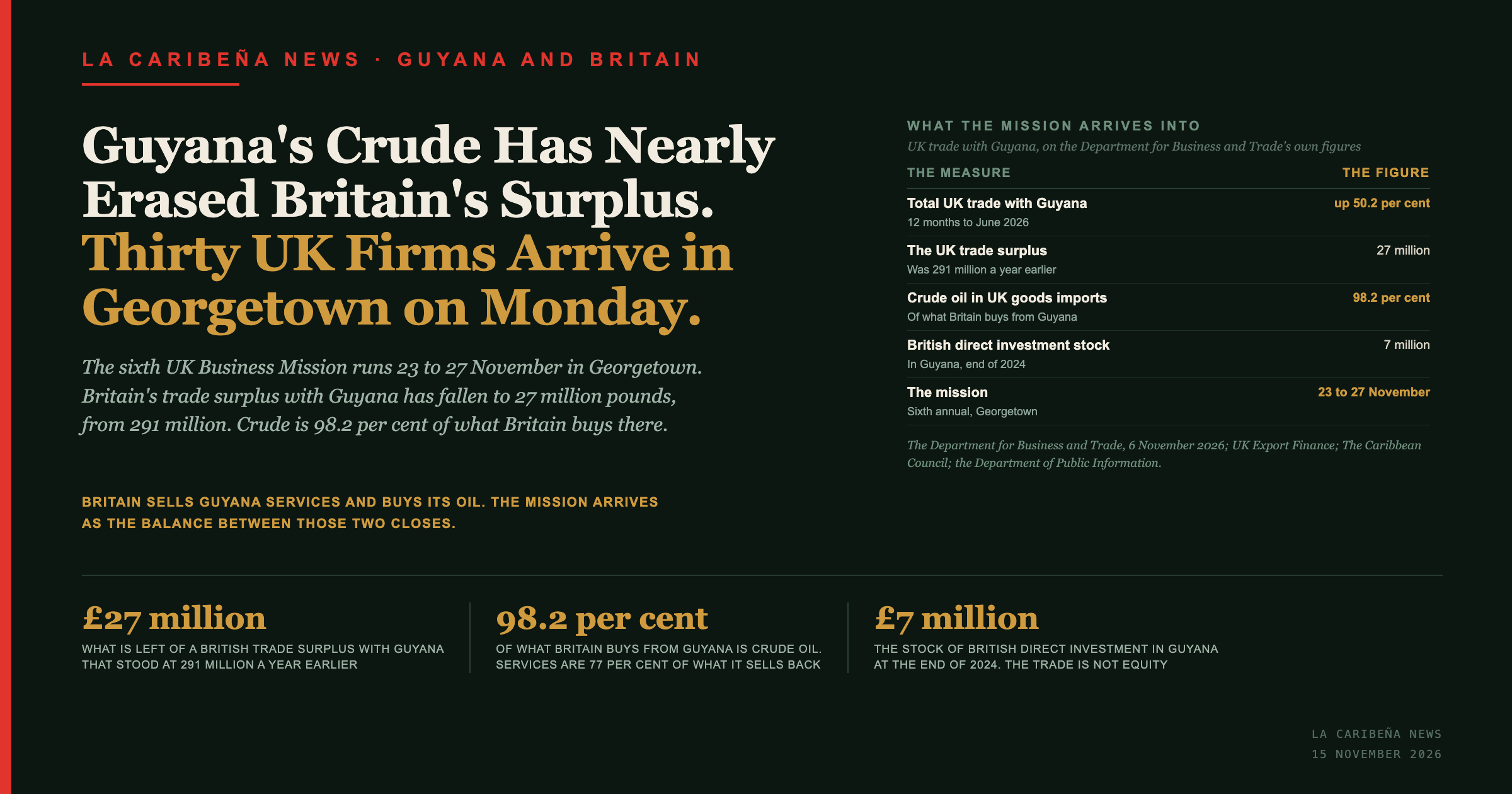
Britain sold Guyana £1.2 billion of goods and services in the year to June. It bought £1.2 billion back. A trade surplus that stood at £291 million a year earlier is now £27 million, and the reason is crude oil, which makes up 98.2 per cent of what Britain buys from Guyana.
On Monday 23 November a British trade mission arrives in Georgetown for five days. More than thirty companies are expected. It is the sixth such mission and the largest, and it lands four weeks after a state visit by King Charles III.
Who is coming, and when?
More than thirty British firms, from Monday 23 to Friday 27 November, in Georgetown.
The mission is organised by The Caribbean Council, which calls it a premier annual UK business mission and dates the series to 2020. Faizal Khan, founding chairman of the British Chamber of Commerce Guyana, announced the programme at a press conference on Friday 13 November. A gala dinner on Wednesday 25 November at the Four Points by Sheraton marks Guyana's 60th Independence anniversary, under the theme "We're Bringing It Home!". Dr Ashni Singh and Alistair Routledge of ExxonMobil Guyana are to speak.
One number is unsettled, and the unit is the problem. The Department of Public Information counts about 30 British business people. News Room Guyana says more than 30 UK companies in its headline, and more than 30 representatives in its first line. The fifth mission, in November 2025, brought 18 representatives from 11 companies. If the new figure counts companies, the mission has roughly tripled in a year. If it counts people, it has grown by about two thirds.
The delegation list is not published. The organiser's mission brochure is a lead-capture form rather than a document, and no company has been named as a 2026 delegate. Two firms are named as mission partners. Kestrel Global Logistics is the strategic country partner. I.T. Transport advises on infrastructure. Of the eleven companies on the 2025 list, two return in another capacity: I.T. Transport, and Mowlem, which holds the airport work described below.
What has happened to the trade balance?
It has almost closed, and Guyanese oil closed it.
| Measure, 12 months to June 2026 | Value | Change on a year earlier |
|---|---|---|
| Total trade in goods and services | £2.5 billion | +50.2% |
| UK exports to Guyana | £1.2 billion | +28.9% |
| UK imports from Guyana | £1.2 billion | +80.7% |
| UK trade surplus | £27 million | from £291 million |
Those are the Department for Business and Trade's figures, from its Guyana trade and investment factsheet released on 6 November. The surplus did not shrink because British exports fell. They grew by £278 million. Imports grew by £542 million, roughly twice as fast.
Underneath the near-balance sit two large and opposite positions. Britain runs a goods deficit with Guyana of £891 million and a services surplus of £918 million. Services are 77 per cent of everything Britain sells to Guyana, and goods are 96.9 per cent of everything it buys. So the relationship is one country selling expertise and the other selling oil.
The factsheet cannot break the larger half of that down. It states that the composition of UK services exports is not available from UK sources. The £956 million that British firms earn selling services into Guyana is unbroken down in the primary record.
Equity is almost absent. British direct investment in Guyana stood at £7 million at the end of 2024, and Guyanese investment in Britain at £5 million. Guyana is Britain's 64th largest trading partner and accounts for 0.1 per cent of its trade.
Which trade figure is current?
The one released on 6 November, and almost nobody is using it.
Four different totals are circulating, and they are four periods rather than a contradiction. The organiser's own mission page carries £1.8 billion, which is the year to December 2025. Most Guyanese coverage of the King's visit carried £2.2 billion, the year to March 2026. The current figure is £2.5 billion. The factsheet itself asks readers not to use earlier editions, because the data are revised.
The stale figure is not confined to one side. The British government's own export guide for Guyana still gives £1.1 billion. Search it for procurement, tender, local content or export finance and one item comes back, the CARIFORUM-UK trade agreement. Two official British pages disagree about the size of the relationship they describe.
How would UK Export Finance work for a Guyanese buyer?
As a loan or a guarantee to the Guyanese buyer, not only to the government.
Dr Ashni Singh set the terms out on 30 October. The envelope is accessible to both government and private sector importers in Guyana. It can take the form of direct lending or a guarantee of borrowing. UK Export Finance will consider up to 100 per cent of a project's value. The content rule starts at 20 per cent British content, a threshold Khan repeated on 13 November.
One carve-out still governs what is eligible. UK Export Finance told Guyanese firms in September that British fossil fuel policy bars it from financing oil and gas contracts. Companies in the wider supply chain face no purity test.
The Guyanese and British accounts of the ceiling diverge. Singh described a figure rising from £750 million in 2021, to £2.1 billion in 2024, to £3 billion in October 2025, and to £3.5 billion now. UK Export Finance publishes no £3.5 billion. Its own country cover page was updated on 13 October. That page gives Guyana a market risk appetite of £3 billion to £4 billion. It says cover is subject to sustainable lending criteria. It also says no commitment on its part can be assumed or inferred. The band has moved: in September it read £2 billion to £3 billion.
Both accounts can hold at once, because a band four billion wide contains a privately communicated ceiling. A Guyanese borrower should treat £3.5 billion as the Guyanese government's characterisation and the band as the agency's own position.
What is already financed, and what is only announced?
Three things are financed. The largest is not.
| Project | Class | Instrument |
|---|---|---|
| Terminal 2, Cheddi Jagan International Airport | Financed, construction imminent | UK Export Finance guarantee on a €61.43 million Santander loan |
| Guyana Fire Service equipment fleet | Underway | Not disclosed; the British supplier is unnamed in every account |
| Linden to Mabura Hill, 121 km | Financed | UK Caribbean Infrastructure Fund, not UK Export Finance |
| Berbice deep-water port and industrial complex | Intent | None stated |
The last row is the one being sold to this mission. Singh said the Linden road will run on past Linden. It is to end in a deep-water port and an industrial site at Berbice, powered by gas from the second pipeline. He named roles rather than parties. He listed builders, consulting engineers, operators, off-takers and service firms. Nothing of memorandum, facility or procurement class is announced for the mission itself.
The airport project carries a caution for anyone quoting it. Three figures attach to the same terminal, and no source reconciles them: a stated investment of about US$65.5 million, the €61.43 million loan, and GY$14.6 billion. The contractor is named as Mowlem in some accounts and as BHM Construction International in the loan documents, with one Guyanese outlet describing BHM as part of the Mowlem group. Guyana has separately been ready to finalise terms for a carrier to use that terminal as a hub, with no carrier or timeline stated.
One change behind all of this is not money. The OECD country risk classification moved Guyana from category 5 to category 4 in October, its second upgrade in four years. That places it with Brazil, Colombia, Panama and South Africa, and it lowers the risk premium on officially supported export credit for Guyanese transactions.
Which sectors is the British side naming?
Eight in the Guyanese announcements, and a longer list from the High Commissioner four months ago.
Four parties have named sectors and no two lists match.
| Named by | Sectors |
|---|---|
| The announcement, 13 November | Energy, construction, engineering, healthcare, digitalisation, transport, shipping, professional services |
| News Room Guyana | Specialist procurement, infrastructure, mining |
| Liam McShane, Deputy British High Commissioner | Transport, aviation, urban development, infrastructure |
| High Commissioner Joseph Fisher, July | Housing, drainage, power transmission, design, digital health, defence, maritime training, film, education |
What Britain actually sells is a different list.
| Largest UK goods exports to Guyana, year to June 2026 | Value | Change |
|---|---|---|
| Miscellaneous metal manufactures | £93.0m | more than doubled |
| Ships | £28.0m | down 19.4% |
| Road vehicles other than cars | £23.6m | down 15.4% |
| Specialised machinery | £20.6m | up 75.4% |
| General industrial machinery | £15.1m | up 8.2% |
Metal manufactures are 32.6 per cent of the goods total on their own. Britain holds 13.4 per cent of Guyana's import market, 3.6 per cent in goods and 29.3 per cent in services. So one list is ambition and the other is the business.
The last row is the oldest and the most senior, and it is the only one that names housing. The Caribbean Council's record of a London roundtable with Joseph Fisher MBE, published in July, says modular construction is a likely route into it. Housing, defence, education and film appear in none of the lists issued this month. That record is the Council's summary of his remarks at a members' event, not a transcript.
Three further facts come from the same record. The British Chamber in Guyana now counts more than sixty members. Three of the four largest global professional services firms are established in the country. A British-funded hospital is described as a flagship of the relationship.
What can a Guyanese firm do in the next eight days?
Approach the organisers directly, and know that the access is gated.
The mission opens on Monday. The organiser is The Caribbean Council, reachable at [email protected] and on +44 20 7583 8739, and its Guyana events are open to members. Four places exist for anyone seeking senior government engagement. The British Chamber of Commerce Guyana runs the surrounding programme. The British High Commission at 44 Main Street sees visitors by appointment and is not a walk-in.
Four people were in the room at the High Commission's reception on 30 October, and they are the counterparties a supplier would be introduced through.
- Gerry Gouveia Jr, Chairman of the Private Sector Commission - Kathy Smith, President of the Georgetown Chamber of Commerce and Industry - Tim Reid, Chief Executive of UK Export Finance - Amy Barklam, His Majesty's Trade Commissioner for Latin America and the Caribbean
There is a route running the other way, and it is the less reported one. The Caribbean Council works with the British Chamber and the Department for Business and Trade to take Guyanese firms to London. It did so at Lord's in September 2024. Dr Peter Ramsaroop, the Chief Investment Officer, pointed at it on 13 November. He challenged local firms to look beyond attracting foreign investors, and to set up in overseas markets themselves. Guyanese firms have done it: Maliyah's Kitchen, a Guyanese agro-processor, secured United States distribution through Go-Invest.
One figure in circulation needs care. A minister said in November 2025 that 40 per cent of firms on past missions closed deals or entered partnerships. No methodology or denominator has been published for it.
The payment terms on oil work are already written down. Local content plans carry an amendment that Guyanese suppliers are paid within thirty to forty-five days of a correct invoice.
The entities
- The Caribbean Council is the British organisation that organises the annual UK Business Mission to Guyana. - The British Chamber of Commerce Guyana (BritCham Guyana) is the bilateral chamber in Georgetown, with more than sixty members. - UK Export Finance (UKEF) is the British government's export credit agency, which lends to and guarantees borrowing by overseas buyers of British goods and services. - The Department for Business and Trade (DBT) is the British department that publishes the Guyana trade and investment factsheet. - The UK Caribbean Infrastructure Fund is the separate British facility financing the Linden to Mabura Hill road. - Dr Ashni Singh is Guyana's Senior Minister in the Office of the President with responsibility for Finance. - Dr Peter Ramsaroop is Guyana's Chief Investment Officer. - Joseph Fisher MBE is the British High Commissioner to Guyana. - Faizal Khan is founding chairman of the British Chamber of Commerce Guyana. - The OECD country risk classification is the scale used to price officially supported export credit, on which Guyana moved from category 5 to category 4 in October 2026.
What the title card says
- Total UK trade with Guyana in the twelve months to June 2026: £2.5 billion, up 50.2 per cent. - The UK trade surplus with Guyana: £27 million, from £291 million a year earlier. - Crude oil as a share of UK goods imports from Guyana: 98.2 per cent. - British direct investment stock in Guyana at the end of 2024: £7 million. - The mission: the sixth UK Business Mission to Guyana, 23 to 27 November 2026, Georgetown. - £27 million is what is left of a British trade surplus with Guyana that was £291 million a year earlier. - 98.2 per cent of what Britain buys from Guyana is crude oil. - £7 million is the stock of British direct investment in Guyana at the end of 2024. - Britain sells Guyana services and buys its oil. The mission arrives as the balance between those two closes. - Sources: the Department for Business and Trade, 6 November 2026; UK Export Finance; The Caribbean Council; the Department of Public Information.
Frequently asked questions
When is the UK business mission to Guyana?
From Monday 23 to Friday 27 November 2026, in Georgetown. It is the sixth of an annual series run by The Caribbean Council.
How large is UK trade with Guyana?
£2.5 billion in the twelve months to June 2026, up 50.2 per cent. That is the Department for Business and Trade figure, released on 6 November 2026. Guyana is Britain's 64th largest trading partner.
Can a Guyanese company borrow from UK Export Finance?
Yes. The envelope is open to private importers in Guyana, not just the government. It comes as a direct loan or a guarantee, for up to 100 per cent of project value, with at least 20 per cent British content.
How big is UK Export Finance's ceiling for Guyana?
Dr Ashni Singh put it at £3.5 billion on 30 October 2026. UK Export Finance's own page, updated 13 October 2026, gives a band of £3 billion to £4 billion. It adds that no commitment can be assumed from it.
Which British projects in Guyana are already financed?
Three. Terminal 2 at Cheddi Jagan International Airport, on a UK Export Finance guarantee over a €61.43 million Santander loan. The Guyana Fire Service equipment fleet. And the 121 kilometre Linden to Mabura Hill road, through the UK Caribbean Infrastructure Fund. The Berbice port is an intention with no instrument behind it.
Which companies are in the delegation?
No list has been published. Two firms are named as mission partners, Kestrel Global Logistics and I.T. Transport. The 2025 mission did publish a list of eleven companies.