By LCN Business Desk
In December 2024 Angola raised US$1 billion in hard currency. It did so by pledging US$1.9 billion of newly issued sovereign bonds that raised no cash of their own, and transferring the return on them to a bank counterparty. The debt statistics recorded the billion.
That transaction appears in Background Analysis 1.4 of the Global Financial Stability Report the International Monetary Fund released on Tuesday under the title "Resilience, Risk, and Transformation". It is an online annex to Chapter 1, and it is where the Fund sets out what it now regards as a measurement problem in sovereign borrowing.
What is a sovereign total return swap?
A derivative contract that functions as a secured loan.
The Fund's own description, in Chapter 1, is generic: a sovereign "can raise cash by pledging assets, often its own bonds, and transferring the return on those assets to a counterparty." The annex is blunter about what that means in practice. These instruments are "legally structured as derivatives" but "can economically resemble collateralized funding, with the sovereign receiving hard-currency financing from a bank counterparty against posted collateral, often including its own bonds."
The collateral exceeds the cash. The Fund puts collateral-to-financing ratios in the transactions it examined at "around 1.3 to 1.6", while noting that its own amounts and ratios "are indicative and may reflect different transaction dates, valuation bases, and public reporting definitions." Angola's December 2024 deal pledged US$1.9 billion of bonds against US$1 billion of financing on the face of the figures, and the gap between that and the stated range is a question of which valuation basis is being used, which the Fund does not resolve.
The risk the Fund identifies runs in the wrong direction at the worst moment. When the collateral is the sovereign's own paper, its value tracks the sovereign's own credit standing. A downgrade, a yield rise or a currency fall cuts the collateral value and triggers a margin call "precisely when liquidity buffers are most strained." Angola's swap required about US$200 million of additional collateral in April 2025, when its bond prices fell.
Legally structured as derivatives, economically resembling collateralised funding, and collateralised with the borrower's own credit.
Which sovereigns have used them?
Four are named, and none is in the Caribbean.
| Sovereign | What the Fund records | Collateral posted |
|---|---|---|
| Angola | US$1bn swap, December 2024, against US$1.9bn of newly issued bonds. Used first when market access was constrained, later for liquidity and refinancing management | Eurobonds and local-currency government bonds |
| Nigeria | A US$5bn programme approved in April 2026, with market reporting indicating about US$1.5bn drawn | Naira-denominated government bonds |
| Senegal | Several transactions reportedly executed in 2025 "amid financing pressures and rising borrowing costs" | Domestic government bonds and cash |
| Colombia | A distinct case: the swap supported a bond buyback and liability-management operation rather than new financing | Global bonds, domestic treasury bonds and bills, US Treasuries |
Source: IMF Global Financial Stability Report, October 2026, Box 1.4.1. The Fund states that public reporting of these instruments "remains concentrated in a limited number of emerging market and frontier economies", so the four are the disclosed cases rather than a complete list.
Chapter 1 itself names no sovereign at all in connection with the instrument. The three countries it mentions anywhere, Egypt, Ghana and Pakistan, appear once each inside a footnote listing 33 central banks that have tightened policy.
Why do the debt statistics not show the full exposure?
Because the recording follows the cash.
In Angola's case the pledged bonds "are documented as ordinary senior unsecured eurobonds" and amount to about a tenth of the country's outstanding international bonds. The Fund's Sovereign Risk and Debt Sustainability Framework treats them as external debt. The statistical treatment does not. Relying on the authorities' own reporting, it "records only the financing amount as external debt, treating the collateral bonds as contingent liabilities."
The annex generalises the point in one sentence: "Total return swaps may be recorded only to the extent that they generate cash."
Nor is the instrument the only layer missing. The Fund lists what its figures capture least: "bilateral lending, total return swaps, private placements, and most collateralized lending", and says they "cannot capture liabilities held outside fiscal accounts." Bilateral loans "may be underreported", and "collateralized and resource-backed loans are often not publicly disclosed."
What is disclosed, even in the reported cases, stops short of the terms that matter. Headline amounts and broad collateral types may be known, but "pricing, fees, collateral valuation thresholds, margin triggers, early termination clauses, and collateral rights are generally not public."
There is also no map for what happens if such a borrower fails. The Fund states plainly that "there is no established precedent for how TRS would be treated in a sovereign debt restructuring", and that counterparties holding collateral may have better means of recovery than unsecured bondholders. That "can create de facto seniority and shift the burden of debt relief onto other creditors."
What happened in Senegal?
An audit restated it, and the market repriced a year afterwards.
Following an audit in 2024, Senegal's central government debt for 2023 was restated from about 74 per cent of GDP to 100 per cent. Successive vintages of the same statistics then added roughly US$2 billion of previously unreported bilateral disbursements, on project commitments that had already been disclosed, alongside off-budget bank borrowing and arrears.
The market did not react when the information arrived. Senegal's spreads "changed little around either disclosure", the audit announcement of 26 September 2024 or the Court of Auditors report of 12 February 2025. Repricing came through 2025 as successive downgrades moved the country out of the single-B rating category.
The Fund draws the conclusion that gives the annex its force: "When exposures are not reported, the absence of a market response cannot be distinguished from the absence of information."
Where does the Caribbean sit in this?
In one footnote.
The analysis covers 53 frontier sovereigns, a group the Fund defines as the constituents of the J.P. Morgan Next Generation Markets index plus low-income sovereigns that have issued or announced international bonds without being in the index. Within that group it identifies 13 that have restructured or faced distress, and three of those are Caribbean: Barbados, Belize and Suriname. All three appear only in the footnote that lists the sample.
The same footnote carries the finding:
"Barbados and Venezuela are absent from International Debt Statistics, so the figures cover 11."
The figure note repeats it in the aggregate: "Of the 53 frontier sovereigns, 49 report to International Debt Statistics."
So the Fund identified Barbados as one of 13 restructured frontier sovereigns, then had to leave it out of its own creditor-composition analysis, because the dataset that analysis rests on does not cover it.
Why are five Caribbean states absent from the dataset?
Income classification governs who reports.
The World Bank states the rule on the International Debt Statistics page itself: "Data are shown for low- and middle-income countries that report public and publicly guaranteed external debt to the World Bank's Debtor Reporting System (DRS)." Its published country list runs to 120 entries and carries ten Caribbean states. Barbados, the Bahamas, Trinidad and Tobago, Antigua and Barbuda and St Kitts and Nevis are not among them.
Querying the database directly gives the same answer. LCN ran every Caribbean state against two separate indicators for the decade to 2024.
| State | External debt stocks in IDS | Income classification | Lending category |
|---|---|---|---|
| Barbados | No data, any year | High income | IBRD |
| Bahamas | No data, any year | High income | Not classified |
| Trinidad and Tobago | No data, any year | High income | IBRD |
| Antigua and Barbuda | No data, any year | High income | IBRD |
| St Kitts and Nevis | No data, any year | High income | IBRD |
| Guyana | 10 years, 2024 = US$3.68bn | High income | IDA |
| Jamaica | 10 years, 2024 = US$14.84bn | Upper middle | IBRD |
| Dominican Republic | 10 years, 2024 = US$53.29bn | Upper middle | IBRD |
| Belize | 10 years, 2024 = US$1.56bn | Upper middle | Blend |
| Suriname | 9 years, 2023 = US$4.05bn | Upper middle | Blend |
| St Lucia | 10 years, 2024 = US$1.19bn | Upper middle | Blend |
| St Vincent and the Grenadines | 10 years, 2024 = US$0.81bn | Upper middle | Blend |
| Grenada | 10 years, 2024 = US$0.86bn | Upper middle | Blend |
| Dominica | 10 years, 2024 = US$0.57bn | Upper middle | Blend |
| Haiti | 10 years, 2024 = US$0.94bn | Lower middle | IDA |
Source: World Bank indicators DT.DOD.DECT.CD, external debt stocks total, 2015 to 2024, and DT.DOD.DPPG.CD, public and publicly guaranteed external debt, 2018 to 2024, queried by LCN on 13 October 2026. The five states return no data on either indicator. Income and lending classifications from the World Bank country API on the same date.
All five sit in the high-income bracket. Guyana is the edge case: the World Bank now classifies it high income too, on the strength of the oil revenue, and it is still on the International Debt Statistics country list and still returns data. A country that crosses the income threshold does not vanish from the dataset on the day it crosses.
This is a coverage boundary, and it is not a statement about any government's conduct. The debt itself is measured and published. The Fund's own World Economic Outlook database carries a general government gross debt ratio for all five.
| State | General government gross debt, % of GDP, 2024 | 2025 | 2026 |
|---|---|---|---|
| Barbados | 98.9 | 96.2 | 93.8 |
| Trinidad and Tobago | 81.0 | 84.0 | 84.6 |
| Bahamas | 73.0 | 71.7 | 70.2 |
| Antigua and Barbuda | 71.6 | 70.2 | 66.8 |
| St Kitts and Nevis | 58.1 | 58.7 | 65.1 |
| Jamaica | 62.5 | 66.0 | 64.3 |
| Guyana | 24.3 | 28.9 | 25.3 |
Source: IMF, World Economic Outlook, series GGXWDG_NGDP, retrieved 13 October 2026. The 2026 column is a projection.
What the World Bank dataset supplies and the debt ratio does not is composition: which creditors are owed, under what kind of contract, and in what order they are repaid. Composition is what the Fund's three recommendations ask authorities to disclose.
The debt ratio is published. The question the Fund says matters now is who holds it, and under what terms.
What does the IMF say should change?
Three things, and all three are about disclosure rather than borrowing less.
The Fund asks authorities to broaden public debt reporting to cover "collateralized debt, derivatives-linked borrowing, guarantees, and contractual risk triggers", and for structured instruments to disclose beyond headline amounts to "collateral composition, over-collateralization, margin triggers, and early-termination provisions, the terms that determine when a claim crystallizes and in what order it is repaid."
It asks that contingent collateral exposures be treated explicitly in debt sustainability analysis, because over-collateralised structures "generate claims that crystallize precisely when a sovereign is least able to meet them", and treating that financing as equivalent to unsecured borrowing "understates both liquidity and solvency risk."
And it asks that surveillance look at the composition of financing and not only at spreads, which "can reverse rapidly when financing conditions tighten."
Chapter 1 rates this vulnerability, which it files under "emerging market buffer erosion and alternative financing", as worse than at its last assessment. The report's wider frame is a market that looks calm on the surface: frontier spreads have retraced to levels last seen in late 2024, and frontier sovereigns issued about US$26 billion of eurobonds in the first half of 2026, the strongest first half since 2018. The Fund notes that compressed spreads alongside a 10-year US Treasury yield above 4.5 per cent is a combination "last observed in 2007".
Guyana's own borrowing and the fund that receives its oil revenue are examined in Guyana's Natural Resource Fund Holds Its Money in an Overnight Account. The growth figures the Fund published the same day are in The IMF Put Latin America and the Caribbean at 2.3 Per Cent. Caribbean issuance into the same market is covered in The CARICOM Fund Sponsoring a US$250 Million Bond Has Disbursed US$169 Million Since 2009, and a separate case in which a swap's headline figure and the sum actually outstanding were far apart in Argentina's China Swap Reads US$19 Billion. Under US$700 Million Was Still Owed.
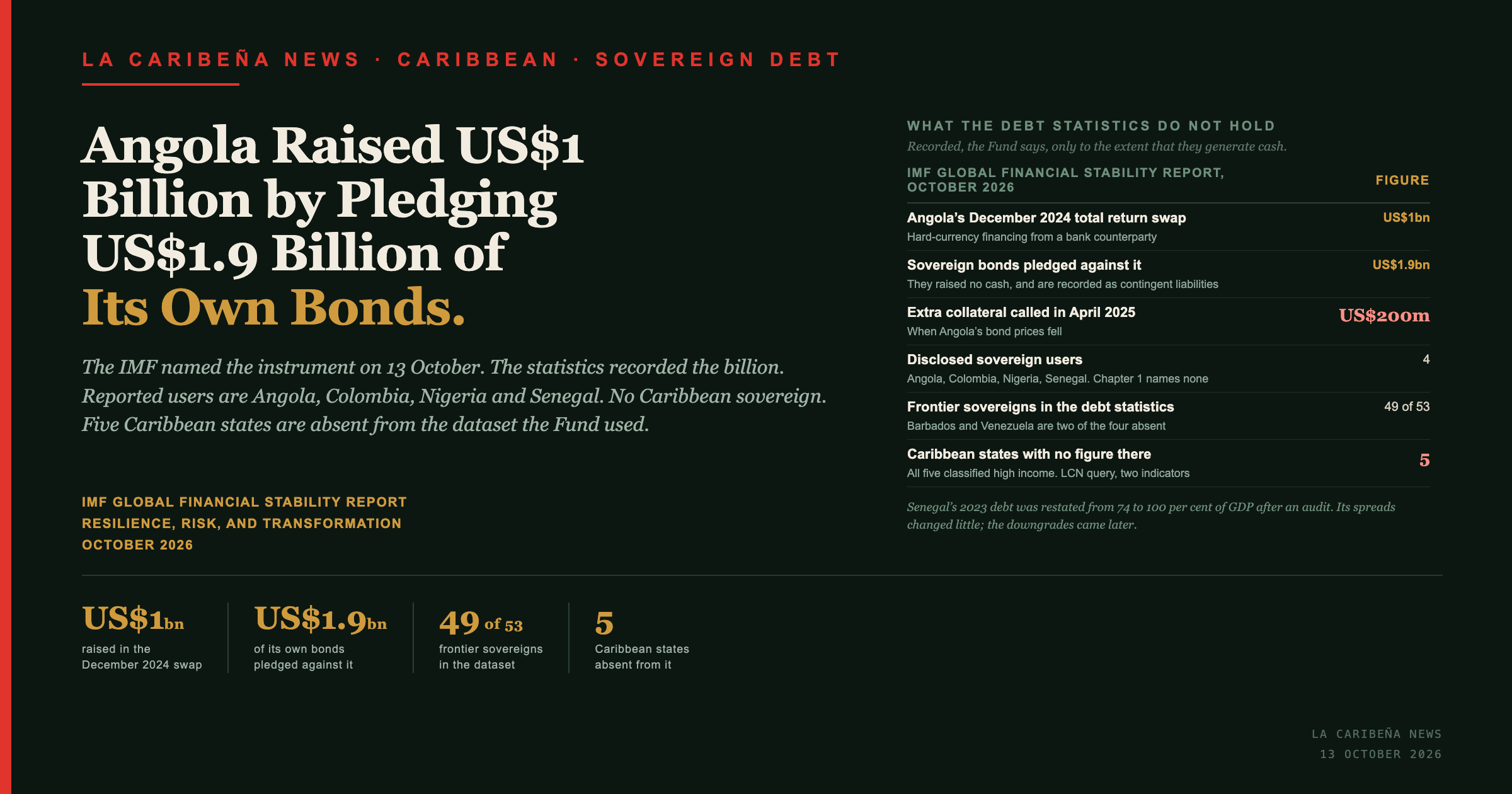
What the title card shows
Every data point on the article's title card, in text. Source for all: International Monetary Fund, Global Financial Stability Report, October 2026, except where stated.
- US$1 billion. The financing Angola raised in its December 2024 sovereign total return swap.
- US$1.9 billion. The newly issued sovereign bonds pledged as collateral against it, which raised no cash themselves. The Fund puts collateral-to-financing ratios in the transactions it examined at around 1.3 to 1.6, and notes its amounts and ratios are indicative and may reflect different valuation bases.
- US$200 million. The additional collateral Angola's swap reportedly required in April 2025 when its bond prices fell.
- 4 sovereigns. The disclosed users of the instrument: Angola, Colombia, Nigeria and Senegal. No Caribbean sovereign is among them, and Chapter 1 names no sovereign at all.
- 49 of 53. Frontier sovereigns that report to World Bank International Debt Statistics. Barbados and Venezuela are two of the four that do not.
- 11 of 13. The restructured frontier sovereigns the Fund's creditor-composition figures actually cover, after Barbados and Venezuela were excluded.
- 5 Caribbean states. Barbados, the Bahamas, Trinidad and Tobago, Antigua and Barbuda and St Kitts and Nevis, which are absent from the World Bank's published International Debt Statistics country list, and return no external debt stock figure on either of two indicators across the decade to 2024. All five are classified high income. Source: the World Bank's International Debt Statistics country list, 120 entries of which ten are Caribbean, and indicators DT.DOD.DECT.CD and DT.DOD.DPPG.CD, queried by LCN on 13 October 2026.
- 74 to 100 per cent. Senegal's 2023 central government debt, before and after its 2024 audit.
Frequently Asked Questions
What is a sovereign total return swap?
A derivative contract in which a government receives hard-currency financing from a bank counterparty and posts collateral, often its own bonds, transferring the return on those assets to the counterparty. The IMF says such arrangements are legally structured as derivatives but economically resemble collateralised funding, and that debt statistics may record them only to the extent that they generate cash.
Which countries have used them?
The IMF names four disclosed cases: Angola, Colombia, Nigeria and Senegal. It states that public reporting of these instruments remains concentrated in a limited number of emerging market and frontier economies, so those are the known cases rather than a complete list. No Caribbean sovereign is named.
Does the IMF say any Caribbean country uses these instruments?
No. The Caribbean appears in the annex only in a footnote listing the 13 restructured frontier sovereigns in the Fund's sample, which include Barbados, Belize and Suriname. Chapter 1 does not mention the Caribbean at all.
Why is Barbados absent from International Debt Statistics?
The dataset is built from the World Bank's Debtor Reporting System, which covers low- and middle-income borrowing members. Barbados is classified high income. The same applies to the Bahamas, Trinidad and Tobago, Antigua and Barbuda and St Kitts and Nevis, none of which returns an external debt stock figure on either of two World Bank indicators across the decade to 2024. Guyana is also classified high income but is present, because it remains an IDA borrower.
Does that mean these countries' debt is unknown?
No. The IMF's own World Economic Outlook publishes general government gross debt ratios for all five, with Barbados at 98.9 per cent of GDP in 2024 and a projected 93.8 per cent in 2026. What the World Bank dataset supplies and the debt ratio does not is the composition of that debt: which creditors are owed and under what kind of contract.