By LCN Business Desk
On the Bank of Guyana's own published figures, the country's Natural Resource Fund stood at US$5,472,911,327 at the close of September. It took in US$766.5 million of profit oil during the month and transferred US$200 million to the Consolidated Fund.
Against a population the IMF puts at 1.025 million, that is about US$5,339 a head. It is the largest pool of money the country has ever held.
All of it is in one overnight bank account.
Where is the money actually held?
At the Federal Reserve Bank of New York, in a deposit account earning overnight interest.
That is stated in terms, not inferred from the balance sheet. The Bank of Guyana's quarterly reports give it a heading of its own. The June 2026 report records:
"The Board of Directors of the Natural Resource Fund at its meeting held on March 27, 2026, conferred its approval to continue with the existing investment mandate for the Fund. It remains mandated that the funds are maintained in the deposit account held at the Federal Reserve Bank of New York earning overnight deposit interest."
The monthly reports show the same position from the asset side. In each of the 33 LCN read, from January 2024 to September 2026, "Financial Assets held at fair value through profit and loss" is zero and the returns table records a "TOTAL CASH PORTFOLIO" weighted at 100 per cent. Management fees, transaction costs and other expenses are zero throughout, which is about what such an account costs to run.
Is this a decision or a drift?
A decision, taken repeatedly.
Each quarterly report names the Board meeting at which the mandate was last confirmed, and the date moves.
| Quarterly report | Board meeting cited |
|---|---|
| December 2024 | 16 May 2024 |
| March, June and September 2025 | 28 March 2025 |
| December 2025 | 28 November 2025 |
| March and June 2026 | 27 March 2026 |
Four separate meetings, then, across the published series.
Two limits on that record matter. These are the dates on which the mandate was last approved, not a register of every Board meeting. And the most recent quarterly the Bank has published covers the second quarter of 2026. The third-quarter report, which would carry any decision taken since March, is not yet out. September's monthly figures are published; the narrative that accompanies them is not.
Each report also carries the same standing instruction: the Bank of Guyana "will continue to monitor the overnight interest rate and related market developments, and inform the Chairman of any key changes to consider the feasibility of redeploying cash."
Redeployment is therefore contemplated inside the Fund's own governance. It is a live question, framed as a function of where the overnight rate goes.
Is the Fund earning what it should?
On its own mandate, yes.
The Fund returned 0.886 per cent in the second quarter of 2026 and 0.877 per cent in the first. Its 2026 year-to-date annualised return is 3.574 per cent, and 2.687 per cent annualised since inception.
The relevant comparison is the overnight rate it is mandated to earn. The June 2026 quarterly notes the US Federal Reserve held its federal funds target range at 3.50 to 3.75 per cent. A 3.574 per cent annualised return sits inside that band.
The Fund is doing what it has been told to do, and doing it accurately. The Benchmark and Excess rows of its returns table are blank in every monthly and quarterly report LCN examined, which follows from the mandate: where the portfolio is a single overnight deposit, there is no comparator portfolio to measure it against.
How much has passed through it?
More than ten billion dollars, and the rate is accelerating.
Since inception the Fund has recorded US$9,167.94 million in profit oil from 117 lifts, US$1,335.25 million in royalties and US$15 million in signature bonus.
| 2026 | Royalty US$m | Profit oil US$m | Withdrawn US$m | Closing US$bn |
|---|---|---|---|---|
| January | 110.9 | 184.1 | 0.0 | 3.555 |
| February | 0.0 | 253.6 | 0.0 | 3.819 |
| March | 0.0 | 213.1 | 400.0 | 3.643 |
| April | 107.5 | 343.3 | 0.0 | 4.105 |
| May | 0.0 | 346.9 | 500.0 | 3.964 |
| June | 0.0 | 437.5 | 120.0 | 4.294 |
| July | 111.2 | 232.2 | 300.0 | 4.351 |
| August | 0.0 | 776.3 | 250.0 | 4.891 |
| September | 0.0 | 766.5 | 200.0 | 5.473 |
Source: Bank of Guyana NRF monthly reports, converted at the Bank's own stated rate of GYD 208.50 to the US dollar. Report amounts are in G$'000.
Profit oil ran at about US$287 million a month from January to July, then US$776.3 million in August and US$766.5 million in September, roughly 2.7 times the earlier rate. That is ExxonMobil completing cost recovery on the projects approved to date, which lifts Guyana's share of Stabroek Block profit oil from 12.5 per cent toward 39.8 per cent. What counts as a recoverable cost is itself the subject of an arbitration over US$214 million.
Royalties do not appear in the September column, and that is the cycle rather than a gap: the reports show royalty received in January, April, July and October only, in each of 2024, 2025 and 2026. October is the next one due.
Government withdrawals to the Consolidated Fund over the nine months total US$1.77 billion. The IMF's Executive Board, concluding Guyana's annual review on 8 October, worked from a Fund of about US$3.3 billion at the end of 2025.
Why does the mandate matter now?
Because of what the IMF asked Guyana to do four days before the September figures were published.
In Country Report 26/262, published on 8 October, Fund staff proposed that Guyana adopt a long-run fiscal anchor of "preserving the real per capita value of NRF assets", with the non-oil primary balance as the operational target tightening over a decade. LCN reported that proposal, and the government's reply, on 11 October.
Preserving real per capita value is a demanding standard over decades. It asks the Fund to outpace inflation and population growth together, indefinitely. An overnight deposit account at a central bank is an instrument built for safety and liquidity, not for that.
That is not a criticism of the mandate. Overnight deposits at the Federal Reserve carry effectively no credit risk and no market risk, which is a defensible choice for a fund that has been doubling in size and from which the government withdrew US$1.77 billion in nine months. Liquidity has a value, and the Fund has needed it.
It does mean the two things now sit together: an anchor that requires long-run real growth, and a mandate the Board has reaffirmed four times which earns the overnight rate. The Fund's own reports say the Bank will tell the Chairman when conditions warrant considering redeployment. Nothing published so far says that point has been reached, and the quarterly report that would say so next has not yet appeared.
What the title card shows
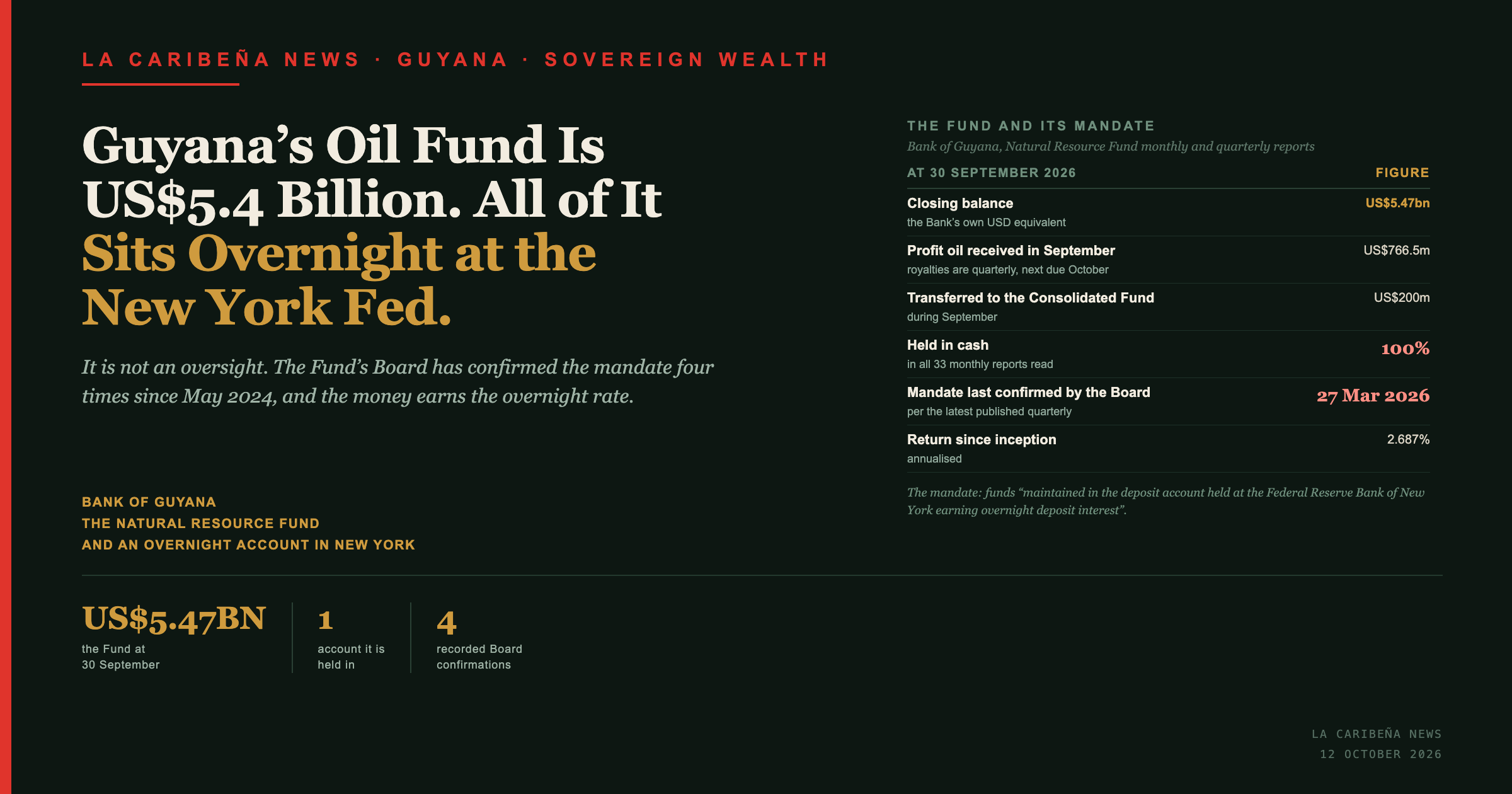
The card sets the headline against a panel drawn from the Bank of Guyana's Natural Resource Fund monthly and quarterly reports. The rows give the closing balance at 30 September 2026 of US$5,472,911,327; profit oil received in September of US$766.5 million; the September transfer to the Consolidated Fund of US$200 million; the share of the portfolio held in cash at 100 per cent, which holds in all 33 monthly reports read; the Board meeting cited by the most recent published quarterly as having last confirmed the mandate, 27 March 2026; and the return since inception of 2.687 per cent annualised.
Three figures run along the foot of the card: US$5.47BN, the Fund's closing balance; 1, the number of accounts it is held in; and 4, the number of Board meetings recorded in the published quarterly reports as having confirmed the mandate since May 2024. The flag block reads BANK OF GUYANA, THE NATURAL RESOURCE FUND, AND AN OVERNIGHT ACCOUNT IN NEW YORK.
Frequently Asked Questions
How much is in Guyana's Natural Resource Fund?
US$5,472,911,327 at 30 September 2026, per the Bank of Guyana's monthly report, stated at GYD 208.50 to the US dollar. That is about US$5,339 for each of Guyana's 1.025 million people.
Where is the Natural Resource Fund invested?
In a deposit account at the Federal Reserve Bank of New York earning overnight interest. The Bank of Guyana's quarterly reports state this as the Fund's investment mandate. The most recent published quarterly, for the second quarter of 2026, cites a Board of Directors meeting of 27 March 2026 as having last approved it; the third-quarter report is not yet published.
What return does the Fund earn?
0.886 per cent in the second quarter of 2026, 3.574 per cent annualised year to date, and 2.687 per cent annualised since inception. The US federal funds target range was 3.50 to 3.75 per cent in June 2026, so the Fund is earning approximately the overnight rate it is mandated to earn.
Why do the Fund's reports show no benchmark?
The Benchmark and Excess rows are blank in every monthly and quarterly report examined. Where the mandate is a single overnight deposit rather than a managed portfolio, there is no comparator portfolio to measure against.
How much did the fund receive and pay out in 2026?
Through September it received US$329.6 million in royalties and US$3,553.7 million in profit oil, and transferred US$1.77 billion to the Consolidated Fund.