By LCN Business Desk
Guyana's foreign currency shortage has been counted so far in what banks could not fill. The state puts about US$2.5 billion a year into the market itself, and intends to more than double it.
"This year, we'll probably be supplying directly maybe about US$2.5 billion but we're looking to more than double that next year," Vice President Dr Bharrat Jagdeo said on Thursday. "And we anticipate much more clearing of the market next year in terms of foreign currency."
He was speaking at the Guyana Manufacturing and Services Association's awards dinner, in remarks reported by Fueled.
Why is demand this high?
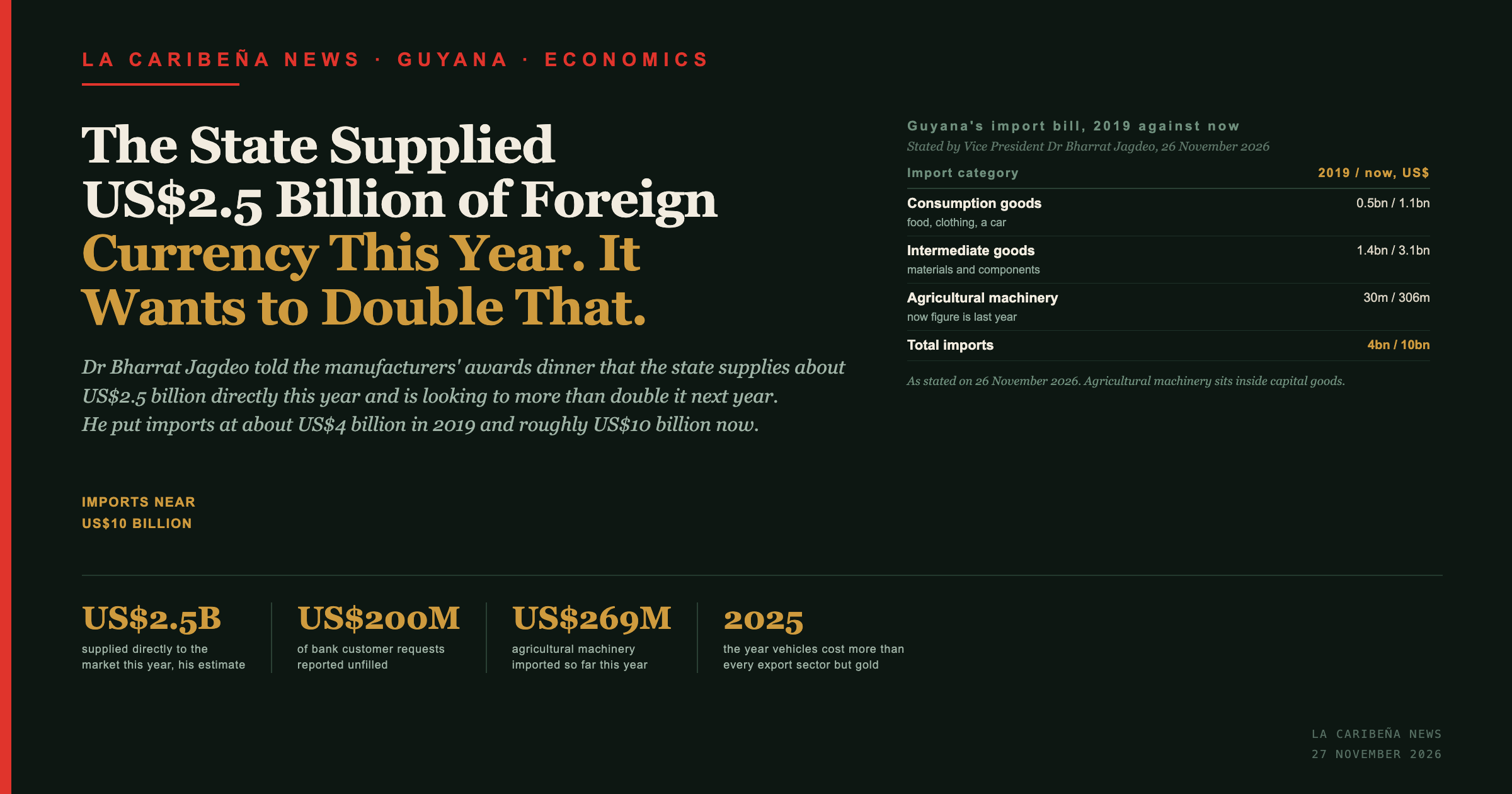
Imports have grown. Jagdeo put them at about US$4 billion in 2019 and roughly US$10 billion now.
| Import category | 2019 | Now |
|---|---|---|
| Consumption goods, from food to a car | about US$500 million | US$1.1 billion |
| Intermediate goods, materials and components | US$1.4 billion | US$3.1 billion |
| Agricultural machinery | US$30 million | US$306 million |
| Total imports | about US$4 billion | about US$10 billion |
As stated by the Vice President on 26 November 2026. Agricultural machinery sits inside capital goods; its "now" figure is last year, with US$269 million so far this year.
He set one line of that bill against the country's earnings. In 2025, Jagdeo said, vehicles alone cost more than the country earned from every export sector but gold. He did not publish the two totals behind that comparison.
What has this looked like from a counter?
Unfilled requests. Commercial banks told the President in September that US$200 million of customer requests could not be met. A former Finance Minister was appointed to study the demand.
It has reached smaller firms as well. A furniture exporter asked why small businesses cannot open United States dollar accounts. The central bank governor asked her why she wanted one.
Does this match what the Fund found?
It names the same cause. The International Monetary Fund said in July that import-heavy private investment keeps Guyana's market tight. The government's nine measures of September 2025 work on documentation and misuse instead.
What does he say the fix is?
Spending from income rather than borrowing. "Clearly, we have to finance more of our expenditure from our own resources," he said. "It will help to reduce the inflationary pressures by borrowing, and it will help to increase the supply of foreign currency."
At the same dinner he put a figure on one of those expenditures. The combined electricity subsidy this year is G$95 billion, and the transmission and distribution network needs about US$4.8 billion.
He added two conditions. The extra supply must go to genuine demand. And demand itself should ease once the country is past this period of heavy initial investment, which he expects to pay back as exports rise.
He also set the problem against the one oil usually brings. Countries that start producing oil often see their currency appreciate, he said, the effect known as Dutch disease. Guyana is under pressure in the other direction, and the government is managing it.
Is there a route that needs fewer dollars?
One is designed, and it has no launch date. CARICOM's planned payment system would move instant payments between member states in local currencies, and four Caribbean central bank governors met a team from the Pan-African Payment and Settlement System in Port of Spain in September.
The dollar is still in the middle of a regional trade. An importer buying shea and cocoa butter from Ghana sends the payment in US dollars.
What should a Caribbean reader take from this?
That the state sells about US$2.5 billion of United States dollars into its own market each year, and intends to sell more than twice that next year.
The quantity is an intention, not an allocation. No mechanism for distributing it was given, and no date was attached to the doubling.
An importer budgeting for 2027 plans against that intention. It also plans against a bank system that reported US$200 million of requests it could not fill.
The room he said it in was planning too. The association hosting him named five industries to build from local raw materials, every one of which buys its inputs in the currency he was discussing.
Title card, text equivalent
All figures on the title card, with their sources.
The panel sets Guyana's import bill in 2019 against now: consumption goods about US$500 million against US$1.1 billion, intermediate goods US$1.4 billion against US$3.1 billion, agricultural machinery US$30 million against US$306 million, and total imports about US$4 billion against about US$10 billion. Source: the Vice President's remarks of 26 November 2026, reported by Fueled.
The four figures in the bottom strip:
- US$2.5 billion: what the state supplies directly to the market this year, on his own estimate. Source: the same.
- US$200 million: customer requests commercial banks told the President they could not fill. Source: La Caribeña News, September 2026.
- US$269 million: agricultural machinery imported so far this year, against US$306 million last year. Source: the Vice President, 26 November 2026.
- 2025: the year he says vehicle imports alone cost more than every export sector but gold earned. Source: the same.
Entities named in this report
- Dr Bharrat Jagdeo is Vice President of the Co-operative Republic of Guyana.
- The Guyana Manufacturing and Services Association (GMSA) hosted the dinner at which he spoke.
- The International Monetary Fund (IMF) reported in July on the tightness of Guyana's foreign exchange market.
- Dutch disease is the currency appreciation that often follows a resource discovery, which he said Guyana is not experiencing.
- The Pan-African Payment and Settlement System (PAPSS) settles payments between African countries in local currencies and met Caribbean governors in September.
- The Caribbean Payment and Settlement System (CAPSS) is CARICOM's planned equivalent, which has no launch date.
- Fueled reported the remarks.
Frequently asked questions
How much foreign currency does Guyana's state put into the market?
About US$2.5 billion directly this year, on the Vice President's own estimate given on 26 November 2026. He said the government is looking to more than double that next year.
Why is demand for United States dollars so high in Guyana?
Imports have risen from about US$4 billion in 2019 to roughly US$10 billion. Consumption goods went from about US$500 million to US$1.1 billion, intermediate goods from US$1.4 billion to US$3.1 billion, and agricultural machinery from US$30 million to US$306 million.
What did the banks say they could not fill?
Commercial banks told the President in September 2026 that US$200 million of customer requests were unmet. A former Finance Minister was appointed to study the demand.
Is Guyana experiencing Dutch disease?
Jagdeo said no. Countries that begin producing oil often see their currency appreciate, he said, while Guyana faces pressure in the opposite direction.
Is there a regional payment system that would use fewer US dollars?
CARICOM's planned system would move instant payments between member states in local currencies. PAPSS said in October 2023 that a commercial Caribbean launch was expected in the fourth quarter of 2024. The meeting that will set a date has not been held, so an importer buying from Ghana still sends US dollars.
What does the government say will reduce the pressure?
Financing more of its spending from its own resources rather than borrowing, which he said would ease inflationary pressure and increase the supply of foreign currency. He also said demand should ease once the country is past its current period of heavy investment.