By LCN Business Desk
Turkey and Australia presided over the longest COP on record, and on 22 November 2026 it closed in Antalya with no cover decision. Two United Nations documents describe what it left small island states.
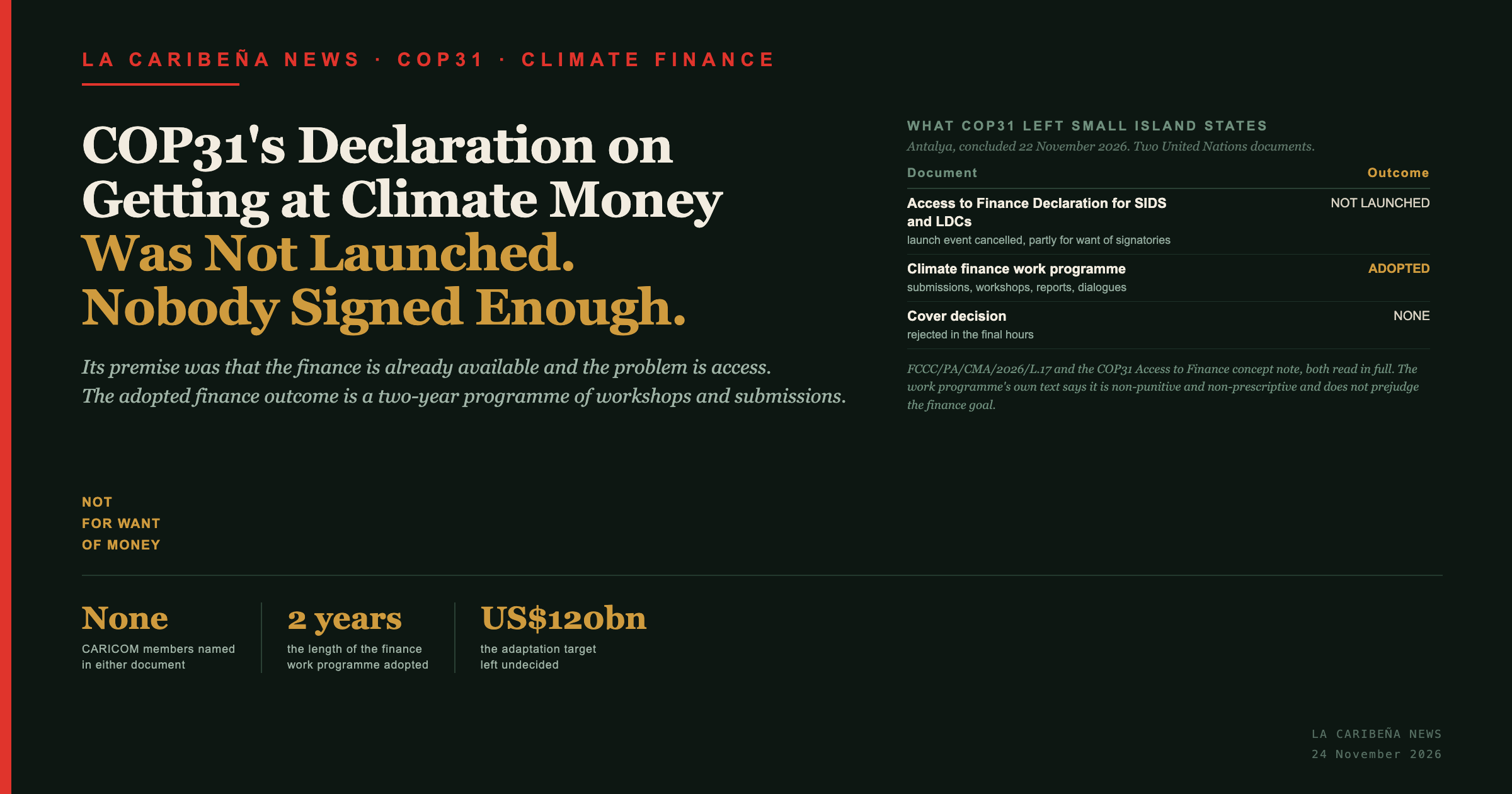
One was never launched. The other is a schedule of meetings.
What was the declaration for?
Getting money out of funds that already hold it, rather than raising more.
The concept note is a one-page UNFCCC document marked OFFICIAL. Australia would use its COP31 role to put the case for small island developing states. The note names three barriers: "long timeframes, unpredictability of finance, and high transaction costs."
The plan came from the COP31 Australia-Pacific Partnership, built as a Declaration and Action Plan for governments and bodies to sign. Its own text places it outside the talks: "This sits outside the formal UNFCCC negotiations."
Its opening premise sets the terms of everything under it.
Access to finance is an implementation issue; the finance is available, and we need to ensure that vulnerable countries who need it most can access it in a manner that reflects their circumstances.
What it asked for was process. Reforms "that should reduce transaction costs, shorten approval timeframes and strengthen country ownership", plus grants, cheap finance and tools that keep debt payable.
Why does the cancellation matter?
Because a text about access is itself a test of access, and it failed.
Carbon Brief reports the Australian presidency was set to launch it at COP31, and that the event was cancelled partly for a lack of signatories. Neither the presidency nor the concept note gives a signatory count.
The panel that was to sit ran 60 minutes and had 5 segments. Australia's David Higgins was to open it. Ruel Yamuna, the Pacific Climate Finance Envoy, was to set out why the barriers are urgent. Türkiye's speaker and the Adaptation Fund's were both still to be confirmed.
Nobody from the Caribbean is named on it. Neither document names a single CARICOM member. The region sits inside the category without appearing in it.
What did get agreed on finance?
A two-year work programme, and the text is candid about its limits.
Draft decision -/CMA.8 was issued on 22 November as an advance version under the reference FCCC/PA/CMA/2026/L.17. It sets up a work programme on climate finance under Article 9 of the Paris Agreement.
| What the decision provides | Paragraph |
|---|---|
| Submissions from Parties and non-Party stakeholders | 3(a) |
| In-person workshops alongside subsidiary body sessions | 3(b) |
| A summary report on each workshop | 3(c) |
| Virtual dialogues, as appropriate | 3(d) |
| Two co-chairs for 2027 and 2028, one developed and one developing | 7 |
Two paragraphs bound what it can do. Paragraph 5 says the work "will not affect the integrity of the new collective quantified goal on climate finance or prejudge its implementation". Paragraph 6 says deliberations are to be "facilitative, enabling, non-punitive and non-prescriptive".
A programme that cannot prescribe and cannot prejudge is a conversation with a calendar.
What happened to the rest of it?
The headline numbers did not survive the fortnight.
Turkey and Australia presided over the longest COP on record and failed to find consensus on their cover decision. The proposal was rejected in the final hours by the European Union, the United Kingdom and several climate-vulnerable countries. Developing countries criticised the lack of progress on finance and the indecision over a proposed US$120 billion target for adaptation.
Calls for new agenda items on adaptation finance and on trade were rejected. The climate finance work programme was the item that got added.
The Global Goal on Adaptation decision mentions neither overshoot nor 1.5C. It does settle its expert taskforce: six nominations per United Nations regional group, with three more from least developed countries and three from small island developing states. On loss and damage there were few substantial outcomes and limited recognition of the funding gap.
What should a Caribbean government or sponsor take from it?
That the money for a project will not come from this process, and that the paperwork around it has not got shorter.
A Caribbean ministry budgeting against climate finance must plan on the funds that already exist. No new one was created. The text says those funds already hold the money and the problem is reaching it. That is a claim about paperwork, not about volume. The paperwork did not change at Antalya.
Regional finance is moving on its own track meanwhile, and faster. Four Caribbean central bank governors met Africa's payment system in Port of Spain, with a CAPSS pilot next. Afreximbank named Suriname's Islamic bank in US$15 million of lines against a CARICOM ceiling raised to US$5 billion. The CARICOM fund sponsoring a US$250 million sustainability bond has disbursed US$169 million since 2009.
Where money has been committed, drawing it is the recurring problem rather than winning it. EC$170.6 million lent to St Vincent and the Grenadines by the Saudi Fund for Development is unspent, across three agreements signed since May 2023. The access question the cancelled declaration was written about is already visible in a Caribbean ledger.
A second international process has a date and a fund. The International Maritime Organization votes on its Net-Zero Framework on 4 December 2026, and the fund it would create names small island states among what it pays for. That one is still live.
And the carbon side has its own arithmetic. Vice President Bharrat Jagdeo said at COP31 that Guyana's forest carbon programme is expected to generate more than US$100 million in 2026, and that a fifth of carbon revenue goes to 252 Indigenous villages.
The entities
- COP31: the thirty-first United Nations climate conference, held in Antalya, Turkey, and concluded on 22 November 2026 without a cover decision. - Small Island Developing States (SIDS): the United Nations grouping that includes CARICOM members and is the category the cancelled declaration addressed. - COP31 Australia-Pacific Partnership: the body that developed the Access to Finance initiative, outside the formal negotiations. - Ruel Yamuna: the Pacific Climate Finance Envoy, listed to speak on access barriers at the cancelled event. - Global Goal on Adaptation: the Paris Agreement's adaptation objective, whose COP31 decision settles an expert taskforce including three nominees from small island developing states. - FCCC/PA/CMA/2026/L.17: the advance version of the draft decision establishing the two-year climate finance work programme.
What the title card shows
Two: the United Nations documents from COP31 that set out what the talks offered small island states, being the Access to Finance Declaration concept note and the finance work programme decision. Zero: the CARICOM members named in either. US$120 billion: the adaptation finance target over which developing countries recorded indecision. Two years: the length of the climate finance work programme adopted on 22 November 2026 under FCCC/PA/CMA/2026/L.17. Six, three and three: the expert nominations per United Nations regional group, from least developed countries and from small island developing states, settled by the Global Goal on Adaptation decision.
Frequently asked questions
What was the COP31 Access to Finance Declaration?
An initiative from the COP31 Australia-Pacific Partnership, outside the formal negotiations, proposing a Declaration and Action Plan on reducing the transaction costs and approval timeframes that small island states and least developed countries face when seeking climate finance.
Why did it not launch?
Carbon Brief reports the event was cancelled partly because of a lack of signatories. No signatory count has been published.
Did COP31 agree anything on climate finance?
Yes, a two-year work programme of submissions, in-person workshops, summary reports and virtual dialogues, with two co-chairs for 2027 and 2028. Its own text says it will not prejudge the climate finance goal and that deliberations are to be non-punitive and non-prescriptive.
What happened to the adaptation finance target?
Developing countries criticised indecision over a proposed US$120 billion target, and calls for a new agenda item on adaptation finance were rejected.
Is the Caribbean named in the COP31 finance documents?
No CARICOM member is named in either the access declaration concept note or the finance work programme decision. Both address small island developing states as a category.
<!-- archive: caribbean-business-cruise-trade-missions-no-published-outcomes-2026 | a trade-mission cruise and its outcomes. Shares Caribbean and business terms and no subject: no climate finance, no COP, no fund. --> <!-- archive: bartica-ferry-reliability-interior-trade-logistics-guyana-2026 | a ferry and interior logistics in Guyana. Domestic transport, unrelated to climate finance access. --> <!-- archive: europe-stopped-selling-citizenship-us-gold-card-investor-migration-2026 | citizenship and investor migration programmes. Shares finance and states as terms and nothing else. -->