By LCN Business Desk
Everything a Caribbean business imports arrives on a ship. A rule that prices what those ships burn is now down to a single day in December.
The International Maritime Organization has put the vote on the IMO Net-Zero Framework on 4 December 2026. Its own meetings calendar carries that session with four words attached: subject to confirmation by MEPC 85, the committee that meets from 30 November to 3 December.
What would the framework do?
Set a fuel standard for big ships and charge the ones that miss it.
It applies to oceangoing ships over 5,000 gross tonnage. The IMO's own explanation of the framework says those ships make more than 85 per cent of shipping emissions. Each one must cut the greenhouse gas intensity of its fuel against a limit that tightens every year. The measure runs across the fuel's whole life, from well to wake.
A ship that comes in over the limit must cover the gap. It can buy surplus units from a cleaner ship, use units it banked earlier, or pay into the IMO Net-Zero Fund. A ship running on fuels the IMO counts as zero or near-zero can earn money instead.
| Ships covered | over 5,000 gross tonnage |
| Share of shipping emissions | more than 85 per cent |
| Current average fuel intensity | 93.3 gCO₂eq/MJ |
| Counts as zero or near-zero | no more than 19.0 gCO₂eq/MJ |
The IMO's own explanation of the framework. The 19.0 figure is 80 per cent below the current average.
Why does the date matter so much?
Because adoption needs two thirds, and the clock after it is 16 months.
The framework is an amendment to MARPOL Annex VI, the air pollution annex of the convention. Adopting it takes a two-thirds majority of the Parties present and voting. There are 108 of them, carrying more than 97 per cent of the world's merchant tonnage, and abstentions do not count towards the two thirds.
After adoption the amendment is deemed accepted ten months later. That holds unless a third of Parties object, or Parties holding half the world's tonnage do. It then takes effect six months after that. The IMO puts the whole sequence at 16 months from the day of the vote.
What happened the last time?
It was adjourned for a year.
An extraordinary session in October 2025 was meant to adopt the framework. Saudi Arabia called for a vote. Member states put the discussion off for twelve months, by 57 to 49, with 21 abstentions and eight countries not present. Trade coverage of the session named Russia, the United States, Panama and Liberia among those backing the delay.
Earlier in 2025 the framework had been approved by 63 countries, including the European Union, India and Brazil.
What is in it for the Caribbean?
The fund it would create names small island states among the things it pays for.
The IMO lists the Net-Zero Fund's uses as rewarding low-emission ships, backing innovation, research, infrastructure and just-transition projects in developing countries, paying for training and technology transfer, and offsetting impacts on vulnerable states, "such as Small Island Developing States and Least Developed Countries".
Every independent Caribbean state in that category is a small island developing state. The IMO has published no percentage split among those uses.
What does this mean for a business here?
Two things, and they run in opposite directions.
The cost of moving a container is set by carriers, and it moves on their decisions long before any treaty does. Hapag-Lloyd filed two rate notices on the same Caribbean corridor eight days apart, which is the speed at which freight pricing actually changes.
Against that, a cost put on fuel reaches a landed price in the end. The money meant to come back to small island states runs on a slower clock than the cost does. Adoption on 4 December would put entry into force around April 2028. A second delay pushes both further out.
What is not established here?
How Caribbean states voted in October 2025. The result is public and the roll call is not. Nothing in this report says how any Caribbean member voted, and no IMO roll-call document for that session was read.
Whether the 4 December session will be held. The IMO's calendar marks it subject to confirmation by MEPC 85. That confirmation had not been given when this was published.
The price per tonne. The framework sets two tiers of pricing. The IMO's published explanation carries the amounts in an image rather than in text, and the figures are not stated here.
What each delegation argued. The reported positions of Russia, the United States, Panama, Liberia and Saudi Arabia above come from trade and legal coverage of the session, not from a transcript.
The entities
- International Maritime Organization is the United Nations agency that regulates shipping. It has scheduled the extraordinary session for 4 December 2026, subject to confirmation. - IMO Net-Zero Framework is the proposed amendment to Annex VI of the MARPOL convention, setting a fuel standard and a price on greenhouse gas emissions from ships over 5,000 gross tonnage. - IMO Net-Zero Fund is the fund the framework would create, whose stated uses include offsetting impacts on Small Island Developing States and Least Developed Countries. - MEPC 85 is the 85th session of the IMO's Marine Environment Protection Committee, sitting from 30 November to 3 December 2026, which must confirm the extraordinary session. - MARPOL Annex VI is the air pollution annex of the convention the framework would amend. It has 108 Parties, carrying more than 97 per cent of world merchant tonnage.
What the title card says
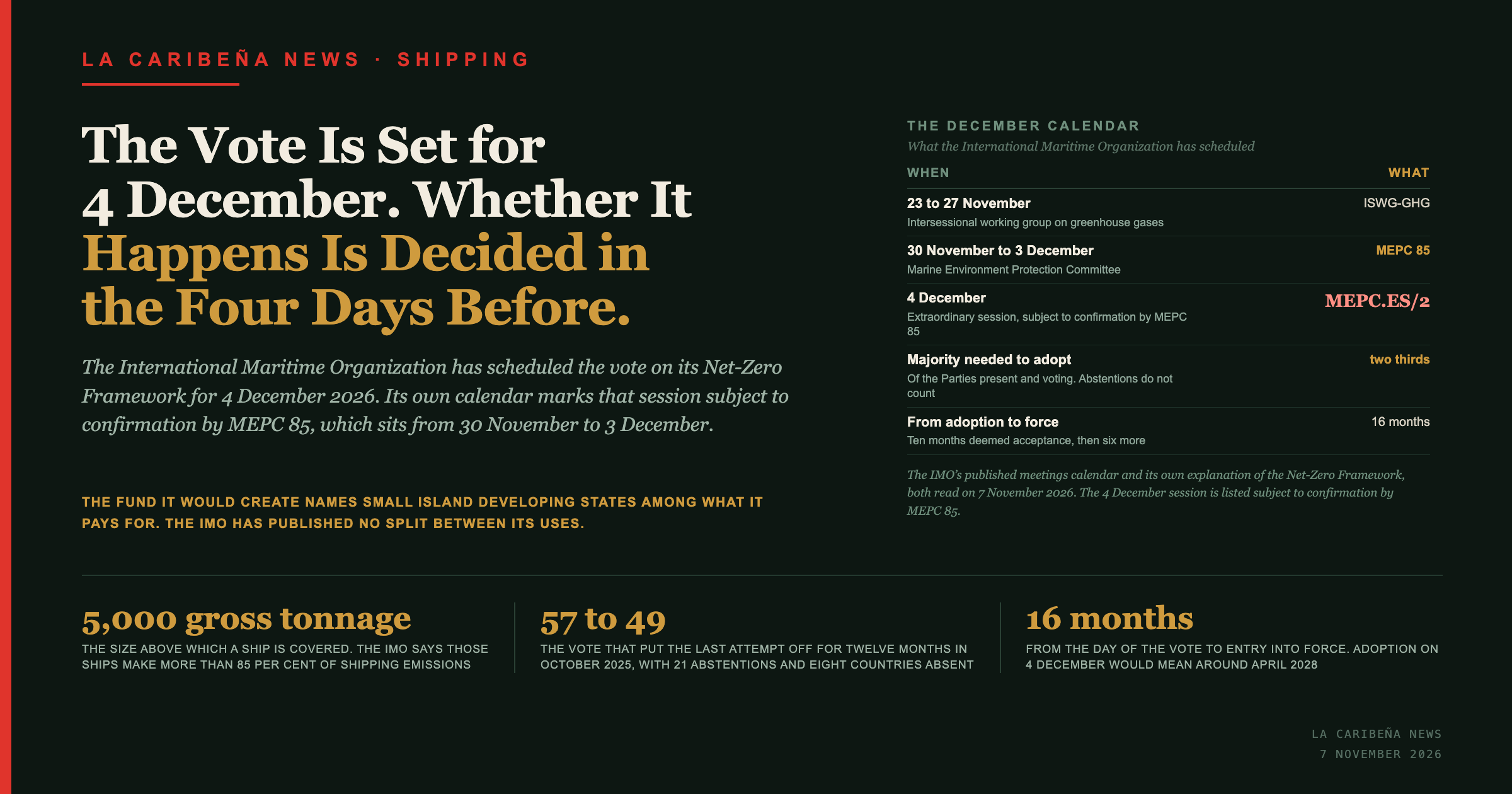
- Kicker: Shipping. - Headline: the vote on a global shipping carbon price is set for 4 December, and whether it happens is decided in the four days before it. - Deck: the IMO's own calendar marks the extraordinary session subject to confirmation by MEPC 85, which sits from 30 November to 3 December 2026. - Standfirst: the fund it would create names Small Island Developing States among what it pays for, and the IMO has published no split between its uses. - Panel, "The December calendar", sub-headed as what the IMO has scheduled, with rows of date against meeting: - 23 to 27 November, intersessional working group on greenhouse gases. - 30 November to 3 December, MEPC 85. - 4 December, extraordinary session, subject to confirmation. - Majority needed to adopt, two thirds of those present and voting. - Time from adoption to entry into force, 16 months. - Panel note: the IMO's published meetings calendar and its own explanation of the framework. - Chip: 5,000 gross tonnage, the size above which a ship is covered. - Chip: 85 per cent, the share of shipping emissions those ships account for. - Chip: 57 to 49, the vote that adjourned the last attempt in October 2025. - Date line: 7 November 2026.
Frequently Asked Questions
When is the IMO vote on the Net-Zero Framework?
The IMO has set an extraordinary session for 4 December 2026. Its calendar marks it subject to confirmation. MEPC 85 decides that, and it meets from 30 November to 3 December.
Which ships would the framework cover?
Oceangoing ships over 5,000 gross tonnage. The IMO says they account for more than 85 per cent of shipping emissions. Smaller ships are not covered. Including ships from 400 tonnes upward is under discussion.
What majority is needed to adopt it?
Two thirds of the Parties present and voting. Annex VI has 108 Parties. Between them they carry more than 97 per cent of world merchant tonnage. Abstentions do not count.
What happened at the last attempt?
An extraordinary session in October 2025 put the matter off for twelve months. The vote was 57 to 49. There were 21 abstentions, and eight countries were absent.
What would the money be used for?
The IMO lists rewards for low-emission ships, innovation and infrastructure in developing countries, and training and technology transfer. It also lists offsetting the impact on vulnerable states, naming Small Island Developing States and Least Developed Countries. The IMO has published no split between them.