By LCN Compliance Desk
A tanker that could not lawfully carry Guyana's flag was flying it in the Indian Ocean in April, with Iranian crude in its tanks. On 4 November the United States Treasury named the network it says had been handing that flag out, and on 5 November Guyana's Maritime Administration Department said it fully supported the action.
What sits between those two dates is five years, four public episodes and a gap that falls on commercial parties rather than on governments. Guyana's ship register is one of the most restrictive in the hemisphere, closed by statute to anyone but Guyanese and Caribbean Community owners. A shipping agent, trade financier or hull underwriter who wanted to test a Guyana flag against that rule has the law to hand. What they do not have is a published list of the ships that are actually on it.
What did the United States Treasury do on 4 November?
Fifteen designations, and an alert addressed to the maritime industry.
The Office of Foreign Assets Control designated five individuals and ten companies under Executive Order 13902, which targets sectors of the Iranian economy. The named individuals include Suniel Kumar Sharma, born in Lucknow in 1979 and listed at Chandigarh, and Jaspreet Preeti Shahid, also of Chandigarh and listed under the alias Jaspreet Kaur. Among the companies is Eswatini Maritime Affairs and International Ship Registry Pte. Ltd., registered in Singapore.
Alongside them OFAC published an alert, Iranian Shadow Fleet Reliance on False Flags for Sanctions Evasion, issued under a campaign it calls Operation Economic Outcast. It is addressed to service providers rather than to the designated parties, and it defines the problem in one sentence: a false flag is "either a flag provided by a fraudulent registry that is not authorized by the host country or a flag falsely claimed by a vessel without supporting registration documentation."
The alert then says something about Guyana that MARAD's own statements do not. The network, it records, "initially provided legitimate flagging services on behalf of jurisdictions such as Dominica, Guyana, Eswatini, and Nicaragua", before "corruption and other risk indicators, such as provision of flags to shadow fleet vessels, resulted in these countries severing their business partnerships with this network and revoking their authorization to provide services on behalf of the governments". It adds that "in several cases, the network continued to flag vessels long after the flag state had publicly denounced them as fraudulent."
The document names the four jurisdictions as a set and attributes the severing to "these countries" collectively. It does not say which country authorised the network in which year, nor which of the four are the several cases where flagging carried on after denunciation.
Who is allowed to fly Guyana's flag?
Only owners who are wholly Guyanese or Caribbean Community, with one route left open to the minister.
The rule is section 11 of the Guyana Shipping Act, Chapter 49:01, Act 7 of 1998, as amended by Act 7 of 2006. A ship "shall not be registered in Guyana under this Act unless she is wholly owned by persons qualified to own a Guyana ship".
| Qualified under section 11(1) | As drafted |
|---|---|
| (a) | nationals of Guyana |
| (b) | persons domiciled or ordinarily resident in Guyana |
| (c) | citizens of Caricom States residing in a member country of the Caribbean Community, where the ship is customarily engaged in international voyages |
| (d) | a body corporate established under the laws of Guyana with its principal place of business in Guyana, or a body corporate that is a national of a Caribbean Community state |
| (e) | persons in bona fide joint venture relationships with (a) or (c) |
| (f) | such other persons as the Minister may by order determine |
Guyana Shipping Act, Cap. 49:01, section 11(1), L.R.O. 1/2012 consolidated edition. Section 11(2) extends registration to bareboat charters by the same categories.
The test is whole ownership, not control or majority, so a single disqualified holder anywhere in the chain defeats registration. And subsection (3) shuts the route a foreign owner would otherwise take, by defining a body corporate for these purposes as one whose majority of shareholders are themselves Guyanese nationals, Guyana-resident persons or CARICOM citizens. Incorporating in Georgetown does not qualify a foreign owner.
The exception is paragraph (f), and it is the reason "no foreign-owned vessel can ever fly the flag" overstates the position. The minister may add categories by order. The consolidated edition's own index of subsidiary legislation, current to L.R.O. 1/2012, lists four regulations and no order under section 11. Anything made since then sits outside that document.
Against this, MARAD's position has been consistent in public for two years. On the five tankers sanctioned in December 2024 it said that Guyana "does not, has not, and will not offer a flag of convenience for vessels".
How long has this been running?
At least five years, across four public episodes before this one.
| Date | Event |
|---|---|
| 2014 | First recorded impersonation attempt by the network, posing as Dominica's maritime authority |
| 2021 | MARAD dates its recognition of false Guyana registrations from this year |
| 27 December 2024 | Treasury sanctions five oil tankers purportedly registered under Guyana's flag |
| December 2025 | A vessel named SKIPPER |
| 22 to 23 April 2026 | US forces seize the tanker Majestic X, formerly PHONIX, carrying Iranian crude under a false Guyana flag |
| 4 November 2026 | Treasury designates the network: five individuals, ten entities |
Dates as reported by Guyanese and regional outlets and, for the designations, by OFAC.
The April seizure ran entirely outside the register. MARAD said of the Majestic X that "there is no record of this vessel or name in Guyana's registry", and that "the IMO number remains recorded in the international database as PHONIX". The ship had already been sanctioned under that former name in 2024. A vessel can therefore carry a flag, change its name, keep an identifying number that points at a sanctioned predecessor, and still find service.
MARAD's statement of 5 November, as carried by Kaieteur News, said the government "remains resolute in its efforts to detect, prevent, and eliminate" the fraudulent use of its flag, that the matter "has been consistently raised at international and regional maritime and shipping forums", and that MARAD and the Ministry of Public Utilities "fully supports the actions taken by the United States" Treasury against the named parties. Coverage of the same statement reports MARAD naming the vehicle as the International Maritime Safety Agency of Guyana. That name does not appear among the ten entities designated on 4 November. What appears instead, inside Sharma's individual listing, is a website.
What does the alert tell a service provider to look for?
Five indicators, and they are written for insurers, trade financiers and anyone else selling into the sector.
OFAC says service providers "are encouraged to conduct enhanced due diligence on vessels with indicia of using a falsely claimed flag", and lists the red flags as:
- "An unknown or no flag reported in maritime databases" - "A flag from a jurisdiction that is commonly listed as false in maritime databases" - "A vessel broadcasting a Maritime Mobile Service Identity number with a country prefix code that contradicts the reported flag of the vessel" - "A flag from a jurisdiction without a known flag registry" - "Flag registration documentation that cannot be verified"
The operative risk in a designation usually lands on commercial counterparties rather than on states, which is the pattern this newspaper found in Colombia, where a sanctioned president's practical difficulty came from an airline cancelling his ticket while embassies, trade and travel carried on. Here the alert makes that explicit by naming the professions it is addressed to. It also tells governments what to do, in terms: report fraudulent operators to the International Maritime Organization so that its Global Integrated Shipping Information database records a vessel as falsely flagged, and act promptly "to avoid reputational and commercial harm".
Washington has reached an industry in stages before, listing the engineering and service firms around Cuba's nickel producer weeks after blocking the producer itself.
What can a counterparty actually verify today?
A counterparty can apply the ownership test at once. Verifying the certificate itself means telephoning Georgetown.
Four of the five red flags above require a maritime database. The fifth requires a document and some way of testing it. Section 11 requires neither: it asks who owns the vessel, which is the one fact a charterer, trade financier or hull underwriter has already collected for other purposes. On a closed register, foreign ownership and a Guyana flag cannot both be true, subject only to a ministerial order that does not appear in the consolidated Act. For this flag state, the ownership chain settles the question faster than any database.
Verification of the paper is the harder half. MARAD publishes registering and licensing of ships among its responsibilities and a page of vessel registration forms. It does not publish a searchable or downloadable list of Guyana-flagged vessels, and its maritime administration page carries no notice about fraudulent registrations or imitation registry websites. The routes it does publish are two telephone numbers, (592) 225-7330 and (592) 226-3356, and a contact form. A registration certificate presented to a buyer, bank or insurer therefore cannot be matched against anything published, which is the condition the fifth red flag describes.
The alert also warns about the sites themselves. OFAC says that fraudulent registries "will use fake websites or websites designed to mimic an existing official website", often "sophisticated forgeries" that "may use incorrect domain names", and listed eight web addresses in Sharma's entry. Two days after the designation, three of those eight were still serving pages: the Eswatini-domained one matching the designated Singapore registry, one other, and the Guyana-facing address. That last one presents itself as providing maritime administration support to Guyana and claims more than 280 ship inspectors. It states no eligibility criteria, no fees and no address, names no official and no ministry, carries no notice of the designation, and its posts are dated April 2021, the year MARAD dates the problem from.
Guyana's maritime institutions are being built out at the same time as this is running. The state awarded G$3.6 billion in September for concrete leading beacons, a vessel traffic service and port security systems on the Demerara Main Ships Channel, and the salvage tender for the ferry MV Barima requires the wreck preserved as forensic evidence for a Commission of Inquiry. Both are capital and casualty work. Neither reaches the register, where the question a counterparty faces is documentary and the published answer is a telephone number.
Update
Updated 7 November 2026. This article originally recorded that no figure for the number of vessels carrying a false Guyana flag was published by MARAD, by OFAC or in the alert, and that none was estimated here. The first part stands and none of those three has published one. A third-party figure has since been read and is now carried in the not-established list below, with the three limits that qualify it. Nothing else in this article is changed.
What is not established here?
Which jurisdiction authorised the network, and when. OFAC's alert names Dominica, Guyana, Eswatini and Nicaragua as a group and attributes the authorisation, the revocation and the continued flagging to "these countries" without separating them. No date, sequence or instrument is given for Guyana specifically, and none is asserted here.
Whether any order has been made under section 11(1)(f). The subsidiary legislation indexed in the 2012 consolidation does not include one. An order made after that edition would not appear in it.
What imsag.org contains. The domain does not resolve. Its contents were not read and are not characterised.
How many vessels still carry a false Guyana flag. No figure is published by MARAD, by OFAC or in the alert. The maritime analytics firm Windward puts Guyana at 43 vessels for the first quarter of 2026, among the registries it describes as having emerged as significant that quarter, behind the Netherlands Antilles on 52 and ahead of Guinea on 28 and Madagascar on 24. Three limits apply to that number: the page does not say who produced it, it says vessels where the next sentence speaks of tankers, and the first quarter ended three quarters before the alert. The same page attributes a worldwide total of 580 falsely flagged vessels to the International Maritime Organization's database, across 22 fraudulent registries, which is a global count and says nothing about Guyana.
Whether Guyana has reported the operators to the International Maritime Organization. The alert recommends it and MARAD has said since 2024 that it shares information on these registrations with UN member states and maritime bodies. Whether a GISIS entry resulted is not established.
The status of the still-reachable websites. That a page answers a request is not evidence that anyone is still being registered through it, or that the operator is still trading. Equally, a domain that does not resolve is not evidence of a takedown.
The entities
- Maritime Administration Department (MARAD) is the Guyanese agency responsible for registering and licensing ships, under the Ministry of Public Utilities. - Office of Foreign Assets Control (OFAC) is the sanctions administrator within the United States Department of the Treasury, which made the designations and published the alert of 4 November 2026. - Guyana Shipping Act, Chapter 49:01 is Act 7 of 1998, amended by Act 7 of 2006, whose section 11 sets who may own a ship registered in Guyana. - Executive Order 13902 is the United States instrument targeting sectors of the Iranian economy, under which the five individuals and ten entities were designated. - Suniel Kumar Sharma and Jaspreet Preeti Shahid are the two individuals of Chandigarh, India, named in the designations, whose entries list the registry websites. - Eswatini Maritime Affairs and International Ship Registry Pte. Ltd. is the Singapore-registered company among the ten entities designated. - Majestic X, formerly PHONIX, is the tanker seized by US forces in April 2026 carrying Iranian crude under a false Guyana flag. - International Maritime Organization (IMO) maintains the Global Integrated Shipping Information database the alert asks governments to correct.
What the title card says
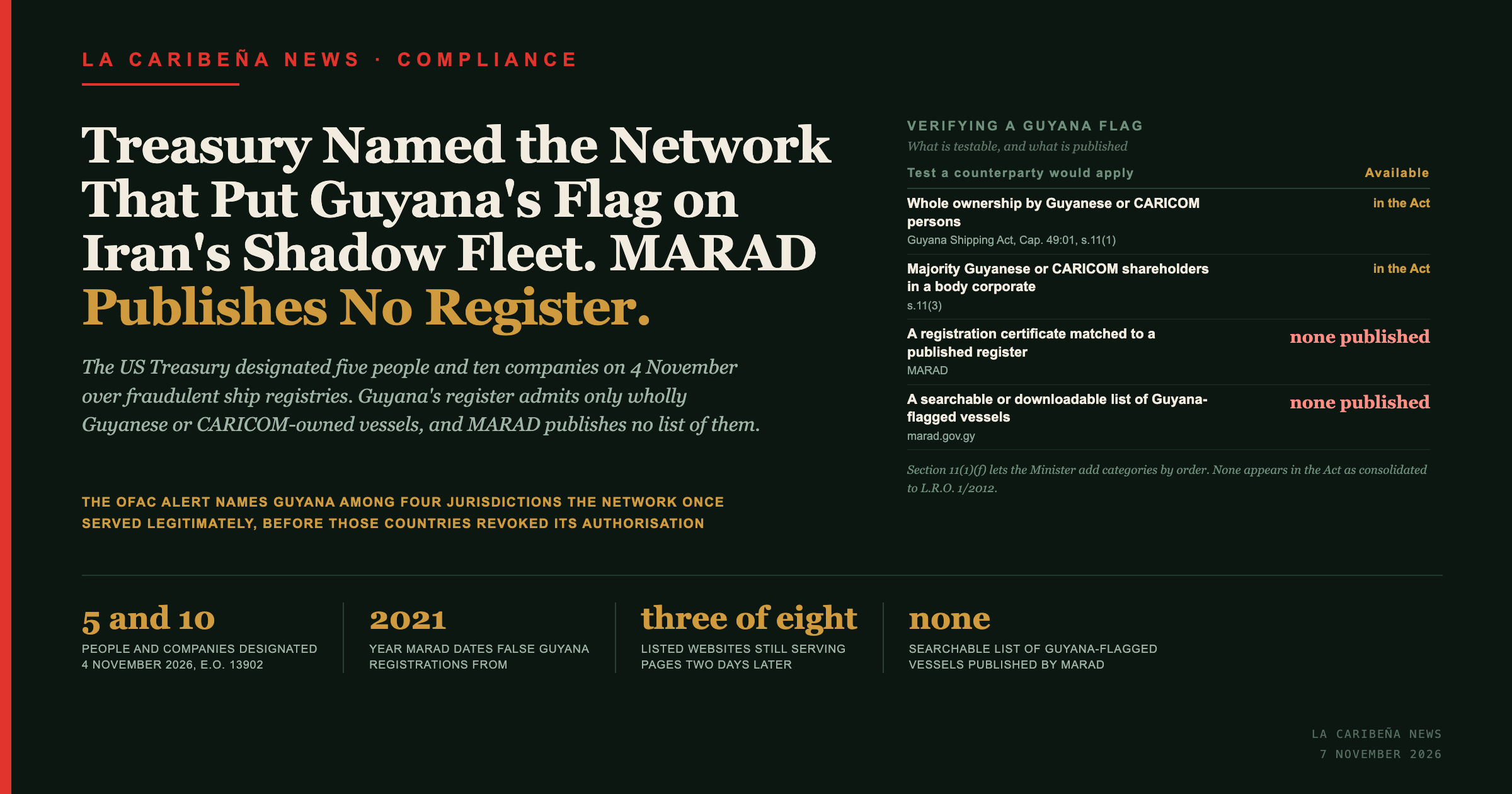
- Kicker: Compliance. - Headline: Treasury named the network that put Guyana's flag on Iran's shadow fleet, and MARAD publishes no register. - Deck: the US Treasury designated five people and ten companies on 4 November over fraudulent ship registries; Guyana's register admits only wholly Guyanese or CARICOM-owned vessels, and MARAD publishes no list of them. - Standfirst: the OFAC alert names Guyana among four jurisdictions the network once served legitimately, before those countries revoked its authorisation. - Panel, "Verifying a Guyana flag", four tests a counterparty would apply: - Whole ownership by Guyanese or CARICOM persons, under Guyana Shipping Act, Cap. 49:01, section 11(1): in the Act. - Majority Guyanese or CARICOM shareholders in a body corporate, under section 11(3): in the Act. - A registration certificate matched to a published register, at MARAD: none published. - A searchable or downloadable list of Guyana-flagged vessels, at marad.gov.gy: none published. - Panel note: section 11(1)(f) lets the Minister add categories by order, and none appears in the Act as consolidated to L.R.O. 1/2012. - Chip: 5 and 10, people and companies designated on 4 November 2026 under Executive Order 13902. - Chip: 2021, the year MARAD dates false Guyana registrations from. - Chip: three of eight, listed websites still serving pages two days later. - Chip: none, searchable list of Guyana-flagged vessels published by MARAD. - Date line: 7 November 2026.
Frequently Asked Questions
Was the seized tanker ever on Guyana's register?
MARAD says not. Its statement on the Majestic X was that there is no record of the vessel or the name in Guyana's registry and that the purported registration was false and fraudulent. The ship's identifying number still pointed at PHONIX, the name under which it had been sanctioned in 2024.
Can a foreign company own a Guyana-flagged ship?
Not on the face of the Act. Section 11(1) requires whole ownership by qualified persons, and section 11(3) requires a qualifying body corporate to have a majority of Guyanese, Guyana-resident or CARICOM shareholders. Section 11(1)(f) allows the minister to add categories by order, and no such order appears in the Act as consolidated to 2012.
What does the OFAC alert require of a business?
Nothing, in terms. Every recommendation in it is framed as encouraged or should. What it does is set out the designation and penalty risk of providing services to falsely flagged vessels, and list five indicators for insurers, trade financiers and other maritime service providers to apply.
How can a Guyana flag be checked?
Against the ownership test in section 11 immediately, since foreign ownership and a Guyana flag are incompatible on a closed register. Against MARAD directly for the certificate, on (592) 225-7330 or (592) 226-3356, or through the contact form at marad.gov.gy. No public list of Guyana-flagged vessels is published.
Does this affect Guyana's own shipowners?
The alert tells affected countries to act promptly "to avoid reputational and commercial harm that could arise from being associated with Iranian sanctions evasion", and lists "a flag from a jurisdiction that is commonly listed as false in maritime databases" among its red flags. That indicator attaches to the jurisdiction rather than to the vessel, which is where the cost to legitimately registered operators sits.