By LCN Business Desk
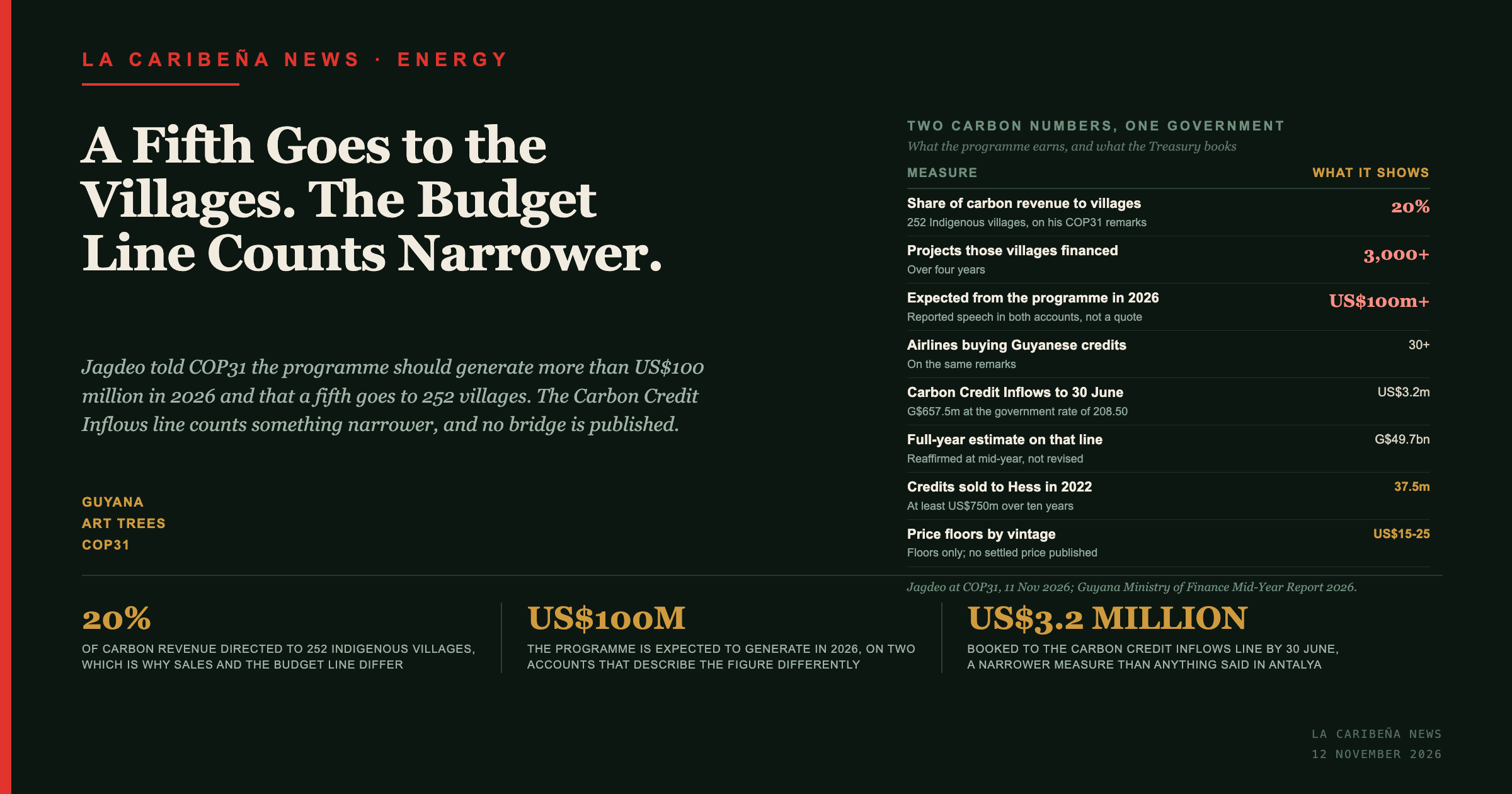
Guyana has two carbon figures in circulation for 2026. One is what the programme earns. The other is what the Treasury books. A fifth of the revenue is directed to villages before the question of which is which arises, and nothing published reconciles them.
What did Jagdeo say at COP31?
That finance is the constraint, and that the money reaches communities.
He spoke on Wednesday at an event co-hosted by Guyana, Brazil, Norway, the Republic of the Congo and the United Kingdom, and was welcomed to the summit by President Recep Tayyip Erdoğan of Türkiye and the United Nations Secretary-General António Guterres. "The key to faster progress is finance," he said, in an account carried by the Guyana Chronicle and credited to the Department of Public Information.
On that account he said the programme was expected to generate more than US$100 million in 2026, with over 30 airlines buying Guyanese forest carbon credits, and that Guyana directs 20 per cent of carbon credit revenue to its 252 Indigenous villages, which have financed more than 3,000 local projects over four years. The deforestation rate he gave is about 0.04 per cent.
He pressed four things: political leadership, certainty in carbon markets, sustained partnerships and a wider range of financing mechanisms. "You need the leaders to take this up, directly, as President Lula has done." He criticised delays by some governments, "notably in Europe", in implementing the aviation offsetting scheme that makes the credits saleable to airlines. "We cannot ask forest countries to make long-term commitments while leaving uncertain the international frameworks on which they rely."
Is that the money the Treasury counts?
No. The budget line counts Central Government receipts, and a fifth of the revenue is directed elsewhere.
The Ministry of Finance budgeted G$49.7 billion of carbon credit inflows for 2026 and recorded G$657.5 million by 30 June, in a Mid-Year Report whose revised estimate repeated the budget rather than lowering it. That line is Carbon Credit Inflows, sitting in the Central Government fiscal accounts beside GRIF inflows and withdrawals from the oil fund.
The 20 per cent going to villages is the clearest reason the two numbers cannot be set against each other, and the Vice President supplied it himself. Beyond that share, no published statement establishes whether village money passes through the Central Government line or around it, what the programme's gross proceeds were, or how a sale in one period becomes a receipt in another. At the government rate of G$208.50 to the United States dollar, the half-year figure is about US$3.2 million; every conversion here is struck at that rate.
What the line can be judged on is its own column. It took G$657.5 million in the first half against a full-year estimate of G$49.7 billion, and the Ministry reaffirmed that estimate rather than moving it.
Do the two accounts of his remarks agree?
Both accounts carry the same figure. They differ on what that figure measures.
The Department of Public Information account has the programme "expected to generate more than $100 million in 2026". INews Guyana, reporting the same remarks the previous day, has "ART-TREES sales expected to exceed US$100 million this year". Generated revenue and credit sales are not interchangeable terms, and neither account is a direct quotation of him on the figure.
What is Guyana actually paid per credit?
Guyana has published a floor. It has not published a price.
Hess agreed in December 2022 to buy 37.5 million ART-TREES credits, about a third of what Guyana expects to issue to 2030, at minimums of US$15, US$20 and US$25 a credit by vintage, and no settled price has been published. The Chronicle puts that agreement at at least US$750 million over ten years. Minimums are floors, so a revenue expectation cannot be checked against a volume.
The counterparty has changed and has been trimming in Guyana. Chevron inherited the Hess agreements and on 23 October dropped a separate Hess commitment in the country.
The entities
- Bharrat Jagdeo is Guyana's Vice President.
- ART-TREES is the standard under which Guyana issues its forest carbon credits.
- Carbon Credit Inflows is the Central Government revenue line in the Ministry of Finance fiscal accounts.
- Department of Public Information is the Guyanese government agency credited with the account of the remarks.
- Hess agreed the 2022 purchase; Chevron now holds it.
- COP31 met in Antalya, Türkiye, with the forests event co-hosted by Guyana, Brazil, Norway, the Republic of the Congo and the United Kingdom.
Figures
- 20 per cent: the share of carbon credit revenue Jagdeo said goes to Guyana's 252 Indigenous villages, which have financed more than 3,000 projects over four years. - More than US$100 million: what he said the programme is expected to generate in 2026. Reported speech in both accounts, not a quotation. - More than 30: airlines buying the credits. - G$657.5 million, about US$3.2 million: Carbon Credit Inflows recorded to 30 June 2026 at the government rate of G$208.50. - G$49.7 billion: the full-year estimate on that line, reaffirmed rather than revised at mid-year. - 37.5 million credits at floors of US$15, US$20 and US$25 by vintage: the 2022 agreement, put by the Chronicle at at least US$750 million over ten years. - 0.04 per cent: the deforestation rate he gave.
Frequently Asked Questions
How much does Guyana expect from carbon credits in 2026? Vice President Bharrat Jagdeo said at COP31 that the programme is expected to generate more than US$100 million in 2026. That figure is reported speech in both published accounts rather than a direct quotation.
Is that the same as the carbon revenue in Guyana's budget? No. The budget line is Carbon Credit Inflows, a Central Government receipts line, which recorded G$657.5 million to 30 June 2026 against a full-year estimate of G$49.7 billion. A fifth of carbon revenue is directed to Indigenous villages, and no published statement bridges the two figures.
How much goes to Indigenous communities? Twenty per cent of carbon credit revenue, to 252 villages, which Jagdeo said have financed more than 3,000 projects over four years.
What does Guyana get per credit? Minimums of US$15, US$20 and US$25 by vintage under the 2022 agreement now held by Chevron. No settled price has been published.