By LCN Business Desk
Brazil sold US$16 billion of agricultural produce abroad in October. That single month was 42.3 per cent of everything the country shipped.
The 15 CARICOM members took US$274.4 million of that trade in ten months. They are taking more of it every year.
What did Brazil sell in October?
Soya beans, coffee, corn, beef and wood pulp, in that order.
Agência Gov, the Brazilian federal government's own news agency, published the month's figures on 18 November. It put October's agribusiness exports at US$16 billion, up 4.1 per cent on October 2025. The sector ran a surplus of about US$14.1 billion in the month alone.
| Product | October 2026 |
|---|---|
| Soya beans | US$3.1bn |
| Green coffee | US$1.6bn |
| Corn | US$1.3bn |
| Fresh beef | US$1.2bn |
| Wood pulp | US$1.0bn |
Three buyers took most of it. China spent US$3.9 billion, the European Union US$2.6 billion, and the United States US$952.1 million.
Those values move on price as much as on volume. Brazil shipped a record 287,300 tonnes of green coffee in October while coffee revenue rose 5.2 per cent and prices fell almost 15 per cent.
Across the ten months the total is US$149.4 billion, 5.2 per cent above the same period last year, an increase of US$7.4 billion. Fresh beef at US$14.2 billion and fresh chicken at US$8.5 billion and 4.3 million tonnes are both records for the period, on the agriculture ministry's own basket.
How much of that did the Caribbean buy?
A fifth of one per cent of it.
Brazil's customs record is published through Comex Stat, the trade ministry's statistics service, and it can be queried by destination. Filtering the 15 CARICOM full members, and taking food as customs chapters 1 to 24, gives US$274,419,329 for January to October 2026.
| Buyer | Food from Brazil, Jan to Oct 2026 |
|---|---|
| Guyana | US$62.1m |
| Haiti | US$42.5m |
| Trinidad and Tobago | US$32.6m |
| Bahamas | US$32.6m |
| Jamaica | US$28.2m |
| Suriname | US$25.9m |
| Grenada | US$11.8m |
| Antigua and Barbuda | US$8.9m |
| The seven smallest together | US$30.0m |
Guyana is the largest Caribbean buyer of Brazilian food and the two countries share a border. Haiti is second on a far smaller economy.
For scale against another big exporter selling into the region, Cuba bought US$97,532,482 of American food in September 2026 alone, and US$1,096,531,767 of American exports in nine months. One Caribbean state took more American food in a month than Brazil sold the whole of CARICOM in three.
One bound on that ratio. Brazil's own "agronegócio" basket is a ministry product list and customs chapters 1 to 24 are not identical to it, so the fifth of one per cent is close rather than exact. The direction is not in doubt.
What is the region actually buying?
Meat, and then more meat in tins and packets.
| Category | Jan to Oct 2026 |
|---|---|
| Meat and edible offal | US$104.0m |
| Preparations of meat, fish and shellfish | US$50.7m |
| Animal feed and food-industry residues | US$24.9m |
| Cereals | US$16.4m |
| Beverages and spirits | US$11.0m |
The first two lines are US$154.7 million between them, 56.4 per cent of everything the region bought. Nothing else comes close, and the fourth-placed line, cereals, is a sixth of the meat line.
Guyana's own order is narrower still. Meat and offal at US$15.7 million lead it, animal feed at US$13.5 million follow, and the two together are 47 per cent of what the country buys from Brazil in food.
Guyana is also setting prices at the other end of that chain. Guyana capped the shop's margin on chicken at G$70 a pound and a shop that did not sign may still charge what it likes. The government will also publish a maximum retail price for four proteins and the name of every business in the scheme. The margin is set here. A large part of the cost underneath it is set in Brazil.
Is the region buying more or less?
More. It rose 12.2 per cent this year, against 1.8 per cent the year before.
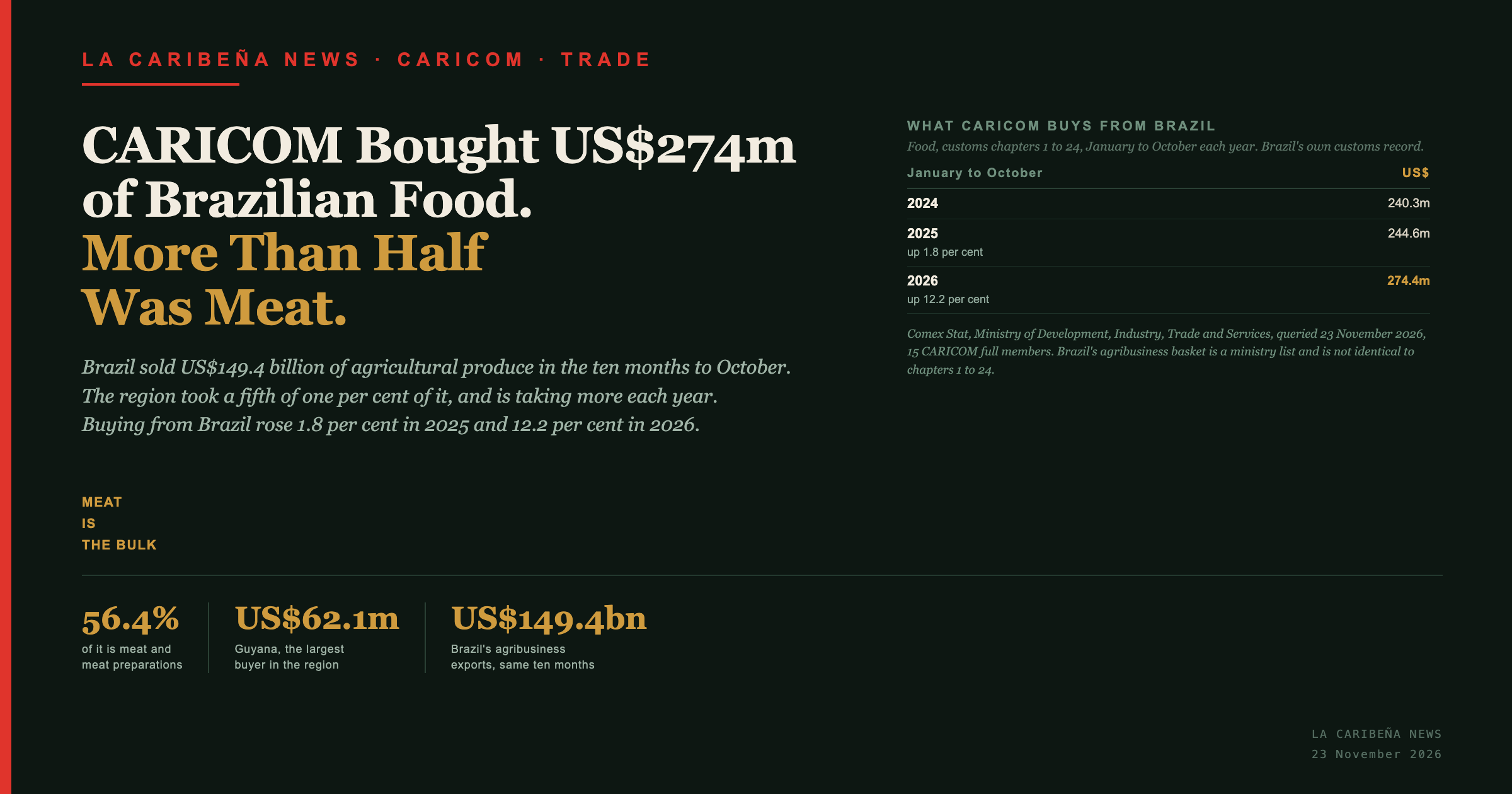
| January to October | Food from Brazil | Change |
|---|---|---|
| 2024 | US$240.3m | |
| 2025 | US$244.6m | +1.8% |
| 2026 | US$274.4m | +12.2% |
Two flat years, then an eighth added in one. The 2026 increase of US$29.8 million is nearly seven times the whole 2025 increase of US$4.3 million.
Set against it, CARICOM's agriculture ministers asked the region to buy Caribbean, and Jamaica's chamber put a price gap in the way. The buying went the other way while they were asking.
Why did Brazilian beef rise in the United States, and does it hold?
A United States quota lifted it, and that quota runs out this month.
Exports to the United States rose 35.7 per cent in October. The government's release names two reasons for it: the temporary widening of the United States tariff quota for lean beef trimmings, valid September to November, and a low base, because an extra surcharge was in force in October 2025.
That quota has a date on it. A proclamation of 26 August added 300,000 tonnes of lean beef trimmings to a United States quota for 90 days from 1 September, in a category where Brazil already takes more than nine tenths. Ninety days from 1 September ends on 30 November.
Both reasons expire. Brazil's beef went where the quota let it go, after its Chinese quota ran out and the United States took the volume. A supplier whose largest customers are rearranged by quota is a supplier whose price moves for reasons that have nothing to do with the Caribbean.
The crop behind it is not short. Brazil's state crop agency forecasts a record 366.1 million tonnes of grain, with wheat down a third and corn exports cut.
What should a Caribbean business take from it?
Its food sourcing is concentrating on one supplier.
An importer competing on price is competing against a supplier the region leans on more each year, not less. Because the bulk of that trade is meat, a move in Brazilian meat prices reaches a Caribbean shelf faster than a move in anything else Brazil sells. And the American quota behind October's beef ends this month, a date a buyer can plan around.
Buying inside the region is not automatically easier. Guyana halted banana imports from Suriname on 30 September to protect its own growers, and five days later Suriname's Customs seized 282 big bags of Guyanese parboiled rice. Both happened the same week the ministers asked the region to buy Caribbean.
The entities
- Caribbean Community (CARICOM): the 15-member regional bloc whose full members are counted here as the buyers. - Comex Stat: the Brazilian Ministry of Development, Industry, Trade and Services statistics service, the source of the destination figures in this article. - Agência Gov: the Brazilian federal government's own news agency, which published the October agribusiness trade figures on 18 November 2026. - Agronegócio: the Brazilian government's agribusiness basket, a ministry product list that is not identical to customs chapters 1 to 24.
What the title card shows
US$274.4 million: Brazilian food bought by the 15 CARICOM members between January and October 2026, from Brazil's own customs record. 12.2 per cent: the increase on the same months of 2025, against 1.8 per cent the year before. 56.4 per cent: the share of that buying that is meat and meat preparations, being US$154.7 million of US$274.4 million. US$149.4 billion: Brazil's total agribusiness exports in the same ten months, up 5.2 per cent. US$62.1 million: Guyana's purchases, the largest in the region.
Frequently asked questions
How much Brazilian food does CARICOM buy?
US$274.4 million between January and October 2026, across the 15 full members, measured as customs chapters 1 to 24 in Brazil's Comex Stat record. That is about a fifth of one per cent of Brazil's US$149.4 billion of agribusiness exports in the same months.
Which Caribbean country buys the most?
Guyana, at US$62.1 million, ahead of Haiti at US$42.5 million and Trinidad and Tobago at US$32.6 million. Guyana shares a land border with Brazil.
What does the region buy?
Mostly meat. Meat and edible offal came to US$104.0 million and preparations of meat, fish and shellfish to US$50.7 million, together 56.4 per cent of the total. Animal feed, cereals and beverages follow well behind.
Is Caribbean buying from Brazil rising?
Yes, and faster. It rose 1.8 per cent in 2025 and 12.2 per cent in the ten months to October 2026.
Why did Brazilian beef sales to the United States jump in October?
The Brazilian government attributes it to a temporary widening of the American tariff quota for lean beef trimmings, valid September to November, and to a low base of comparison because a surcharge applied in October 2025.
<!-- archive: venezuela-rodriguez-caricom-visits-guyana-trade-2026 | energy diplomacy, not food trade. Shares CARICOM, Guyana and trade as terms and no subject. --> <!-- archive: new-zealand-mining-technology-latin-america-guyana-trade-2026 | a different exporter in different goods. Its food line is milk to Guyana, which bears on nothing here. --> <!-- archive: caricom-model-aquatic-food-safety-bill-no-enactment-2026 | seafood safety legislation and its enactment gap. This piece measures purchase volumes and touches no standard. --> <!-- archive: trustbank-amanah-afreximbank-15-million-suriname-caricom-five-billion-2026 | trade finance facility, not goods trade. No overlap beyond the bloc's name. --> <!-- archive: oecd-latin-america-steel-imports-47-per-cent-china-2026 | steel imports into Latin America. Different commodity, different direction, different bloc. --> <!-- archive: intercaribbean-barbados-martinique-january-2027-caricom-associate-member-no-fare-2026 | an air route and an associate-member question. No goods trade in it. --> <!-- archive: brazil-outbound-travel-spending-2026-ahead-caribbean-market-2026 | Brazilian outbound tourism spending. Same country, and services rather than goods. -->