By LCN Business Desk
Brazil feeds a good deal of the Caribbean, so what its crop agency says in November lands on a regional food bill by March. Conab, the Companhia Nacional de Abastecimento, published its second survey of the 2026/27 harvest, its segundo levantamento, on 13 November. The Brazilian government set out the headline figures the same morning. The headline is a record.
Underneath it, the two lines Caribbean importers actually buy moved the other way.
What does the survey forecast?
A record built on more land rather than better yields.
| Crop | 2026/27 forecast | Change |
|---|---|---|
| All grain | 366.1 million tonnes | up about 1.3 per cent |
| Planted area | 85.3 million hectares | up 1.9 million hectares |
| Average yield | 4,290 kg a hectare | down about 1 per cent |
| Soybeans | 181.6 million tonnes | on 49.3 million hectares |
| Corn, all three crops | up to 148 million tonnes | area up 4.9 per cent, yield down 2.3 per cent |
| Rice | about 10.6 million tonnes | area down 0.8 per cent |
| Beans | 2.9 million tonnes | down 1.8 per cent |
| Wheat | 5.3 million tonnes | down 33.2 per cent |
Brazil planted 1.9 million more hectares and got 1 per cent less out of each one. The record is a land record.
A record volume is not the same as a record return, and Brazil has shown that twice this year already: it set export records for oil and coffee in the same month, and only one of them paid.
Why does the wheat line matter here?
Because Brazil imports wheat in a good year, and this one is 33.2 per cent smaller.
Conab puts the winter crop area down 10.7 per cent, from 3.35 million hectares in 2025 to about 3 million in 2026. The harvest was more than 78 per cent complete when the survey closed, so this is measurement rather than projection. Weather in Paraná and Rio Grande do Sul cut quality as well as yield, and more of the low grade crop is going into animal feed rather than being milled.
Carryover stocks were revised down on higher domestic use, to 955,500 tonnes from the 2025 crop and 436,500 tonnes from the 2026 crop.
A country that harvests a third less of a staple it already imports buys more of it. Caribbean flour millers and bakeries buy in the same Atlantic market. Nothing in the survey prices that, and the survey is a volume document, not a price one. What it establishes is the direction of Brazilian demand.
What happened to corn, which is what the feed bill rests on?
The 2025/26 export figure was cut by 6.8 per cent, to 40.9 million tonnes.
Conab revised 2025/26 corn exports to 40.9 million tonnes, 6.8 per cent below its last survey. For 2026/27 it estimates about 43 million tonnes. Ending stocks are put at 19 million tonnes at the end of January 2027 and 20.9 million at the end of January 2028.
Corn is poultry and pork feed. A buyer in Georgetown, Kingston or Port of Spain who planned against the earlier export number planned against 3 million tonnes that are not there. The 43 million for next season has not been shipped and is not a commitment.
Is the soybean crop safe?
Not yet determined. It was 66.8 per cent planted when the survey closed.
Planting had reached 66.8 per cent of the area in the first week of November, with Mato Grosso at 95.6 per cent. Conab records irregular rainfall, high temperatures and the effects of El Niño in early October, and says growers remain cautious about yield potential. A soybean forecast made at two thirds planted is a forecast about weather that has not happened.
What else is El Niño doing in the region?
Two other crops carried the same cause this week, one of them down more than 20 per cent.
Bloomberg reported El Niño damage to Ecuador's cocoa crop, and FreshFruitPortal put Peru's blueberry export forecast down more than 20 per cent year on year. Three agricultural forecasts in one week carry the same cause, and the usual substitutes may be short in the same season.
This newspaper set out the risk before the harvest. Brazilian analysts are not forecasting a general fall in production, they are forecasting unevenness, too much rain south and too much heat north, and excess moisture at harvest raises the risk of grain sprouting before it is taken off, fungal disease and loss of commercial quality. Conab has now reported exactly that in Paraná and Rio Grande do Sul. That piece also recorded what the last comparable event cost closer to home: Guyana lost 37 per cent of a rice crop.
What should an importer or a processor do with this?
Work from the 13 November figures, not October's: wheat 5.3 million tonnes, corn exports 40.9 million.
The dated facts are these. Wheat is down 33.2 per cent on a 10.7 per cent smaller winter area. Corn exports for the season now ending are 40.9 million tonnes, not what was previously published. The soybean crop is a forecast taken at two thirds planted.
The regional answer to an import bill is already on the table and already contested. CARICOM's agriculture ministers asked the region to buy Caribbean, and Jamaica's Chamber of Commerce told them to close the price gap first. Guyana has gone further and will publish a maximum retail price for four proteins, and the name of every business in the programme. Both rest on what imported feed and flour cost, which is what this survey moves.
A buyer with cover already contracted is fine. A buyer planning the first quarter of 2027 on last month's Brazilian numbers is working from a document Conab superseded on 13 November. Conab publishes these surveys monthly.
The entities
- Conab: the Companhia Nacional de Abastecimento, Brazil's state agency for food supply, which publishes the official crop surveys. - Segundo levantamento: the second survey of the 2026/27 harvest, published on 13 November 2026. - Paraná and Rio Grande do Sul: the southern Brazilian states where weather cut wheat quality and yield. - Mato Grosso: Brazil's largest soybean state, 95.6 per cent planted when the survey closed. - El Niño: the climate pattern Conab records as affecting early October conditions, and which has also been reported on Ecuador's cocoa and Peru's blueberries.
What the title card says
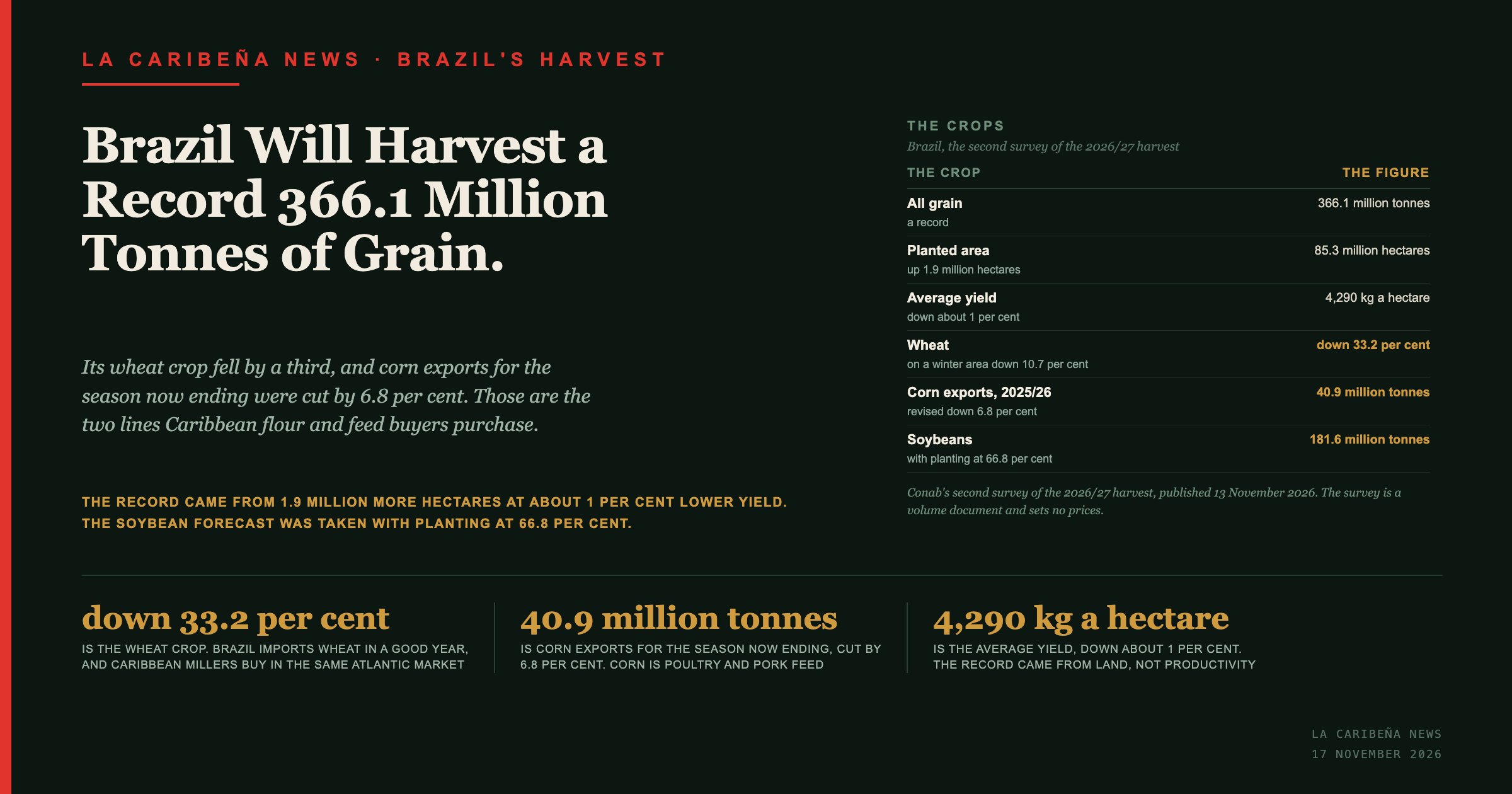
- Survey published: 13 November 2026. - Total grain forecast: 366.1 million tonnes, up about 1.3 per cent. - Planted area: 85.3 million hectares, up 1.9 million. - Average yield: 4,290 kg a hectare, down about 1 per cent. - Wheat: 5.3 million tonnes, down 33.2 per cent, on a winter area down 10.7 per cent. - Corn exports for 2025/26: revised to 40.9 million tonnes, down 6.8 per cent. - Soybeans: 181.6 million tonnes forecast, with planting at 66.8 per cent.
Frequently asked questions
How much grain will Brazil harvest in 2026/27?
Conab forecasts 366.1 million tonnes in its survey of 13 November 2026, about 1.3 per cent above the previous season and a record.
If it is a record, why does it matter that yields fell?
Because the increase came from land, not productivity. Planted area rose by 1.9 million hectares to 85.3 million while average yield fell about 1 per cent to 4,290 kg a hectare.
What happened to Brazilian wheat?
Production is forecast at 5.3 million tonnes, down 33.2 per cent, on a winter crop area down 10.7 per cent. Weather in Paraná and Rio Grande do Sul cut quality as well as yield, and more low grade wheat is going into animal feed.
Will there be less Brazilian corn to buy?
Conab cut its estimate of 2025/26 corn exports to 40.9 million tonnes, 6.8 per cent below its previous survey, and estimates about 43 million tonnes for 2026/27.
Is the soybean number reliable?
It is a forecast made with planting at 66.8 per cent complete, and Conab records irregular rainfall, high temperatures and El Niño effects in early October.
What is not established?
Prices. The survey is a volume document and sets none. Whether Brazil's smaller wheat crop raises what a Caribbean miller pays, which depends on the whole Atlantic market. And the second and third corn crops, for which this survey publishes no separate figures.