By LCN Business Desk
A retailer joining this programme is told what it pays and what it may charge. On chicken, that is the whole margin.
The Department of Public Information published the names of 68 participating businesses on 19 November 2026, with the prices each has agreed.
What is in force today?
Chicken, and only chicken.
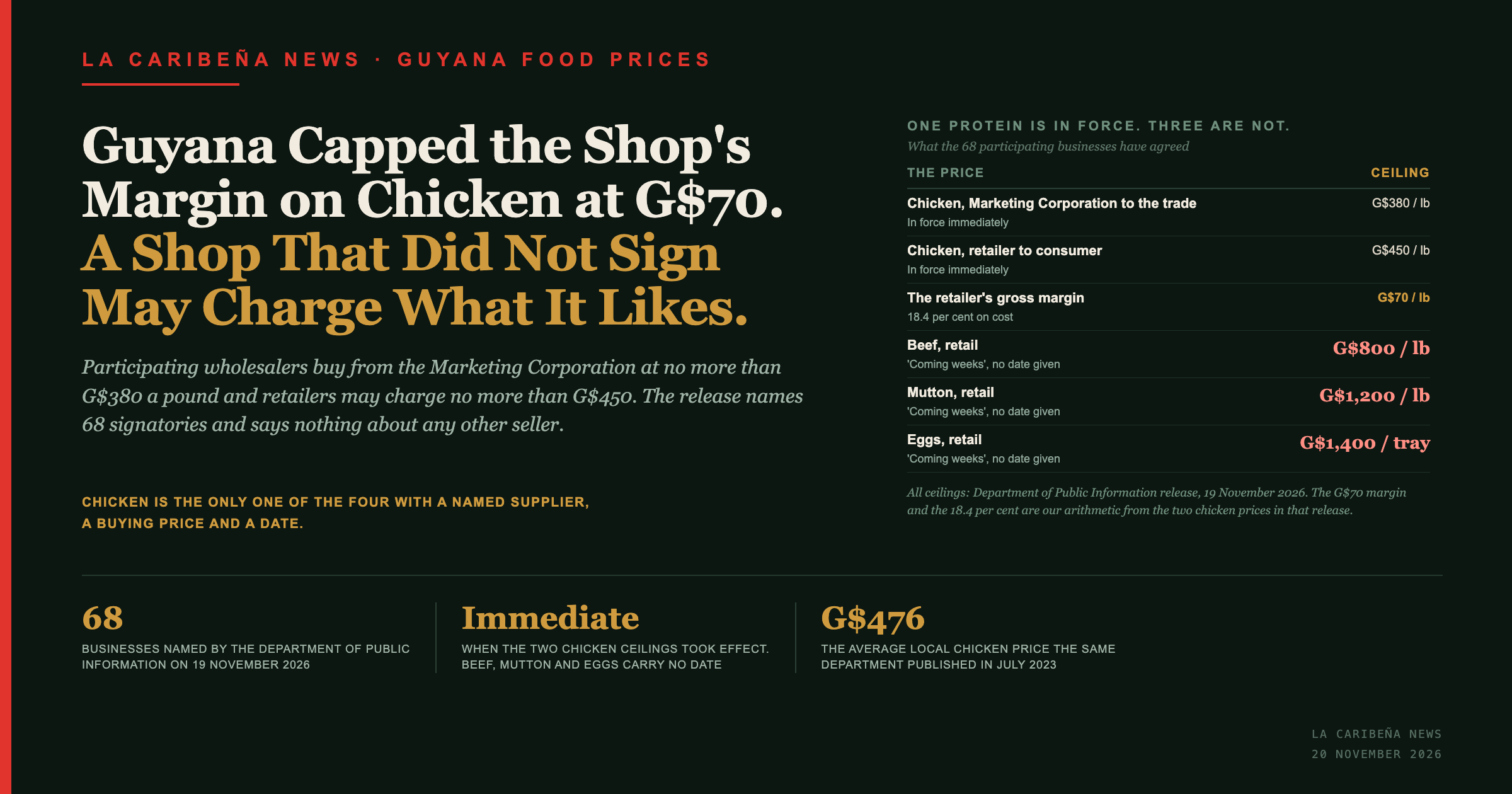
| Protein | Ceiling | In force |
|---|---|---|
| Chicken, Marketing Corporation to the trade | G$380 a pound | immediately |
| Chicken, retailer to consumer | G$450 a pound | immediately |
| Beef, retail | G$800 a pound | "coming weeks" |
| Mutton, retail | G$1,200 a pound | "coming weeks" |
| Eggs, retail | G$1,400 a tray | "coming weeks" |
Source: the Department of Public Information release of 19 November 2026.
Chicken is the only one of the four with a named supplier, a buying price and a date. The Guyana Marketing Corporation supplies participating wholesalers and distributors, who supply supermarkets and market vendors. The other three name a shelf price and nothing behind it.
What does the programme do to a retailer's margin?
It caps it, at G$70 a pound.
A participating retailer buys programme chicken at no more than G$380 and may not sell above G$450. The widest gross margin available is therefore G$70 a pound, 18.4 per cent on what it pays, before rent, refrigeration, waste and labour. A shop may sell for less and earn less. It may not earn more.
A single ceiling sets what a shopper pays. Two ceilings set what the shop can earn.
What does a shop outside the programme face?
No ceiling, and a competitor on the same street who has one.
The release names 68 participants and the prices they have agreed. It says nothing about any other seller. Two classes of retailer therefore trade side by side: one that may not exceed G$450 on a pound of chicken, and one with no agreed ceiling at all.
The operating risks were named in October, after political actors called for price controls aimed at retail mark-ups. The Georgetown Chamber of Commerce and Industry was founded in 1889 and incorporated by Ordinance No. 3 of 1890, which makes it a creature of statute. Its statement of 28 October reads, "The Chamber firmly opposes the introduction of broad price controls", warning that such intervention "could distort market conditions, disrupt supply chains, reduce product availability". It asked instead for better access to foreign currency for importers and a review of import duties. The same Chamber has reported for two years that businesses could not get US dollars on time. In September the commercial banks counted just over US$200 million of unfilled requests. On the public record this newspaper can find, the Private Sector Commission, the umbrella body for private sector organisations, has published no position.
For a business deciding whether to sign, the durability of the arrangement is the other half of the question. The International Monetary Fund's 2026 Article IV concluding statement of 31 July tells Guyana to "gradually phase out broad price-mitigating measures over time" and to consider improving the targeting of subsidies. The statement does not use the words price control.
How do the ceilings sit against what prices have been doing?
Food has been rising faster than everything else.
Food prices rose 6.7 per cent between the end of 2025 and the end of June 2026. They carried 3.4 points of the 4.4 per cent rise in consumer prices. Vegetables alone carried 2.5 of those points.
For the four proteins themselves, the most recent market check on the public record this newspaper can find is three years old. In July 2023 the Department of Public Information gave an average of G$476 a pound for local chicken and G$633.33 for beef, across Stabroek, Bourda, Mon Repos and other markets. Mutton ran at G$1,350 at Stabroek. A shop setting those against the new ceilings reads across three years of the rises above.
Eggs cannot be read across at all. The 2023 figures are per egg, the ceiling is per tray, and neither release states a tray size.
What was committed on 13 November, and what has arrived?
The list and the prices have arrived. The price series has not.
President Irfaan Ali said on 13 November that Guyana would publish every participant and the maximum retail price agreed with them. Both are now published, six days later, so a retailer can check whether its own supplier is in the programme. The release is headlined "over 65" and its numbered list runs to 68.
The same statement committed to a regular price dashboard carrying farmgate, wholesale and retail prices and the saving in each region. The release of 19 November carries no dashboard and no date for one. That matters for anyone trying to judge the programme, because Guyana measures inflation against a basket chosen after a household survey finished in 2006, and six official inflation rates are in circulation.
Neither the release nor the two Guyanese outlets reporting it names any consequence for a participant that charges above its agreed ceiling.
<!-- archive: cjia-terminal-2-hub-deal-benchmarks-airline-incentives-2026 | read 20 Nov 2026 and not linked: it is an airport hub agreement and airline incentives. The shared terms are Guyana, government and business. No food, no retail price, no ceiling --> <!-- archive: guyana-exporter-us-dollar-account-governor-ganga-asked-why-2026 | read 20 Nov 2026 and not linked: it is small firms being refused US dollar ACCOUNTS. The foreign-currency point the Chamber raises is carried by the broader shortage piece, linked at the sentence where it bears -->
The entities
- Guyana Marketing Corporation (GMC): the state agency that will distribute chicken to participating wholesalers and distributors at no more than G$380 a pound. - Department of Public Information (DPI): the government information arm that published the participant list and the ceilings on 19 November 2026. - Georgetown Chamber of Commerce and Industry (GCCI): founded 1889 and incorporated by Ordinance No. 3 of 1890, whose statement of 28 October 2026 firmly opposed the introduction of broad price controls. - Private Sector Commission (PSC): the umbrella body for private sector organisations in Guyana. - International Monetary Fund (IMF): whose 2026 Article IV concluding statement of 31 July advised Guyana to phase out broad price-mitigating measures over time. - President Irfaan Ali: who announced the programme on 13 November 2026 and under whose initiative the 68 businesses have signed.
What the title card shows
68: businesses named by the Department of Public Information on 19 November 2026 as participants in Guyana's protein price programme. G$380 a pound: the most a participating wholesaler or distributor pays the Guyana Marketing Corporation for chicken, in force immediately. G$450 a pound: the most a participating retailer may charge a consumer for chicken, in force immediately. G$70 a pound: the widest gross margin available on programme chicken, 18.4 per cent on cost. G$800 a pound, G$1,200 a pound and G$1,400 a tray: the ceilings for beef, mutton and eggs, due in "coming weeks" with no date given. Immediate: when the two chicken ceilings took effect, against no date for beef, mutton or eggs. G$476 and G$633.33: the average market prices for local chicken and beef the same department published in July 2023.
Frequently asked questions
What exactly changed on 19 November 2026?
The government published the names of 68 participating businesses and the prices they have agreed. The chicken arrangement took immediate effect. Beef, mutton and egg ceilings were stated as coming in the following weeks.
How much can a shop make on programme chicken?
At most G$70 a pound. It buys at no more than G$380 from the Guyana Marketing Corporation and sells at no more than G$450, which is 18.4 per cent on what it pays, before costs. It may sell for less.
Are the beef, mutton and egg prices in force?
No. The release gives G$800 a pound for beef, G$1,200 for mutton and G$1,400 a tray for eggs, and says these are expected in the coming weeks. It gives no date, no wholesale price and no distributor for any of the three.
What happens if a participant charges more than the ceiling?
The release does not say, and neither does the reporting of it by Guyana Times or INews Guyana.
How can anyone tell whether prices actually fall?
The programme committed on 13 November to a price dashboard covering farmgate, wholesale and retail prices by region. It has not appeared. The national inflation index cannot answer the question, because its basket was chosen after a household survey that finished in 2006.