By LCN Business Desk
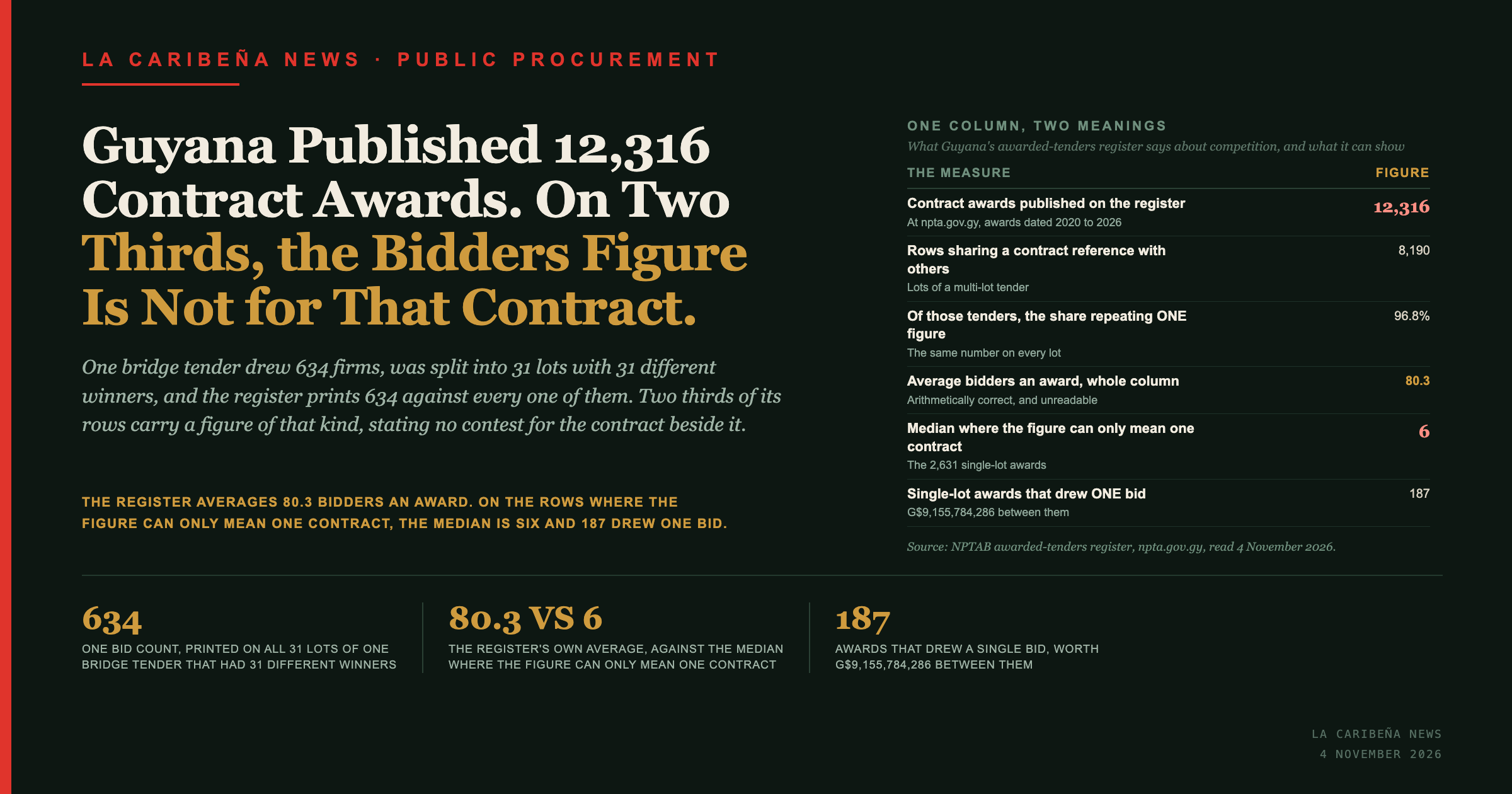
The Ministry of Public Works advertised one tender in 2026 for the rehabilitation and construction of bridges, and 634 firms answered it. The work was 31 separate bridges. Thirty-one different firms each won one, for sums between G$30,405,145 and G$56,687,160, and the National Procurement and Tender Administration Board published all 31 awards in its register with 634 in the bidders column of every row.
A firm that bid for the seventh of those bridges and lost can look up that row and read 634. It is the wrong number for the question being asked. Nobody outside the Board can say how many firms wanted that one bridge, and the register will not say either, because 634 is how many answered the advertisement.
The Board puts its whole awarded-tenders history on a single page at npta.gov.gy, ten columns wide. The column headed No. of Tenders/Proposals means one thing on a contract advertised and awarded on its own, and another on a lot of a larger tender, and nothing published alongside it says which row is which.
What does the register actually publish?
Every award since 2020, with a competition figure on seven rows in eight.
The table covers every award from 2020 through 2026 and names the procuring entity, the contract reference, the awardee, a description, the amount, the currency, the procurement method, the number of tenders received and two dates. National Competitive Bidding accounts for 10,571 of the awards and Limited National Bidding for 257.
| The bidders column, over the whole register | Rows | Share |
|---|---|---|
| A plain number | 10,687 | 86.8% |
| Nothing at all | 1,614 | 13.1% |
| Something else, including one contract reference | 15 | 0.1% |
| Of the plain numbers: rows above 100 bidders | 1,983 | 18.6% |
| Of those rows above 100, sitting on a multi-lot tender | 1,977 | 99.7% |
Source: the National Procurement and Tender Administration Board awarded-tenders register at npta.gov.gy, read on 4 November 2026. The full table and a row-level extract are held by this newspaper.
A number above a hundred is the tell, and it is almost never a row standing on its own.
Why is the average eighty and the median six?
Because most awards are lots of a larger advertisement, and the same figure is printed on every lot.
Of 4,086 contract references in the register, 1,404 appear on more than one row. Those multi-lot references account for 8,190 of the register's 12,316 awards, and on 1,349 of the 1,393 that carry a figure at all, every lot shows the identical number. One tender's response is therefore added into the column once for every lot it was split into.
The bridge tender, contract 06/2026/31, is the clearest case rather than an unusual one. Its lots came to G$1,116,849,577 between them, so a single advertisement contributes 634 to the column thirty-one times. The same mechanism runs across 1,348 other references.
::: The column reading 80.3 bidders an award measures how finely a tender was sliced, not how many firms competed for the work. Where the register can only mean one contract, the figure is six. :::
How contested is a Guyana contract where the figure can be read?
Six bids at the median, and 187 contracts had no competition at all.
The 2,631 single-lot awards are the only rows where the published figure cannot mean anything but the contract beside it. Their median is six and their mean 10.5, against 103.1 on the multi-lot rows. One award in fourteen of them drew a single bid, 460 drew two or fewer, and the 163 single-bid awards priced in Guyana dollars come to G$9,155,784,286 between them.
| The largest awards that drew one bid | Procuring entity | Amount |
|---|---|---|
| Rehabilitation of six X-ray rooms | Ministry of Health | G$696,421,647 |
| Cell No 3, Haag Bosch sanitary landfill | Ministry of Local Government and Regional Development | G$658,863,700 |
| Supply and delivery of anti-retrovirals | Ministry of Health | G$427,888,572 |
| Design and build, international cricket facility | Ministry of Culture, Youth and Sport | G$327,000,000 |
| Emergency anti-retrovirals | Ministry of Health | G$306,859,391 |
| Procurement of arms and ammunition | Ministry of Home Affairs | G$284,281,800 |
Single-lot awards whose published tender count is one. Source as above.
Health procurement appears three times in six, and a sole bid for a drug supply is a different commercial fact from a sole bid for a landfill cell.
Does the column ever describe one contract?
On a single-lot award, yes, and this newspaper has already reported one of them from the other end.
The salvage of the ferry that sank off the Essequibo coast sits in the register as contract 211/2026/34, awarded to BK International Inc at G$1,034,000,000 on 6 October 2026 under National Competitive Bidding, with three tenders received. One contract, one row, and a figure that means what it says. Three firms bid to raise the MV Barima, under a tender requiring the wreck to survive as evidence, and the register and the tender agree.
The same holds further up the scale. Three bids from two bidders were opened for Guyana's natural gas liquids storage and offloading facility, and B&J Civil Works beat five other bidders to a G$118 million Guyana Football Federation contract. Where one contract is advertised and awarded on its own, the count is a count.
What else does the published record get wrong?
Enough that a reader taking a row at face value can be wrong about what it says.
The currency column reads UD$ on eight rows, G4 on two, a bare zero on seven and G$ US$ on four. The procurement method column holds a number on fifteen rows, one of them 69000000 on a Moruca potable-well drilling award whose contract amount is also 69,000,000. Award dates include the years 0222, 1957, 2031, 2040 and 2926, so the register's published date range runs from 2000 to 2040 while its credible range is 2020 to 2026. On one row, a Guyana Sugar Corporation Inc boiler-tube supply at G$55,440,000, the bidders cell holds the contract reference 236/2024/21 rather than a number, and on two rows the contract amount is a date.
On the rows carrying two currency symbols at once, nobody reading them can tell which of the two the amount is in, and the difference between them is not small. Anyone sorting the table by date, or pulling out the current year's awards, is handed contracts parked centuries outside the period the register covers.
Each of these is a single row or a handful. The multi-lot figure is not: it is the majority of the table.
Where is the small-business set-aside the law requires?
Not in this register. It has no column that identifies a small business, so the share the statute reserves cannot be checked against what the Board publishes.
The Small Business Act 2004, amended by the Small Business (Amendment) Act No. 4 of 2021, reserves a minimum share of the government's procurement of goods, services and works for small businesses. Tabling the amendment, Minister of Tourism, Industry and Commerce Oneidge Walrond told the National Assembly it "paves the way for small businesses to access at least 20 per cent of government's procurement of goods, services and works". The Board operates a margin of preference alongside it: its Chairman, Tarachand Balgobin, said in March 2021 that bidding documents carry a 5 per cent advantage for registered small businesses against a statutory ceiling of 10 per cent, and that the Small Business Bureau's database of registered firms is what a bidder must show it is on.
No cell in the register names a small business, an SME, a set-aside or a margin of preference, in any of the ten columns on any of the 12,316 rows. The procurement method column carries eighteen distinct values and not one of them marks a small-business award or a preference applied. A register that cannot name a small business cannot show a share reserved for them, whatever that share is.
What the register will show is the size of the band the set-aside was described as covering. Balgobin put it at goods of G$3,000,000 and under and capital works of G$7,000,000 and below.
| Awards priced in Guyana dollars | Awards | Share of those awards | Share of their value |
|---|---|---|---|
| At or below G$3,000,000 | 1,152 | 11.8% | 0.20% |
| At or below G$7,000,000 | 2,120 | 21.8% | 0.81% |
| All awards priced in Guyana dollars | 9,733 | 100% | 100% |
The 9,733 awards whose amount and currency both parse, totalling G$787,895,943,955. Four Guyana-dollar rows are excluded because their amount cell is blank or holds a date. Source as above.
One award in five falls inside that band and carries less than a hundredth of the money. A reservation set as a share of contract value behaves very differently from one set as a share of contract count, and nothing published says which of the two the reservation is measured on.
The Board has spoken to the question from the other direction. Its Chief Executive said in October 2022 that almost 80 per cent of government contracts went to small and medium-sized businesses. The claim describes the same awards in the same register, and the register carries no column that would let a reader confirm or dispute it.
What should a contractor or a lender do with this?
The contract reference has to be read before the bid count, and a repeated reference is a warning.
Where a reference appears once in the register, the tender count beside it describes that contract. Where the same reference appears against several awards, that count cannot be read as the lot's own, and the competition for any single lot is not published. That check takes a moment and it is the difference between a usable figure and a meaningless one. A firm pricing its next bid, a ministry benchmarking its own competition and a lender sizing country risk are all reading the same column, and the average it yields is an artefact of lot-splitting rather than a measure of how contested Guyana's public contracting is.
A matching gap sits on the tendering side. The Procurement (Amendment) Act 2019 created a register of bidders, and the registration portal for contracts below G$15 million was not accepting new accounts when it was checked in October, the band where most work small firms can reach is advertised. The Ministry of Agriculture accounted for 29 of the 39 tenders then listed on the Procurement Opportunities portal, two of its drainage advertisements pricing 20 lots at G$1,091,013,262. Those twenty lots are exactly the shape that produces one figure on twenty rows.
Competition is also the measure by which project money moves. St Vincent shows the same point from the disbursement end, where EC$170.6 million lent by the Saudi Fund for Development is unspent, and what is in the agreements has not been contracted.
What is not established here?
Nothing published on the register states the basis of the figure, so whether the Board intends it per advertisement is not on the record.
No statutory instrument has been identified prescribing what the awarded-tenders register must publish, and whether the Procurement Act 2003 or the Procurement (Amendment) Act 2019 speaks to the point is unresolved here. Why 1,614 awards carry no figure at all is also unstated. The 44 multi-lot references whose lots do carry different figures are not explained by the pattern above, and the register does not say what distinguishes them. On the small-business reservation, the absence of a column is not evidence about whether the reservation is being met: whether the Board, the Small Business Bureau or the Public Procurement Commission reports performance against it in some other publication has not been established here, and the Bureau's register of qualifying firms is not public.
The entities
- National Procurement and Tender Administration Board is the Guyanese body that publishes the awarded-tenders register at npta.gov.gy, the source of every figure in this article. - Ministry of Public Works is the procuring entity on contract 06/2026/31, the 31-lot bridge rehabilitation whose rows all read 634. - BK International Inc is the firm awarded the MV Barima salvage at G$1,034,000,000 against three tenders, on a single-lot award. - Ministry of Health is the procuring entity on three of the six largest single-bid awards, including the rehabilitation of six X-ray rooms at G$696,421,647. - Guyana Sugar Corporation Inc is the entity on the one row whose bidders cell holds a contract reference instead of a number. - Procurement (Amendment) Act 2019 is the statute that created Guyana's register of bidders, reported by this newspaper in October 2026. - Small Business Act 2004 is the statute whose 2021 amendment reserves at least 20 per cent of government procurement of goods, services and works for small businesses. - Small Business Bureau is the agency holding the database of registered small businesses a bidder must appear on to claim the preference. - Tarachand Balgobin is the Chairman of the National Procurement and Tender Administration Board who set the preference at 5 per cent and named the G$3,000,000 and G$7,000,000 ceilings.
What the title card says
- Headline: Guyana has published 12,316 contract awards, and on two-thirds of them the bidders figure does not count the bids for that contract. - Award rows published in the register: 12,316. - Rows sitting on a multi-lot contract reference: 8,190, which is 66.5 per cent. - Multi-lot references repeating one figure on every lot: 1,349 of 1,393, which is 96.8 per cent. - Average bidders across the whole column: 80.3. - Median on single-lot rows, where the figure can only mean one contract: 6. - Single-lot awards that drew one bid: 187. - Value of the single-bid awards priced in Guyana dollars: G$9,155,784,286. - Lots under contract 06/2026/31, every one of them reading 634: 31.
Frequently Asked Questions
How many bidders does a Guyana government contract attract?
On the 2,631 awards in the register whose figure can only describe one contract, the median is six and the mean 10.5. The average across the whole column, 80.3, is inflated by multi-lot tenders that repeat one advertisement-level figure on every lot.
Why do some rows show more than a hundred bidders?
1,983 rows do, and 1,977 of them sit on a tender awarded in lots. The same figure is printed on every lot of the tender, so a tender split into thirty-one lots shows one number thirty-one times.
How can I tell whether a row's bid count describes that contract?
Check whether the contract reference appears elsewhere in the register. A reference appearing once belongs to a single-lot award and its count describes that contract. A reference appearing against several awards carries the advertisement's count.
How many Guyana contracts were awarded on a single bid?
187 single-lot awards record one tender received, and 460 record two or fewer. The 163 single-bid awards priced in Guyana dollars total G$9,155,784,286.
Can the 20 per cent small-business set-aside be verified from the register?
No. The Small Business Act 2004, as amended in 2021, reserves at least 20 per cent of government procurement of goods, services and works for small businesses, and none of the register's ten columns identifies a small business or records that the 5 per cent margin of preference was applied. Awards at or below the G$7,000,000 capital-works ceiling the Board's Chairman named are 21.8 per cent of Guyana-dollar awards and 0.81 per cent of their value.
Does the register contain other errors?
On small numbers of rows, yes. The currency column reads UD$, G4 or a bare zero on 24 rows between them, the procurement method column holds a number on 15, and award years include 0222, 1957, 2031, 2040 and 2926.