By LCN Business Desk
A procurement pipeline is a sales pipeline seen from the other side. The Government's eProcurement portal is carrying 39 live advertisements, and three quarters of them come from one ministry.
Who is actually buying, and under which name?
Four procuring entities, not one ministry.
The portal lists every one of the 29 under the heading "21-Ministry of Agriculture". The advertisements behind them name four different buyers, each with its own document fee, its own collection counter and its own procurement office.
| Procuring entity | Advertisements read | What it is buying | Cost of the bidding documents |
|---|---|---|---|
| National Drainage and Irrigation Authority | 3 | Culverts, revetments, check structures, access bridges, drainage structures, a farm-to-market road, a fisherman's wharf, operator's quarters, and security and monitoring of the East Demerara Water Conservancy embankment | G$3,000 for each bid document, non-refundable |
| Guyana Sugar Corporation Inc. | 2 | Quicklime, reshell rollers, refractory materials, packaging-plant elevator materials, mild steel to stainless steel conversions, crystallizer and pug mill works | Free to download from guysuco.com and epr.guysuco.com; G$2,000 for a printed set |
| Ministry of Agriculture | 2 | Construction of a Centre of Excellence at the Guyana School of Agriculture compound, Mon Repos, and security services for the Ministry | G$3,000 for the Centre of Excellence set, issued as a PDF on a flash drive; G$2,000 for the security set |
| Fisheries Department | 1 | Aquaculture cage mesh for a cage culture project | G$1,000 |
Source: the eight Invitation for Bids advertisements behind the 29 procurements, read from the portal's own document store on 25 October 2026.
A supplier tracking "the Ministry" is therefore tracking four counters, and the same buyer does not charge the same price twice: the Ministry's own two advertisements carry different fees for their document sets. Collection is split across three locations, with the Authority's documents uplifted from a cashier's cage at Regent Street and Vlissengen Road and the corporation's printed sets paid for at a cashier at LBI Estate on the East Coast.
What every one of them shares is the destination. Bids go into a single tender box at the National Procurement and Tender Administration Board at the Ministry of Finance, Main and Urquhart Streets, and the bidding runs as National Competitive Bidding under the Procurement Act 2003.
What are the works worth?
Enough to price against, because the Authority publishes its own estimate for each lot.
| Engineer's estimate band | Lots | Combined |
|---|---|---|
| Below G$15 million | 5 | G$55,456,065 |
| G$15 million to G$100 million | 14 | G$614,376,697 |
| Above G$100 million | 1 | G$421,180,500 |
| All published estimates | 20 | G$1,091,013,262 |
Source: the National Drainage and Irrigation Authority's advertisements of 21 September and 7 October 2026.
The single largest estimate is more than twelve times the median and sits in the same advertisement as eight items priced between G$31 million and G$50 million, so one advertisement spans two quite different classes of business. And the Authority has cut several projects into identically priced lots, including three right-bank Mahaicony culvert lots at G$9,333,975 each, which means a firm can bid one lot rather than the set.
A company with one crew and one excavator can therefore price a single culvert lot without pretending to capacity it does not have.
Which of these can a newly registered firm actually reach?
None of the five smallest, unless it was already on the register.
The Procurement (Amendment) Act 2019 requires a supplier to be on a register of bidders before taking part in procurement, and to apply at least seven days beforehand. La Caribeña News reported on 16 October that the Administration runs two bidder registration portals and the one for contracts below G$15 million was not taking new names.
That portal still returned the same notice on 25 October 2026: "Registration Period Closed. New registrations are currently not being accepted. Existing users can still log in to view their application status."
So the five lots priced below G$15 million, worth G$55,456,065 between them, are reachable only by firms already carrying that registration. The seven-day rule compounds it, because even an immediate reopening would not help a firm whose nearest deadline is days away. The lots were cut small, and the door to the band they sit in is shut.
What does it cost to get into the room?
Between nothing and G$3,000 for the documents, charged on two different bases, plus a bid security.
The Authority charges its G$3,000 "for each bid document", and the fee is non-refundable. A contractor intending to price the whole of its 7 October batch of seven projects therefore pays G$21,000 before submitting a single figure, and keeps none of it whether it wins or loses. The corporation runs the opposite model: a complete set is downloadable at no cost from its own websites, and the G$2,000 buys a printed copy for anyone who would rather not download it.
The bid security is the larger exposure and it is disclosed unevenly. The Fisheries Department states its own on the face of the advertisement, an original bid security of 2 per cent of the bid price in Guyana dollars. The Authority's advertisements say only that a bid security is required "amounting to the value specified in the bid document", so a firm cannot learn what it must post until it has paid the non-refundable fee to find out.
The Ministry's Centre of Excellence tender also requires one hard copy and an electronic copy on a flash drive carrying an exact PDF of the hard copy, and the bidding documents themselves are issued as a PDF on a flash drive. A firm without that small piece of administrative capacity is non-compliant before it has priced anything.
What must a bidder already hold?
A track record and current compliance, both of which take longer to obtain than a tender window.
The Centre of Excellence advertisement sets out its qualification requirements plainly: completion of at least three jobs of a similar nature in the last three years, valid National Insurance Scheme and Guyana Revenue Authority compliances, and valid business registration. The construction period is 240 calendar days.
Those three conditions are sequential rather than simultaneous. Compliance certificates are issued on the authorities' timetable, not the bidder's, and a firm that starts assembling them when it sees a tender has already missed it.
What does a retender tell a supplier about the sugar work?
That the first round did not produce an award, and that the second one has already closed its door.
The Guyana Sugar Corporation is advertising six requests for proposals closing on 10 November 2026, covering quicklime for the industry, reshell rollers, refractory materials, materials to upgrade the Albion packaging plant elevator across three lots, and materials to convert mild steel to stainless steel at Blairmont Estate across four lots and at Albion Estate across five.
Separately, two items are explicitly retenders: the rehabilitation of four mild steel high grade crystallizers with stainless steel, and the decommissioning of a high grade pug mill and its replacement with stainless steel at Albion Estate. Both close on 27 October 2026.
Both also made a site meeting compulsory, at Albion Estate on 20 October 2026. That date has passed. A supplier reading the portal today cannot satisfy a compulsory condition set five days ago, which closes those two to anyone who was not in the room, and leaves the field to whoever attended.
The corporation's capital position sits behind all of it. La Caribeña News reported that Guyana revised what it will spend on the corporation to G$16.4 billion, or 1.04 per cent of total national expenditure, and that spending has run well above budget for years. The stainless steel conversions are what some of that money buys, at two named estates.
Which deadlines are live?
Five, and the first is in two days.
| Bid opening | Procuring entity | Items |
|---|---|---|
| 27 October 2026 | Fisheries Department; GuySuCo | 3 |
| 29 October 2026 | National Drainage and Irrigation Authority | 10 |
| 5 November 2026 | National Drainage and Irrigation Authority; Ministry of Agriculture | 9 |
| 10 November 2026 | Guyana Sugar Corporation Inc. | 6 |
| 17 November 2026 | Ministry of Agriculture | 1 |
Source: the portal's own advertised bid opening dates, cross-checked against the closing dates printed in each advertisement.
One of these is not a job but an income stream. The Authority's security and monitoring of the East Demerara Water Conservancy embankment runs from 1 November 2026 to 31 October 2029, so a single award carries three years of billing, where every civil works lot in the same pipeline ends when the structure is built. Bids open at 09:00 and late bids are rejected, which both sugar advertisements state in terms. The practical consequence for a firm is that the 29 procurements are not one opportunity but five separate commercial deadlines, and the work of qualifying for the latest of them has to start before the earliest has closed.
Where is this pipeline published?
On eprocure.gov.gy, whose front page shows none of it to anything but a browser.
The 39 is that portal's own count of what it was advertising, and it is not a count of everything a Guyanese firm could bid for. The same tenders appear elsewhere: the Guyana Sugar Corporation publishes its complete bidding document sets on guysuco.com and epr.guysuco.com, and every advertisement in this pipeline also runs as a formal Invitation for Bids in its own right. A supplier working only from one list is working from one buyer's view of the market.
The portal, titled Government of Guyana Procurement Opportunities and marked "Powered by NDMA" for the National Data Management Authority, presents its opportunities through a script. A plain request for the page returns a loading shell of a few hundred characters, with the words "Opportunities loading" and a total of nothing, and no links to any document. The advertisements, the lot structures and the engineer's estimates behind them come from the data the portal serves to that page.
A supplier who checks the page on a slow connection, or whose browser fails to run the script, sees an empty list rather than 39 live tenders, and nothing on the page says that is what has happened.
The entities
- National Procurement and Tender Administration Board (NPTAB) is the body at the Ministry of Finance that receives every bid in this pipeline into a single tender box.
- National Drainage and Irrigation Authority (NDIA) is the agency under the Ministry of Agriculture advertising the drainage and irrigation civil works, and the only buyer here that publishes an engineer's estimate for each lot.
- Guyana Sugar Corporation Inc. (GuySuCo) is the state sugar producer advertising six requests for proposals and two retenders at Albion and Blairmont Estates.
- Guyana School of Agriculture (GSA) is the institution at Mon Repos whose compound is the site of the Centre of Excellence tender.
- Government of Guyana Procurement Opportunities is the state eProcurement portal at eprocure.gov.gy whose opportunities index listed the 39 tenders counted here.
- National Data Management Authority (NDMA) is the state body whose mark the eProcurement portal carries as its platform provider.
- Engineer's estimate is the procuring entity's own published valuation of a lot, against which a bidder prices its tender.
- National Competitive Bidding (NCB) is the procedure specified in the Procurement Act 2003 under which all of these tenders are being conducted.
- Procurement (Amendment) Act 2019 is the instrument that created the register of bidders and requires a supplier to apply at least seven days before participating in procurement.
What the title card shows
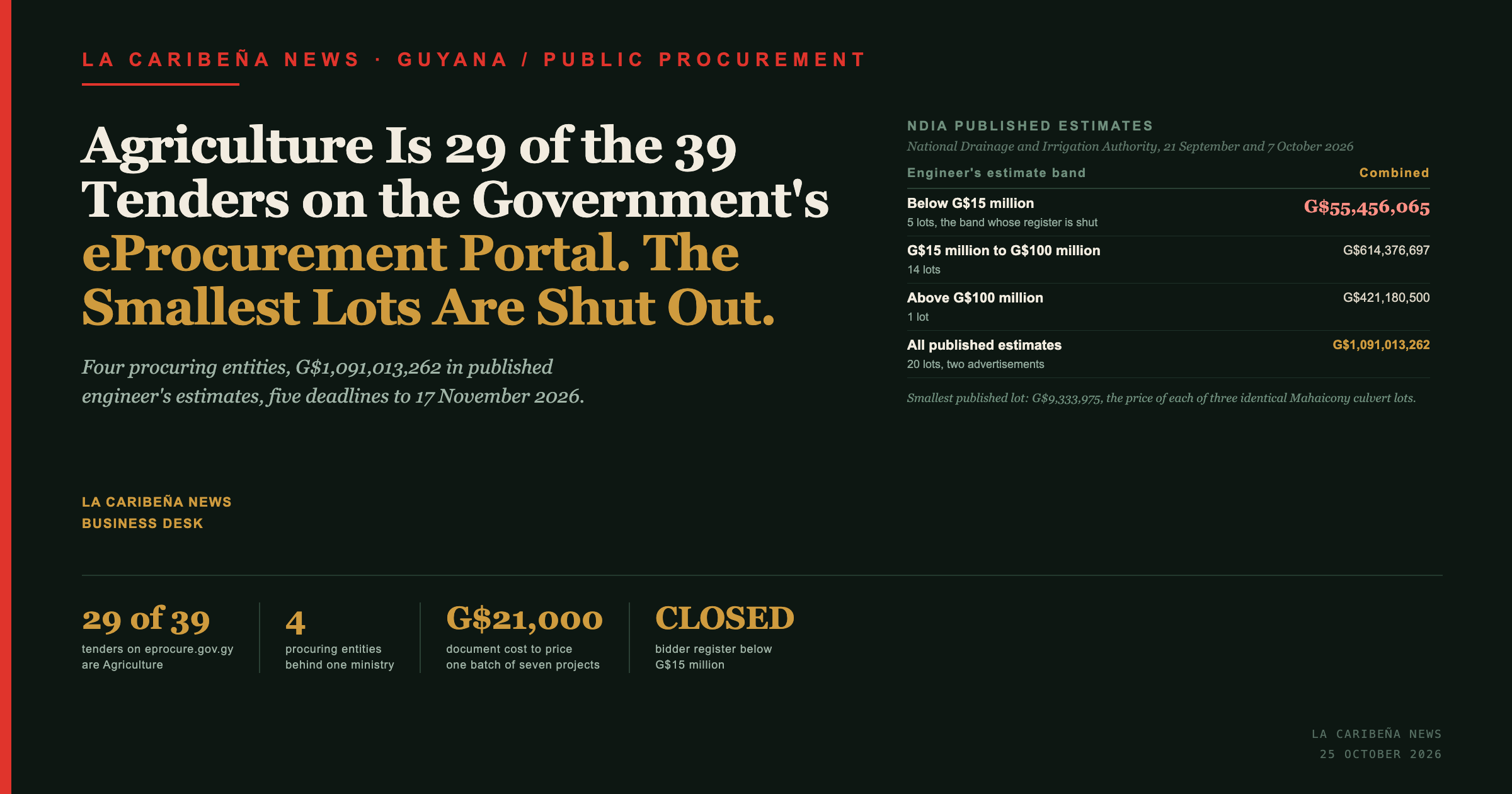
Every data point on the article's title card, in text.
- 29 of 39. The share of tenders listed on the Government of Guyana Procurement Opportunities portal at eprocure.gov.gy that are Ministry of Agriculture. Source: the portal's own opportunities index, read 25 October 2026.
- G$1,091,013,262. The sum of 20 published engineer's estimates in two drainage advertisements. Source: National Drainage and Irrigation Authority, 21 September and 7 October 2026.
- G$9,333,975. The smallest published lot estimate, and the price of each of three identical right-bank Mahaicony culvert lots. Source: as above.
- G$421,180,500. The largest published lot estimate. Source: as above.
- 5 lots, G$55,456,065. The lots priced below G$15 million and their combined estimate. Source: as above.
- Registration Period Closed. The notice on the bidder registration portal for contracts below G$15 million, read 25 October 2026. Source: the National Procurement and Tender Administration.
- G$21,000. The non-refundable document cost of pricing all seven projects in the Authority's 7 October batch, at G$3,000 for each bid document. Source: National Drainage and Irrigation Authority.
- 4 procuring entities. The separate buyers behind the single ministry heading, across eight advertisements. Source: the eight advertisements.
Frequently Asked Questions
How many procurements is Guyana's Ministry of Agriculture currently advertising?
Twenty-nine of the 39 tenders listed on the Government of Guyana Procurement Opportunities portal at eprocure.gov.gy on 25 October 2026 sit under the Ministry of Agriculture. That figure is the portal's own count and not a national total. They come from four separate procuring entities: the National Drainage and Irrigation Authority, the Guyana Sugar Corporation, the Ministry itself and the Fisheries Department.
What are the Guyana drainage tenders worth?
The National Drainage and Irrigation Authority published 20 engineer's estimates across its advertisements of 21 September and 7 October 2026, totalling G$1,091,013,262. The smallest is G$9,333,975 and the largest is G$421,180,500.
Can a small Guyanese contractor bid for the smallest lots?
Only if it already holds registration for the band. Five lots are priced below G$15 million, and the Administration's bidder registration portal for contracts below that figure read "Registration Period Closed. New registrations are currently not being accepted" when checked on 25 October 2026. The law also requires an application at least seven days before participating.
What does it cost to obtain the bidding documents?
It depends on the buyer and on the basis of the charge. The National Drainage and Irrigation Authority charges a non-refundable G$3,000 for each bid document, so seven projects cost G$21,000. The Guyana Sugar Corporation publishes a complete set free on guysuco.com and epr.guysuco.com and charges G$2,000 only for a printed copy. The Fisheries Department charges G$1,000, and the Ministry G$3,000 for the Centre of Excellence set and G$2,000 for the security set. A bid security is separate.
What is GuySuCo buying at Albion and Blairmont?
Six requests for proposals closing 10 November 2026 cover quicklime, reshell rollers, refractory materials, materials to upgrade the Albion packaging plant elevator, and materials to convert mild steel to stainless steel at both Blairmont and Albion Estates. Two further items, a crystallizer rehabilitation and a pug mill replacement, are retenders closing 27 October with a compulsory site meeting that was held on 20 October.