By LCN Business Desk
If you buy land from the Guyanese state, take a stake beside it, or sell to it, the company on the other side of the table is usually NICIL. It owns part of three extractive companies, has reported no income from its shareholdings, and has not put a set of accounts before Parliament for any year since 2006.
What does the state own, and what has it earned?
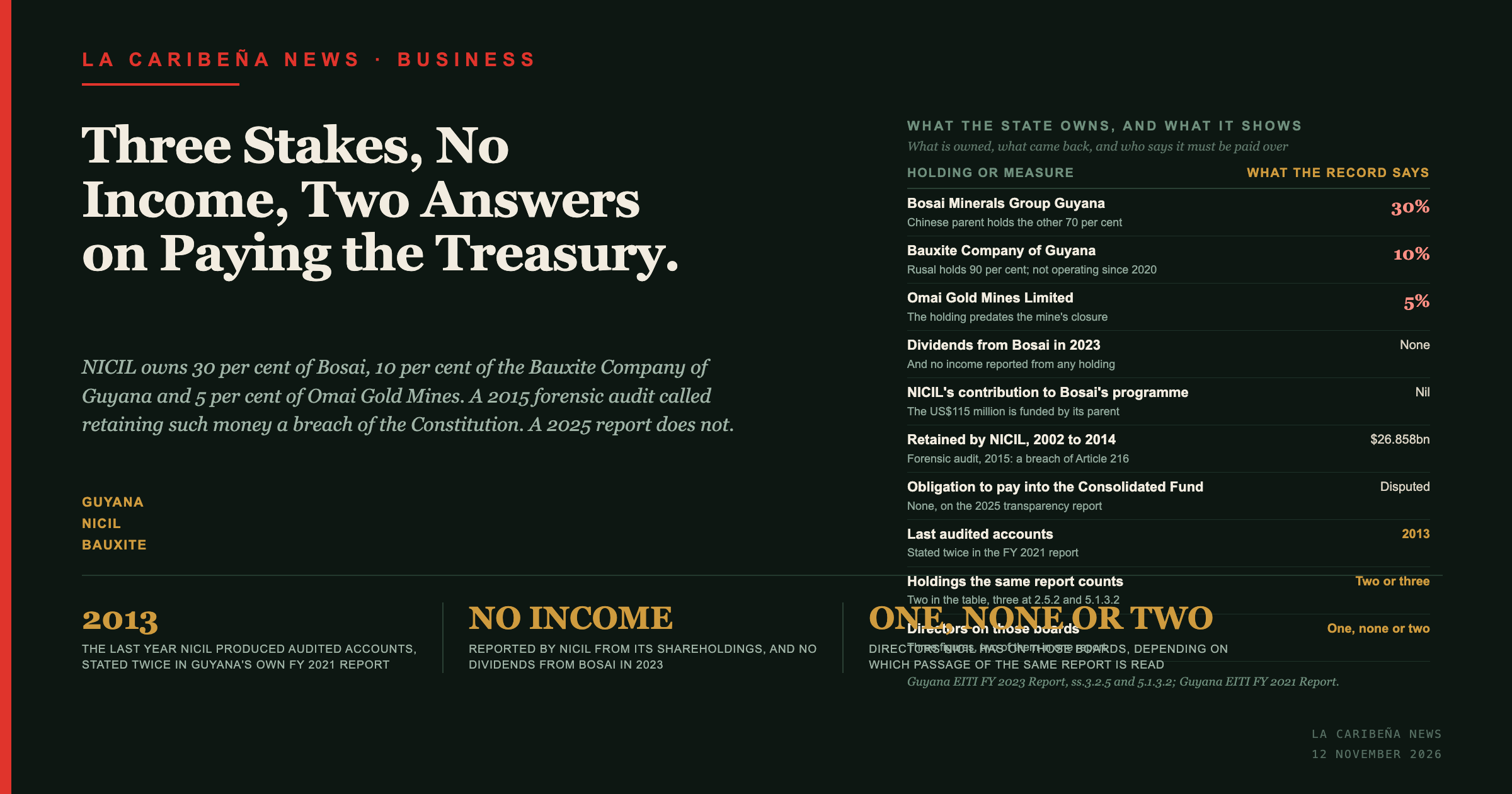
The state holds three minority stakes, and NICIL has reported no return on them.
The National Industrial and Commercial Investments Limited is wholly owned by the Government of Guyana and was built to hold every government shareholding in one place. Guyana's transparency reporting for 2023, prepared by BDO Professional Services Inc., records what it holds in the extractive sector.
| NICIL shareholding | Stake | Other owner |
|---|---|---|
| Bosai Minerals Group Guyana Inc. | 30% | Bosai Minerals Group Co. Ltd, China, 70% |
| Bauxite Company of Guyana Inc. | 10% | Rusal, Russia, 90% |
| Omai Gold Mines Limited | 5% | Not stated in the report |
Bosai is spending US$115 million on its bauxite production, funded entirely by its Chinese parent, with NICIL neither contributing nor guaranteeing any of it. NICIL took no dividend from Bosai in 2023, and told the administrators it had earned nothing from any of its holdings. The report cannot keep its own count of how many there are: two in its state participation table, three where it lists them by name. It cannot keep count of the board seats either, saying in one place that NICIL has appointed a director to Bosai's board and in another that it has no board representation anywhere, while the Bauxite Company's own accounts say NICIL is entitled to two.
Is NICIL required to pass that money to the treasury?
Two reports commissioned by the Guyanese state answer that in opposite directions.
BDO says no. As a company formed under the Companies Act, it reports, NICIL's board "is statutorily permitted to declare its own dividend to its shareholder and is under no obligation to pay into the Consolidated Fund."
A forensic audit of NICIL delivered to the government by the consultant S. A. Goolsarran on 26 October 2015 starts from the same fact and ends somewhere else. Article 216 of the Constitution sends all money received by Guyana into the Consolidated Fund, excepting money that an Act of Parliament routes elsewhere or lets the receiving body keep for its expenses. Because NICIL was incorporated under the Companies Act rather than created by its own Act, the audit found, that exception cannot reach it. Dividends and asset sale proceeds are state revenue, NICIL holds the shares as an agent rather than an owner, and since the holdings were handed over for nothing the arrangement is "akin to a Power of Attorney and therefore NICIL cannot claim ownership of these corporations and hence the returns from them."
The audit put the money retained between 2002 and 2014 at $26.858 billion and found it had been kept in the face of a National Assembly resolution of December 2012 directing NICIL to pay such revenue over.
Neither document settles it. One is a transparency report; the other a consultant's audit for a government five months in office. Between them they establish that Guyana has answered this question officially twice, a decade apart, and answered it differently both times.
When did NICIL last account to Parliament?
For the year 2006.
Parliament's register of papers laid before the National Assembly gives the most recent NICIL filing as its annual report for the year ended 31 December 2006, laid on 18 July 2013, seven years late. The register's own link to the document is empty. Finance Secretary Sukrishnalall Pasha confirmed the position to the Public Accounts Committee on 24 March 2025: "the last report was laid in the National Assembly in terms of NICIL is 2013."
Pasha added that statements had gone to the Auditor General up to 2024, which is a different thing. The Fiscal Management and Accountability Act and the Audit Act require the accounts of public bodies to be audited and laid before the National Assembly; reaching the Auditor General is a step on that road, not the end of it. Asked directly for its 2023 audited statements, NICIL declined to provide them.
What does this mean for a business dealing with the state?
That the counterparty cannot be checked.
NICIL is not a distant holding vehicle. It is the body that holds and moves state property, and the name on the other side of the paperwork when that property changes hands. Five orders in a single October gazette moved 2,368 acres out of it, almost all to the Central Housing and Planning Authority. It is also a shareholder sitting beside private owners in a bauxite producer at Linden and a gold company at Omai.
Any business that buys from it, partners with it or holds equity alongside it would, with an ordinary commercial counterparty, pull the accounts. Here there are none to pull. The last set laid before Parliament describes a financial year that ended before the oil was found, and the company's own website publishes no share register, no schedule of holdings, no dividend record and no annual report. A firm doing diligence on NICIL is left with what other institutions have written about it.
That matters beyond the firms directly across the table. The $26.858 billion in the forensic audit is money that, on one of the two official readings, belonged in the budget that funds procurement, roads and the contracts Guyanese businesses bid for.
What is happening to the two bauxite holdings?
One is dormant with its majority owner reported to be selling. The other is carried by its Chinese parent.
The Bauxite Company of Guyana has not operated since Rusal withdrew in 2020. Its capacity is about 1.7 million tonnes a year and its production is recorded at zero. Finance Minister Ashni Singh announced in January that a Berbice River restart had been approved, naming no operator, with production expected towards the end of 2027.
In September, Kaieteur News carried a Bloomberg report that Rusal is exploring a sale of its Guyana and Jamaica assets and has approached potential buyers. That account rests on people familiar with the matter, says there is "no certainty that a transaction will materialise", and records that Rusal declined to comment. On it, the state's ten per cent may get a new ninety per cent partner before it gets a dividend.
Where does the state hold nothing?
At Bonasika, the only one of the three drawing new money.
The United States Department of War announced on 7 August an US$85.5 million equity investment in Strategic Bauxite USA, LLC, with US$64.5 million of private co-investment, to acquire and expand the First Bauxite mine and build calcination capacity in Guyana. The state holds no part of it, and the mineral agreement governing the mine provides for none.
The omission is not statutory. The Mining Act allows a prospecting licence to carry an option for the State to take an interest in any mine that follows, and requires the option to be settled before a mining licence issues. The framework contemplates state equity. At Bonasika it was not taken.
So Guyana carries equity in the two bauxite operations whose economics are hardest, none in the one that has just drawn a foreign government's balance sheet into the country, and charges the same 1.5 per cent royalty on refractory ore as on ore bound for smelters.
The entities
- NICIL, the National Industrial and Commercial Investments Limited, is the state holding company, wholly owned by the Government of Guyana, which holds government shareholdings and state property.
- Bosai Minerals Group Guyana Inc. operates at Linden and is 70 per cent owned by Bosai Minerals Group Co. Ltd of China.
- Bauxite Company of Guyana Inc. is 90 per cent owned by Rusal and has not operated since 2020.
- Omai Gold Mines Limited holds the Omai site, where the state's five per cent predates the mine's closure.
- S. A. Goolsarran is the consultant who delivered the Government of Guyana's forensic audit of NICIL on 26 October 2015.
- Sukrishnalall Pasha is Guyana's Finance Secretary, who gave the Public Accounts Committee the position on NICIL's reports in March 2025.
- BDO Professional Services Inc. prepared Guyana's extractive transparency report for 2023; Hart Resources Ltd prepared the report for 2021.
Figures
- 30 per cent of Bosai, 10 per cent of the Bauxite Company of Guyana, 5 per cent of Omai Gold Mines: NICIL's extractive shareholdings. - No income: what it reported from them, including no dividends from Bosai in 2023. - US$115 million: Bosai's investment programme, funded entirely by its Chinese parent. - $26.858 billion: retained by NICIL between 2002 and 2014 on the 2015 forensic audit's finding. - 18 July 2013: when NICIL last laid a report before the National Assembly. It covers the year ended 31 December 2006. - 2,368 acres: state land moved out of NICIL in a single October gazette. - 1.7 million tonnes: the Bauxite Company of Guyana's annual capacity, against production recorded at zero. - US$85.5 million and US$64.5 million: the United States equity and private co-investment at Bonasika, where the state holds nothing. - 1.5 per cent: the royalty Guyana charges on every grade of bauxite.
Frequently Asked Questions
What does NICIL own in Guyana's extractive sector? Thirty per cent of Bosai Minerals Group Guyana, ten per cent of the Bauxite Company of Guyana and five per cent of Omai Gold Mines Limited.
How much has the state earned from those holdings? NICIL reported no income from its shareholdings, and no dividends from Bosai in 2023.
Does NICIL have to pay that money to the treasury? Two state-commissioned reports disagree. The 2023 transparency report says its board may declare its own dividend and need not pay the Consolidated Fund. The 2015 forensic audit found Article 216 of the Constitution admits no such exception for NICIL, and put the sum retained between 2002 and 2014 at $26.858 billion.
When did NICIL last report to Parliament? Its annual report for the year ended 31 December 2006, laid on 18 July 2013. The Finance Secretary told the Public Accounts Committee in March 2025 that 2013 remains the last time.
Why does this matter to a business? Because NICIL is the counterparty when state property or state shareholdings change hands, and no accounts have been laid before Parliament against which to assess it.