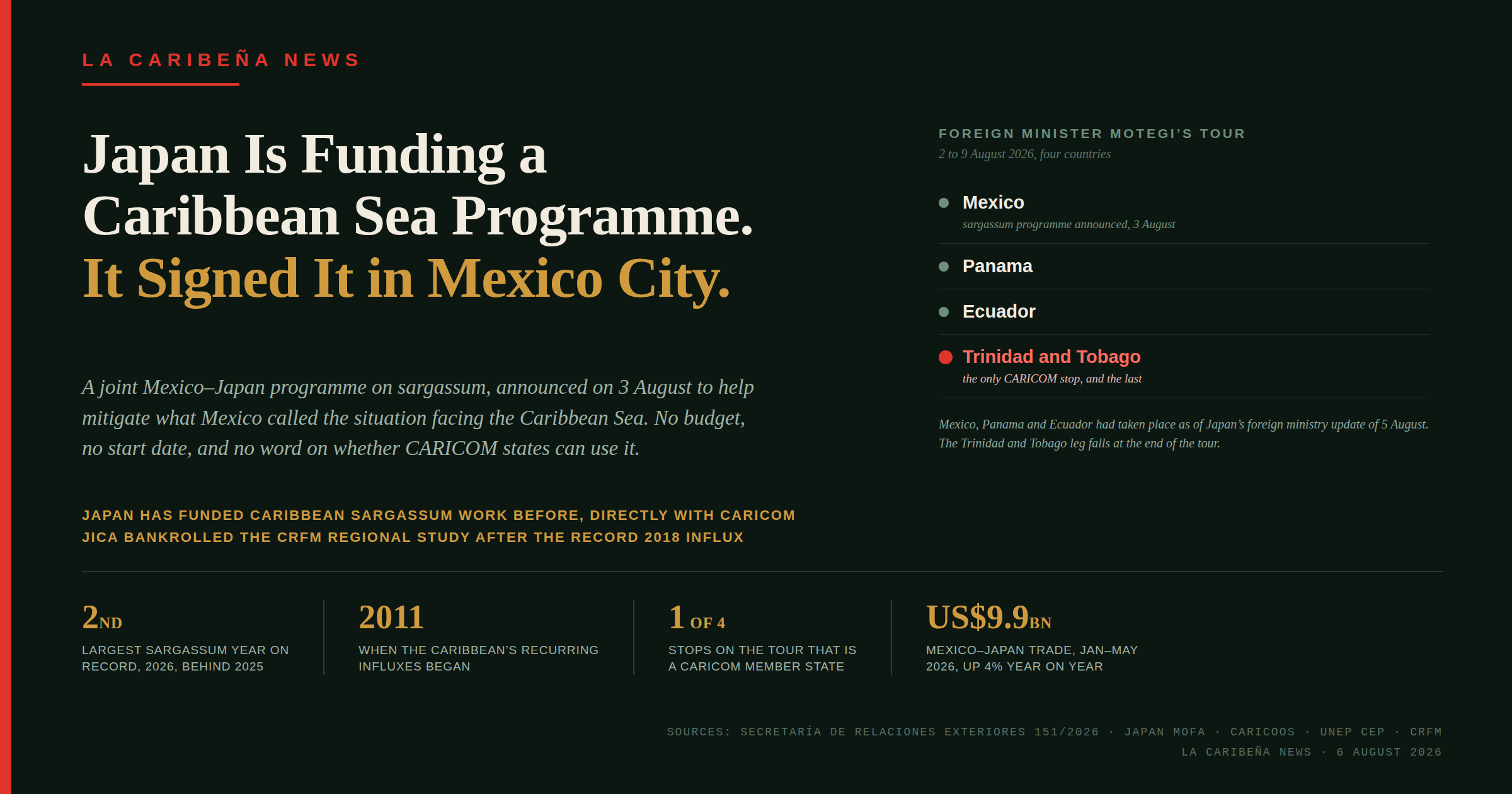
Japan's foreign minister is midway through an eight-day tour of Latin America and the Caribbean that ends in Trinidad and Tobago. The one commitment aimed at the Caribbean Sea was announced in Mexico, between two governments, for a problem that lands on a dozen other coastlines.
BY LCN NEWSROOM
Quick summary: Mexico and Japan announced on 3 August 2026 that their development cooperation agencies will launch a joint programme on sargassum to help mitigate what Mexico's foreign ministry called the situation facing the Caribbean Sea. Japan's foreign minister is touring the region until 9 August, finishing in Trinidad and Tobago. 2026 is on course to be the second-worst sargassum year on record.
What the title card shows
Every data point on the article's title card, in text.
- 2 to 9 August 2026. Dates of Japanese Foreign Minister Toshimitsu Motegi's visit to Mexico, Panama, Ecuador and Trinidad and Tobago. Source: Japan's Ministry of Foreign Affairs.
- One. CARICOM member state on the itinerary, Trinidad and Tobago. Source: as above.
- 3 August 2026. Date the sargassum programme was announced, in Mexico City. Source: Mexico's Secretaría de Relaciones Exteriores, Comunicado 151/2026.
- Second largest. Where 2026 ranks among sargassum years, behind 2025. Source: CARICOOS sargassum outlook, 31 July 2026.
- 2011. The year the Caribbean's recurring sargassum influxes began. Source: Caribbean Regional Fisheries Mechanism.
- USD 9.9 billion. Mexico-Japan bilateral trade, January to May 2026, up 4 per cent year on year. Source: Secretaría de Relaciones Exteriores.
- 2018. The record influx after which the Japan International Cooperation Agency funded the Caribbean Regional Fisheries Mechanism's regional study across CARICOM states, as noted on the card. Source: UNEP Caribbean Environment Programme.
- The itinerary shown on the card. Mexico, Panama, Ecuador and Trinidad and Tobago. Mexico, Panama and Ecuador had taken place as of Japan's foreign ministry update of 5 August; the Trinidad and Tobago leg falls at the end of the tour. Source: Japan's Ministry of Foreign Affairs.
What did Mexico and Japan actually agree?
A working group, an economic dialogue, and one line about the Caribbean Sea.
Mexico's foreign ministry set out the meeting in Comunicado 151/2026, issued on 3 August. Foreign Secretary Roberto Velasco Álvarez and Japanese Foreign Minister Toshimitsu Motegi agreed to establish a working group and announced a High-Level Economic Dialogue covering artificial intelligence, the digital economy and supply chain resilience.
Then, near the end, this: under development cooperation between the two countries' cooperation agencies, they announced the coming launch of a joint programme to address sargassum, one that would build capacity and help mitigate the situation facing the Caribbean Sea.
That is the sentence that matters to this region, and it is the one that travelled least. Coverage led on artificial intelligence.
The ministry also recorded bilateral trade of USD 9.9 billion from January to May 2026, up 4 per cent on the same period a year earlier, and marked 138 years of the relationship.
Who met whom, and why did reports disagree?
Two separate meetings on the same day, which is why accounts named different Mexican ministers.
Some reports named Foreign Secretary Velasco. Others named Economy Secretary Marcelo Ebrard. Both are correct.
Mexico's foreign ministry records the Velasco meeting. Japan's Ministry of Foreign Affairs separately records a meeting between Motegi and Ebrard on the same 3 August, running 60 minutes from 5.30pm local time. In that one the two agreed to hold the High-Level Economic Dialogue within the Japanese fiscal year, to continue energy cooperation in light of the situation in the Middle East, and to keep working together within the CPTPP framework.
So there was no contradiction to resolve. Motegi saw the foreign secretary and the economy secretary on the same day, and each ministry published its own account.
How bad is the sargassum problem now?
Bad enough that this year is the second worst on record, and the record is last year.
Sargassum is a floating brown seaweed. In open ocean it is habitat. Piled on a beach it rots, drives away visitors, fouls fishing gear, blocks engine intakes and releases hydrogen sulphide as it decomposes. For Caribbean economies built on tourism and fisheries, it arrives as a cost.
The Caribbean Coastal Ocean Observing System, in its outlook of 31 July 2026, reported that with the peak month over, 2026 is set to be the second largest sargassum year, second only to 2025. It expected beaching events around the Caribbean to continue while easing from the June and July peak.
This is not new and it is not occasional. The Caribbean Regional Fisheries Mechanism dates the recurring influxes to 2011, with large events in 2014 and 2015 and an unprecedented year in 2018.
Has Japan done this before in the Caribbean?
Yes, and directly with CARICOM rather than through a third country.
This is the part that gives the Mexico announcement its edge. After the record 2018 influx, the Caribbean Regional Fisheries Mechanism began a regional fact-finding study documenting the seaweed's impact across CARICOM states. The United Nations Environment Programme's Caribbean Environment Programme recorded that the survey was funded by the Japan International Cooperation Agency, which it noted had coordinated Japanese official development assistance to CARICOM states for over two decades.
So Japan already has a working channel to the Caribbean on precisely this problem, built with the region's own fisheries body. The new programme announced this week runs through Mexico instead.
That is not a criticism of the programme. Mexico's Caribbean coast is heavily hit and Mexico is a serious partner. It is an observation about architecture, and it raises a question the two announcements do not answer.
Sargassum does not stop at Mexico's territorial sea. A programme aimed at "the situation facing the Caribbean Sea", agreed between two governments, will be judged by whether the other governments on that sea can use it.
What has not been established?
Three things, and they are the reporting this story still needs.
The scope. Neither announcement says whether the joint programme covers CARICOM states, or is confined to Mexican waters and Mexican capacity. The phrase used is "the situation facing the Caribbean Sea," which is broader than Mexico. The mechanism described is bilateral.
The money. No budget, duration or start date has been published for the programme by either government. It is described as about to be launched.
The agencies. The communiqué refers to the two countries' development cooperation agencies without naming them. On the Japanese side this would ordinarily mean the Japan International Cooperation Agency. La Caribeña News has not seen that confirmed for this programme.
Where does Trinidad and Tobago fit?
It is the last stop, and the only CARICOM state on the itinerary.
Japan's foreign ministry lists the trip as a visit to Mexico, Panama, Ecuador and Trinidad and Tobago from 2 to 9 August 2026. As of the ministry's own update on 5 August, the Mexico, Panama and Ecuador legs had taken place. The Trinidad and Tobago leg falls at the end of the tour.
That makes Port of Spain the one place on this itinerary where Japan will sit down with a CARICOM government, days after committing to a Caribbean Sea programme somewhere else. What is agreed there is worth watching, and this newspaper will report it.
What is Japan actually pursuing in this region?
Its foreign minister set it out in writing a week ago, and the Caribbean appears in it.
Motegi published an article through Agencia EFE on 31 July under the title "Japan and Latin America and the Caribbean: Stronger and More Prosperous Together". It is a policy statement rather than a communiqué, and it is unusually direct about method.
He describes three pillars. The first is Japan's traditional relationship of trust, resting on development cooperation tailored to each country's circumstances. Within that he singles out small island developing states facing climate impacts, for which he says Japan provides solutions using advanced technology and the expertise of Japanese companies.
The second is economic. Here he commits Japan to expanding economic partnership agreements, naming the strategic expansion of the CPTPP and a new agreement with Mercosur. Readers following this newspaper's coverage of the EU-Mercosur agreement and Caribbean sugar will note that a second major economy is now negotiating preferential terms with the same South American bloc.
He also points to PLACIDA, a public-private platform for Latin American and Caribbean infrastructure development that Japan launched last July.
Read together with the tour, the pattern is a country widening its options in this hemisphere. The Caribbean's question is a narrower one: on which of these tracks is it a participant, and on which is it a coastline that other people's programmes are aimed at.
Frequently Asked Questions
What is sargassum and why does it matter economically?
A floating brown seaweed. At sea it is habitat; piled on beaches it decomposes, releases hydrogen sulphide, deters visitors and fouls fishing gear and engine intakes. For economies dependent on tourism and fisheries it arrives as a direct cost.
How bad is 2026?
The Caribbean Coastal Ocean Observing System reported on 31 July that 2026 is set to be the second largest sargassum year on record, behind 2025, with the peak month already passed.
What exactly did Mexico and Japan announce?
Mexico's foreign ministry said the two countries' development cooperation agencies would launch a joint programme to address sargassum, strengthen capacity and help mitigate the situation facing the Caribbean Sea. No budget, duration or start date was published.
Does the programme include CARICOM states?
Neither government has said. The stated aim refers to the Caribbean Sea; the mechanism announced is bilateral between Mexico and Japan.
Has Japan funded Caribbean sargassum work before?
Yes. The Japan International Cooperation Agency funded the Caribbean Regional Fisheries Mechanism's regional fact-finding study into the record 2018 influx across CARICOM states.
Is Japan visiting any CARICOM country on this trip?
Trinidad and Tobago, the final stop on a tour running 2 to 9 August 2026 that also took in Mexico, Panama and Ecuador.