By LCN Business Desk
Officials, producers, financiers and development agencies are in Panama City for three days to write something the region does not yet have: a shared plan for growing more food without clearing more forest.
The deadline giving the meeting its urgency is not in the agenda. It is in Brussels, and it is twelve weeks away.
What is actually happening in Panama?
A roadmap, not a conference.
The Food and Agriculture Organization and the Inter-American Development Bank are running a regional exchange from 6 to 8 October, Towards a shared Latin American roadmap for solutions to decouple agricultural production from deforestation, with support from Japan's Ministry of Agriculture, Forestry and Fisheries and the UN-REDD Programme.
The stated aim is "a shared, country-led roadmap for action" on expanding what the organisers call forest-positive agrifood systems. The three days run through country experiences, deforestation-free trade mechanisms, traceability tools, and the roadmap itself. In the room are government representatives, producers, private-sector actors, financial institutions, regional organisations and development partners.
What is the deadline behind it?
The European Union's deforestation regulation, which starts applying on 30 December 2026.
The regulation bars from the European market goods that cannot be shown to be free of deforestation. The European Commission sets the dates as 30 December 2026 for large and medium operators and 30 June 2027 for micro and small operators, except where those smaller operators were already covered by the EU Timber Regulation, in which case the earlier date applies to them too.
Those dates are themselves the product of a delay. The application date was pushed back twelve months from 30 December 2025 under an amending regulation, and the Commission has run a simplification review alongside it. The sector has had two years of moving deadlines, which is part of why a roadmap is being drafted now rather than in 2024.
From today, 30 December is twelve weeks.
Which commodities and which countries?
Seven commodities, and a three-tier classification of almost every country on earth.
The Commission lists the covered goods as cattle, wood, cocoa, soy, palm oil, coffee and rubber, together with derived products including leather, chocolate, tyres and furniture.
Alongside that sits a country benchmarking system placing 194 countries into low, standard and high risk. Analysts tracking the classification report that only four countries were placed in the high-risk tier and more than 140 in low risk, with the share of operators and products subject to checks set at 9 per cent for high risk, 3 per cent for standard and 1 per cent for low. Brazil, the region's largest agricultural exporter, is classified standard.
A low-risk classification does not exempt anyone. It allows a simplified due diligence route under Article 13 of the regulation for qualifying operators sourcing exclusively from low-risk countries, which is a lighter paperwork burden rather than an absence of one.
Where does the Caribbean sit?
On the commodity list, and largely outside the conversation.
Three of the seven covered commodities are Caribbean exports: cocoa, coffee and wood. The Dominican Republic, the region's largest cocoa exporter, is reported to have been placed in the low-risk tier, which would put its operators on the 1 per cent check rate and open the Article 13 route.
The meeting in Panama is framed as a Latin American roadmap. On the event's own published description, which names no Caribbean state, no CARICOM institution and no Caribbean commodity, the region does not appear in it. The organising body's regional mandate is Latin America and the Caribbean, and the host country sits at the isthmus between them.
That absence may be a matter of a webpage rather than a room. It is worth establishing which, because the roadmap being drafted this week is the document that regional lenders and agencies will cite when they decide what to finance.
What does this mean for a region trying to grow more food?
It puts a condition on the thing the Caribbean has already committed to doing.
CARICOM's agriculture ministers asked the region to buy Caribbean produce at the end of September, and the regional target to cut the food import bill has already slipped to 2030, with Belize as the benchmark. Cutting an import bill means growing more at home, and growing more means either higher yields on the same ground or more ground.
The scale of that choice is visible next door. This newspaper reported this morning that Brazil's state of Piaui took off a record 6.82 million tonne grain harvest, five times its 2016 crop, from an area 8.3 per cent larger than the year before. Roughly half of that rise came from yield and half from land.
A target to grow more food and a rule against clearing more land are the same question asked from two directions.
The roadmap being written in Panama is an attempt to answer it for the producers. Whether it is also answered for the importers, which is what most of the Caribbean is, is not something the published agenda says.
What the title card shows
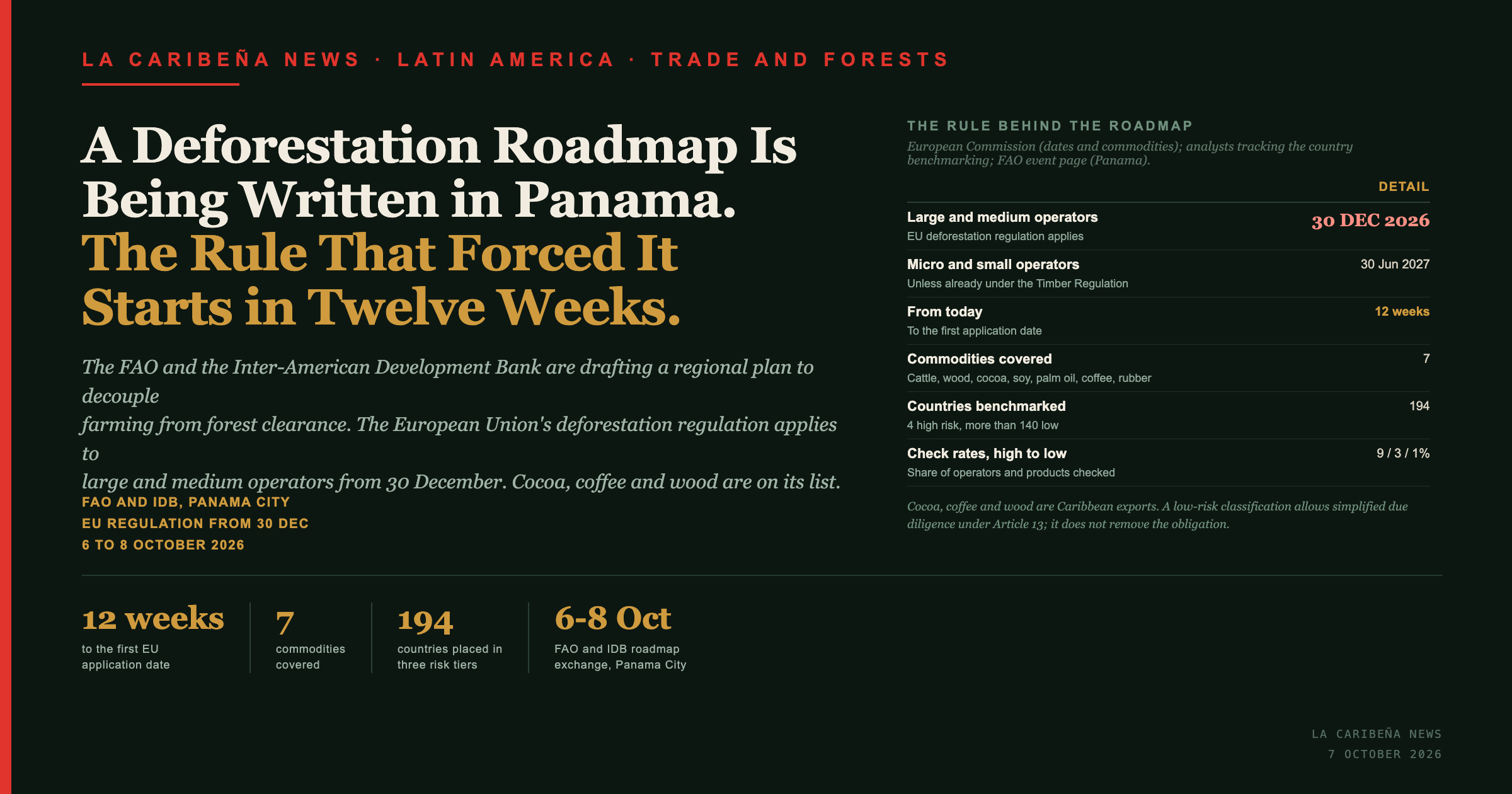
Every data point on the article's title card, in text.
* 6 to 8 October 2026. The dates of the FAO and Inter-American Development Bank regional exchange in Panama City, supported by Japan's Ministry of Agriculture, Forestry and Fisheries and the UN-REDD Programme. Source: FAO event page. * 30 December 2026. The date the European Union deforestation regulation begins to apply to large and medium operators. Source: European Commission. * 30 June 2027. The date it begins to apply to micro and small operators, except those already covered by the EU Timber Regulation. Source: as above. * Twelve weeks. The interval between 7 October 2026 and 30 December 2026. Calculated. * Seven. The commodities covered: cattle, wood, cocoa, soy, palm oil, coffee and rubber, plus derived products including leather, chocolate, tyres and furniture. Source: European Commission. * 194. The countries placed into low, standard or high risk under the benchmarking system, with four in high risk and more than 140 in low, as reported by analysts tracking the classification. * 9, 3 and 1 per cent. The share of operators and products subject to checks in the high, standard and low risk tiers respectively, on the same reporting.
Frequently Asked Questions
What is the European Union deforestation regulation?
A rule barring from the European market goods that cannot be shown to be free of deforestation. It covers cattle, wood, cocoa, soy, palm oil, coffee and rubber, together with derived products such as leather, chocolate, tyres and furniture.
When does it start applying?
30 December 2026 for large and medium operators and 30 June 2027 for micro and small operators, except where the smaller operators were already covered by the EU Timber Regulation, which brings them to the earlier date. Both dates follow a twelve-month postponement.
Which Caribbean exports are covered?
Cocoa, coffee and wood are all on the list of seven commodities, along with derived products including chocolate.
Does a low-risk country classification mean no obligations?
No. It allows qualifying operators sourcing exclusively from low-risk countries to use a simplified due diligence route under Article 13, and sets the check rate at 1 per cent rather than 3 or 9. The obligation itself remains.
What is being decided in Panama?
Not a binding instrument. A country-led regional roadmap on decoupling agricultural production from deforestation, covering country experiences, deforestation-free trade mechanisms and traceability tools, drafted over three days by governments, producers, financiers and development partners.