By LCN Business Desk
The Netherlands Court of Audit put it in four words in its title. There is no safety net.
Its report on Bonaire, Sint Eustatius and Saba, Geen vangnet voor Caribisch Nederland, was adopted on 6 May and published on 12 May 2026. The cabinet answered it on 5 October.
What did the Court of Audit find?
An absence in every category it examined.
"We conclude that there are no strategic stocks of drinking water, food, medicines and fuel in the Caribbean Netherlands."
A strategic stock, on the Court's definition, is held back from daily use and released only when the supply chain is disrupted. Because no Dutch policy sets a level for these islands, the Court built its own standards framework from existing international norms and measured the regular stocks against it.
| Court's standard | Bonaire | Sint Eustatius | Saba | |
|---|---|---|---|---|
| Drinking water | 10 days | 3 to 4 days | 7 days | 1 day |
| Food | none set | 14 to 21 days | 7 days | 7 days |
| Medicines | 7 days | 3 to 6 weeks | 1 to 2 months | 1 to 2 months |
| Fuel | 72 hours | standard not met | standard not met | standard not met |
Source: Netherlands Court of Audit, "No safety net for the Caribbean Netherlands", 12 May 2026. Figures are regular stocks, held for day-to-day use. On fuel the Court records that the 72-hour standard is not met while all three islands hold large regular stocks.
Saba's figure is the smallest the Court recorded anywhere: 600 five-gallon bottles.
How long would the water actually last?
Longer than that, and the cabinet's reply is where the fuller number appears.
In a crisis the islands fall back on emergency drinking water, which is limited to what is needed for drinking and food preparation. The cabinet puts that at a minimum of three litres per person per day, the same standard as in the European Netherlands. On that basis it cites a different inspectorate, the Human Environment and Transport Inspectorate.
| Court of Audit, regular stock | Inspectorate, emergency supply | |
|---|---|---|
| Saba | 1 day | over 4 days, plus 2 days of household water in tanks |
| Bonaire | 3 to 4 days | at least 26 days |
| Sint Eustatius | 7 days | 7 days |
Sources: Netherlands Court of Audit, 12 May 2026; Kamerbrief of 5 October 2026, reference 2026-0000518199.
The two bodies are measuring different things rather than contradicting each other. A reader given only the first column has the smaller half of the picture.
The cabinet adds that drinking water on Bonaire stays vulnerable because production depends on imported fuel, materials and chemicals, and that damage to infrastructure or to the seawater intake can stop it.
Why do European rules not reach these islands?
They stop at the Atlantic.
The Court examined strategic reserves in the European Netherlands in 2022 under European Union obligations to hold certain stocks. Those obligations do not extend to the Caribbean Netherlands. The Court found no Dutch policy filling the gap, recording that there is no policy specifically for fuel and none specifically for food.
That is why it had to write its own standards framework before it could measure anything.
How does anything reach the islands?
Through two others, neither of which is a Dutch municipality.
"All stocks in the Caribbean Netherlands are reliant on imports, brought to the islands via regional hubs in Curaçao and St Maarten."
Food comes from the European Netherlands, Santo Domingo, Colombia and Miami, and the Court records that the three islands "produce little to no food of their own". Supply from the European Netherlands runs by air once a week. By sea it takes six weeks.
In a crisis, the Court records, the decision would not be the islands' to make.
"private parties and commercial interests may determine how regular stocks of drinking water, fuel, medicines and food are used in times of crisis."
The second is who they would be bidding against.
"The BES islands will have to compete for scarce goods against other islands in the region and it is far from certain which islands suppliers will prefer."
Where formal agreements exist, as with fuel, the Court found "uncertainty about the allocation of responsibilities". The Court set its findings before the House in a covering letter of 12 May signed by its president, Pieter Duisenberg.
What fuel costs the region, and what governments have done about it, is examined in What Fuel Costs Across the Caribbean and in Cayman Waived Fuel Duty.
Has the chain been tested?
In January, and the Court opens its executive summary with it.
"The closure of the Strait of Hormuz raised the risk of a global fuel shortage and in January 2026 the geopolitical situation in Venezuela (70 km from Bonaire) was so precarious that Dutch airlines temporarily suspended flights to and from the Caribbean region."
That suspension, the Court records, "had an immediate impact on the residents of the Caribbean Netherlands because the islands are almost completely reliant on imports".
What did the cabinet say back?
That the message is clear, and that it cannot all be done at once.
The reply came in a letter to the House of Representatives on 5 October, signed by Eric van der Burg, State Secretary of the Interior and Kingdom Relations, and D.M. van Weel, Minister of Justice and Security, and sent on behalf of five further ministers.
It accepts the finding without qualification.
"The Court of Audit's message is perfectly clear: when it comes to drinking water, food, medicines and fuel there must be a clear 'plan B' when a disaster or crisis disrupts supply."
The cabinet, it says, endorses the conclusion that there are no strategic stocks on the three islands. Then comes the operative sentence.
"The implementation of the recommendations takes place within the existing financial frameworks. Account must also be taken of the local context. This means that not everything can be done at once."
The Court had asked for two things: that the government decide what level of strategic stocks is desirable, record it and assign responsibility; and that it provide a stock of food and drinking water, with the storage to hold it.
What money is committed?
Twenty-four million euro, into production rather than storage.
The cabinet is putting €24 million into raising food production across the Caribbean part of the Kingdom. Of that, €18 million establishes a foundation called the CariFoodFund, a revolving fund making loans to businesses in the food security chain, which the cabinet intends to have fully operational by the end of 2026. The remaining €6 million is reserved for what it calls the public pillar, under which the six local governments can apply for investment in infrastructure, irrigation systems, and water and cold storage.
It has also commissioned two studies into new trade and supply routes, one for the Windward and one for the Leeward islands, covering alternative regional suppliers, ports, transport routes, cooperation between islands and the effect of trade barriers.
How long did the answer take?
Five months, and it arrived two days before a deadline parliament set.
The internal decision note submitted to the State Secretary records that when the report was published in May, the minister gave "a short administrative response". The House then pressed, by committee letter on 11 June and by a motion from members Tseggai and Ceder, for a fuller reply before the Kingdom Relations budget debate of 7 October.
| 6 May 2026 | Court of Audit adopts the report |
|---|---|
| 12 May 2026 | Published. The minister gives a short administrative response |
| 11 June 2026 | The standing committee asks for a fuller one |
| 2 October 2026 | The Council of Ministers adopts the letter as item 6 |
| 5 October 2026 | The letter is sent |
| 7 October 2026 | The budget debate that was its deadline |
Sources: Beslisnota of 2 October 2026, reference 2026-0000518188; Council of Ministers decision list of 2 October 2026, kenmerk 3843436; Kamerbrief of 5 October 2026.
The letter notes that in November 2025 the Justice and Security Inspectorate had already found the three islands insufficiently prepared for disasters and crises.
What did the second report find?
That nobody has a clear picture of what the islands can do.
Annexed to the same letter is a study by the research bureau Crisisplan, commissioned by the two ministries and covering all six Caribbean islands of the Kingdom, the three Dutch municipalities and the autonomous countries Aruba, Curaçao and Sint Maarten. Its opening finding is about knowledge rather than equipment.
"The crisis capacities available to the public bodies and the Caribbean countries of the Kingdom are not well understood."
Its per-island analysis is published anonymously, as Island 1 through Island 6, so no finding in it is attached to a named island. Across them it reports crisis plans that do not all meet the requirements reasonably expected of one, and facilities so unequal that some islands have a brand new crisis centre while others can offer their team almost nothing, which it calls undesirable.
The staffing finding is the bluntest. For many crisis teams, it says, a crisis must not last too long, because there are no qualified replacements or the replacements do crisis management as a secondary duty, so a team can exhaust quickly. Most teams have limited access to cyber and chemical, biological, radiological and nuclear expertise, and no knowledge of critical infrastructure or the cascade effects of losing electricity. In a power failure, informing the population becomes difficult and tourists are left without information altogether.
At sea it is starker.
"The islands have no or insufficient capacity to organise a large-scale rescue operation at sea."
For one of the anonymised islands the report sets out the fuel position directly: with rationing, the authorities can keep the most important processes running for at least three days, a window intended to let a fuel ship resupply. If that delivery does not arrive within three days, it states, emergency services, generators and critical infrastructure including the water supply, the hospital, the prison and the banks can fail.
Two of the six, Curaçao and Sint Maarten, have no entry at all in the International Monetary Fund's flagship forecast, set out in The IMF Put Latin America and the Caribbean at 2.3 Per Cent. They are the two through which everything reaches the other three.
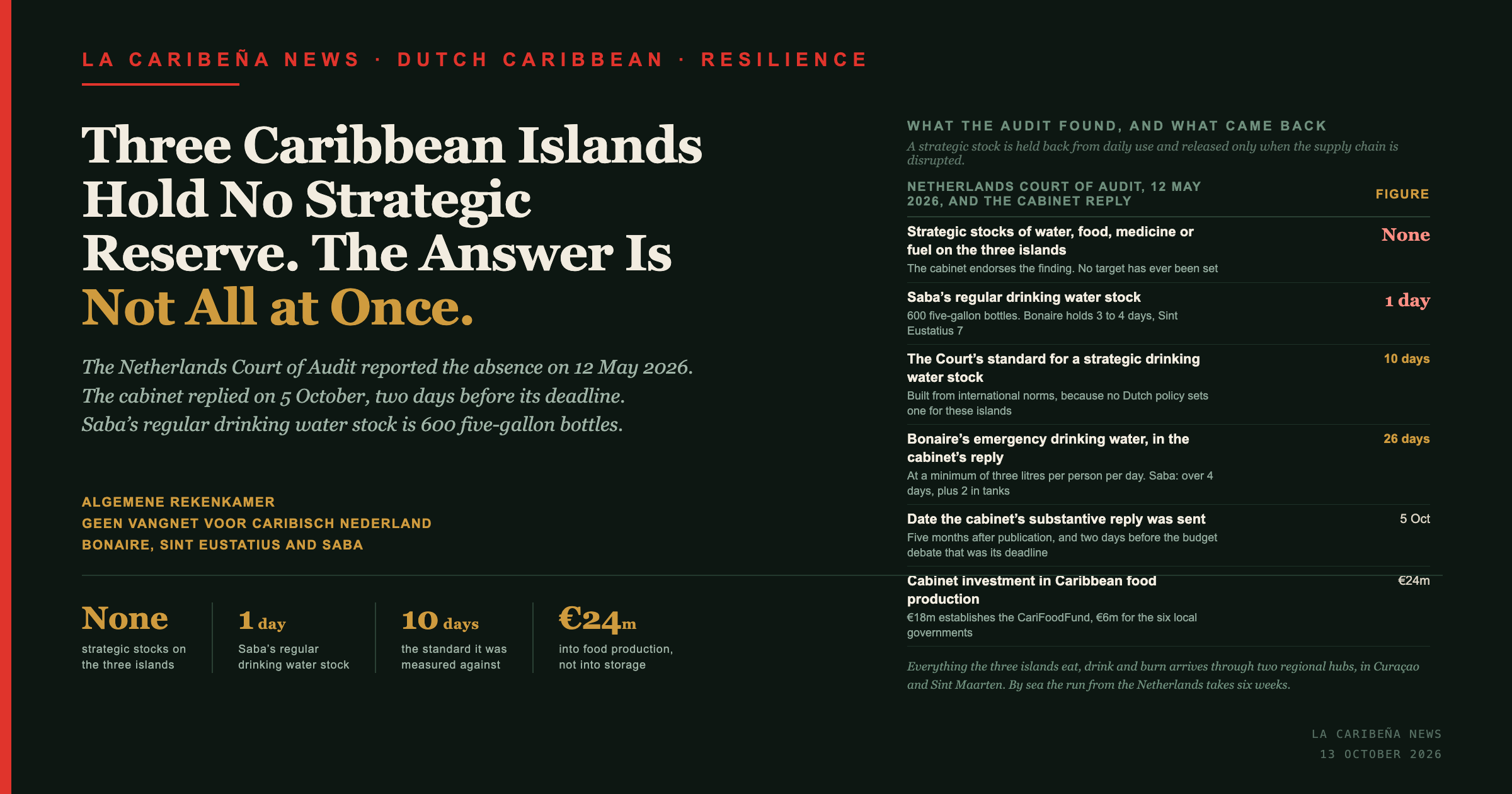
What the title card shows
Every data point on the article's title card, in text. Source for all: Netherlands Court of Audit, "No safety net for the Caribbean Netherlands", 12 May 2026, except where stated.
* 0 strategic stocks. Of drinking water, food, medicines or fuel on Bonaire, Sint Eustatius or Saba. The cabinet endorses the finding. * 1 day. Saba's regular drinking water stock, 600 five-gallon bottles. The Court's standard is 10 days. The Human Environment and Transport Inspectorate puts Saba's emergency supply at over 4 days plus 2 days of household water, and Bonaire's at at least 26 days. Source for the emergency figures: Kamerbrief, 5 October 2026. * 6 weeks. The time supply from the European Netherlands takes by sea. By air it runs once a week. * €24 million. Cabinet investment in raising Caribbean food production, of which €18 million establishes the CariFoodFund and €6 million is reserved for the six local governments. Source: Kamerbrief, 5 October 2026. * 5 months. From the report's publication on 12 May to the cabinet's substantive reply on 5 October, which arrived 2 days before the budget debate parliament had set as the deadline. * 70 km. The distance from Bonaire to Venezuela, cited by the Court in the context of January 2026, when Dutch airlines temporarily suspended flights to the region. * 6 islands. Covered by the annexed Crisisplan study, which publishes its per-island analysis anonymously.
Frequently Asked Questions
What did the Netherlands Court of Audit find?
That there are no strategic stocks of drinking water, food, medicines or fuel on Bonaire, Sint Eustatius or Saba, that the government has set no targets for such stocks, and that it is not clear who is responsible for holding them. Its report, "No safety net for the Caribbean Netherlands", was published on 12 May 2026.
How much drinking water do the islands hold?
On regular stocks, the Court recorded three to four days for Bonaire, seven for Sint Eustatius and one for Saba, against its standard of ten. The cabinet's reply cites the Human Environment and Transport Inspectorate putting emergency supply at over four days for Saba plus two days of household water, at least 26 days for Bonaire and seven for Sint Eustatius.
What did the Dutch cabinet reply?
That the Court's message is perfectly clear and that a plan B is needed, and that it endorses the conclusion that no strategic stocks exist. On acting, the letter says implementation takes place within the existing financial frameworks and that not everything can be done at once. It commits €24 million to raising food production.
Why did the reply take five months?
The minister gave a short administrative response when the report appeared in May. The House then asked for a fuller one by committee letter and by a motion from members Tseggai and Ceder, to arrive before the Kingdom Relations budget debate of 7 October. The Council of Ministers adopted the letter on 2 October and it was sent on 5 October.
Do European Union rules require these reserves?
No. The Court examined the European Netherlands in 2022 under EU obligations to hold certain strategic stocks. Those obligations do not extend to the Caribbean Netherlands, and the Court found no Dutch policy specifically covering fuel or food.