By LCN Business Desk
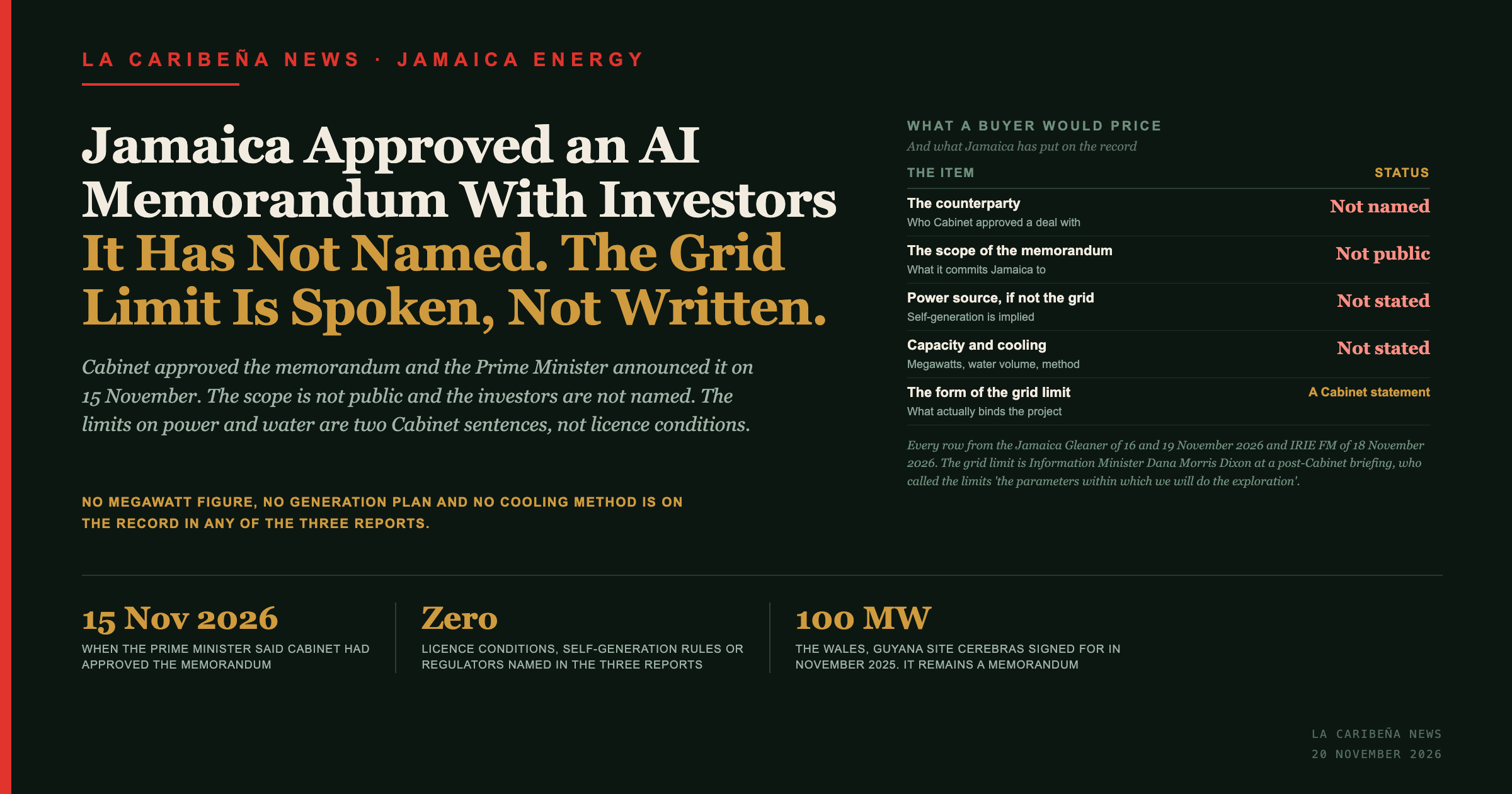
Prime Minister Andrew Holness said on 15 November that Cabinet had approved a memorandum on AI infrastructure. The investors are not named and the scope is not public.
He told a party conference that Cabinet had approved it. The Jamaica Gleaner calls the other side an undisclosed group of investors.
What has the government actually committed to?
An exploration, on its own description.
Dana Morris Dixon is the Information Minister. At a post-Cabinet briefing she said: "this is just an MOU". She said "No agreement is being signed". She also said "There is no investor coming."
The scope of the memorandum has not been made public. Holness said the aim is "so that Jamaica can have a footprint and not only be a consumer of the technology". Minister Andrew Wheatley has set up a task force on AI.
What limits the project, and in what form?
Two Cabinet statements, which the minister calls parameters.
She gave the limits in two sentences at the post-Cabinet briefing. "We have said as a Cabinet that it can have no impact on our water systems." And: "We've also said as a Cabinet that it cannot be pulling from the [electrical] grid." The brackets are the Gleaner's. She described these as "the parameters within which we will do the exploration".
| What a buyer would price | What is on the record |
|---|---|
| The counterparty | Not named |
| The scope of the memorandum | Not public |
| Power source if not the grid | Not stated |
| Capacity in megawatts | Not stated |
| Cooling method and water volume | Not stated |
| The form the grid limit takes | A Cabinet statement |
Sources: the Jamaica Gleaner of 16 and 19 November 2026 and IRIE FM of 18 November 2026.
None of the three reports names a licence condition. None names a self-generation rule. None mentions the Office of Utilities Regulation or Jamaica Public Service. A spoken parameter and a licence condition are different instruments, and only the first is on the record.
Why does the grid limit matter commercially?
Because Caribbean grids have little room, and a data centre is a large steady load.
A site barred from the public grid must make its own power. That means plant and fuel, and a deal for whatever it cannot make. None of it has been described.
The scale is the point. A docked cruise ship draws up to 12 megawatts, and Grenada's entire power system is 70. A data centre is a larger and steadier load than a ship.
Two neighbours have signed the same kind of document and said more in it. Guyana signed with Cerebras Systems in November 2025 for a site at Wales of up to 100 megawatts, beside its gas-to-energy plant. Trinidad and Tobago signed three memoranda with United States companies on 11 July 2026 covering up to 800 megawatts of data centre capacity. Both neighbours named counterparties and capacities. Jamaica has named neither.
There is a base rate for these documents, and a supplier should know it. Cerebras listed on Nasdaq this year as CBRS. Its prospectus of 14 May 2026 does not mention Guyana. Neither does its quarterly report of 12 November 2026. That does not mean the memorandum has lapsed. It means the company has not treated it as material enough to disclose to its own investors. The Wales memorandum remains a memorandum, as this newspaper reported in September. Ernst & Young facilitated it and is a counterparty to a 300-megawatt Trinidad memorandum.
What is being asked for before anything is signed?
A policy first, and the document published.
Christopher Brown speaks for the Opposition on science and technology. On 16 November he asked the government to publish the memorandum and table it in Parliament. He asked that no further AI deals be signed until a national policy reaches Parliament, with safeguards on water, energy and the land. He also asked for a full public impact assessment, the investor names, and who would pay for any upgrades.
"An MOU should flow from policy, not stand in for it," Brown said.
The entities
- Memorandum of understanding on AI infrastructure: approved by Jamaica's Cabinet and announced on 15 November 2026, with a counterparty the government has not named and a scope that is not public. - Andrew Holness: Jamaica's Prime Minister, who announced the Cabinet approval at a party conference. - Dana Morris Dixon: Jamaica's Information Minister, who set out the grid and water parameters at a post-Cabinet briefing. - Andrew Wheatley: the minister who set up Jamaica's task force on AI. - Christopher Brown: Opposition Spokesperson on Science, Technology and Digital Transformation. - Cerebras Systems: the United States company, listed on Nasdaq as CBRS, that signed a memorandum with Guyana in November 2025 for a data centre of up to 100 megawatts at Wales. - Ernst & Young: the consultancy that facilitated Guyana's memorandum and is a counterparty to Trinidad and Tobago's 300-megawatt one.
What the title card shows
Not named: the counterparty to the memorandum of understanding Jamaica's Cabinet approved, announced on 15 November 2026. Not public: the scope of that memorandum, per the Jamaica Gleaner of 19 November 2026. Two: the Cabinet statements that limit the project, being that it can have no impact on water systems and cannot be pulling from the electrical grid. Zero: licence conditions, self-generation requirements or regulatory instruments mentioned across the three reports. Not stated: the power source, the capacity in megawatts, the cooling method and the water volume. Up to 100 megawatts: the Wales, Guyana data centre Cerebras Systems signed a memorandum for in November 2025, which remains a memorandum. Up to 800 megawatts: the data centre capacity Trinidad and Tobago signed three memoranda for with United States companies on 11 July 2026, one of them a 300-megawatt document Ernst & Young is a counterparty to. 12 megawatts: what a docked cruise ship can draw, against a Grenadian power system of 70.
Frequently asked questions
What did Jamaica's Cabinet approve?
A memorandum of understanding on AI infrastructure, announced by Prime Minister Andrew Holness on 15 November 2026. The Information Minister describes it as an exploration, saying "this is just an MOU" and "No agreement is being signed".
Who are the investors?
The government has not named them. The Jamaica Gleaner describes an undisclosed group of investors, and the Opposition has asked for the names.
Is the limit on grid and water use binding?
Nothing in the three reports makes it so. The Information Minister describes two Cabinet statements as "the parameters within which we will do the exploration". There is no licence condition, no self-generation requirement, and no mention of the Office of Utilities Regulation or Jamaica Public Service.
How would the facility be powered?
Not stated. A project barred from the public grid is a self-generation project, and no generation plan, fuel or capacity figure has been published.
What has the Opposition asked for?
That the memorandum be published and tabled in Parliament, that no further agreements be signed until a national AI policy is laid before Parliament with environmental, energy and water safeguards, and that a full, independent and public environmental and resource impact assessment be carried out.