By LCN Business Desk
The International Tribunal for the Law of the Sea sat on Argentina's request against the United Kingdom on Tuesday, and its own notice says the second round of oral arguments runs today from 10:30 in Hamburg. Judges ad hoc made their solemn declarations on Monday 9 November.
What did Argentina actually ask the Tribunal to order?
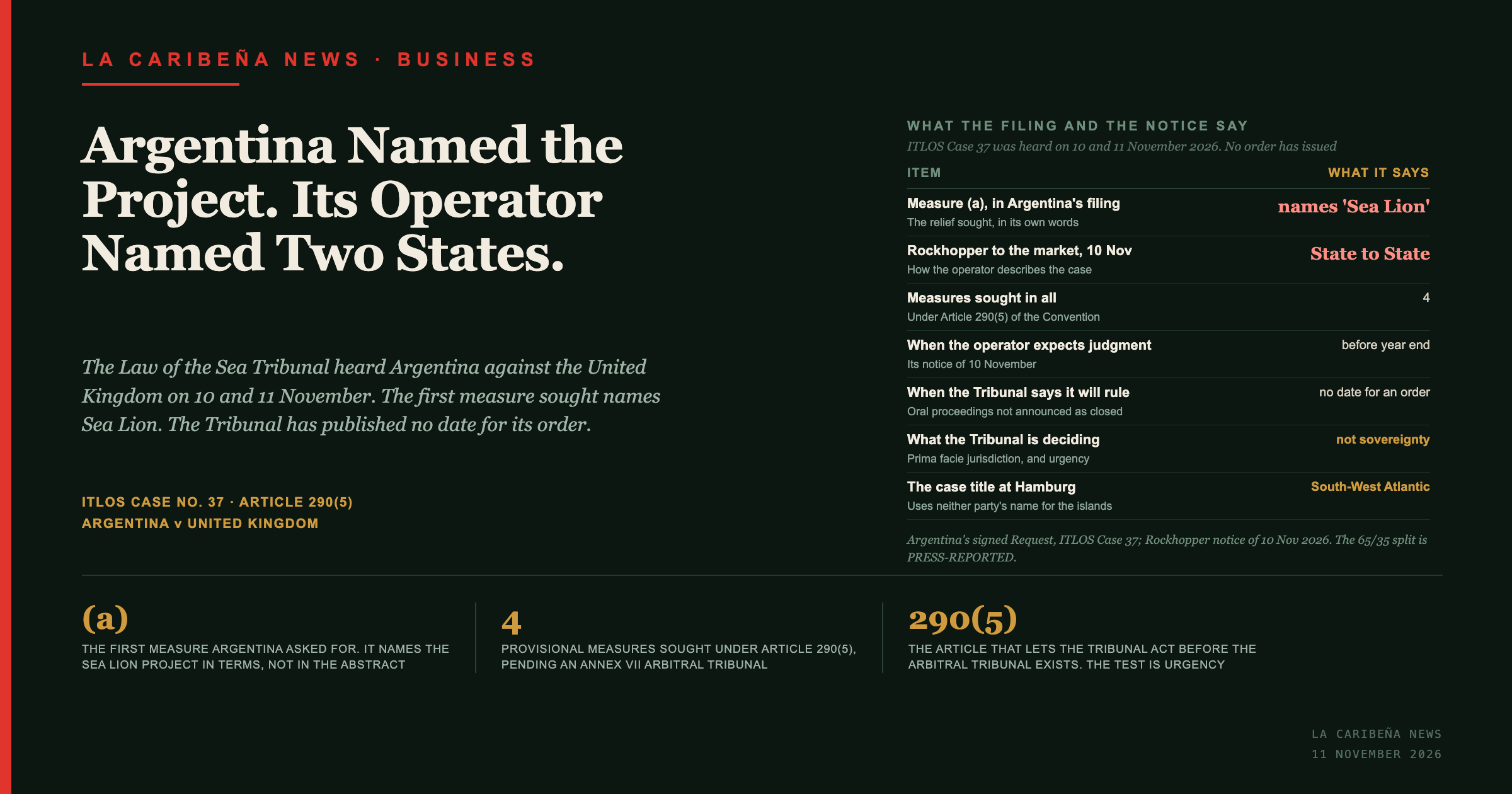
Four measures, and the first one names the project.
| The United Kingdom is to | |
|---|---|
| (a) | "prevent the commencement or continuation of the exploitation of hydrocarbon resources on the continental shelf in the North Malvinas Basin by the so-called 'Sea Lion' project" |
| (b) | "refrain from using the information obtained in the exploration of the natural resources of the disputed maritime areas to the detriment of the rights of the Argentine Republic" |
| (c) | "cease preventing the Argentine Republic from complying with its obligation under Articles 192 and 194 of UNCLOS to protect and preserve the marine environment of the maritime areas subject to dispute" |
| (d) | "refrain from any other measure that might aggravate the dispute, in particular the granting of new permits for the exploitation of the resources of the disputed continental shelf" |
Source: Argentina's signed Request for the prescription of provisional measures, ITLOS Case No. 37. Quotations are from that document.
Argentina's stated reason is that exploitation would "produce an irreversible fait accompli and irreparable damage to the Argentine rights at stake".
What did the operator tell the market?
That it is a matter between governments, and that a decision should come before the year is out.
Rockhopper Exploration issued a notice on 10 November titled "Commencement of ITLOS Hearing". It records that the hearing is scheduled for two days, with judgment expected prior to the end of the year, and describes the proceedings as a State to State matter between the United Kingdom and Argentina. The company said a further update, including implications, if any, for its Sea Lion project would be provided as and when appropriate.
Both descriptions are accurate. The case is between two governments, and the relief sought names the project. A reader holding either company's stock is entitled to see those two sentences next to each other.
Navitas Petroleum and Rockhopper hold the North Falkland Basin licences where Sea Lion has been sanctioned for development, in a 65 and 35 per cent split. That split is as reported in the press rather than stated in the company's notice.
The Tribunal has said nothing about timing. Its pages carry no date for an order and no announcement that the oral proceedings have closed, and reporting of the hearing has put the wait at several weeks. The only date in circulation is the operator's, and a listed company's expectation is not a court timetable.
What is the Tribunal actually deciding?
Not sovereignty. Whether to freeze the position while a different tribunal is assembled.
Argentina filed on 13 October 2026 under Article 290(5) of the Convention, after sending the United Kingdom a Notification and Statement of Claim on 28 September instituting arbitration under Annex VII. Article 290(5) lets this Tribunal prescribe measures before the arbitral tribunal exists, and the test is narrow: whether that arbitral tribunal would have prima facie jurisdiction, and whether the situation is urgent.
If the Tribunal does prescribe measures, what they are worth is already on the British parliamentary record. A British minister told the Commons that such orders are binding on the parties, on the afternoon Argentina's request reached Hamburg.
Urgency is where a sanctioned field with a construction schedule meets a dispute with no end date. Argentina's case is that first production would be irreversible. The United Kingdom's position on the merits is for the arbitration, not for this week.
That mechanism is why this is worth a Guyanese reader's time. Argentina is not asking for a ruling on who owns the seabed. It is asking a tribunal to stop production while ownership is argued elsewhere, on the ground that first oil cannot be undone. Guyana's dispute over the Essequibo sits at the International Court of Justice, a different forum under a different instrument, and nothing decided in Hamburg binds it. What transfers is the argument about irreversibility, and the demonstration that a state can put a sanctioned project in front of an international tribunal inside three weeks.
The hearing was fixed by Order 2026/10 of 20 October, made by the President of the Tribunal, Judge Maurice K. Kamga, and attested by the Registrar, Ximena Hinrichs Oyarce. That order was made three days before the British Prime Minister raised Sea Lion with President Donald Trump, and the Downing Street readout records no American position.
How did the dispute reach Hamburg?
Through an Argentine courtroom first, and then through a licensing decision that went the other way.
Argentine federal judge Mariel Borruto ordered Rockhopper and Navitas on 16 September 2026 to stop drilling, subsea installation and first production at Sea Lion until an Argentine environmental impact assessment is done. Five days later the Islands extended every licence.
The revenue is already being planned against. The Falkland Islands Executive Council adopted the Islands Plan 2026-2030 on 27 October, with progressing a sovereign wealth fund for energy revenues as the first of six first-year priorities.
Key figures
- Four. The provisional measures Argentina has asked the Tribunal to prescribe. The first names the Sea Lion project. - 10 and 11 November 2026. The hearing dates, fixed by Order 2026/10 of 20 October. - 13 October 2026. The date Argentina filed its request under Article 290(5). - 28 September 2026. The date Argentina notified the United Kingdom, instituting Annex VII arbitration. - Before the end of the year. When Rockhopper Exploration told the market on 10 November it expects judgment. The Tribunal has published no date. - 65 and 35 per cent. The reported split between Navitas Petroleum and Rockhopper in the North Falkland Basin licences, as reported in the press rather than in the company's notice. - Neither. The number of the two parties' preferred names for the islands that appears in the Tribunal's own title for the case.
Frequently Asked Questions
What is ITLOS Case No. 37?
It is titled "Case concerning hydrocarbon exploitation in the South-West Atlantic Ocean (Argentina v. United Kingdom), Provisional Measures". Argentina filed on 13 October 2026 under Article 290(5) of the United Nations Convention on the Law of the Sea, after notifying the United Kingdom on 28 September that it was instituting arbitration under Annex VII.
What has Argentina asked for?
Four provisional measures. The first asks the Tribunal to require the United Kingdom to prevent the commencement or continuation of hydrocarbon exploitation on the continental shelf in the North Malvinas Basin by the Sea Lion project. The others concern the use of exploration information, Argentina's ability to meet its marine environment obligations under Articles 192 and 194, and refraining from new permits that would aggravate the dispute.
Has the Tribunal ruled?
No. The hearing ran on 10 and 11 November 2026. The Tribunal has published no date for an order and has not announced that the oral proceedings are closed.
What did Rockhopper tell shareholders?
In a notice of 10 November titled "Commencement of ITLOS Hearing", that the hearing was commencing in Hamburg, was scheduled for two days, that judgment is expected prior to the end of the year, and that the proceedings are a State to State matter between the United Kingdom and Argentina. It said any implications for the Sea Lion project would be reported as and when appropriate.
Does this decide who owns the islands?
No. Article 290(5) lets the Tribunal prescribe measures before an Annex VII arbitral tribunal is constituted, and the test is whether that tribunal would have prima facie jurisdiction and whether the situation is urgent. Sovereignty is not before it this week.
The entities
- International Tribunal for the Law of the Sea (ITLOS) is the court established under the United Nations Convention on the Law of the Sea, sitting in Hamburg.
- Case No. 37 is "Case concerning hydrocarbon exploitation in the South-West Atlantic Ocean (Argentina v. United Kingdom), Provisional Measures". Its title uses neither party's preferred name for the islands.
- Article 290(5) of the Convention allows the Tribunal to prescribe provisional measures pending the constitution of an arbitral tribunal under Annex VII.
- Judge Maurice K. Kamga is President of the Tribunal and made the order fixing the hearing.
- Ximena Hinrichs Oyarce is the Registrar of the Tribunal.
- Rockhopper Exploration is the London-quoted company holding an interest in the North Falkland Basin licences.
- Navitas Petroleum is the other holder of those licences.
- Sea Lion is the oil project in the North Falkland Basin, called the North Malvinas Basin in Argentina's filing, which has been sanctioned for development.
- Mariel Borruto is the Argentine federal judge who ordered the project halted in September 2026.