By LCN Business Desk
Eleven days ago the extra sum had no stated value. On Monday it had one, and the project total had three.
What did the National Assembly approve?
G$24.7 billion, about US$118 million, for the plant at Wales.
The Assembly sat as the Committee of Supply on Monday 23 November and took the Office of the Prime Minister first. The request carried the Gas to Power Project. The request was G$24.688 billion, or approximately US$118 million.
It sat inside a larger package. The Assembly approved G$89.8 billion in supplementary funding that day, across two financial papers piloted by Senior Minister Ashni Singh. The largest single allocation in the paper was G$27.4 billion for the Ministry of Public Works. The gas project came next.
That makes it the second-largest head in a sitting where G$1 billion of the same package finishes a cash grant whose portal closes on 30 November.
What is the plant's cost now?
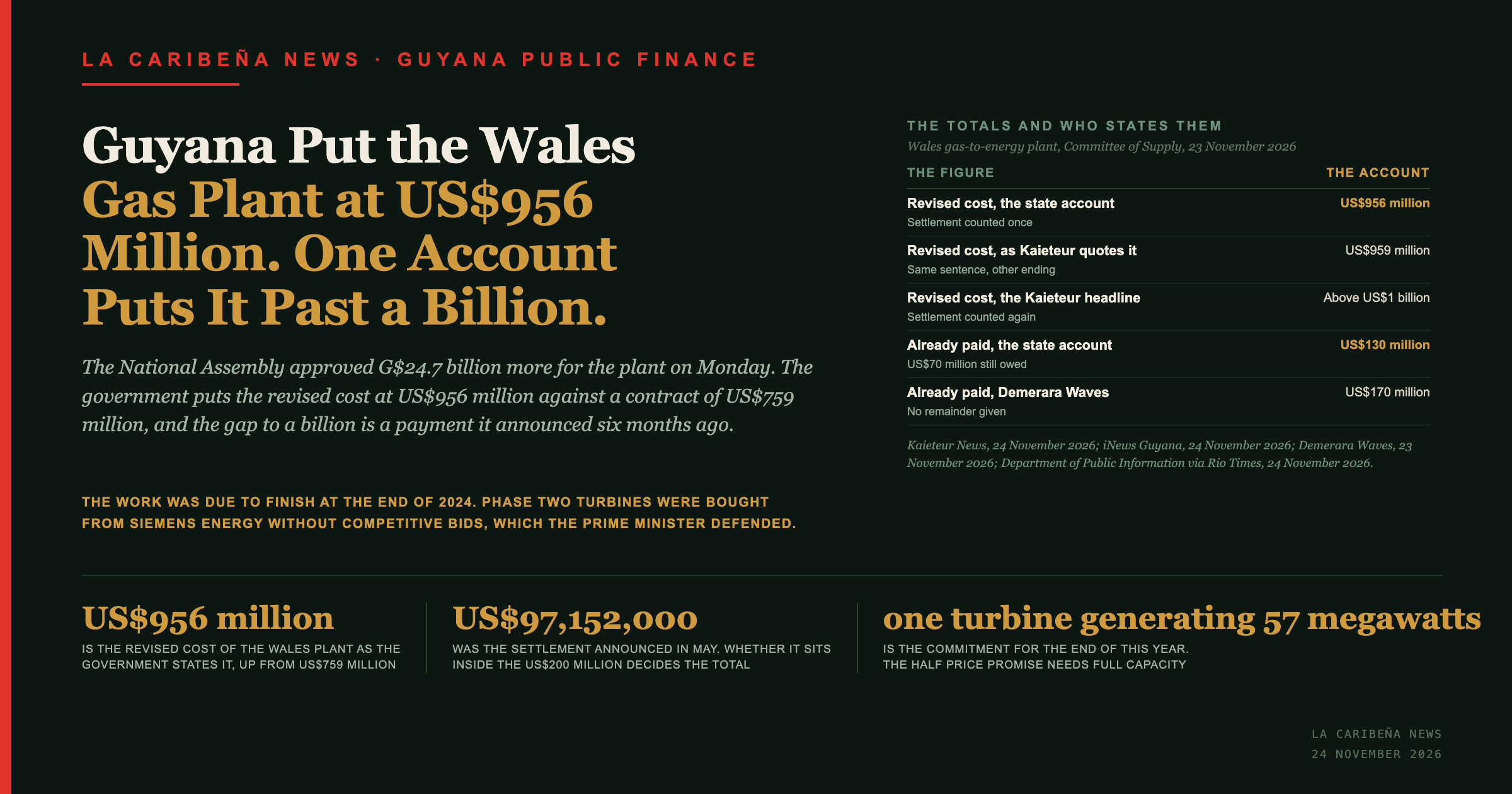
US$956 million, on the government's own account, against a contract of US$759 million.
Prime Minister Mark Phillips gave the figure in answer to Opposition Member of Parliament Vinceroy Jordan. The Department of Public Information said the project's revised cost is now US$956 million. iNews Guyana reported the same figure from the same exchange, and so did Demerara Waves.
The contractor is LINDSAYCA, a company headquartered in the United States, engaged as the joint venture CH4/LINDSAYCA to build a 300 megawatt power plant and a natural gas liquids plant on the West Bank of the Demerara River. The work was due to finish at the end of 2024.
Monday's approval takes this year's provision for the project to G$54,493,084,785, or about US$262 million, on Kaieteur News's figures.
Why does one account put it past a billion?
Because the accounts differ on one payment, and it was made six months ago.
| Revised cost stated | Who states it | What it treats May's settlement as |
|---|---|---|
| US$956 million | Department of Public Information, iNews Guyana, Demerara Waves | inside the US$200 million |
| US$959 million | the Prime Minister, quoted by Kaieteur News | not stated |
| Above US$1 billion | Kaieteur News | additional to the US$200 million |
Three accounts of the Committee of Supply sitting of 23 November 2026, and the Prime Minister's quoted words in two of them.
Demerara Waves accounts for the government's figure. On its reading the contractor is paid a further US$100 million on top of the 12.8 per cent, or US$97,152,000, over the original contract sum that the government announced in May. The US$200 million the Prime Minister named is those two together.
Kaieteur News reads the US$200 million as new money arriving on top of the May settlement, and headlines the project past a billion dollars.
The two readings cannot both be true of the same money. Nothing said in the Committee of Supply settles which, because the question is not about Monday's sum at all.
The same quotation comes back two ways. iNews Guyana and Demerara Waves both have the Prime Minister moving the cost from US$759 million to US$956 million. Kaieteur News quotes that sentence ending at US$959 million.
What did this newspaper already report?
That US$197 million had been added, when the newer half of it had no figure at all.
On 13 November the Prime Minister confirmed more than US$100 million in additional financing to the contractor, and could not state the sum he had approved. This newspaper put that beside the May settlement and reported at least US$197 million added to a US$759 million contract.
The government's US$956 million is that contract plus that sum. The figure the state published on Monday is reached by counting the May settlement once.
How much has already been paid?
Two figures, forty million dollars apart.
The Department of Public Information says US$130 million has been paid so far, and the Prime Minister is quoted to the same effect in Kaieteur News and in iNews Guyana, with US$70 million still to pay. Demerara Waves puts the amount already paid at US$170 million.
Demerara Waves gives no figure for what remains.
What is inside the G$24.7 billion?
Five lines the Prime Minister named, and a remainder he did not.
| Line | Amount | Converted |
|---|---|---|
| LINDSAYCA, the contractor | G$12.1 billion | US$58 million |
| Siemens Energy, turbines for phase two | G$4.25 billion | US$20 million |
| Transmission and substation infrastructure | G$866.3 million | US$4.2 million |
| Additional land acquisition | G$378.57 million | US$1.8 million |
| Lender monitoring for US EXIM Bank | G$35.3 million | US$169,000 |
Breakdown as Kaieteur News reported it, which lists these five "among others". Converted at the Bank of Guyana transaction rate of G$208.5 to US$1, the rate Rio Times applied to the same sitting.
The five named lines do not account for the whole request. The Prime Minister gave no overview of the G$12.1 billion for the Wales contractor, the largest of them, and asked to supply the breakdown later. "I will ask that we provide the disaggregated sum to the honourable member," he said. "So we will have to lay over the disaggregation."
APNU's parliamentary leader Terrence Campbell had asked for the breakdown first. He put the running total at G$44 billion over a voted provision of G$10 billion, and said the request was not budgeted.
Who got the turbine money, and how?
Siemens Energy, with no competitive bids, and the government defended that in the House.
The G$4.25 billion goes to the German manufacturer for phase two, a second plant at Wales. Demerara Waves reports that the government had already paid 10 per cent of the turbine cost, and that Monday's approval of about US$20.3 million makes a second payment of the same share.
The Prime Minister said Siemens Energy was the only company making the turbines, so the government chose to sole source rather than invite bids. His reason was the queue. "You don't go into a store and see a gas turbine on the shelf," he told the committee. Lead times that used to run two years now run longer, because demand has risen.
"In order to ensure we keep it in schedule, 2030 for phase two, we are forced to do long-lead procurement, which is pay up some money up front, and you secure the commitment from the supplier."
Phase two is the second half of the 600 megawatts Guyana has said Wales will carry. Demerara Waves puts its capacity at 260 megawatts. iNews Guyana puts it at 300.
It is not the only Guyanese energy work this year whose bidding was narrowed before it began. India extended a US$500 million line of credit whose own rules let only Indian companies bid for the work.
What stops the next request?
One signed amendment and one that is not signed yet.
The Prime Minister told Campbell that amendment five has been signed by both sides and amendment six is pending. Between them they cap what can flow to the contractor and set penalties for missed targets. Money is released against work completed, "in an open book manner".
Asked to promise there would be no further requests, he declined to.
"I am not clairvoyant but I am confident that the amendment entered into and the ones to come will hold."
The May settlement already carried that structure. It dropped penalties the government kept the right to switch back on, in exchange for first power by the end of 2026, all gas turbines by the first quarter of 2027 and combined-cycle operation by June 2027.
The first of those three dates is five weeks away. Demerara Waves reports the government now targeting the first quarter of 2027 for start-up. iNews Guyana reports it still targeting first commissioning by the end of 2026, with all turbines running by the end of the first quarter. The two accounts of Monday do not agree on whether the date the settlement bought still stands.
What is not in any of these figures?
The pipeline that feeds the plant, and the cost of the years of waiting.
Demerara Waves states the first plainly: the cost of the plant does not include the pipeline, which it puts at about US$1 billion, financed by ExxonMobil and repayable by Guyana. The gas itself comes free. That pipeline has its own open figure, because Exxon has not stated the cost of a repair to it, on an asset whose final cost it has never stated.
The second is a different measure. US$956 million is what the two plants cost to build. What the delay has cost the country is a separate figure, which this newspaper reported in August at about US$884 million, driven by heavy fuel oil, powership rentals and the legal dispute. The two are not added, because one is construction and the other is what was burned while waiting for it.
What does this mean for a business in Guyana?
The promise is not tied to the plant starting. It is tied to the plant running at full capacity.
The minister responsible for finance told the committee the money would help finish the project, which is meant to hold tariffs down and deliver the promised 50 per cent reduction in electricity costs. The Prime Minister put the same commitment in the House: 300 megawatts at half the cost.
On 15 August the Prime Minister said there would be no 50 per cent reduction in bills until the plant reaches full capacity, which was then expected in mid-2027. What the contractor committed to by the end of this year is one turbine generating 57 megawatts.
Until the plant runs, the state is paying for the fuel it was meant to replace. The same financial paper carried G$8 billion for Guyana Power and Light's fuel costs, bought to hold a tariff that does not rise. A business in Berbice that lost stock in a 46-hour outage last week has one route to the value of it, and it starts with a complaint.
For a firm costing a 2027 year, the figure that matters is not US$956 million. It is the month full capacity arrives, and nothing said on Monday moved it.
What the title card shows
- The National Assembly approved G$24.688 billion, approximately US$118 million, for the Gas to Power Project on 23 November 2026. Source: Kaieteur News, 24 November 2026. - The Department of Public Information said the project's revised cost is now US$956 million. Source: Rio Times, 24 November 2026, citing DPI of 23 November. - The original contract sum was US$759 million. Source: Demerara Waves, 23 November 2026, and iNews Guyana, 24 November 2026. - LINDSAYCA's total demand reached US$200 million, of which US$170 million was already paid. Source: Demerara Waves, 23 November 2026. - US$130 million has been paid so far, with US$70 million still to pay. Source: Department of Public Information via Rio Times, and the Prime Minister quoted in Kaieteur News and iNews Guyana. - The May settlement was 12.8 per cent, or US$97,152,000, over the original contract sum. Source: Demerara Waves, 23 November 2026. - G$4.25 billion of the request goes to Siemens Energy for phase two turbines, sole sourced. Source: Kaieteur News and Demerara Waves. - Monday's approval of approximately US$20.3 million makes a second payment of 10 per cent of the turbine cost. Source: Demerara Waves, 23 November 2026. - The Prime Minister gave no overview of the G$12.1 billion for the contractor and asked to lay over the disaggregation. Source: Kaieteur News, 24 November 2026. - The work was due to finish at the end of 2024, and this year's provision for the project now stands at G$54,493,084,785, or about US$262 million. Source: Kaieteur News, 24 November 2026. - Amendment five is signed by both sides and amendment six is pending. Source: the Prime Minister quoted in Kaieteur News and iNews Guyana. - There is no 50 per cent reduction in bills until the plant reaches full capacity of 300 megawatts, expected in mid-2027. The end of 2026 commitment is one turbine generating 57 megawatts. Source: Prime Minister Mark Phillips, reported by Kaieteur News, 15 August 2026. - The cost of the plant does not include the pipeline, put at about US$1 billion, financed by ExxonMobil and repayable by Guyana. Source: Demerara Waves, 23 November 2026.
The entities
- LINDSAYCA: the contractor building the 300 megawatt power plant and the natural gas liquids plant at Wales, headquartered in the United States, engaged as the joint venture CH4/LINDSAYCA at US$759 million. - Mark Phillips: Prime Minister of Guyana, who answered for the request in the Committee of Supply on 23 November 2026. - Ashni Singh: Senior Minister in the Office of the President with responsibility for finance, who piloted the two financial papers. - Terrence Campbell: parliamentary leader for A Partnership for National Unity, who asked for the breakdown. - Vinceroy Jordan: Opposition Member of Parliament, whose question drew the revised cost figure. - Siemens Energy: the German turbine manufacturer paid for phase two turbines without competitive bidding. - US EXIM Bank: the United States Export Import Bank, whose lender monitoring requirement carries G$35.3 million of the request. - Committee of Supply: the National Assembly sitting as its spending committee, where supplementary requests are examined.
Frequently asked questions
How much does Guyana's Wales gas-to-energy plant cost now?
The Department of Public Information puts the revised cost at US$956 million, against an original contract of US$759 million. Kaieteur News reports it above US$1 billion. The difference is whether the US$97,152,000 the government settled with the contractor in May sits inside the US$200 million the contractor demanded or on top of it.
How much did the National Assembly approve on 23 November 2026?
G$24.688 billion, approximately US$118 million, for the Gas to Power Project, inside a package of G$89.8 billion across two financial papers. The largest allocation in the paper was G$27.4 billion for the Ministry of Public Works.
How much has LINDSAYCA already been paid of the US$200 million?
Two figures are on the record. The Department of Public Information and the Prime Minister say US$130 million, with US$70 million to come. Demerara Waves says US$170 million.
Were the phase two turbines put out to tender?
No. The Prime Minister told the Committee of Supply that Siemens Energy was the only manufacturer making them and that the government chose to sole source rather than invite competitive bids, to hold a 2030 schedule for phase two.
When will the Wales plant deliver power?
The May settlement committed the contractor to first power by the end of 2026. Demerara Waves reports the government now targeting the first quarter of 2027 for start-up. iNews Guyana reports it still targeting first commissioning by the end of 2026.
Does the US$956 million include the pipeline?
No. Demerara Waves states that the cost of the plant does not include the pipeline, which it puts at about US$1 billion, financed by ExxonMobil and repayable by Guyana.
When will Guyanese electricity bills fall by half?
Not when the plant starts. Prime Minister Mark Phillips said on 15 August 2026 that the 50 per cent reduction does not apply until full capacity of 300 megawatts, expected in mid-2027. The commitment for the end of 2026 is one turbine generating 57 megawatts.
Is the US$956 million the same as the US$884 million cost of the delay?
No. US$956 million is what the two plants cost to build. The roughly US$884 million this newspaper reported in August is what the two-year delay cost the country, through heavy fuel oil, powership rentals and the legal dispute. The two measure different things and are not added.