By LCN Business Desk
An announced prohibition, and a published record that does not yet carry it.
Guyana already has a statute governing electronic nicotine delivery systems. It has regulated them since 2017, and on its own terms it does not prohibit importing them.
What was announced?
A restriction on importing vapes and vaping products, to be made by order under the Customs Act.
President Irfaan Ali announced it on 17 October 2026 and restated it on 20 October. As reported, the mechanism is an order under the Customs Act, Chapter 82:01, to be signed by Finance Minister Ashni Singh.
The reported terms would restrict imports of all types of vapes and vaping products, with exceptions available only by approval of the Minister of Health, the National Tobacco Control Council or the Tobacco Control Board. Products described as medicinal or therapeutic would not be automatically exempt.
What does the gazette record show?
No order under the Customs Act restricting vaping imports, as at the most recent published issue.
| Check, 21 October 2026 | Result |
|---|---|
| Most recent publication in the Official Gazette | Official Gazette, 17 October 2026 |
| That issue's Legal Supplement, Acts | NIL |
| That issue's Legal Supplement, Bills | NIL |
| Subsidiary legislation in that issue | Order No. 188 of 2026, and a Public Holidays Act notification |
| Order under the Customs Act, Chapter 82:01 | Not present |
Source: Official Gazette of 17 October 2026; Guyana Official Gazette publication record.
Nothing has been published since. The gazette record is silent on whether the order has been signed, and silence there settles only what has been published, not what exists.
What does the 2017 Act already do?
It regulates electronic delivery systems in detail, and it does not ban them.
The Tobacco Control Act 2017, Act No. 17 of 2017, defines an "electronic delivery system" to cover both an electronic nicotine delivery system and an electronic non-nicotine delivery system, and treats them alongside tobacco products throughout.
| The 2017 Act, on electronic delivery systems | |
|---|---|
| Advertising, promotion and sponsorship | Prohibited |
| Packaging, labelling and health warnings | Required |
| Sale to a purchaser whose age is unverified | Restricted |
| Sale by telephone, internet or other remote means | Restricted |
| Sale through an automatic vending machine | Restricted |
| Toy or confectionery imitations, section 33 | "No person shall import, manufacture, sell, display for sale, or distribute" |
| Reporting by manufacturers, importers and wholesale distributors, section 38 | Required |
Source: Tobacco Control Act 2017, Act No. 17 of 2017.
No general prohibition on importing an electronic delivery system appears in the Act.
Where does the Act touch imports at all?
In two places, and each one operates only after the Minister has made regulations.
The first concerns packaging and labelling. The Act provides that where the Minister makes new regulations on packaging and labelling, then after nine months from their entry into force:
"no person shall manufacture, import, distribute. sell or offer for sale any tobacco product or electronic delivery system, other than a tobacco product or electronic delivery system contained in intact packages that meet the packaging and labelling requirements under this Act and the new regulations."
The second is section 39, on product content and emissions. Subsection (1) lets the Minister make regulations regulating, testing and measuring contents and emissions. Subsection (2) then provides:
"Where the Minister makes regulations pursuant to subsection (1), no person shall manufacture, import, sell or offer for sale, any tobacco product, electronic delivery system, or component that contravenes the regulations."
Neither is a standing import ban. Each requires regulations to exist first, and each then bites only on product that fails them. In the 2017 Act, "Minister" means the Minister with responsibility for public health.
Why does the choice of statute matter?
Because the announced order runs under a different Act, through a different Minister.
The regime above sits with the health Minister under the Tobacco Control Act. The announced restriction sits with the Finance Minister under the Customs Act, Chapter 82:01. On the text of the 2017 Act, a general power to bar vape imports outright is not among the health Minister's powers; what the Act gives is a power to set standards and then exclude product that does not meet them.
The reported exceptions run back the other way. Approval would rest with the Minister of Health, the National Tobacco Control Council or the Tobacco Control Board, all of which belong to the 2017 regime rather than to the Customs Act.
What does this mean for the rest of the Caribbean?
That an announcement and an instrument are different things, and only one of them is enforceable at a port.
A customs officer acts on a gazetted order. Until one is published, the controls that bind an importer of electronic delivery systems in Guyana are those in the Tobacco Control Act 2017, which govern how the product is packaged, labelled, advertised and sold rather than whether it may enter.
The same gazette that is the test here delivered a commencement order and two public holidays this month, reported in Guyana Passed a Sea Defence Law in May 2024 and Deepavali Falls on a Sunday This Year. Guyana's tariff treatment of other goods entering the region was examined in Sanitary Pads Enter the Caribbean at 20 Per Cent Duty.
The entities
- Tobacco Control Act 2017 is Act No. 17 of 2017, Guyana's statute on tobacco products and electronic delivery systems.
- Customs Act, Chapter 82:01 is the statute under which the announced order would be made.
- Irfaan Ali is the President of Guyana and announced the restriction.
- Ashni Singh is the Finance Minister reported as the signatory of the order.
- National Tobacco Control Council and the Tobacco Control Board are bodies named among the reported routes to an exception.
- Official Gazette is where subsidiary legislation is published in Guyana.
- Electronic delivery system is the Act's term covering both nicotine and non-nicotine devices.
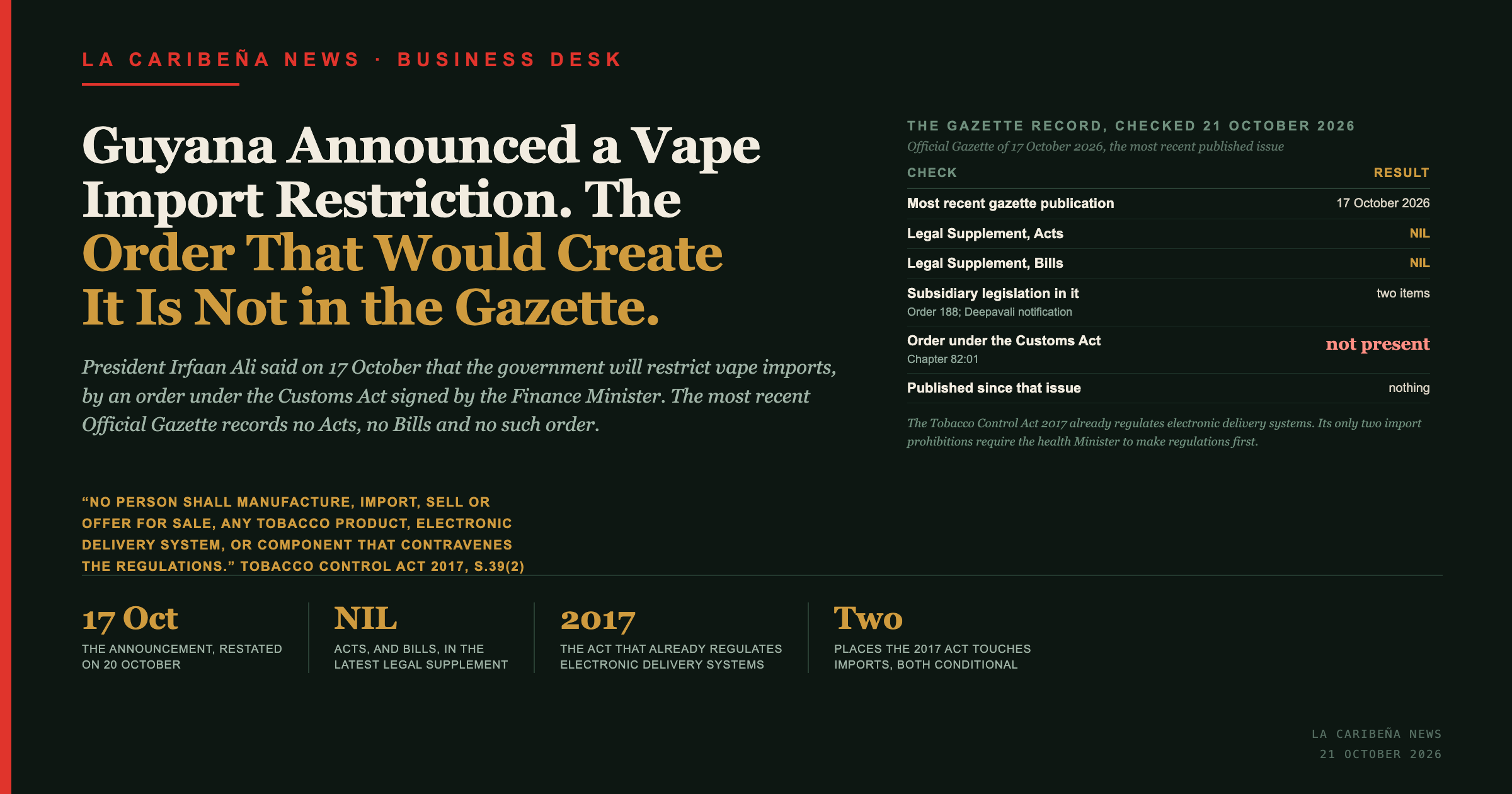
What the title card shows
Every data point on the article's title card, in text.
- 17 October 2026. The date of the announcement, restated on 20 October. Source: reports of the President's statement.
- Not present. An order under the Customs Act, Chapter 82:01, in the most recent published gazette. Source: Official Gazette of 17 October 2026.
- NIL. Acts, and Bills, in that issue's Legal Supplement. Source: as above.
- 2017. The year of the Act that already regulates electronic delivery systems. Source: Tobacco Control Act 2017, Act No. 17 of 2017.
- Two. Places where the 2017 Act touches imports, each conditional on regulations being made first. Source: as above.
- Quotation: "no person shall manufacture, import, sell or offer for sale, any tobacco product, electronic delivery system, or component that contravenes the regulations." Tobacco Control Act 2017, section 39(2).
Frequently Asked Questions
Has Guyana banned vape imports?
A restriction was announced by President Irfaan Ali on 17 October 2026. As at 21 October, no order under the Customs Act, Chapter 82:01, appears in the Official Gazette, and the most recent issue is that of 17 October.
How would the restriction be made?
By an order under the Customs Act, Chapter 82:01, reported as being for signature by Finance Minister Ashni Singh.
Who could grant an exception?
As reported, the Minister of Health, the National Tobacco Control Council or the Tobacco Control Board. Products described as medicinal or therapeutic would not be automatically exempt.
Does Guyana already regulate vapes?
Yes. The Tobacco Control Act 2017 defines electronic delivery systems to include both nicotine and non-nicotine devices, prohibits their advertising, promotion and sponsorship, requires packaging and labelling, requires age verification by the seller, and restricts remote and vending-machine sales.
Does the 2017 Act ban importing vapes?
No general import prohibition appears in it. Two provisions touch imports, and each operates only where the Minister with responsibility for public health has first made regulations, and then only against product that contravenes them.
Why is a different Minister involved?
The 2017 Act's powers sit with the Minister responsible for public health. The announced order is under the Customs Act and is reported as being signed by the Finance Minister.
What binds an importer in the meantime?
The Tobacco Control Act 2017, which governs how electronic delivery systems are packaged, labelled, advertised and sold.